
I’m beginning to hear a growing narrative that real-time bidding (RTB)—the beating heart of programmatic—is on its way out and the future of advertising will be consumed by what I’m calling AITB or Artificial Intelligence Time Bidding.
I realize “time bidding” doesn’t necessarily make sense.
Also, “on the way out” seems premature for my old friend, RTB. Bringing your proprietary, first-party data—and even your own AI—would seem to create an opportunity for an auction.
But…
Artificial Intelligence is the new “blackbox” auction in the AI marketer’s mind and an orthogonal move away from the open real-time auction to which we’re accustomed.
And of course, Google’s Performance Max and Meta’s Advantage+ are the AI answer say Google and Meta, respectively.
What will that mean for programmatic ad tech companies? A steady diet of innovation and integration cures everything as it always has. The market moves.
And “the moving” tips ad tech companies to the service end of the spectrum which collides with their agency brethren, who are orchestrating ad tech plans on behalf of their clients.
I’m also hearing about interest in a real-time, programmatic-like auction among LLMs for all this pay-per-crawl business. Thank you, Cloudflare.
Real-time-LLM crawl bidding could be the industry’s first seven-letter acronym: RTLLMCB.
More hearing: In a video interview, programmatic pioneer and Scope3 CEO Brian O’Kelley believes programmatic is in transition and discussed an example with “AI chat” as proof.
Mr. O’Kelley said, “I think we’re gonna see a complete re-imagination of the value chain.” He’s worried not enough people are thinking about “what that looks like.” See the video with Index Exchange CMO Lori Goode.
The IAB opportunity
Next, IAB Tech Lab leader Anthony Katsur sounded the alarm post-Cannes – this is something that I’ve been hearing a bit about, too…
The gist is that an enormous wave of opportunity is coming ashore for IAB members and in the interest of taking full advantage, the IAB’s attention needs to immediately swivel to the future of advertising standards in the age of AI. Simultaneously, the association and its membership need to wipe away middling member projects and white papers with no future consequence.
All hands on deck.
Marketers and transparency
Marketers want transparency on their AI-enabled buying. But what I’m hearing is a touch sarcastic.
-
“Marketer, are you an AI? No. You’re not. And AI is gonna figure out endless, dense, curving paths to your end customer that is not going to make sense to your media mix modeling. Now, hand me your ‘bags.’”
That wasn’t very nice.
I’d suggest “AI transparency” in media buying and selling is an opportunity. It will be solved by an ad tech-related, AI-enabled measurement and analytics business if it isn’t starting already.
Bottom line: It’s early – there is so much more to come. On the other hand, you better be working on it now or you’ll be too late.
LLMs & CHATBOTS
Tale of two LLM costs
As advertising companies tap into LLMs via APIs, today’s costs are a concern but so is projecting pricing going forward.
tl;dr: OpenAI versus Google’s Gemini pricing appear to be going in different directions, but approaching a price equilibrium of sorts.
OpenAI customer and founder Samuel Brashears at Y Combinator startup DryMerge said on LinkedIn last week:
“We were losing thousands of dollars on every user.”
“Then OpenAI cut their prices by 80%. Every AI company is actually two companies:“
“1. The one that exists today (probably losing money)“
“2. The one that will exist in 6 months (could be profitable)”
Brashear provided a graphic on OpenAI pricing to support his argument.
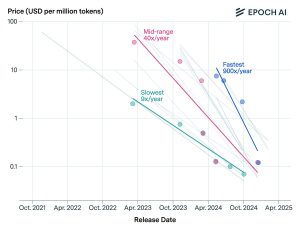
But CTO Ryan Barker of Zefr, a brand safety and measurement company, disagreed, noting that this isn’t necessarily true for every LLM’s pricing.
On LinkedIn, he shared his own data on Gemini pricing (initially Flash 1.5) that showed an increase in price as iterations of the LLM model were rolled out.
Mr. Barker wrote Saturday, “Gemini is up in price. Open AI is down in price but is still more expensive than Gemini. Both are higher quality than August 2024 models.”
BRANDS
Handing the creative ‘wheel’ to AI
On growth marketer Andrew Faris’ podcast, “8 steps to fixing a broken Meta account,” Faris concludes his list of fixes with creative.
(By the way, by “broken,” he means the Meta ads account is just not working like it used to – there’s something wrong: overspending, small budget volatility, technical issues, etc)
Given the promise of AI optimization of creative, Faris’ findings seem particularly relevant to the marketer using AI:
“#8 – Make More Creative: If you’re dealing with Meta ads, more creative is almost always going to be helpful and will almost always solve some amount of problems. It is very possible that the entire problem with your ad account right now is that your creative is not working anymore, something is drained, and you just need to get better at making more and better creative.”
”It almost always helps. This is also the time to try weirder stuff than you’re comfortable with. If your account is performing really poorly, get crazier, try something with more variation in general, so it’s more variable from what you’re normally running.”
Hear more on the Apple Podcasts app.
Given the theme of Faris’ comments that more creative is better, no wonder so many “AI+creative” tools are being rolled out these days – there appears to be a need by marketers.
Target’s Chief Revenue & Digital Officer Sarah Travis noted the creative element in her retail media network’s – Roundel’s – platform last week. She said on Linkedin:
“A big part of the Target magic is finding something unexpected that brings you joy. That spark of discovery is often powered by Roundel.”
”Seeing the launch of Precision Plus, a new capability that uses AI and real-time insights to help brands show up in the right moments, is a really proud moment.”
Read more: Target’s Roundel Rolls Out New AI Ad-Buying Tool (July 10) – Adweek
BRANDS
GenAI marketers: AI is the future
Marketers may be having trouble wrapping their arms around the fast-moving AI opportunity in ads and marketing.
But, B2B marketers selling GenAI tools are having trouble, period. And the challenges have nothing to do with AI technology and more to do with noise in the AI marketplace says a LinkedIn researcher.
A new research paper from LinkedIn tells B2B marketers who are selling GenAI tools and services that their creative can be a detriment to their company’s brand. From a section titled, “The State of Gen AI Advertising:”
“One of AI’s serious problems is that most ads, and therefore most brands, are indistinguishable from the competition. This leaves a sea of brands saying mostly the same thing: AI is the future.”
Get “How To Win Mindshare In The GenAI Race” (June) from the LinkedIn B2B Institute.
h/t @duncanwc
BRANDS
The answer engine effect: Zero-click search
“Zero-click search is killing traditional TOFU (top of funnel) content. Brands that adapt with original data and real insights won’t just survive, they’ll stand out.”
Read: The New Top of Funnel: How AI Is Rewriting TOFU (July 11) – search marketer Noah Greenberg
TECH
Meta adding transparency to AI creative
Digital marketer Bram Van der Hallen reported on LinkedIn that more transparency is coming to creative on the AI-enabled Meta ad platform.
Mr. Van der Hallen wrote:
“Meta is finally opening its black box when using ‘Flexible formats’ and ‘AI generated images’. 📦 Here’s what you need to know:”
”Meta added a NEW breakdown option called ‘Creative’ that allows you to break down results from your ads by:”
”Flexible format: When you have ‘Flexible format’ enabled, you can select up to 10 images and videos in a single ad campaign. You can now see results by flexible format in Ads Manager.””Image generation: When you generate images variations to diversify your creative, you can now compare your data by generated images.”
Read more on LinkedIn (July 10).
More: Meta unveils Creative breakdown for Flexible formats and AI generated image ads (July 12) – PPC Land
TECH
Google and Model Context Protocol
Last week on the Google Developer blog, Google asked for feedback on the need for Model Context Protocol (MCP) from the ads community.
“The Google Ads API team is exploring bringing a Model Context Protocol Server to the developer base to allow third-party GenAI tools to work with advertiser accounts. We are seeking your initial input to help us shape our roadmap.”
The “Google Ads API MCP Interest Form” is here.
One question from the form: “What types of workflows would you be most interested in accomplishing via GenAI/LLM with MCP?” The choices are as follows:
- Performance reporting
- Creating Ads entities like campaigns or keywords
- Uploading things like creatives or conversions
- Managing an existing account by making changes to entities or settings
- Something else
Why it matters: Since LLM-maker Anthropic open-sourced the protocol last November, there has been growing momentum to make MCP an industry-wide standard in the interest of preserving different facets of data ownership. Google tipping into MCP would be another step toward solidifying its presence industry-wide.
In November, Anthropic described MCP as:
“…a new standard for connecting AI assistants to the systems where data lives, including content repositories, business tools, and development environments. Its aim is to help frontier models produce better, more relevant responses.
The advertising technology industry has steadily climbed aboard – perhaps for fear of LLMs taking over their ad tech business, which echoes independent ad tech’s love-hate relationship with “walled gardens” today.
Scott Howe, CEO of data connectivity platform LiveRamp, wrote a month ago on LinkedIn:
“The real question isn’t how smart these models are, but rather who controls both the public and increasingly proprietary information from which they learn. That’s where MCP (model context protocol) enters the picture.” Read his thesis.
SELL-SIDE
Podcast: Blocking bots, Google Search impact
On the Marketecture podcast on Friday, Marketecture’s Ari Paparo digs into recent news of Cloudflare starting a pay-per-crawl option for chatbots on behalf of publishers as well as a “red button” option (or “easy button” as Cloudflare described it in the past) which lets their publisher clients immediately stop all AI bot crawlers.
Mr. Paparo noted the potential impact on Google search traffic referrals by choosing the easy/red button:
“I think that the controversy over search is the interesting part here, because anyone can change the robots.txt to ban crawlers. But Google is claiming that they will only will accept one robots.txt entry for both search and AI. And this has already come up in the DOJ case.”
”I sound like a broken record, but this is kind of where it’s being litigated. It’s obviously an interesting issue, because no one wants to be excluded from search, but you might want to be excluded from AI. And I think Google is pushing the limits here in terms of fair use and what they could do here.”
Hear more on the Apple Podcasts app.
ENTERPRISE
Podcast: AI acceptance or pilot purgatory
On eMarketers’ Behind the Numbers podcast, Rice University Professor and CEO of AI company DemystifAI CEO, Kathleen Perley joins the eMarketer team to discuss enterprise AI strategy. She said the question on AI integration into CEOs’ business strategy is pretty simple today.
Ms. Perley said (lightly edited for clarity):
“…Are you willing to make a shift or a change? Is this going beyond just experimentation? From a business perspective: are you going to stay in ‘pilot’ purgatory forever, or are you actually going to invest in restructuring your processes?…”
Hear more on the Apple Podcasts app.
PROMPT
Prompt: In five years, how will your advice for growth marketers using AI in their ad campaigns change?
Response from meta.ai:
In five years, my advice for growth marketers using AI in ad campaigns will likely undergo significant changes due to advancements in AI technology. Here are some key shifts to expect:
- Increased Focus on Strategic AI Adoption
- Enhanced Hyper-Personalization
- Rise of Predictive Analytics
- Advancements in AI-Powered Content Creation
- Growing Importance of Ethics and Governance
- Emerging Trends to Watch…
MORE
- Opinion: The Consulting Crash Is Coming (July 10) – Joe Nocera on The Free Press
- Opinion: I’ve been thinking a lot about the future we’re building with AI…” (July 10) – Marc Benioff, CEO, Salesforce on LinkedIn