
He’s back.
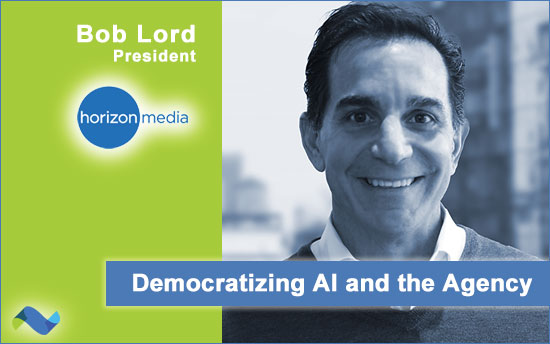
In January, independent media agency Horizon Media and its CEO/founder Bill Koenigsberg announced the appointment of Bob Lord as President.
A familiar figure to many in advertising, Mr. Lord’s career spans media, marketing and technology with key leadership roles at IBM, Aol and Publicis among others.
Today, Mr. Lord is tasked with guiding the indie media agency into the age of AI as the advertising service layer reaches new heights of disruption.
Horizon Media has had a number of initiatives in the past year related to artificial intelligence integration for both its internal and client-facing strategy. Notable milestones include the launch of its marketing services agency One Horizon last December, ongoing development of its marketing intelligence platform Blu and the hiring of an AI innovation-focused executive team in July.
- Transition to Horizon Media: IBM
- Transition to Horizon Media: Democratization
- AI transformation and headcount
- Transparency between marketer and agency
- Internal AI enablement at Horizon
- Optimizing the answer engine for the marketer
- What Mark Zuckerberg’s fully-automated ad system means
- The indie opportunity
- Regarding the “Agency of Record” concept
Scroll down for the interview which has been lightly edited for clarity.
Transition to Horizon Media: IBM
So, I spent almost a decade at IBM and what I realized in the software business was technology had advanced so much that it had gone beyond what we were all playing with in programmatic – the idea of setting up neural data networks and using large language models was already embedded in the applications at IBM such as in the supply chain or asset management practices.
Fundamentally, I realized that programmatic was really just a little bit of the bite at the apple of what should be happening in marketing and media.
When I spoke to the CMO and the marketing group at IBM, they were still struggling with the basics of, “Did the media dollar actually have an impact on my sales?” And it seemed like it was solvable. So, I ended up deciding to leave IBM after that time, and started doing consulting and advisory work — obviously going back into my old marketing career—and I realized that the industry had only become more complicated for marketers.
And I started to work with CEO Bill Koenigsberg here at Horizon, and he had something called the “Blu ID” – that’s what their “bread and butter” was. We went after audiences with a Blu ID. But it wasn’t democratized, meaning that everyone didn’t have access to it. So, the opportunity was to re-architect this Blu ID, which can identify audiences, and democratize access to it with a simple GUI interface where you can use natural languages.
Transition to Horizon Media: Democratization
First, we started democratizing access internally, but now it has evolved to where we’re building a tool that makes the marketer’s job easier, not a tool that actually makes the agency run faster. Remember, I was at one of the holding companies (Publicis) and I know that the agenda there is to run my agency faster – not always in the best interest of the marketer.
I think what we’re doing here with the advent of AI is building a tool for marketers to make their jobs easier and take this marketing problem —which is marketing complication— out of the system. All you’re really trying to do is identify the audience, figure out what the media is that you want to go buy, and then measure against that media payment.
It’s a very simple proposition. So therein lies the opportunity, and that’s why I came back [to the agency world in January] and said to our CEO, Bill Koenigsberg, “Let’s partner together: let’s hit ‘no tech debt’ and ‘no data debt’ at all.”
And we basically re-built Blu, literally in three months, and launched it at CES. The big validation for me was we won the Spectrum account, which was an $800 million piece of business based on Blu technology -and we beat out all the holding companies.
When someone sees the technology, they’ll say, “Why hasn’t someone done this before?” And the reason is that there’s so much inertia in the system that it prevents everyone from actually doing the right thing: building tools for marketers.
So why did I come back?… I think this is such a great opportunity—and similar to when programmatic began—to use technology and data in a way to revolutionize what media and marketing does on behalf of marketers.
On AI transformation and agency headcount
First, let me step back a bit.
I believe we’re at a moment in time where we can start to change the full-time employee (FTE) model for media agencies. And if you go back in history, say 10-15 years, media agencies were very tight partners with brands. But it’s evolved into this cost reduction [relationship]. For example, “How cheaply can the agency actually place media for me now?”
Importantly, now, I can plug our Blu platform in as an integral part of the marketer’s ad tech system. If I can get into the ad tech system that plugs into their ERP system—which is their financial system—for the first time, the CMO and the CFO are friends, because media dollars start to have a direct link back to performance on how the marketer is driving performance in the company.
I think we are 12 to 18 months away from going from the model of cost reduction and the marketer pushing the agency to do more for less to a performance-based outcome measurement system that will be synonymous with whether or not marketer wins. And we will win as a media agency.
It’s not out of reach [for agencies and marketers] – and it’s very typical in the software industry. So now we’re repositioning Horizon Media as the “new age” media agency which brings a platform, data strategy and drives your business. Those are the three value propositions.
Now, the agency’s whole entire remuneration system changes. It goes from how many FTEs the agency has on the business to whether or not the agency has helped drive the marketer’s performance. That’s where the future is going in my mind.
On transparency between marketer and agency
We’re prioritizing collaboration and transparency with the marketer. Let me just double click on transparency…
A lot of what we’ve done in the marketing world is we’ve worked with cohort groups which I’ll define as not knowing exactly who the individuals are that make up the group.
Today, the idea that we are at the “atomic level” with our data sources and can understand who the audiences are, and match that to our clients’ first-party data, well then we have opened up the “black box” to say that this is the data we’re using. That’s the first element of transparency.
The second thing of transparency is: What do you want the model to do?
You can very easily write natural language for a model to do something, but you need to open it up and say, “How is the model making the decision the marketing team and the collaboration process are helping us to understand what that model is doing and how the decisions are being made.”
If you don’t understand the data and you don’t understand how the model is making decisions, no one is going to trust the system.
And that’s the collaboration process that we’re rolling out that is not your typical holding company media agency. It’s not even the Horizon Media from two years ago.
This is a trusted partner who’s not only going to help you execute on your media, but find, for example, new locations for quick-serve restaurants and so on.
On AI-enablement internally at Horizon
There are a number of areas. We’re using Microsoft Copilot for searching emails and doing office tasks. Recently, Google’s announced something called Agentspace, where they took all the innovation on the Gemini tools – from Lens to Gemini to NotebookLM – and allowed us to put them behind our firewall at Horizon.
Now when I come into work, or a media planner comes into work, we can type a question into Gemini in a protected environment and ask Horizon databases, financial systems and so on, any question we want.
I’ve used it to prepare for client meetings and search my emails. I’ve used it for access to our financial system where I ask it to tell me, for example, about the last three months revenue from individual clients and any inflection points.
My legal department is using it to evaluate their NDAs. So, as an agency, I can take all the AI innovation that Google’s doing and pull it into Horizon Media. This is going to fundamentally change the way that we do work internally in the organization. It’ll make us faster, more effective.
Theoretically, a year from now, there will be a set of Horizon agent tools that we all use to do our job better, whether you’re an entry-level person or you’re the CEO of the company.
I don’t know all the answers yet, but we’re creating an environment where people can collaborate together in different ways. We’re using Section AI to do training internally on how we usher in AI responsibly and so that it’s human-centric. The human has to be responsible for the answer to the client and the transparency.
On optimizing the answer engine for the marketer
First, the only reason why the marketing world is moving to answer engine optimization (AEO) and generative engine optimization (GEO) is because the customer is moving the cheese. There are a lot fewer people going to traditional search, no question. They’re going to Reddit answers, Amazon search, or AI-enabled answer engines like Perplexity.
So now the question is, as a marketer, how do you get involved and ensure that your brand shows up in those answers?
That’s a whole different content strategy today. So, you need to think about website design, what your content needs look like, how it needs to show up in more Q&A structures and so on.
Content needs to be out on social more, too, and picked up by influencers. There’s a whole new marketing program around AEO, AI Overviews and AI mode. It’s interesting, because if you talk with Google, they now talk about a continuum from search all the way out to Gemini AI answers -and how you actually collaborate in that continuum.
As money starts shifting, this is not about the SEO silo versus the SEM silo or AEO silo. This is about how do we actually communicate with the customer. And I think that’s a whole new world in which a media agency like Horizon needs to evolve our services. And the clients need to shift funding around that.
The agency is still in business.
On Meta CEO Mark Zuckerberg saying that by the end of 2026, marketers can just drop off their budget into Meta’s fully automated, AI-enabled ad system
My premise here —and this is just from trying to get AI adopted at IBM— if you don’t provide somebody with transparency around data, on how the model was educated or trained, and you don’t give them insight to how the decision-making is done, you will not get great adoption over time.
The good news for marketers around some of these “black boxes” is there are going to be more options in-market to reach their audiences than there are today. And I believe that clients are going to understand that their first-party data is their competitive advantage.
Today, if you’re a lazy marketer, you have a very easy job of just writing a couple of checks in order to get the reach you want.
A good marketer wants to create a real value exchange between the brand and the consumer, and if I’m a media agency like Horizon, we’ve got to create other options for them, other than buying on “black boxes”.
There may be a percentage of the budget that has to go there because it provides reach and people are comfortable with it. But again, I’ll go back to “How did my media dollar perform for me?” If I really don’t know how my media performed for me in that “black box,” why am I going to spend it there versus another alternative of spending dollars on, say, CTV, where I can get a pass-back of information.
If Amazon can show me that I actually am making my media dollars work harder than over there in the “black box”, I’m going to spend more money on Amazon. And that’s going to change the behavior of a Zuckerberg, in my opinion, when money starts going that way.
I also think retail media networks are at an interesting moment in time where they’re continuing to scale.
And by the way, Amazon is incredibly aggressive with what they’re doing with their tools and technology, what they’re doing with their DSP. They’re leaning in hard with brands. They know it’s really important to give insight to the customer, to the brands, on how their dollars perform. Having that kind of new entrant in the mix is a really refreshing thing for us.
The indie opportunity
I think it’s an opportune time for “new age” agencies to come forward and change the industry once and for all, and give marketers tools that they deserve so that they can get their jobs done easier and faster.
Michael Kassan actually wrote a piece recently about the changing landscape and what needs to happen around performance.
We’re going to start to see momentum, which will challenge the legacy holding companies. Size and/or scale is not going to be as important as it used to be, in my mind. The other interesting industry thing will be what happens on the creative side.
I don’t ever think the brand identity piece will move away from creative agencies – it’s always going to be really important. But the execution and assembly of what that looks like will be commoditized and go away.
My belief is, 12 months from now, those great creative agencies that we all love will still do their brand creative and brand strategy work, but the creative assembly, scoring and monitoring will be done by a media agency. And that’s where Horizon is committing.
We have something called One Horizon. One Horizon is partnering with the likes of Smartly, Pencil AI, VidMob, Innovid, Kargo and others. We’re figuring out what are the best tools and technologies to help us do the creative assembly, because it can be low cost.
We don’t need “squirrels in the basement” assembling things. Technology can do that for you. We have to use technology where it’s smart for us – but it’s not going to take over the Executive Creative Director role.
As innovations happen, I will be bringing in new partners on behalf of our clients. I’m going to choose vendors based on the best innovations that are happening.
The “agency of record” concept
When I was running Razorfish, “Agency of Record” (AOR) really meant something. Whether it was WPP or Wunderman, it was real and that was over a decade ago.
But as an AOR, you were basically “one with the brand.” I remember winning a Mercedes account, and we were “one with Mercedes.”
Today, in the agency model’s evolution, I’m not sure that those kinds of relationships are as deep as they used to be. It seems as though people —especially CMOs—swap out their agencies, it becomes like chewing gum. It’s crazy.
I believe we need to go back to what it was. We talk about it here at Horizon. Business is personal and our CEO has created great, long-term relationships.
With our technology, data and creative tools offering for the marketer, we can now become a really strong partner and get back to what an “Agency of Record” used to be: a partnership. This is about helping to drive our customer’s business.
Today, an “Agency of record” is a transactional vendor because procurement and purchasing has gotten between the marketer and the agency over time. That’s what needs to change in the next year. I think it will.