
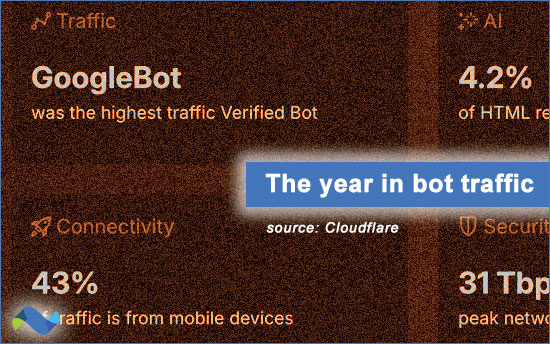
In Cloudflare’s interactive 2025 annual report published yesterday, the content delivery network said that internet traffic grew 19% in just one year.
See Cloudflare’s “2025 Year In Review.”
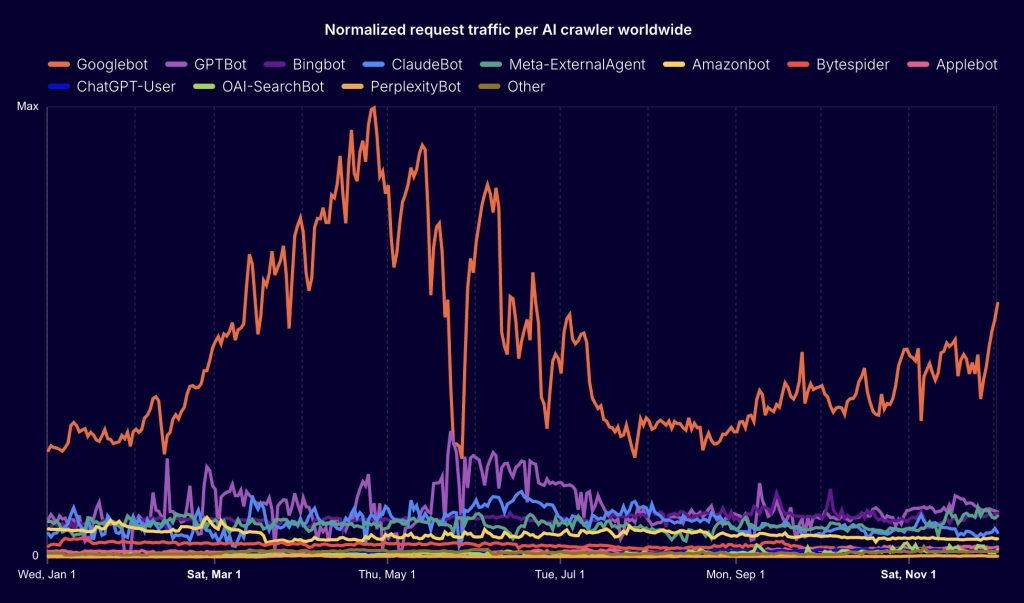
The results for “AI & Bot Crawler” traffic showed a gain for the year primarily due to Googlebot, according to Cloudflare’s data. But AI bot crawling seems to have moderated since the middle of the year. (See graphic below)
More:
- The 2025 Cloudflare Radar Year in Review: The rise of AI, post-quantum, and record-breaking DDoS attacks (December 15) – Cloudflare blog
- ChatGPT’s rivals, Kwai’s quiet rise: the top Internet services of 2025 (December 15) – Cloudflare blog
From tipsheet: The peaks in May and June speak to the urgency with which Cloudflare and its CEO, Matthew Prince, announced its AI crawler marketplace product for publishers in July. Not only did it vow to protect its publisher-side customers, Cloudflare also saw an opportunity to create a new revenue-generating product.
The content marketplace for crawlers has yet to publicly launch.
LLMS & CHATBOTS
Developments
- OpenAI hires Google’s Albert Lee to lead corporate development (December 15) – The Information (subscription)
- Zoom brings its AI assistant to the web with access to free users (December 15) – TechCrunch
- The rise of the telco LLM (December 15) – Nokia
TECH
Opinion: AI empties Madison Avenue
In the op-ed section of The Wall Street Journal yesterday, Columbia University professor Rajeev Kohli published a piece critical of the impact he believed AI and automation would have on parts of the advertising industry – mainly creatives and agencies.
Mr. Kohli wrote:
“Ad creation has traditionally been the purview of creative workers and ad agencies. The new AI systems create ads from text prompts and by combining digital assets. They resemble the first textile mills and assembly lines—more productive, faster and cheaper than human creations. But unlike those early factories, AI advertising systems don’t only produce. They are integrated into distribution and optimization systems that no stand-alone ad agency can match. This soup-to-nuts integration is immensely valuable. Smaller companies—like restaurants, shops and mom-and-pop businesses—can afford to produce ads they couldn’t before. Large advertisers often need smaller ad teams and can run multiple new ad campaigns. A majority of Google’s advertisers reportedly use Performance Max.
But this integration has a cost. By automating ad creation at scale, these platforms are displacing creative workers and agencies. WPP, the world’s largest advertising holding company, has begun using AI for many tasks and eliminated 25% of its freelancers. Actors, photographers, videographers, artists, animators, voice actors, sound designers, set designers, copywriters, editors and translators all stand to lose their work.”
Read: “AI Is About to Empty Madison Avenue” (December 15) – The Wall Street Journal (subscription)
From tipsheet: Empty Madison Avenue? I’d say transform it, for sure. And some jobs are obviously going away. In time, agencies likely get smaller but there could be a lot more of them spread across the internet.
Also — and Mr. Kohli speaks to this — there is organic growth being enabled today for businesses large and small using AI-enabled ad systems such as AppLovin’s Axon, Meta’s Advantage+ and Google’s Performance Max.
That growth-due-to-AI story is harder to tell longer term because, well, it has happened yet. But, I’m not of the belief that AI is going to be a zero-sum game.
LLMs & CHATBOTS
AdCP first campaign results coming Q1
Promising “full results will be released in Q1 2026,” ad platform PubMatic and marketing agency Butler/Till announced the launch of a “fully autonomous, end-to-end agentic advertising campaign across CTV for Clubtails, a leading flavored malt beverage brand from Geloso Beverage Group.”
PubMatic confirmed that the campaign ran through its buy-side-focused Activate platform and used Ad Context Protocol (AdCP) for the workflow:
“The workflow uses AdCP (Ad Context Protocol), an open protocol from AgenticAdvertising[dot]org, enabling standardized, transparent API for agent-to-system communication.
Butler/Till submitted a natural language brief through Claude, Anthropic’s Gen AI platform, and PubMatic’s agents interpreted the brief, generated the media strategy, initiated campaign setup, and will now continuously optimize pacing, targeting, and performance across premium programmatic supply.
While the workflow originates in the agency’s chosen AI platform, the underlying intelligence and execution are driven by PubMatic’s agentic application layer….”
Read the press release. (December 15)
Regarding the news, Scope3 CEO Brian O’Kelley said on LinkedIn yesterday, “Unreal that it’s only two months since the announcement of AdCP and we’re already seeing live pilots…”
Both PubMatic and Butler/Till were a part of the initial launch of AdCP.
Related: Media agencies test AI planning agents, while edging toward buying tools (December 15) – Digiday (subscription)
From tipsheet: In the use case outlined in the press release, the client and the buying platform are using AdCP for workflow automation to ultimately buy and manage a campaign across programmatic supply. Programmatic is not dead!
PubMatic is also not hesitating when it comes to the nascent protocol as evidenced by last week’s lead role in discussing new governance. The company’s public market pulpit provides, arguably, AdCP’s strongest voice currently.
CONNECTED TV
Samsung data enabling Amazon DSP
Samsung Ads is looking to unlock its ad platform and the valuable data available from Samsung devices (especially Smart TVs) in a new integration with Amazon Publisher Cloud, a data clean room.
A Samsung press release explained yesterday:
“The integration enables advertisers to join the Smart TV footprint of Samsung Ads with Amazon’s shopping, streaming, and browsing signals to plan and activate signal-enhanced campaigns through Amazon Ads, driving greater reach and relevancy.”
Read the release. (December 15)
AdExchanger reporter Victoria McNally detailed the use case for marketers:
“… a marketer trying to reach a particular type of shopper – parents who buy diapers, for example – can match that interest to segments within Samsung’s network where those types of shoppers are highly likely to appear. Before, an advertiser would only be able to use their own intuition to make these types of connections between different audience segments.”
Read more on AdExchanger. (December 15)
From tipsheet: More reach for Amazon’s AI-enabled DSP. And for Samsung, its media is now overlaid by Amazon’s shopping data potentially making placements — such as CTV — even more valuable.
The race for more differentiated data and inventory never ends.
AGENCIES
The indie agency playbook
After pointing to a MediaPost article regarding his indie agency’s latest client win, indie agency Acadia CEO and co-founder Jared Belsky divulged his broad recipe for creating a successful agency on LinkedIn yesterday.
He began with a nod to the recent Omnicom-IPG merger:
“While too much of the industry is watching ‘merger-palooza’ we at Acadia are far more interested in watching this trend of ‘budget consolidation’ where clients are just looking to see more results, with less silos, and to find a partners who are as comfortable talking about Amazon DSP’s latest feature, Google’s newest AI release while also talking Reach & Frequency or incrementality testing.
Retail Media + National Media + Performance Media + Analytics. More and more we are going to see RFPs looking for this…”
Read more from Mr. Belsky on LinkedIn. (December 15)
Read: Kidde Consolidates Media Account With Acadia (December 15) – MediaPost
From tipsheet: MediaPost’s Steve McClellan notes that Kidde’s media spend is likely in the range of $4 million annually. For agency holding companies like Omnicom/Publicis/WPP, this budget size might not be of interest unless the client was willing to use a self-service platform such as WPP Open Pro, which was announced in October.
Belsky’s Acadia appears to be doing much more than offering a self-serve ad platform though, and is an example of how a small-but-nimble agency team can win. Belsky is well-known for his strong stand against principal-based media buying, i.e. the agency buys media and then resells it to the client at a markup.
That doesn’t sound very agentic, does it?
A lot more indie agency opportunity is ahead in the age of AI as long as AI keeps delivering improved ROAS for the cohort of smaller marketers where every nickel matters.
TECH
Quantcast pitch: “Come test with me”
Touting his company’s new “Q Suite” platform on LinkedIn yesterday, Quantcast CEO Konrad Feldman shared his company’s positioning which emphasized the benefits of advertising workflow automation due to AI.
He put himself in the position of the marketer:
“The Old Way: You have a brilliant new strategy you want to test. But in a traditional DSP, executing a new strategy alongside your current one means doubling manual workload. The cost of innovation is exhaustion.
The Autonomous Way: You hand the execution to AI (which already trades way better than we can). Suddenly, testing a new strategy doesn’t add workload; it adds opportunity.”
Read more on LinkedIn. (December 15)
From tipsheet: The AI-drive automation pitch across planning, campaign management, creative, etc., is shared by many platforms touting AI capabilities. For potential clients, the truth will come through in the testing of the platforms. Given his nearly 20 years of experience as co-founder and CEO of Quantcast, Mr. Feldman is very aware of this.
BRANDS
Outcomes & the post-treatment window
Post-treatment window (PTW) seems like a compelling metric for outcomes-focused marketers who are looking to understand the causal effects of their ad spend.
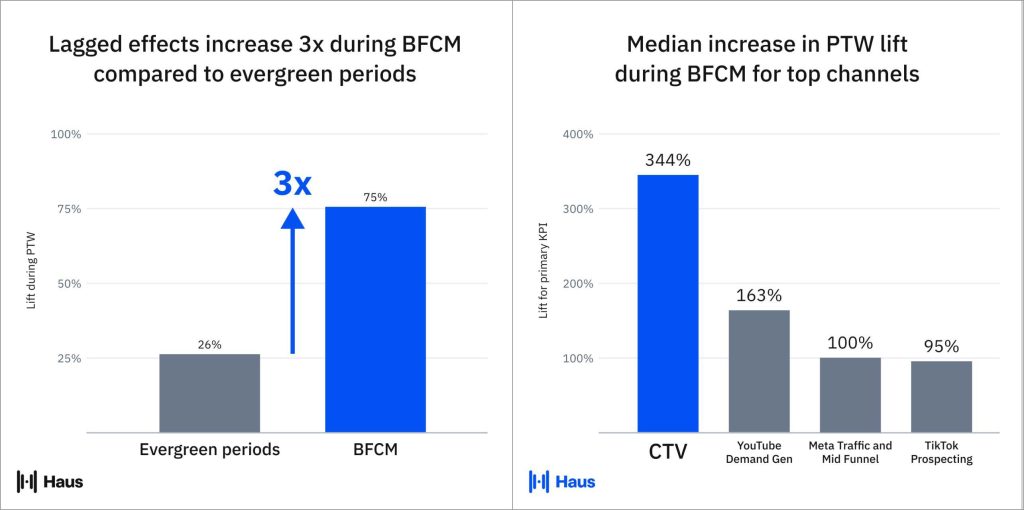
Incrementality measurement firm Haus has defined PTW as allowing “brands to measure the latent or delayed effect of advertising on prospects in their funnel. Think of it as turning a standard holdout experiment into a longitudinal study.”
Last Friday on LinkedIn, Haus’s Chief Strategy Officer Olivia Kory added visuals and insights to explain PTW’s relevance during the Black Friday—Cyber Monday (BFCM) season.
She wrote, in part:
“Timing matters: Brands that ended their treatment at least three weeks before BFCM saw slightly higher lift than experiments that ran closer to BFCM.
Amplified delayed impacts: During BFCM, Haus brands saw almost triple the lift during the post-treatment window compared to evergreen post-treatment windows throughout the year.
Big CTV swings pay off: CTV saw the largest median increase in post-treatment window lift, 344%, during BFCM across top channels, over double the PTW lift of the next highest channel.”
Read more on LinkedIn. (December 12)
From tipsheet: The message here is you need to understand what your ad spend is really doing, i.e. “Show me the outcomes.”
PEOPLE MOVES
Now hiring at AppLovin
“If [AppLovin’s AI-enabled] Axon can offer a scalable way to move users from first impression to conversion — priced on revenue generated — we don’t just have a massive business opportunity. We can actually help merchants of all sizes grow their businesses meaningfully along the way.
In just over a year, and with only a small slice of the addressable market, we’ve reached a level of spend that other platforms haven’t achieved in over a decade. It’s a testament to the power of the platform and the team bringing it to market…”
Applovin hires Sam Applebaum as “Director, Ecommerce” (December 15) – Sam Applebaum on LinkedIn
MORE
- Big Q4 for ads? “The Holidays Came Early This Year, at Least for Advertisers” (December 15) – The Wall Street Journal (subscription)
- Opinion: “When The Last Click Disappears: How AI Shopping Breaks Attribution And Rejuvenates Brand-Building” – Chris Kelly, CEO, Upwave on AdExchanger
- Hyper-personalisation Leads India’s AI Advertising Evolution: Study – BW Marketing World
- Opinion: “AI ads and the uncanny valley problem” (December 15) – Campaign Asia
- Trump Order Puts State AI Advertising Laws (December 15) – Inside Radio