
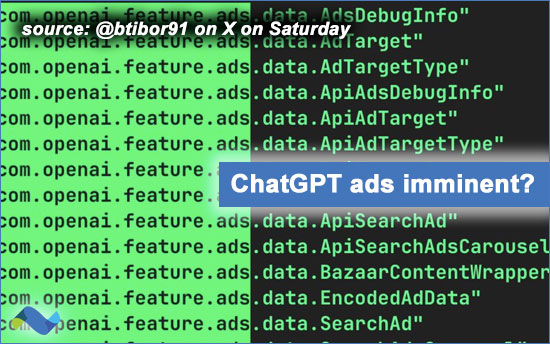
An Austrian AI engineer named Tibor Blaho reported seeing what may be the first inkling of an ad strategy for ChatGPT by OpenAI.
Sharing a screenshot on Saturday, Mr. Blaho said on X:
“ChatGPT Android app 1.2025.329 beta includes new references to an ‘ads feature‘ with ‘bazaar content‘, ‘search ad‘ and ‘search ads carousel‘“
See the screenshot on X or review this newsletter’s header graphic. (November 29)
On X, Blaho also pointed to an October article from The Information regarding OpenAI’s ad exploration and noted that the “company is considering whether ChatGPT could show ads based on its memory or the information it remembers about users according to a current employee…”
Bleeping Computer unpacked the news and offered its take:
“OpenAI is now internally testing ‘ads’ inside ChatGPT that could redefine the web economy.
Up until now, the ChatGPT experience has been completely free.
While there are premium plans and models, you don’t see GPT sell you products or show ads. On the other hand, Google Search has ads that influence your buying behaviour.”
Read more on Bleeping Computer. (November 29)
From tipsheet: Assuming this code is genuine, ads may be coming faster than expected to ChatGPT. Early Q1?
LLMs & CHATBOTS
Walmart puts ads in its shopping assistant
The Wall Street Journal reported last week that Walmart is testing ads in its chatbot known as “Sparky.” The WSJ’s Suzanne Vranica identified Sparky as an “agent” (more later) and outlined the customer’s journey:
“Users were served a Sponsored Prompt on Walmart[dot]com and when they clicked on the prompt, Sparky responded with an answer. A click-to-buy ad for the product appeared below Sparky’s response, according to people familiar with the matter.”
The Journal noted that Amazon also recently debuted sponsored prompts for its AI shopping assistant, Rufus. It’s evident that online retailers are eager to maintain and grow their advertising opportunity — and margin — as Generative AI grows in its influence.
Read: “Walmart Is Exploring Bringing Ads to Sparky, Its New AI Shopping Agent” (November 28) – The Wall Street Journal (subscription)
From tipsheet: What’s unexplored in the article is how Walmart is powering its chatbot or shopping assistant. While Walmart undoubtedly handles the front-end and checkout capabilities internally or through various partners, I’d guess the underlying conversational intelligence for Sparky is likely coming from OpenAI’s models and APIs.
You may recall that OpenAI and Walmart made an announcement about their new partnership in mid-October.
Though focused on enabling Walmart purchases using ChatGPT’s Instant Checkout, Walmart President and CEO Doug McMillon was quoted in the partnership release intimating a broader purpose: “For many years now, eCommerce shopping experiences have consisted of a search bar and a long list of item responses. That is about to change… We are running towards that more enjoyable and convenient future with Sparky and through partnerships including this important step with OpenAI.”
Finally, from tipsheet: The WSJ’s Vranica calls Sparky an “agent”. From here, I’d call this an AI-enabled chatbot. If Sparky was an agent, and truly agentic commerce, Sparky would autonomously buy a product on behalf of the consumer’s pre-set parameters. Is agentic commerce getting redefined? If it uses an LLM on the back end of the chatbot, it seems to be “agentic” for some.
LLMs & CHATBOTS
Developments
- Anthropic says it solved the long-running AI agent problem with a new multi-session Claude SDK (November 28) – VentureBeat
- In its most recent quarter, Alibaba’s profit slumped but AI business impressed —including its AI shopping assistant Qwen (November 25) – The Wall Street Journal (subscription)
- OpenAI’s lead under pressure as rivals start to close the gap (November 29) – Financial Times (subscription)
TECH
Shopping with Amazon’s AI chatbot “Rufus”
According to Sensor Tower data, use of Amazon’s “Rufus” shopping assistant/chatbot was on the rise during “Black Friday.”
Sensor Tower SVP Ian Simpson reported on LinkedIn: “Our early Black Friday data confirms Amazon users are experimenting with ‘Rufus.’ The Agentic Shopping age has begun! This is a first-of-its-kind dataset…” Read more. (November 28)
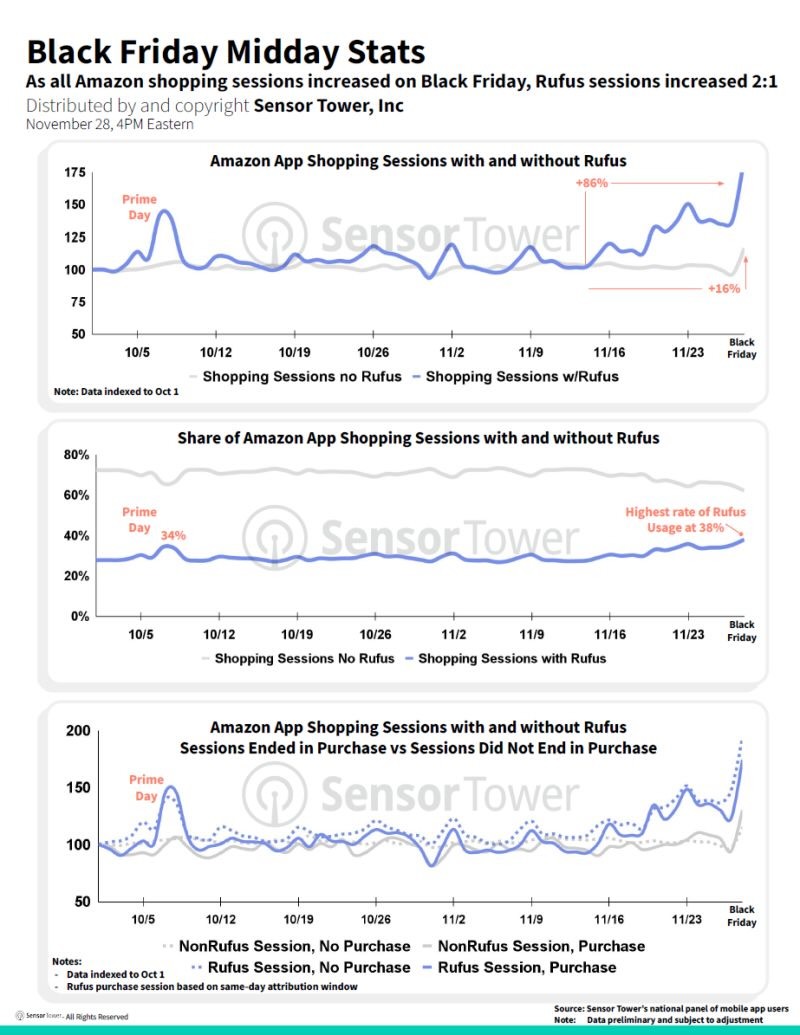
From tipsheet: Amazon is going full-steam-ahead with its AI-enabled shopping assistant future.
EVENTS
AWS re:Invent this week
Amazon Web Services’ annual cloud computing conference, re:Invent 2025, takes place all this week in Las Vegas. AI is featured throughout —and so is advertising with talks such as “Build AI Commerce Media Agents: Audience Discovery & Campaign Performance (IND411)”. See event catalog.
LLMs & CHATBOTS
Re-ranking social posts in LLMs
Stanford researchers announced that they have created a tool which allows the user to downrank individual political posts on X and affect the post’s listing within the Large Language Model (LLM) – xAI’s Grok, in this case.
Published in Science, the researchers concluded:
“We found that increasing exposure to AAPA (antidemocratic attitudes and partisan animosity) posts significantly increases affective polarization and negative emotions, whereas decreasing exposure reduces them. These changes were comparable in size to 3 years of change in United States affective polarization. As political polarization and societal division become increasingly linked to social media activity, our findings provide a potential pathway for platforms to address these challenges through algorithmic interventions.”
Read: “Reranking partisan animosity in algorithmic social media feeds alters affective polarization” (November 27) – Science
Read the release from Stanford University. (November 27)
From tipsheet: This tool clearly has applications across advertising and marketing. Aren’t generative engine optimization (GEO) companies trying to affect listings on behalf of their clients today? Of course. At a minimum, the Stanford tool speaks to LLM “conquesting,” i.e. targeting a competitor which automobile companies and their agencies perfected. Overall, it’s optimization.
STARTUP
Ads entrepreneur crawling commerce
John Laramie, whose startup Adstruc targeted automated out-of-home ad planning and was acquired in 2024, is launching a new commerce startup called CartHappy. According to Jason Del Rey of The Aisle, Mr. Laramie “is building a Chrome browser extension to help online shoppers price-compare and easily build a weekly shopping cart.”
Central to Mr. Laramie’s strategy is unfettered crawling of retailer websites.
In previewing the article on LinkedIn, Del Rey writes:
“‘You are positive none of these retailers will try to shut you down?’ I asked him.
‘You mean try to buy me?’ Laramie joked.
He pointed to Walmart’s public statements about welcoming Al crawlers as a sign of where the industry is heading. ‘I look at that as the bellwether for the industry, because they are smoking every other grocer,’ he said. ‘It is going to force everyone else to do the same thing.’
Whether that is strategic foresight or wishful thinking remains to be seen…”
Read more on LinkedIn. (November 26)
Read: “Grocery prices are squeezing Americans and AI startup CartHappy wants to help” (November 26) – The Aisle (subscription)
More:
- “CartHappy Launches Platform to Transform Grocery Shopping and Help Families Save Thousands” (November 26) – press release
- On the launch of CartHappy (November 25) – John Laramie on LinkedIn
From tipsheet: At the very least, Mr. Laramie’s position about web crawling should garner interest. Whether it’s the type of interest that Perplexity has garnered from Amazon remains to be seen.
Stepping back, in the age of AI, perceptions about intellectual property continue to be tested. Agentic commerce —or whatever you want to call it— appears to be an emerging battleground.
TECH
Ad Context Protocol 2.5 is out
Ad Context Protocol (AdCP) 2.5 is out, according to Scope3 CEO Brian O’Kelley, who is part of the coalition supporting development of a new agentic advertising protocol.
Mr. O’Kelley said last Tuesday on LinkedIn:
“This is a stable release that will enable consistency across the many agentic pilots happening over the next 6-8 weeks. Many of these new features address issues or ideas that have come up in the initial agent-to-agent tests. Huge thanks to the many people and companies who have contributed to AdCP so far!!”
New key features for the update:
- Type Safety & Code Generation
- Batch Creative Previews
- Schema Infrastructure
- API Consistency
- Signal Protocol Refinement
- Template Formats
- Enhanced Product Discovery
Read about the features’ details on LinkedIn. (November 25)
More:
- “AdCP Basics: Creating a trusted advertising supply chain using adagents[dot]json” (October 27) – Brian O’Kelley’s blog
- Website: AdContextProtocol.org
TECH
Defining an agentic framework
On a wide-ranging episode of the AdTech AdTalk podcast, ad tech executives and hosts Adam Heimlich and Gareth Glaser discussed the importance of containerization innovation and the IAB Tech Lab’s Agentic RTB Framework (ARTF) which was introduced in November.
Chalice AI’s Heimlich, who is part of the team developing the framework, was careful to distinguish between protocol and framework.
He offered his definition of an agentic framework on the podcast [16:26]:
“The key thing that I think people should think of as the salient definition of agentic frameworks — everyone jumps to the agent — but what allows for agentic behavior is companies providing services to each other.
[For example,] the reason my Claude engine could pull information from Slack is because Slack provides a service to Claude to understand that this request is coming from the end user —me.
That’s what creates agentics. So I want people to hear ‘deep, purposeful integration’ when they hear this word ‘agentic.’
People are used to RTB, which is a different kind of framework. It’s a federated framework: everyone gets the same thing.
An agentic framework, the difference is purpose. We’re trying to do something across companies so we provide services to each other so that the end user could have a better service. That’s the back end of an agentic workflow – a kind of collaboration.”
Hear more on the AdTech AdTalk podcast. (November 28)
MEDIA BUYING
Agentic media buying ‘baby steps’
Joining the pantheon of Digiday’s “Confessions” series participants, an anonymous ad tech industry executive discussed his company’s pilot of an AI-enabled media buying agent for a client. The shrouded exec explained, “It was essentially trading the way a trafficker would, but automated. … It looked at insertion orders (IOs) … it set up the campaigns, it set the campaigns live, and it started optimizing them.”
After two days of running the pilot, the executive said that fear set in (“we got scared”) and his company pulled the plug for fear of budget overspending overnight or over the weekend. They reverted to human trading. Read more. (November 25 – subscription)
From tipsheet: Test and learn. It’s early.
AGENCIES
Omnicom acquisition & algos of record
“AI isn’t a trend. Omnicom isn’t just an acquisition. WPP and Dentsu aren’t just reorganizations. They’re a tectonic shift. Agencies are being reshaped into algorithms of record, and the old playbook won’t cut it…”
Read more: “A Big Bang Reshapes Agencies Into Algorithms Of Record” (November 26) – Forrester
Related:
- “Some detailed thoughts on IPG + Omnicom…” (November 28) – Henry Innis, Mutinex
- “Omnicom’s IPG takeover is finally complete. What do we know?” (November 26) – The Drum (subscription)
TECH
Recent announcements of interest
- “Fascinating program from Criteo’s BidSwitch (…) making AI crawlers bid for access to publisher content. In a limited test of the ‘Dynamic Content Ledger’ with Raptive and SmartMedia Technologies, 51.4% (1,757 out of 3,418) of AI crawlers agreed to a publisher’s price (minimum bid floor) to crawl.” (November 24) – Pixalate marketer Gavin Dunaway on LinkedIn
- “By combining neuroscience and AI, we can reach people in moments when they’re most receptive, leveraging advertising that feels natural, meaningful, and emotionally resonant without relying on personal data…” (November 21) – Seedtag CEO Brian Gleason on LinkedIn
SELL-SIDE
Publishers still adding free content
“Zoom out: For People Inc., the business opportunity in creating a recipes platform ties back to its massive digital advertising business.
’What we’re doing is this is driving those registered users back to our site more often, and they are staying longer,’ People Inc. Chief Business Officer Alysia Borsa said.
‘The concept of saving a recipe has a lot of value,” said Rich Maggiotto, general manager of MyRecipes.’”
Read: People Inc. builds recipes business (November 26) – Axios
From tipsheet: There are several interesting angles here from the publisher fka Dotdash Meredith.
- First: This is not a move to subscriptions.
- It’s a free, ad-supported website.
- Another emerging opportunity: Be a resource for Large Language Models (LLMs) with gobs of original content and create revenue from crawler licensing fees.
- Finally, feed your own chatbot: The content could feed the publisher’s own LLM which manifests itself as a chatbot on the publisher’s site. Still early days on the last one.
MORE
- Nine Publishers Sue OpenAI And Microsoft For Alleged Copyright Violations (November 28) – MediaPost
- Meta Integrates More AI-Powered Options Into Its Ad Flow (November 25) – Social Media Today
- EU to examine if Apple Ads and Maps subject to tough rules, Apple says no (November 28) – Reuters (subscription)
- Black Friday Data Shows Online Sales Strong (November 29) – Forbes
- Publicis partners with Genius Sports for its AI-enabled FANhub ad platform (November 25) – press release