

Adobe announced yesterday that it will acquire search (SEO) and generative engine optimization (GEO) platform firm Semrush for $1.9 billion.
From the Adobe press release:
“Adobe will acquire Semrush, a leading brand visibility platform, in an all-cash transaction for $12.00 per share, representing a total equity value of approximately $1.9 billion. Semrush is a powerful partner for marketers looking to manage brand visibility and audience reach through its data-driven generative engine optimization (GEO) and search engine optimization (SEO) solutions. (…)
With products like Adobe Experience Manager (AEM), Adobe Analytics and the newly introduced Adobe Brand Concierge, Adobe is solving major pain points for brands embracing agentic AI. Together, Adobe and Semrush will deliver a comprehensive solution that gives marketers a holistic understanding of how their brands appear across owned channels, large language models (LLMs), traditional search and the wider web.”
Read the full release. (November 19)
From tipsheet: This acquisition is pretty simple for Adobe. It’s all about adding a currently well-known GEO product (Semrush One) in a market with new AEO/GEO entrants every week. Good on Semrush for striking now at a 74% premium to its previous-day’s stock price (the company’s stock had been sliding all year).
Adobe may have set the market for GEO and AEO (answer engine optimization) firms in the process. $1.9 billion (all cash) seems like a healthy top if you group it with SEO firms and the perception that SEO products have been commoditized.
You may recall Semrush from its research graphics (1, 2, 3) in the trade media which show answer engines’ traction with consumers as publishers’ website traffic numbers decline.
According to Reuters, Adobe wants to “strengthen its marketing tools and attract brands with generative artificial intelligence products.”
Emarketer analyst Grace Harmon told Reuters: “The price is steep as Semrush isn’t a massive revenue engine on its own, so Adobe is likely paying for strategic value. The payoff could be high too if Adobe can quickly turn Semrush’s data into monetizable AI products.”
Ms. Harmon’s view echoes the latest AI narrative: AI is great, but what about the product and (recurring) revenue? Meanwhile, like many companies, Adobe sees existential risk and opportunity with AI. It’s swinging for the fences -albeit, not at a Figma level.
Read more in Reuters. (November 19)
More:
- Semrush CEO Bill Wagner’s post on LinkedIn. (November 19)
- Semrush founder and CTO Oleg Shchegolev’s post on LinkedIn. (November 19)
- Conductor CEO Seth Besmertnick’s post (a Semrush competitor) on LinkedIn (November 19)
LLMs & CHATBOTS
Developments
- Nvidia shares rise on stronger-than-expected revenue, forecast (November 19) – CNBC
- Perplexity’s AI shopping tool is now free for all, just in time for Black Friday – how to try it (November 19) – ZD Net
- Building more with GPT-5.1-Codex-Max (November 19) – OpenAI
BRANDS
Use case: Agents, insights, investment
Ad agency holding company Havas is contracting with – and investing in – an AI-enabled research platform called Vurvey Labs to execute campaigns on behalf of pharmaceutical clients among others, according to AdExchanger’s Joanna Gerber.
She reported:
“[Vurvey’s] main offering is what it calls a ‘people model,’ which is a large-scale model trained on millions of customer interviews that can generate AI agents and populations that reflect a diversity of human personalities and behaviors. The agents can deliver insights by simulating how actual people think, feel and respond to new ideas.”
Read more on AdExchanger. (November 19)
From the press release on the $8.5 million Series A investment round which includes Havas, Hillman Group and analyst Rich Greenfield’s LightShed Partners, Vurvey CEO Chad Reynolds reiterated:
“Unlike many AI tools that are focused on efficiency, Vurvey was designed to amplify people. Our models are powered by the voices of real people all over the world, allowing companies to synthesize research and bake the consumer into every innovation, market launch, and brand experience.”
Read the release. (November 19)
From tipsheet: As Ms. Gerber noted, video + survey = Vurvey.
Vurvey’s focus on transferring human interactions (such as voice, eye-tracking) into data for AI seems to have some correlation with Vision AI at RealEyes and its recent offshoot, adverteyes[dot]ai.
Remember the Portable People Meter sending human viewer data to Nielsen?
What’s old is new again for AI data generation in advertising and marketing.
INVESTMENT
Kawaja launches AI LUMAscape
Founder and CEO Terence Kawaja of investment banking firm LUMA Partners has finally relented.
After pushing back on the hordes regarding the need for an AI version of his world-famous LUMAscapes (every company is going to create/integrate/use AI, after all), Mr. Kawaja published his new AI LUMAscape on Linkedin yesterday. AI companies are categorized into five sections: Foundational LLMs; Customer Experience; Media Facilitation; and Data Enablement; and Answers Economy.
Kawaja explained on LinkedIn:
“There’s only one thing that we can say with certainty about this launch version of the AI LUMAscape: it is wrong. We know that for certain. Now we need you all – the market – to tell us where. Maybe we left off your deserving company, maybe we mischaracterized your capabilities – sorry, and let’s get on the phone so you can explain how / why so we can see how best to resolve it. Or maybe you would just like to chat about it – we’d like to hear from you. BTW, no guarantees that such interaction will produce an edit but it’s helpful.”
Read his entire intro to the AI LUMAscape.
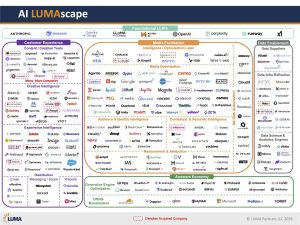
According to ChatGPT’s count, approximately 350 companies are currently represented on the map.
Get the high-resolution version of the AI LUMAscape here.
RETAIL MEDIA
Criteo CEO talks agentic commerce
“We’re entering the dawn of agentic commerce, which will be a transformative channel for retailers and merchants. And it’s only the beginning.
AI has always been in Criteo’s DNA. Our AI strategy spans four key areas: boosting internal efficiency, enhancing our AI-powered products, building agentic shopping support for retailers and exploring API partnerships with LLMs to power more relevant product recommendations.”
More: Criteo CEO on how AI is changing the future of advertising (November 19) – Yahoo! Finance
TECH
Bringing transparency to AI slop
TikTok announced that it was looking for new ways to address transparency when it comes to AI-generated content (AIGC – new acronym alert!). It’s not that the social video platform wants it to go away, but they want viewers to know what they’re getting.
The company shared a three-pronged plan in a press release yesterday involving the platform’s creators:
- Tools: “Testing a new tool to help people shape the AIGC in their feed.”
- Labeling: “More advanced AIGC labeling technologies.”
- Education: “A $2M educational fund for experts to make content about responsible AI.”
On the labeling front, TikTok explained:
“To bolster our AI-generated content labels, we’re also testing a solution called ‘invisible watermarking.’
We require people to label realistic AI-generated content on TikTok and layer multiple strategies to apply that rule. This includes labeling tools we offer creators as well as our own detection models. We also use a cross-industry technology called C2PA Content Credentials, which embeds metadata into content that lets us—as well as other platforms who use C2PA—know when something is AI-generated. These efforts helped label over 1.3 billion videos to date.”
Read more. (November 19)
More: Sick of AI videos? TikTok has a new tool to keep them out of your feed. (November 19) – Business Insider
From tipsheet: That’s 1.3 billion known AI-generated videos on TikTok alone. Will labeling work? I can imagine it becoming like the relentless GDPR pop-up: “Just get it out of my way.”
At some point, AI use in video could be normalized such that the consumer assumes every video across his/her digital experience has AI in it.
TECH
Defiant Viant says future is autonomous
Co-founder and COO Chris Vanderhook of ad tech company Viant was defiant yesterday on LinkedIn regarding the volatility his firm has experienced in the public markets.
“We don’t care where the market is right now. We don’t care what the latest pundits say about adtech vs. the walled gardens (you’ve all been saying the same thing for 20 years!). We’re here to build our vision for the future — and that future is autonomous. So if we could go back in time, would we go public again? Every. Single. Time.”
Read Mr. Vanderhook’s screed on LinkedIn. (November 19)
The company — which uses the ticker symbol “DSP” and positions itself around “AI-enabled programmatic advertising” and “Viant AI” — was valued at $600 million as of yesterday.
Back in February, the company’s valuation reached more than $2 billion. In the most recent quarter, Viant reported “a 7% year-over-year increase in revenue to $85.6 million and a 13% rise in gross profit to $39.8 million” and announced a new, high-profile client, Molson Coors. Read more.
Related: The argument “for” publicly-traded WPP (November 19) – David Gaines, CEO, integrated agency, Media by Mother on LinkedIn
LLMs & CHATBOTS
Gemini 3’s effect on Google Search
“Gemini 3 landed in Search yesterday – and it’s been really fun to see you bring complex science & math concepts to life in AI Mode. These simulations are all dynamically generated with Gemini 3’s agentic coding capabilities. Check out a few examples…”
PODCAST
Brand agents meet advertising
“This is not programmatic, this is different. But I think this idea that as a brand, my content, my experience should live wherever the consumer is, whether that’s on my owned and operated properties or outside of those walls, and be able to engage with consumers intelligently and adapt on the fly, it’s really a totally new paradigm.”
- Firsthand CEO and co-founder Michael Rubenstein “on how ‘brand agents’ are reshaping advertising, publishing, and the internet itself” (November 14) – The Media Copilot
- Also hear it on The Apple Podcasts app. (November 14)
MORE
- Amazon’s Prime Video Using AI to Produce Video Recaps for Original Series (November 19) – Variety
- “The 2026 Upfronts are going to be the first one where Virtual-Out-of-Home (VOOH) and Virtual Product Placement (VPP) are integrated as viable growth mechanisms for publishers.” (November 19) – Cory Treffiletti, Rembrand on LinkedIn
- MediaMint’s AI Agent Puts A Fresh Spin On Simplifying Ad Ops (November 19) – AdMonsters
- An anatomy of the trust fault line running through Amazon’s ad ambitions (November 19) – Digiday (subscription)
- Opinion: AI search & the shift towards inauthenticity & commercial interests (November 19) – Search Engine Land