

Adobe enters AEO/GEO, talks LLM advertising
In Adobe’s Q3 conference call last Thursday, CEO Shantanu Narayen said in his prepared remarks that customers of the Adobe Experience Platform (AEP) were already seeing strong, 70% adoption of its AI assistant capabilities. Furthermore, he expected AEP to benefit from the large language models (LLMs) advertising and marketing yet to come.
Mr. Narayen stated:
“The explosion of content creation and automation in the enterprise and the beginning of new marketing needs such as LLM optimization and LLM advertising are a massive opportunity for Adobe. We’re infusing AI into Adobe Experience Manager with our upcoming LLM Optimizer release, a powerful agentic app to improve brand visibility, drive acquisition and maintain engagement with customers across LLM platforms…”
Read Adobe’s Q3 transcript for prepared remarks with Wall Street analysts. (September 11)
Later, in the Q&A with analysts, CEO Narayen discussed how his company is already using the “LLM Optimizer” internally:
“… it was actually working internally with our Adobe[dot]com team, which obviously runs a big digital business. That’s how we got going on the LLM Optimizer. (…) A lot of our customers or prospects were starting to ask questions within ChatGPT and Perplexity and so on, ‘How do I edit this PDF? I have a large PDF. How do I compress it?’ Those kinds of questions. We realized that we had a lot of content available, that if we made it available through the right channels, that would get picked up by the LLMs and that that would give our Acrobat brand a lot more visibility through the LLMs. That’s how the idea for the product came about.”
See the Q&A on Investing[dot]com. (September 11)
Read: Adobe targets CMOs on a GEO mission – The Stack (September 12)
From tipsheet: Not only is Adobe anticipating the advertising space for LLMs, it’s entering into the generative engine optimization (GEO) or answer engine optimization (AEO) space.
AEO/GEO as a feature of a large customer data platform – like Adobe’s AEP – is both a threat and an opportunity for AEO/GEO startups:
-
The opportunity: Get acquired and become the big platform’s AEO/GEO feature.
-
The threat: Become increasingly unnecessary as large marketing and/or data platforms with huge reach build or buy their own solutions.
-
A third option could be as a standalone. But, only time will tell if they can achieve enough scale to make that a reality.
In June, Adobe announced its “agentic layer” for Adobe Experience Platform: Adobe Experience Platform Agent Orchestrator.
LLMs & CHATBOTS
Chatbot Perplexity’s future
With Perplexity’s advertising executive, Taz Patel, having exited the company, industry participants are beginning to wonder aloud regarding what’s next for the Perplexity chatbot. Digiday’s Krystal Scanlon wrote on Friday:
“According to three of the ad execs Digiday interviewed for this article, no one really knows what Perplexity’s strategy is, or if it even knows itself. Patel’s sudden departure — with no immediate successor in sight — only makes that murkiness harder to ignore.
Read more. (September 12 – subscription)
From tipsheet: Two things matter most: Either Perplexity’s rumored funding round (read TechCrunch on September 10) comes through or it sells before the financial foundation of the company falls apart. In this AI hype cycle, funding should be no problem.
LLMs & CHATBOTS
Developments
-
Sierra CEO Bret Taylor on why the AI bubble feels like the dotcom boom (September 11) – The Verge
-
As Tech Leaders Flatter Trump, Anthropic Takes a Cooler Approach (September 12) – The Information (subscription)
BRANDS
CMO on LLM-First Buying in B2B
Sydney Sloan, CMO at software marketplace G2, discussed “LLM-First Buying: The Death of Traditional Funnel Marketing” and other topics in an interview with SaaStr, a software-as-a-service community website.
“Pay-per-click is no longer the way that we can buy our way [sic],” according to Ms. Sloane.
Consequently, she outlined a new buyer journey due to the introduction of large language models (LLMs):
“LLM Research: Buyers start with ChatGPT, Claude, or other LLMs for initial discovery
Source Verification: They visit the sources cited by the LLM (often user-generated content sites)
Peer Review: They check peer review sites like G2 for validation
Shortlist Creation: LLMs help build RFP templates and vendor shortlists
Direct Engagement: Only then do they visit vendor websites or marketplaces…”
Read more on SaaStr’s website. (September 12)
More: G2 Report: “AI Now Means ‘Always Included,’ Disrupting All Stages of the B2B Software Buying Journey” (May 14) – G2 press release
BRANDS
Agentic personalization pitch
Privately-held Optimizely, a data experience platform (DXP), showed off agentic tools for marketers at its Optimizely Opticon event last week in New York City.
Overall, the company said it is using an agentic strategy to create deeper personalization with potential customers. CMS Wire’s Greg Kihlstrom covered the event and offered his three takeaways for marketers:
“First, AI isn’t going anywhere. AI is not only here to stay, it is continuing to evolve in complexity, with agentic orchestration soon to be a competitive differentiator between brands that lead and those that lag behind.
Second, content and experiences are still the centerpiece of effective marketing. After all, as [Optimizely CEO Alex] Atzberger said in his opening keynote, ‘content is the connective tissue’ that ties together the customer experience.
And finally, the human component of marketing and marketing operations can’t be ignored, as well as the internal customer experience it creates.”
From tipsheet: Optimizely has $400 million in ARR according to CEO Atzberger in a recent podcast.
BRANDS
Tactics: On AI-enabled marketing with Meta
Marketer Jon Loomer has amassed tips and tricks for Meta’s AI-enabled Advantage+ ad system with application for both SMBs and big brands.
Here are two of the foundational entries that may be of interest to the marketer:
“The Modern Approach to Meta Advertising Strategy” – September 2
-
This is a very tactical overview where, for example, simplicity is advocated by Mr. Loomer: “Once again, aim to consolidate. In most cases, you can get away with a single ad set in a campaign. There are exceptions, but your goal should be to prioritize simplicity where possible. If you do use multiple ad sets, also turn on Advantage+ Campaign Budget so that your budget is distributed optimally between ad sets.”
“Meta Andromeda: What It Means for Your Ad Strategy” – August 18
-
Mr. Loomer takes the marketer through Andromeda, a machine-learning system for ad personalization that is used by Advantage+
AGENCIES
Your AI slop is my opportunity
Adweek covered the AI ‘slop’ opportunity last week. “Opportunity?” you ask. Yes. As consumers grow weary of the use of AI in the creation of ads and marketing, the opportunity to use authenticity as a differentiator is presenting itself to the marketing community.
Adweek’s Brittaney Kiefer wrote, “While many brands have been accused of adding to the slop pile, others are starting to counter the trend to stand out in a new phase of the internet.” BMW was touted as an example. Read more. (September 11 – subscription)
AGENCIES
Opinion: AI agents are junior strategists
“AI agents work best as junior strategists. Their output equals their management. Give direction, structure, and feedback, and they transform productivity. Leave them unguided, and they deliver unfinished, off-brand work.”
Read: “The rise of Agentic AI and its disruptive impact on marketing agencies” – Pepper Content co-founder Anirudh Singla on The Economic Times (September 13)
SELL-SIDE
AI anti-trust lawsuit for Google
Penske Media filed an antitrust lawsuit against Alphabet for Google’s use of AI Overviews. According to The Wall Street Journal, Penske Media believes that “the AI summaries that appear atop search results are illegally using its reporting and depressing online traffic.”
13 publications including Rolling Stone, Billboard and The Hollywood Reporter are appended to the complaint by Penske.
Read more in the WSJ. (September 13 – subscription)
With data showing up to 25% traffic loss due to AI Overviews, publishers have made clear their displeasure —and their fears— in what they see as an abrogation of the unwritten agreement between Google and publishers. Pre-AI, publishers bore the cost for content creation which Google then indexed in its search engine in return for referral traffic back to publishers. With AI-enabled answer engines and search results, there is potentially less need for the users to visit publishers’ websites.
The WSJ quoted from the complaint filed by Penske:
“With every article it publishes on its websites, [Penske Media Corporation] is forced to provide Google with more training and grounding material for its [AI] systems to generate AI Overviews or refine its models, adding fuel to a fire that threatens PMC’s entire publishing business…”
Axios noted that Penske’s filing follows other lawsuits related to Google’s AI Overviews such as from online education company, Chegg, and Arkansas newspaper, the Helena World Chronicle. The suits identify content being “siphoned” off and a loss of ad revenue.
More: Penske Media Corporation v. Google LLC (1:25-cv-03192) (September 12) – Court Listener
From tipsheet: The publisher conundrum of blocking Googlebot continues. Googlebot crawls publisher content and informs Google’s search engine and AI Overviews/AI Mode. Simultaneously, Google is trying to thread the needle and protect its enormous search ad business while transitioning to an answer engine future where competitive threats—such as OpenAI’s ChatGPT—are marching ahead.
SELL-SIDE
The SMB (and AI) trend in CTV
Was Magnite’s acquisition of AI ad tech startup streamr[dot]ai part of a wider trend in CTV? It depends on the trend you seek:
-
Enabling SMBs to easily buy CTV ads (and pause ads!).
-
The increasing use of AI to create, in this case, CTV ads.
-
A mix of both.
The Verge’s Janko Roettgers reported on Friday that Roku’s CFO Dan Jedda said his company wanted to encourage SMBs to use generative AI to create video ads that will run on its streaming service. “No longer is it going to be about the top 200 advertisers. It’s going to be about 100,000 advertisers,” said Mr. Jedda at a recent Citi investor event. Read more.
More: What’s Next for Streamr[dot]ai Now That It’s Been Acquired By Magnite? (September 12) – AdExchanger
From tipsheet: Aggregating SMB budget into a formidable CTV ad buying segment can only happen if it is easier to make CTV ads. In theory, the benefits will compound for CTV publishers as competition for individual impressions builds due to a more hyper-targeted (local) SMB marketer.
TECH
Infographic: How fast will AI search grow?
On LinkedIn, eMarketer VP of Content Paul Verna shared snippets of his research company’s latest report, “The Future of Digital 2026: How to Stay Relevant in an AI-Transformed World.”
Mr. Verna explained that the eMarketer team delved into 3 areas:
“How genAI, AI assistants, and AI agents are reshaping the digital economy
How the pace of change with AI is faster and more cutthroat than with previous innovation cycles
How brands, retailers, agencies, and ad platforms need to rethink how to stay relevant”
Among the charts he shared was one about AI search advertising growth expectations.
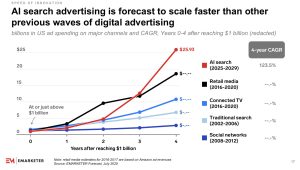
Read more on LinkedIn. (September 12)
TECH
Podcast: CEO Lisa Utzschneider on AI at IAS
Appearing on the Marketecture podcast, Integral Ad Science CEO Lisa Utzschneider discussed her firms plans for AI – many of which she says have already been in place.
Ms. Utzschneider said:
“We’ve been leveraging AI for years with our products. Majority of our products are powered by AI.
In particular, our multimedia classification products. So by leveraging AI, our modeling is faster. It’s higher velocity.
We are removing the human from the model validation. So if you went under the hood of IAS today, you would see that 97 percent of our model validation has no human in it…”
Hear more on the Apple Podcasts app. (September 12)
From tipsheet: Integral Ad Science is a publicly-traded company with a $1.4 billion market cap today. Walled garden platforms and startups, alike, want to steal IAS’ business.
POLICY
FTC getting busy
- Government Puts AI Companies on Notice About Boastful Advertising: 5 Practical Lessons for the Tech Sector (September 12) – JD Supra
- Google, Amazon Under FTC Investigation Over Ad Pricing (September 12) – TheWrap
PROMPT
How could regulation shape advertising within large language models by 2030?
Response from OpenAI’s ChatGPT:
Here’s how I see regulation likely shaping the ways advertising inside or through large language models (LLMs) by 2030 — the levers regulators might pull, trade-offs, and what that could mean for marketers, platform providers, and users.
MORE
- firmly[dot]ai and CJ Forge Strategic Partnership to Transform Native Commerce for Publishers and Merchants – press release
- AI Startup Founders Tout a Winning Formula—No Booze, No Sleep, No Fun (September 12) – The Wall Street Journal
- A.I.’s Prophet of Doom Wants to Shut It All Down (September 12) – The New York Times (subscription)
- Opinion: The Three Tribes of Tomorrow’s Shoppers: Nostalgics, Hybrids, and Delegators (September 12) – Tom Burg, SVP of Marketing, Aqfer on Aqfer blog
- Opinion: When CMOs and CFOs Align Their KPIs, They Deliver More Value (September 12) – Michael Kaminsky, Recast on HBR