
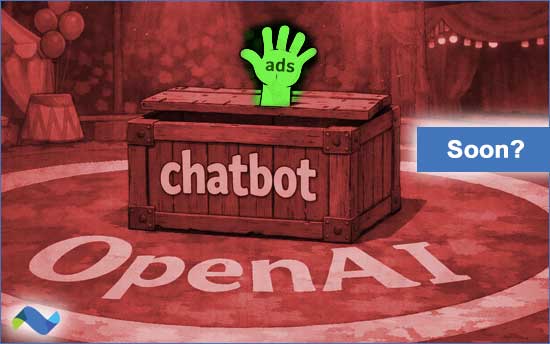
Just in time for the Christmas holiday, The Information delivered a lengthy gift for advertising lovers who were waiting for ads to appear in OpenAI’s ChatGPT.
While new details were scant, there is more talk of ads apparently going on at OpenAI even though CEO Sam Altman’s very public “code red” was thought to have shut down all ad strategy in hopes of supercharging ChatGPT’s overall performance.
“OpenAI wants to show ads as unobtrusively as possible to users and ensure that the company doesn’t lose users’ trust, said the person with knowledge of the effort.
That could mean ads that show up only once a user’s conversation has progressed in a certain direction. One ad mockup showed display ads as a secondary step in ChatGPT once a user has expressed interest in finding more information rather than in the initial ChatGPT response, said the person who saw the mockup.
For instance, if a user asks ChatGPT to make an itinerary for a trip to Barcelona, the chatbot could suggest visiting the Sagrada Família. That suggestion wouldn’t be sponsored, but if the user clicks on a link for the Sagrada Família, a pop-up notice could appear with multiple sponsored links to different businesses that offer paid tours.”
A “nugget” at the end of the article speaks to the “gold rush” that will likely occur once ads are unleashed at OpenAI:
“One executive at a large ad agency said they have been trying to get in touch with OpenAI to help create relationships for their clients for six months with no answer. A marketer at a consumer healthcare brand, meanwhile, said that OpenAI has only been sharing generic tips on how to optimize the brand’s site to show up in ChatGPT responses but haven’t offered any details on how they could pay to advertise.”
When ads in ChatGPT are finally launched at scale, clients will be asking the service layer, “Got ChatGPT ads?”
Read: OpenAI’s Ads Push Starts Taking Shape (December 24) – The Information (subscription)
From tipsheet: Once again, “ads in a chatbot” remains a top storyline for the media along with funding for AI companies.
The ad product development process seems painful at OpenAI, no? There’s even talk of an ads “sidebar”?…. wow.
The real story here could be that the ads initiative at the company continues in spite of “code red”. But, the exact timing of the anecdotes isn’t clear in the article — I’d guess that they are all pre-”code red.”
From here, rather than tentative steps forward, it seems like OpenAI needs to aggressively test-and-learn—then repeat. The sooner they unlock ad revenue, the better for their consumer product efforts.
Also, even though The Information reiterated a lurking threat to Google’s ad business, does anyone still believe this given Google’s financial results over the past few quarters? Any ad product that OpenAI creates will likely grow the overall ad “pie”.
Related: “OpenAI’s choice to report Weekly Active Users (WAU) instead of the more common Monthly Active Users (MAU) as an indicator of product growth is curious.” (December 24) – Eric Seufert, analyst, Mobile Dev Memo on LinkedIn
LLMS & CHATBOTS
Developments
- “I’ve never felt this much behind as a programmer. The profession is being dramatically refactored as the bits contributed by the programmer are increasingly sparse and between. I have a sense that I could be 10X more powerful if I just properly string together what has become available over the last ~year…” (December 26) – Andrej Karpathy, co-founder of OpenAI, on X
- Observability vs Monitoring for Agentic AI Products (December 26) – Adaline Labs on Substack
- “Sam Altman: How OpenAI wins, AI buildout logic, IPO in 2026?” (December 18) – Big Technology Podcast on Apple Podcasts or read a summary on The Independent
PLATFORMS
Podcast: On Snapchat and Perplexity
In the most recent episode of the AdExchanger Talks podcast, AdExchanger’s Allison Schiff interviewed Ajit Mohan, Snap’s chief business officer.
Among the topics discussed, generative AI and its strategic importance to Snap’s messaging app. Mr. Mohan identified the positive impact of AI on workflow automation especially as it related to campaign planning and management for Snap’s SMB clientele as well as the company’s augmented reality (AR) glasses slated for next year.
Mohan also called out his company’s deal with Perplexity – announced in November – and his expectations beyond the $400 million in cash and equity promised by Perplexity to Snap:
“There’s a lot of new energy around AI chatbots, including in commerce. So there’s dramatic progress in terms of new services that are coming up. And a lot of that is through messaging.
The engagement with AI is through chat prompts. Now, it so happens that there’s a lot of models, but there aren’t too many large messaging platforms in the world. And we tend to, you know, we have a platform with a billion users.
So we see a huge opportunity, and our partnership with Perplexity is a great example, where I think there’s an opportunity for platforms like Perplexity to leverage the scale of a platform like Snapchat, fundamentally oriented around messaging, as they look to acquire new customers…”
Hear more on the Apple Podcasts app. (December 22)
From tipsheet: Given Mohan’s response, it doesn’t sound like Snap has a strategy for chatbots other than revenue. So why not find a chatbot willing to pay for placement similar to Google’s deal with Apple and its preferred search engine placement in the Apple Safari browser?
Quick comparison:
-
As of today, Snap has a market cap of about $13.5 billion. And Perplexity was alleged to have a valuation of $20 billion in September.
-
Today, Snap has about 1 billion users globally. Perplexity publicly reported 20 million in May 2025 with 20% month-over-month growth (could be ~40 million now).
tipsheet speculation: Perplexity merges with Snap in 2026 as it looks to supercharge both companies’ footprints? It’s an intriguing match as an AI-enabled advertising engine is perfected within the Snap app and/or the Perplexity chatbot (ads do not exist in Perplexity today).
Related:
- 6 (More) AI Startups Worth Watching (December 23) – AdExchanger
- Hot Spots in AI Advertising Start-Ups (December 22) – Marketecture
- Unexpected AI-First Companies (December 19) – Swift Ventures
BRANDS
2026: Marketers’ cost-reduction pressure
A survey of “marketing leaders” from recruiting firm Spencer Stuart was the subject of a Wall Street Journal article on Tuesday.
- The Survey: “The AI Reckoning: Why Marketers Think 2026 Is a Make-or-Break Year” (December 2025) – Spencer Stuart
- The Article: “Layoffs Expected as Marketers Face Pressure Over AI Savings, Survey Finds” (December 23) – The Wall Street Journal (December 23)
No surprise, but efficiency and headcount reduction were at the top of the list when it comes to AI’s expected impact on the marketing function, according to Spencer Stuart.
The WSJ’s Patrick Coffee reported:
“Thirty-seven percent of marketers at $20 billion-plus companies said their CEOs and chief financial officers expect them to cut costs by at least 20% within the next two years, the survey found.”
The WSJ’s Coffee aggregated several other relevant surveys in the article and finds other forces at play, too.
“The upheaval can’t be blamed entirely on AI, according to Tim Derdenger, associate professor of marketing and strategy at Carnegie Mellon University’s Tepper School of Business. A slowing economy, as well as a correction in pandemic-era over-hiring, have also played key roles, he said.
‘You’re having these two waves slowly approach each other, and they are going to crash into each other,’ said Derdenger regarding AI and the larger economy.”
From tipsheet: In 2026, could growth be the new story line for AI rather than cost reduction and efficiency? Large marketers don’t seem to think so. But, SMBs will likely embrace the growth potential through AI faster as long as there is a return.
Once large marketers shake out their teams and strategy — and their relationship with the CFO — the AI growth “train” could come to big budget marketers. 2027… or sooner?
Another trend affected by AI will be brand marketing moving to performance marketing.
TECH
IAS acquired, going AI-first
Last Tuesday, CEO Lisa Utzschneider of measurement and optimization platform Integral Ad Science announced the successful closing of her company’s acquisition by private equity firm Novacap for $1.9 billion (all-cash).
Read the release. (December 23)
On LinkedIn, Ms. Utzschneider made clear that AI was at the top of her company’s priorities post-acquisition. She reflected on the past year’s accomplishments:
“Pioneering the AI-First Frontier: We proved that AI is our engine, not just a buzzword. We announced our new AI-powered assistant IAS Agent, filed 12 new patents, and are now processing the equivalent of 70 years of video every single day.
Setting the Global Benchmark for Trust: We became the first to earn Ethical and Responsible AI certification and were honored as the sole recipient of Adweek’s Tech Stack Award for Measurement and Analytics.
Scaling a Global Ecosystem: We strengthened and scaled critical integrations across Meta, YouTube, Amazon, Spotify, and TikTok, ensuring IAS is the essential pulse of media quality wherever audiences are.
Protecting the Industry: The IAS Threat Lab neutralized four global fraud schemes, protecting billions in spend and cementing our role as the world’s trusted independent authority.”
Read more on LinkedIn. (December 23)
From tipsheet: If AI is top of Ms. Utzschneider’s list, it’s at the top of Novacap’s list for reasons to buy the company. The PE firm is making a bet on AI transformation and advertising with IAS.
Will Novacap take IAS public again in the future post-AI-transformation? Combine it with one of its portfolio company’s such as Cadent? Sell it to a “walled garden”? Create an IAC-like holding company? Or?
TECH
Agentic AI isn’t ready
“Agentic AI has grandiose ambitions, promising marketers ideation and execution all in the same go with little oversight. The reality, however, is that humans still have the wheel.
In this piece by Kimeko McCoy, we speak to Karen Rodriguez of New American Funding, Doug Sweeny of ŌURA, Diego Lomanto of WRITER, and David Dweck of Go Fish Digital.”
Read more from Digiday on LinkedIn. (December 23)
More: Despite the hype, agentic AI isn’t ready to take the brand controls just yet (December 23) – Digiday (subscription)
RESEARCH
B2B marketers investing in AI tools
On LinkedIn, eMarketer’s chief content officer Vladimir Hanzlik offered a 6-slide “gift” of AI trends being tracked by his research company. Among them, what will B2B marketers invest in in 2026? AI marketing tools.
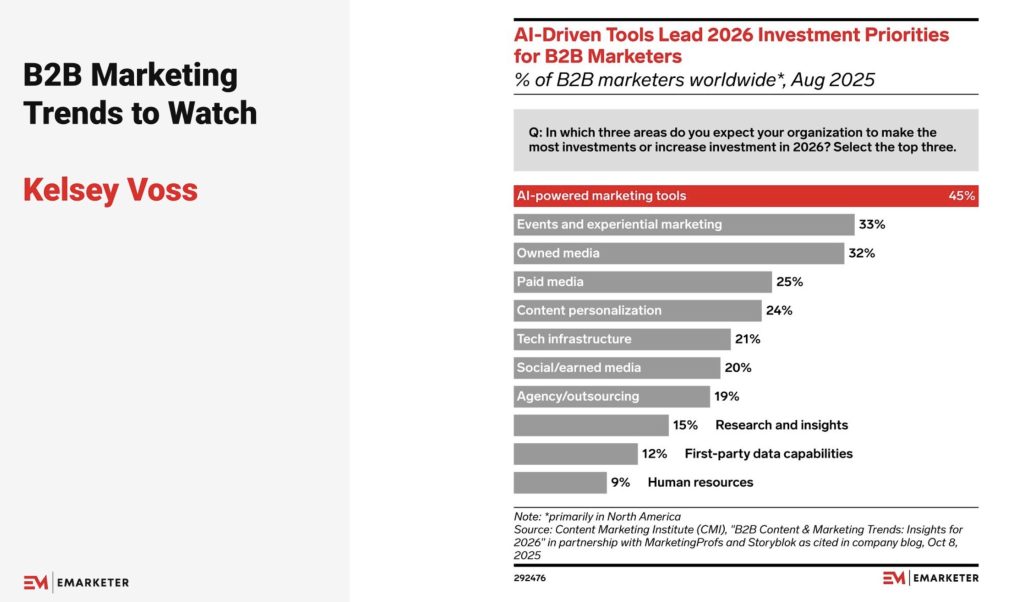
More: “AI-Driven Tools Lead 2026 Investment Priorities for B2B Marketers” (% of B2B marketers worldwide, Aug 2025) – eMarketer
STARTUPS
Rubicon Project founder returns
It’s not ads, yet, but Rubicon Project co-founder and former CEO Frank Addante announced that he’s re-entering the world of startups.
He wrote on LinkedIn last Wednesday:
“I’m happy to share that I started a new company as Founder & Chief Human at Hello Haven AI! Your Personal AI Operating System – your own personal AI that gets to know you, keeps your data private and integrates 300+ AI technologies – and picks the best one for each job. Why just use one AI when you can use them all?…”
Read more on LinkedIn. (December 24)
From tipsheet: Personal workflow optimization. Surely with all that potential for data collection there is an ads future here?
MORE
- The Great Targeting Takeback: Why PMax and Advantage+ Are Brilliant Strategy (December 24) – Henry Innis on Substack
- Inside CloudX’s $30M Bet on Agentic AI for Mobile Monetization (December 23) – Games Forum
- Rembrand’s CEO wants to grow virtual ad placements in streaming, and he’s looking elsewhere for models (December 24) – Digiday
- “Why Everything is Television — A Theory of Media in the Age of Algorithms” (December 27) – Andrew Lipsman’s Media, Ads + Commerce newsletter
- How APIs Unlock Better Insights Into AI Search Visibility – Nick Clark on gumshoe[dot]ai blog