
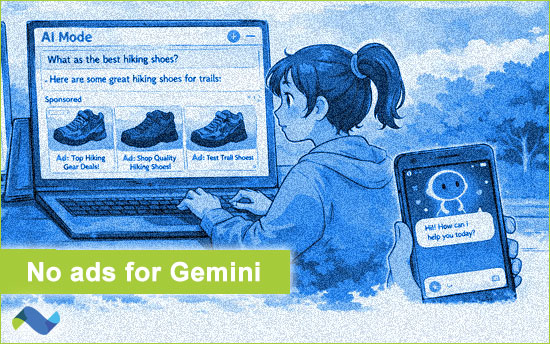
Google VP of global ads Dan Taylor spoke to Business Insider about recent tests for ads in AI placements such as Google Search’s “AI Mode” and “AI Overviews.”
But what about “ads in a chatbot” and ads for Google’s Gemini chatbot?
Business Insider’s Lara O’Reilly reported:
“With Google’s Gemini surging in popularity, speculation has been bubbling in the ad industry that the app might be on the cusp of introducing ads to capitalize on the moment — and help offset the hefty AI infrastructure costs.
Not so, according to Google’s VP of global ads, Dan Taylor. In an interview with Business Insider this week, Taylor reaffirmed there are ‘no plans for ads in the Gemini app.’’
Instead, the ads team is prioritizing ad placements within AI search. (…)
‘Search and Gemini are complementary tools with different roles,’ Taylor said.”
Read more on BI. (January 14)
Reading between the lines
On LinkedIn, Mobile Dev Memo analyst Eric Seufert observed about the BI article:
“I’d go further and propose that Google withholding ads from the Gemini chatbot creates a war of attrition enabled by consumer expectations and capital asymmetry. Google can afford to sustain losses indefinitely with the Gemini chatbot, and it’s already monetizing the model in its most prominent consumer surface area. Why insert ads?
As Ben Thompson recently pointed out on TBPN, the ad-free version of Gemini is an effortless substitute for ChatGPT, imposing very low / no switching costs on users.”
Read more on LinkedIn. (January 15)
From tipsheet: The longer OpenAI waits on launching an ad strategy, the more painful it gets for the company which will eventually need the revenue and margins to pay for its consumer-facing product.
LLMS & CHATBOTS
Developments
- OpenAI’s hidden ChatGPT Translate tool takes on Google Translate (January 15) – Bleeping Computer
- Anthropic’s Claude Cowork Is an AI Agent That Actually Works (January 15) – Wired (subscription)
- Airbnb Names Meta’s Head of Generative AI, Ahmad Al-Dahle, as CTO (January 15) – Bloomberg (subscription)
TECH
IAB framework aims at synthetic humans
Industry trade group IAB launched its “AI Transparency and Disclosure Framework” (IAB login required) yesterday in an effort to get in front of concerns around “AI slop” and AI-generated humans used in advertising, in particular.
David Cohen, CEO, IAB said in a release, “We are certainly at a critical inflection point with generative AI. While AI is transforming how we work from ideation to execution and measurement, we must get transparency and disclosure right, or we risk losing the trust that underpins the entire value exchange. We’re giving the ecosystem tools it needs to drive responsible innovation.”
The new framework attempts to walk the line between labeling everything that uses AI and potentially misleading consumers with humans-that-are-not-humans which the IAB calls “synthetic humans.”
The IAB suggests two overarching themes for proper disclosure – one for consumers, one for machines:
From the release:
“Consumer-facing disclosures, with standardized text labels or visual cues like visual indicators (watermarks, badges, or standardized icons), interactive elements (tap/hover information icons), and adjacent placement (disclosure placed next to rather than on the creative asset)
Machine-readable metadata (C2PA protocols) for technical compliance, combined with advertiser-led decisions on consumer-facing disclosure…”
Read: “IAB Releases Industry’s First AI Transparency and Disclosure Framework to Guide Responsible Advertising in a Generative-AI Landscape” (January 15) – IAB
The Study
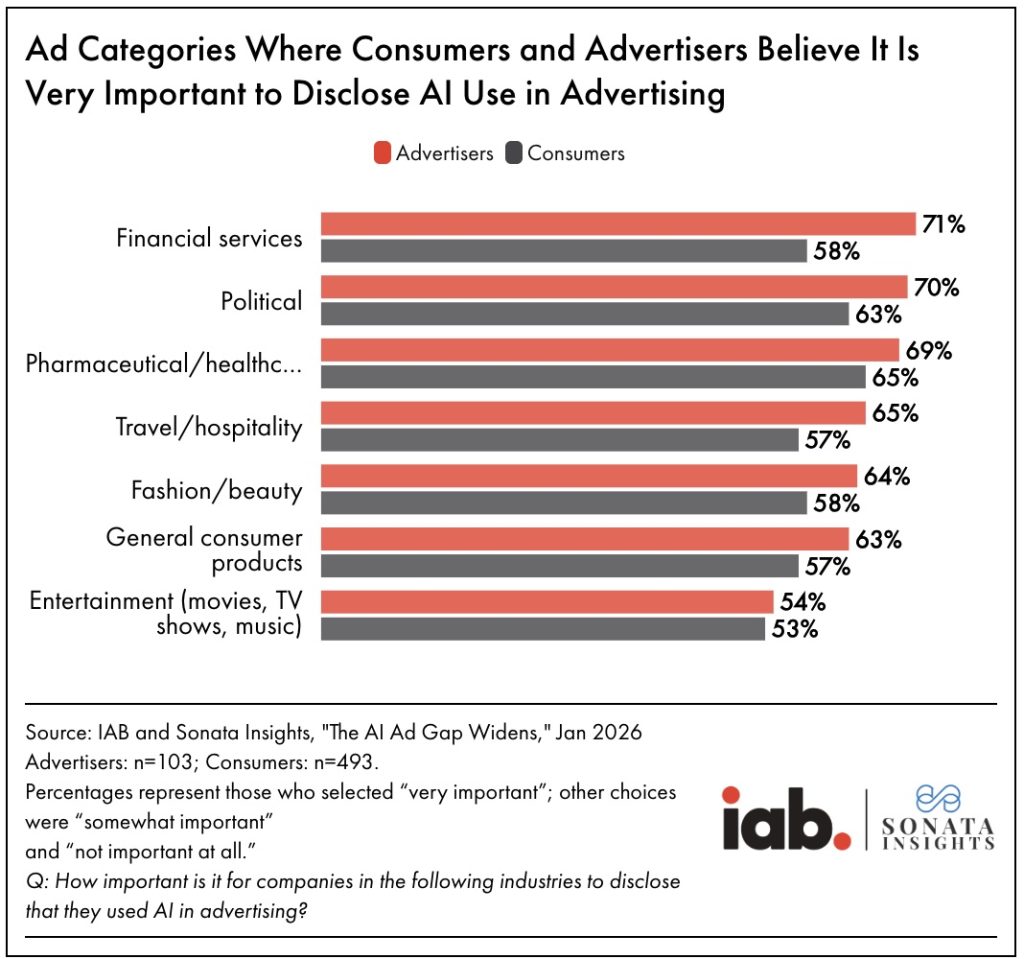
In parallel to the framework proposal, IAB VP, AI and Marketing Innovation, Caroline Giegerich, IAB SVP of Research Jack Koch and Sonata Insights’ Debra Aho Williamson created a study among Gen Z (16-27) and Millennial (28-43) consumers which, at a high level, supported why disclosure of AI used in advertising is a good idea.
Titled, “The AI Ad Gap Widens: Consumer Skepticism Persists as AI Advertising Expands—But Disclosure Can Close the Gap”, the study showed that across every vertical more than half of consumers believed disclosure was “very important”.
Read more on IAB’s website. (January 15)
From tipsheet: No doubt AI disclosure makes sense in these early AI days especially as consumers become accustomed to its integration into daily human life. There is a responsibility of industry — particularly the tech industry — to make clear the human benefits of AI.
But, because easily-created “synthetic” humans are a recent phenomenon, it seems fair to wonder about the long term and if this is something with which consumers will become accustomed.
After all, in a few years, the AI-enabled machine will “naturally” communicate with us more and more. That robot doing your vacuuming is asking for a new bag, by the way.
At some point, do consumers begin to assume that potentially all media may be manipulated by AI and the AI disclosure goes away like a GDPR pop-up?
LLMs & CHATBOTS
Yahoo DSP’s “agentic world” strategy
Yesterday, Digiday explored the adoption of Large Language Models (LLMs) by Yahoo DSP and found the ad tech company is empowering their demand-side platform with “a data backbone for the agentic world.”
Digiday’s Seb Joseph wrote:
“Yahoo DSP, for instance, is welcoming LLMs into the orchestration layers and interfaces of its platform while keeping the core bidder rooted in deterministic bidding logic. LLMs may drive dashboards and workflows. They are not being positioned as the engine that decides what to buy, when to buy it or how much to pay.
‘Nothing that we’re doing at the moment would suggest that agentic or an LLM will take the place of bidding logic,’ Adam Roodman, gm of Yahoo DSP explained. ‘I mean there could be parts of it eventually but at its core it will still be machine learning.”
Read: “‘We don’t care if you don’t use our UX anymore’: Yahoo recasts its DSP as a data backbone for the agentic world” (January 15) – Digiday (subscription)
From tipsheet: Trend: ad tech in a chatbot.
VENTURE CAPITAL
Compressing and monetizing the open web
New Enterprise Associates (NEA) venture capital partners Mason Murray and Danielle Lay delivered the first in a promised series of posts on their firm’s blog yesterday called “Monetization of the AI Internet.”
NEA believes that advertising is about to experience a proverbial seismic shift with agents at the center of the transformation.
The duo conclude Part I:
“The internet is reorganizing around AI, compressing the open web, and concentrating attention around a smaller set of high-signal surfaces. Advertising is just the first of many systems that are destined to change. Ad creative, targeting, and delivery are collapsing into a single real-time loop, and a wide variety of fast-moving startups are being purpose-built for this shift.
We focused this post on the human-facing layer of internet monetization because it’s where founders are shipping today and where customers are scaling spend fastest. But a second layer is emerging beneath: a machine-readable internet where agents will transact on our behalf. Its economics won’t look like the ad-dominated Web 1.0 or Web 2.0, and its infrastructure is still materializing. In our next post, we’ll explore the emerging agent-to-agent layer, and why it may represent the largest greenfield opportunity yet.”
Read: Monetization of the AI Internet (January 15) – NEA
OpenAds CEO Steven Liss further distilled the post on LinkedIn (January 15):
“The Future:
• New attention surfaces (AI chat/search) are competing with the old. The 3rd wave of digital advertising (after desktop and mobile) breaks out if attention moves to a net-new interface (gaming, AR, voice, wearables, Waymos auctioning your suggested route between Lowes vs Home Depot…)
• The proliferation of AI is an explosion of non-human attention. AI SEO and pay-per-scrape are early attempts to monetize it. Agentic commerce is the next. Look to this space for an enormous, unintuitive market.”
From tipsheet: Venture capital opinions can create “eye rolls.” But, NEA’s opinion likely speaks to the tipsheet[dot]ai choir.
TECH
JWX adds GenAI video creation platform
Sell-side video monetization platform JWX (formerly “JWP Connatix” up until December) announced it was beefing up the video content creation side of the business with the acquisition of Aug X Labs yesterday.
The startup’s product — Augie Studio — says it provides an “all-in-one AI-assisted Commercial Video Studio” on its website.
Terms of the deal were not disclosed.
A press release explained:
“Augie Studio will now be incorporated into JWX Studio, adding an LLM-powered content transformation layer to an existing product suite that helps publishers extend the value of their content while improving operational efficiency across teams…”
According to JWX, Aug X Labs founder Jeremy Toeman will be JWX’s SVP of AI Innovation where he’ll “spearhead JWX Studio’s production services team and AI-first products.” Augie X Labs entire 6-member team will join JWX.
JWX CEO John Nardone said of the acquisition on LinkedIn:
“…Augie is our first big move to pay off our multi-channel vision. And there is more to come. A deep pipeline of new products and capabilities are coming to market….so stay tuned!”
Read more on LinkedIn. (January 15)
Related: Mr. Toeman also runs the “Founder@50” podcast through Substack. See a recent episode with Sonata Insights analyst Debra Aho Williamson.
From tipsheet: The acquisition continues a trend in the advertising technology industry of offering video creation tools or capabilities (especially for SMBs) – and in this case, the publisher. Adding the AI “content transformation” capabilities speaks to the need for quickly making content work in any format in the age of AI. For JWX, this meshes with their StudioDRM product which provides digital rights management for video.
SELL-SIDE
Cloudflare acquires AI licensing solution
Content delivery network Cloudflare acquired Human Native, a UK-based startup which has developed an AI data marketplace for publisher creator content across text, audio and video to AI developers.
Read: “Cloudflare Strengthens Content Offering to AI Companies with Acquisition of Human Native” (January 15) – press release
On Cloudflare’s blog, company executives zoomed out to explain the acquisition’s ramifications for content creator compensation in the age of AI:
“Cloudflare is investing heavily in creating the foundations for these new business models, starting with x402.
We recently announced that we are creating the x402 Foundation, in partnership with Coinbase, to enable machine-to-machine transactions for digital resources.
Payments on the web have historically been designed for humans. We browse a merchant’s website, show intent by adding items to a cart, and confirm our intent to purchase by putting in our credit card information and clicking ‘Pay.’ But what if you want to enable direct transactions between automated systems? We need protocols to allow machine-to-machine transactions.
Together, Human Native and Cloudflare will accelerate our work in building the basis of these new economic models for the Internet…”
Read more on Cloudflare’s blog. (January 15)
Human Native co-founder and CEO James Smith was explicit on his startup’s purpose on LinkedIn yesterday: “When we started Human Native, our goal was clear: get Generative AI out of its ‘Napster era’. We believed that for the web to thrive in the age of AI, creators must have control, credit, and fair compensation for their work.” Read more.
From tipsheet: Cloudflare CEO Matthew Prince spoke of the opportunity to corral AI bots into a business model on behalf of his publisher clients last summer. It appears the Cloudflare content marketplace built for AI crawlers is a step closer with the Human Native purchase.
PEOPLE MOVES
Perplexity’s ad man reappears
Taz Patel, who briefly led advertising initiatives at AI chatbot company Perplexity, has taken a new role at AI video startup Higgsfield. He said on LinkedIn:
“I’m stoked to announce that I’m joining Higgsfield AI as Vice President of Platform Partnerships, working alongside Alex Mashrabov and the team to scale globally.
Looking forward to engaging with ecosystem partners and platforms that are looking to produce high-quality content through cutting-edge AI tools.”
Read more. (January 14)
Adweek’s Trishla Ostwal spoke to Mr. Patel and explained:
“While Higgsfield is being used by enterprise-level agencies and brands on a self-serve business, ‘we’re just not engaging them yet’ on a deeper level, Patel said.
As marketers increasingly test AI-generated video—often quietly and without standardized processes—Higgsfield is betting that the next phase of growth will come not from novelty, but from structure.”
Read: Former Perplexity Ad Exec Taz Patel Joins AI Video Startup (January 15) – Adweek (subscription)
TECH
Lawsuit over Google’s AI training
Copyright owners continue to make their case to the courts in an effort to stem what they see as stealing by tech companies who are training their AI models on their content.
A lawsuit involving a group of visual artists who “sued Google for allegedly misusing their work to train an AI-powered image generator” was joined yesterday by publishers Hachette Book Group and Cengage Group.
Reuters reported:
“‘[Publishers Hachette Book Group and Cengage Group] said in their proposed complaint that the tech company engaged in one of the most prolific infringements of copyrighted materials in history’ to build its AI capabilities, copying content from Hachette books and Cengage textbooks without permission.”
Read more from Reuters on US News. (January 15)
More: Class Action complaint filed on January 15 – Thomson Reuters (PDF)
Related: Will Google Ever Have to Pay for Its Sins? (January 15) – The Atlantic
From tipsheet: Earlier this week, a Google lawyer joined a UK government committee hearing on AI and copyright and defended the company’s position.
Court systems and governments are just getting started when it comes to AI.
PEOPLE
John Gentry, CEO, OpenX
-
“Today we lost a dear friend and industry leader, John Gentry. John passed away last night surrounded by family after a long and courageous battle with cancer..” (January 15) – Jason Fairchild, CEO, tvScientific on LinkedIn
MORE
- “Notes From a 20-Year CEO, One Year Post-Acquisition by Publicis” (January 15) – Andy Monfried (founder and CEO of Lotame) on LinkedIn
- “PayPal Responds to Honey Stand-Down Allegations and Rakuten Advertising Removal” (January 15) – Hello Partner on LinkedIn
- The top 5 AI marketing activations to know about right now (January 15) – Ad Age
- “Click Happens and Then What? How Ad Quality Impacts Churn” (January 15) – Game Biz Consulting on LinkedIn
- Attain Advances the Outcomes Era Across Every Channel and the Entire Funnel (January 15) – press release