
On an episode of Mobile Dev Memo podcast titled, “Are Chatbots driving eCommerce sales?”, analyst Eric Seufert quizzes FERMÀT Commerce CEO and co-founder Rishabh Jain about chatbots’ impact on eCommerce as well as the road ahead. Mr. Jain should know given his popular startup’s advertising optimization platform.
The insights across answer engine optimization (AEO) — or generative engine optimization (GEO) — are non-stop. The episode took place right after this past Black Friday and before OpenAI’s “code red” announcement.
A few “hot takes” from Mr. Jain (lightly edited):
2026: “There’s not a brand that we talk to who does not have in 2026 a plan to show up more in AI Search. What does that mean? I think people are still not clear on what that actually means to show up more because how you measure it and what actions you take are still being formulated. So that part of it is still not well-known. But right now, every brand has an initiative to show up more in AI Search next year.”
On AEO optimization clients: “It’s only the larger brands who are trying to have a strategy in AI search, at least from what we are seeing.”
How AEO is different from SEO: “The one big nuance is that it appears ‘grey hat’ and ‘black hat’ tactics do not work for AEO. Putting random words in the code text or buying reviews and things like this —those seem to be less effective, probably because an LLM is trying to reconcile any piece of content with whatever else it sees on the internet. The more ‘grey hat’ or ‘black hat’ your tactic is, the less likely it is to show up in the LLM because the LLM is actually synthesizing. And one of the parts of synthesizing, which LLMs do, is that it is checking whether or not it’s showing up in other places. And so you have to do more pure white hat things than in the traditional SEO world.”
Both Jain and Seufert were clearly optimistic about ads surviving in the retail chatbot environment — especially as it related to Amazon — if only because consumers are already used to it.
Mr. Jain said (lightly edited):
Commerce media: “… I think that if the AI engine is giving a recommendation that’s different from the ad system — I think we’re used to that. At some point, the difference is big enough that the people who are not being recommended don’t have the economics to purchase the ad spot.
And so these things are self-correcting in some ways. You know, like on Amazon, it’s rare that the top sponsored ad is past the first page organically, too. And it’s just because the economics self-fulfill…”
Hear more on Mobile Dev Memo and read the transcript. (December 2 – free content)
From tipsheet: Also, if you believe Messrs. Jain and Seufert, UTM’s will become the ad tech industry’s next obsession with huge implications for programmatic. Goodbye, cookies. The UTM, or click ID as it is also known, will be the new privacy-safe vessel for ad targeting.
Related: Does Apple police fingerprinting? (December 3) – Eric Seufert on Mobile Dev Memo (subscription)
COMMERCE MEDIA
AEO for Rufus
Much of the answer engine optimization (AEO) discussion today centers around OpenAI’s ChatGPT —and then Google’s version of chatbots (AI Overviews, AI Mode, Gemini).
But what about the chatbots within the mega-retail aggregators such as Rufus on Amazon or Sparky on Walmart?
In the aforementioned podcast, Eric Seufert quoted Amazon CEO Andy Jassy who said on a recent quarterly earnings call that his company was on pace to drive $10 billion in incremental revenue due to Rufus. Mr. Jain concurred that Rufus and Sparky had driven significant purchasing according to his company’s most recent Black Friday results.
So, how do you optimize for Rufus if you’re a brand? Short answer: it’s not yet clear.
Jain and Seufert didn’t directly answer the Rufus question in the podcast, but they did leave a few bread crumbs —which may be most relevant for ChatGPT AEO (lightly edited):
Content on retailer domains: “It appears retailer domains right now are very authoritative with LLMs for commerce brands.
So if you’re a brand and you work with a retailer, one of the main places I would try to get the content published is on the retailer’s domain in addition to your own domain. And that ends up being very effective.”
Content in traditional media: “Traditional media sources are still ranked highly because the LLM is trying to mimic how a human would do the search.”
Use PR: “Brands can publish on their own blogs. There’s a lot of brand-retailer relationships where the brand is allowed to publish directly onto the retailer’s blog. That’s where the PR side of it comes in, where you want to get it published in other journals, if you can get it picked up. That’s where all of the work is in terms of the tactics and investment that we’re seeing for 2026 planning.”
Price matters in chatbot rankings: “Keep in mind is that the chatbot/LLM over rotates (compensates) on price.”
From tipsheet: Rufus, Sparky and their ilk will undoubtedly become DTC brands’ new obsession in 2026. How you optimize an Amazon or Walmart product feed will probably be part of AEO optimization company pitches of the future, too.
Could Amazon or Walmart “spark up” an enhanced publishing (content marketing) environment for brands to promote their products at some point? Just a thought.
Related: “As AI reshapes shopping, US retailers try to change how they’re seen online” (November 26) – Reuters (subscription)
LLMS & CHATBOTS
Developments
- Episode 11: Shaping Model Behavior in 5.1 (December 2) – OpenAI on Apple Podcasts
- HSBC and Mistral AI join forces to accelerate AI adoption across global bank (December 2) – HSBC
- “While onstage at @andrewrsorkin‘s DealBook Summit just now, Anthropic CEO Dario Amodei says the company will ‘land somewhere between 8 and 10’ billion in revenue this year” (December 3) – Alex Heath, Sources on X
CREATIVE
Reels gets reviewed by Meta
With Meta’s Reels product a key outlet for ads within Meta’s automated ad system, Advantage+, the company promoted 2024 data on Tuesday which showed Instagram Reels’ power.
(OpenAI CEO Sam Altman specifically mentioned his appreciation of Instagram ads in October.)
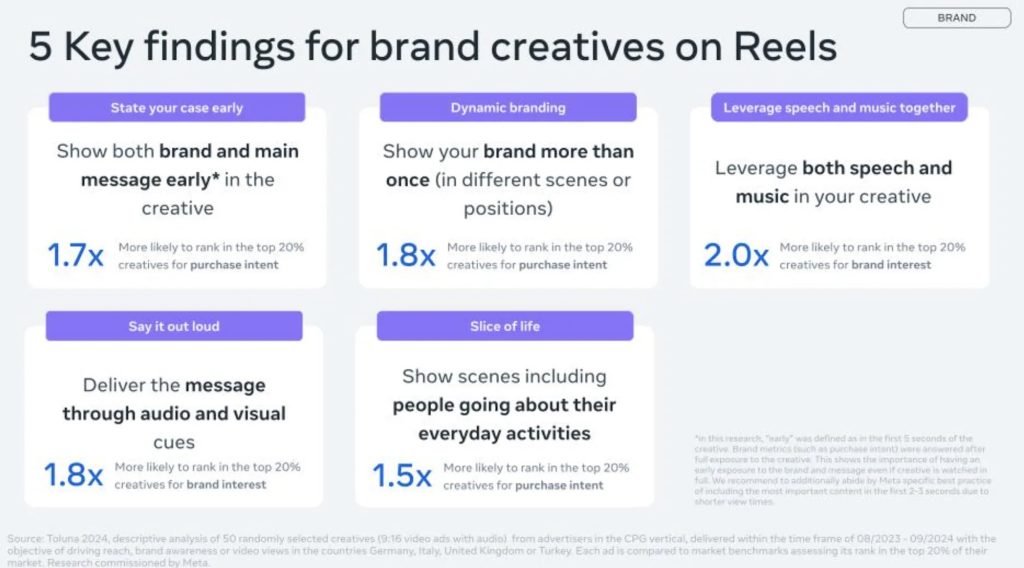
Read: “Best Practices: Deconstructing the Power of Reels: How Creative Strategies Can Drive Success” (December 2) – Meta
From tipsheet: How good is it at Meta? 2024 data — rather than something from this year — is good enough. Marketing, baby.
CONNECTED TV
Taboola and LG team on AI performance ads
According to Axios, Taboola is partnering with LG to provide AI-enabled performance advertising across the open web to LG’s connected TV advertisers.
Axios’ Sara Fischer reported:
“The companies will offer a new ‘Performance Enhancer’ tool to expand the ads and messages from LG’s connected TV (CTV) advertising partners to the inventory of Taboola’s existing publishing partners on the web and social media.
The tool will leverage Taboola’s Realize AI tech, which allows publishers to sell performance ads across the open web.”
Read more in Axios. (December 3)
In October, Taboola announced a similar deal with Paramount that enabled advertisers using Paramount’s self-service, ad-buying platform known as Paramount Ads Manager to buy across Taboola publishers.
More: LG Ad Solutions and Taboola Partner to Bring TV-Driven Performance to the Open Web – Taboola (December 3)
From tipsheet: Offering reach extension to CTV advertisers is a way for ad tech firms to enter into the growing demand of the CTV market.
BRANDS
AI helping with longer consideration
“[Gartner analyst Kassi Socha] said Guitar Center’s AI tools show the technology is working its way beyond apparel, shoes and fashion brands. While brands like Sephora and Zara have used recommendation tools in stores for years, Socha said brands with products that require more consideration have moved slower before adopting technology or trends to make sure the experiences are the right fit. Those include brands that sell musical instruments, cars or mattresses.
(…) Socha said, ‘There are some things that not every human can be an expert in, like pitch or tone, where a tool can become an expert.’”
Read: AI is permeating everything we do’: How Guitar Center developed 2 AI tools this year – Modern Retail (December 2)
From tipsheet: Imagine the implications in advertising with AI and longer consideration cycles such as buying a new car.
How do you stay top of mind over 5-10 years with the consumer? This would also appear to be a job well-suited for AI and automation.
SELL-SIDE
Microsoft’s AI OS for publishers
Microsoft VP of AI Nikhil Kolar announced on LinkedIn yesterday that he is heading up a new effort to create an “AI OS” after speaking with publishers over the past year.
Mr. Kolar’s new role doesn’t sound like a content marketplace exclusively (which was leaked in September), but it is sell-side focused.
He explained on LinkedIn
“My focus in this new role will be to build the AI Operating System for digital businesses of all kinds. Unifying products and services from Microsoft AI and Microsoft Azure (Lydia Smyers Silvia Candiani), and our emerging agentic ecosystem into one coherent partner experience.
Although this role was shaped by publisher feedback, the mission is far broader.
Any digital business — a publisher, a commerce site, a marketplace, a brand, a mobile app, or anyone building an agentic experience — can benefit from this work.
The simple version: Help digital businesses drive durable, sustainable growth in the human and agentic web with Microsoft.
It’s early days, and I’m in listening mode.”
Read more from Mr. Kolar on LinkedIn. (December 3)
From tipsheet: This effort likely dovetails with the announcement last month of Windows OS’ agentic strategy and continued integration of its AI-enabled Copilot chatbot. Read more in The Verge. (November 18)
PLATFORMS
The Trade Desk machinations
Demand-side platform (DSP) The Trade Desk may be aggressively battling for clients with its AI-enabled Kokai ad system. Digiday reported yesterday that the company’s pricing has become negotiable.
Digiday quoted an anonymous source:
“‘It’s the first time I’ve seen The Trade Desk actually be willing to negotiate rates,’ said the programmatic lead, who spoke on the condition of anonymity, as did all the buying execs contacted for this story. ‘We’ve had the same rates for several years. Now, they’re willing to negotiate and give us some incentives.’”
Read more on Digiday. (December 3 – subscription)
Related: The Trade Desk Loses Jud Spencer, Its Longtime Engineering Lead – AdExchanger
PLATFORMS
Criteo all-in on agentic commerce
Criteo’s Michael Komasinski reviewed his first year as CEO of the commerce media platform with Digiday’s Ronan Shields.
Mr. Komasinski said his company has fully embraced an “agentic commerce” strategy which he defines as continuing to integrate the power of the latest Large Language Models (LLMs) with Criteo’s AI-powered tools which, in turn, can help retailers deliver everything from product recommendations to serving ads.
A new AI-powered self-serve advertising platform is in the works for Q1 2026. The platform builds upon the company’s existing Commerce Go automated ads system which was rolled out in Q4 2024.
Finally, according to Digiday’s Shields on LinkedIn, Komasinski said regarding Criteo M&A rumors, “We’re not in a process of any kind today”.
Read: “Criteo CEO Michael Komasinski on agentic commerce, experiments with LLMs, and M&A rumors” (December 3) – Digiday
From tipsheet: At the end of October, Criteo began the process of re-domiciling to Luxembourg (from France) in an effort to be listed as “ordinary shares” on NASDAQ rather than its existing American Depositary Shares (ADS) classification. Read the release. (October 29)
In short, with the access to the U.S. markets that this move could unlock, it gives the appearance that Criteo is thinking long-term rather than short-term (i.e. getting acquired, M&A, etc.).
PLATFORMS
QOTD: Advertising’s “AI Mission”
“The best AI does not need a manual. It needs a mission.”
(See Mr. Zimmerman’s “lesson”.)
“This lesson applies directly to advertising. AI given clear success metrics and the freedom to explore, will consistently outperform rigid rule based systems. The key is to tell the system exactly what success looks like, and then let AI discover the best path to achieve it.”
BRANDS
Moving from efficiency to growth with AI
Looking over the past year, MarTech managing editor Constantine von Hoffman shared his “five key changes in how AI agents are being used and understood across the marketing landscape“ yesterday.
With a focus on marketers, he began:
“From efficiency to growth: Last year, most marketers focused on squeezing more out of their teams and tools. That made sense — AI was new, and the easiest wins were around productivity. Tools for content ideation (used by 69%) and copywriting (62%) were among the most common applications. Today, the bar is higher. Efficiency is taken for granted.
Now the focus is on growth — using AI to drive innovation, unlock new revenue streams and create differentiation. Instead of “do more with less,” it’s “do more with more.” As the 2026 report puts it: “More is not better — better is better.” In other words, it’s not about how much AI you use — it’s about what you do with it.”
Read all five changes on MarTech. (December 3)
And, get MarTech’s 2026 report. (PII required)
MORE
- Treasure Data Expands Access To Its AI Marketing Cloud Through AWS Marketplace (December 2) – press release
- Study: Google’s AI Mode May Kill Traffic For Facts—But Not For Businesses – Frank Olivo of marketing consultancy Sagapixel
- Vaudit Surpasses $1 Billion in Digital Ads Audited in 2025 and $100 Million in Refunds Processed for Global Brands (December 3) – press release
- Need for Speed in AI Sales: AI Doesn’t Just Change What You Sell. It Also Changes How You Sell It. (November 21) – a16z
- Bombora Audiences Now Available on Reddit to Reach B2B Buyers at Scale (December 3) – press release