
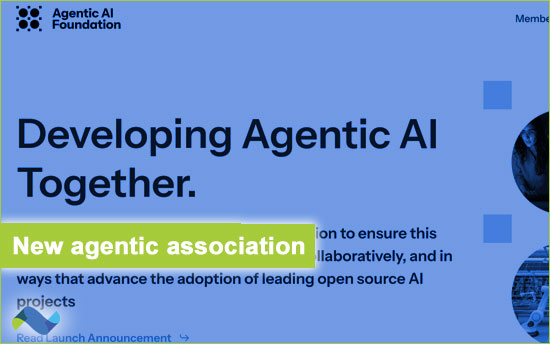
In an announcement yesterday, Anthropic, OpenAI, AWS, Block, Google, Microsoft and Cloudflare — as well as many others — said they will work on open source AI standards (such as MCP) as part of the “Agentic AI Foundation.”
Notably, Bloomberg is a part of the founding AAIF core, and Meta is not a member yet.
Read:
- Linux Foundation Announces the Formation of the Agentic AI Foundation (AAIF), Anchored by New Project Contributions Including Model Context Protocol (MCP), goose and AGENTS[dot]md (December 9) – AAIF.io
- Also read Anthropic and OpenAI.
The Information’s Aaron Holmes broke the news and explained on LinkedIn:
“The idea is similar to how the world’s banks have standardized interbank electronic payments. For AI agents to work properly in automating white-collar tasks, the companies developing the agents and the companies running the enterprise apps those agents use will need to agree on technical standards for how these technologies connect to each other.”
Read more on LinkedIn. (December 9)
From tipsheet: Ad tech and marketing technology companies are absent from the AAIF’s membership list (see it) other than most of the walled gardens.
Agentic advertising protocol efforts are already underway with the Agentic RTB Framework (ARTF) and Ad Context Protocol (AdCP).
LLMS & CHATBOTS
Developments
- Sensor Tower: ChatGPT Nears 900 Million Weekly Active Users But Gemini is Catching Up – The Information (subscription)
- Mistral AI surfs vibe-coding tailwinds with new coding models (December 9) – TechCrunch
- Meta’s shifting AI strategy is now focused on Avocado rather than Llama (December 9) – CNBC
PLATFORMS
Streamlining data management and AI
Better data in, better results (and measurement) out.
With that in mind in the age of AI, Google senior director of product management, Kamal Janardhan, announced her company’s new Data Manager API yesterday:
“To make it simpler for marketers to connect first-party data with Google’s advertising tools, we’re introducing the Data Manager API. The new tool helps developers, agencies and advertisers build even more custom and automated connections with Google Ads.
Instead of managing multiple APIs across Google platforms, the Data Manager API creates one centralized, secure connection so advertisers can easily get the most out of Google AI for their campaigns…”
Read more on the Google Ads & Commerce blog. (December 9)
Data Manager API is available today for “Google Ads, Google Analytics and Display & Video 360, with more integrations coming soon.”
From tipsheet: A Google spokesperson answered a couple of questions from tipsheet.
On Data Manager API and clean rooms:
“…this is not a clean room solution and currently does not integrate with Google’s clean room, Ads Data Hub. That said, Google Ads Data Manager leverages Confidential Matching, a privacy enhancing technology that uses Trusted Execution Environments (TEEs) to further protect customer’s data and adds another layer of privacy and security. Put simply, customers using the API have the option to encrypt their data before it ever leaves their server.”
On Data Manager API and Google’s AI-enabled Performance Max and AI Max:
“…it’s available for Google Ads and all campaign types within, including Performance Max and AI Max. The way these campaigns perform and optimize is defined by the data that customers bring in – which is now streamlined through the Data Manager API.”
More: Google gives agencies access to data manager for AI ad targeting tools (December 9) – Ad Age (subscription)
SELL-SIDE
The chatbot and the programmatic ad network
Joining solutions such as Taboola’s DeeperDive and Dappier, sell-side platform (SSP) PubMatic announced a new ads-in-a-chatbot integration with startup Kontext, which is growing its own network of AI-enabled chatbots with ad placements.
PubMatic touts this as “programmatic access to AI-powered conversational inventory.” See LinkedIn.
Even though PubMatic is originally known as an SSP, the new product is about enabling the buy-side — through its Activate platform. AdWeek’s Kendra Barnett reported:
“Starting today, this capability will be folded into PubMatic’s platform to help advertisers place ads in consumer AI interfaces using familiar programmatic workflows. Within PubMatic’s SSP, or the DSP of their choice, advertisers can select the chatbots they would like to appear in from a list of available partners.”
Read more in Adweek. (December 9)
From tipsheet: If you check out Kontext’s home page, you may feel transported back to pre-programmatic days when ad networks flourished.
See Kontext’s advertiser and publisher pitches.
This is emblematic of the race among some ad tech firms as they try to become the de facto manager of chatbots for publishers while corralling demand from advertisers looking for chatbot placements.
Will SSPs transform into chatbot placement aggregators? If publishers embrace hosting bespoke chatbots on their own sites, why not? The combined scale could be attractive to advertisers.
Also, this PubMatic-Kontext deal combines both audience-based buying using a “User ID” along with contextual, answer-level targeting.
OpenAI might say ads and user targeting threaten user trust in the chatbot. But, are you sure about that, OpenAI? The open web and, probably, Google are in the process of finding out.
See Kontext Docs about User IDs and retargeting.
Also: Kontext receives funding (August 5) – Andrej Kiska, CEO, Kontext on LinkedIn
PLATFORMS
PE firm bets on AI-enabled ad tech
Yesterday, TV advertising platform Cadent acquired VuePlanner, a YouTube video advertising and planning platform, for an undisclosed sum.
Cadent made its case for the tuck-in acquisition in a release, “With over 62% of US internet users using YouTube daily, Cadent clients will now have access to one of the biggest ad ecosystems on the market, seamlessly integrating YouTube budget and activations into one total strategy.”
Read more. (December 9)
For private equity firm Novacap, Cadent’s owner, this is another acquisition in the ad tech space.
In September, the Canadian PE firm acquired Integral Ad Science for $1.9 billion. Reuters reported at the time that “The deal, expected to close before the end of this year, is the latest in a string of private equity buyouts of software and technology companies as they bet on artificial intelligence to become a strong driver of growth.”
More: “Cadent Acquires YouTube Advertising Company VuePlanner” (December 9) – AdExchanger
From tipsheet: The bet by Novacap could be that ad tech incumbents will be transformed by AI and, post-AI-wave, incumbents who make it through to the other side, will win.
Novacap also appears to be focused on Connected TV (CTV) and video ads.
TECH
Podcast: The future of (ads) SaaS & AI
Early-stage investor Gavin Baker said on this week’s “Invest Like The Best” podcast that if you’re running a company with Software-as-a-Service (SaaS) tools, AI is going to bring you lower margins but higher profits —and eventually better margins.
But, there will be a transition which SaaS companies must weather first.
Baker told podcast host Patrick O’Shaughnessy:
“I think that applications SaaS companies are making the exact same mistake that brick and mortar retailers did with e-commerce. So brick and mortar retailers, — particularly after the telecom bubble crashed — they looked at Amazon and they said, ‘It’s losing money. E-commerce is going to be a low-margin business.’ (…) And so they did not invest in e-commerce — they clearly saw customer demand for it, but they did not like the margin structure of eCommerce.
(…)And now here we are and Amazon has higher margins in their North American retail business than a lot of retailers that are mass market retailers. So margins can change.
And if there’s a fundamental transformative kind of new technology that customers are demanding, it’s always a mistake not to embrace it. And that’s exactly what the SaaS companies are doing. They have their 70-90% gross margins and they are reluctant to accept AI gross margins.
The very nature of SaaS is software you write once, very efficiently, and then you distribute it broadly at very low cost. And that’s why it was a great business. AI is the exact opposite where you have to recompute the answer every time.
And so a good AI company might have gross margins of 40%. The crazy thing is because of those efficiency gains, they’re generating cash way earlier than SaaS companies did historically, but they’re generating cash earlier, not because they have high gross margins, but because they have very few human employees.”
Hear more on the Apple Podcasts app. (December 9)
From tipsheet: Legacy advertising and marketing technology companies, whose underlying business model may be SaaS, are dealing with this transition today as Large Language Models (LLMs) enable new, more efficient structures.
MORE
- The case against AI agents for programmatic ad buying (December 9) – Digiday
- Commission opens investigation into possible anticompetitive conduct by Google in the use of online content for AI purposes (December 8) – European Commission
- Welcome to The AI Ad Economy (December 9) – Debra Aho Williamson on The AI Ad Economy
- Opinion: From Chaos to Control: Orchestrating AI Across Enterprise Marketing – Bob Walczak, CEO, MadConnect on Marketing Profs
- “the much-awaited totally free 127-page ‘Martech for 2026’ report just dropped…” (December 9) – Martin Kihn, SVP, Salesforce on LinkedIn