
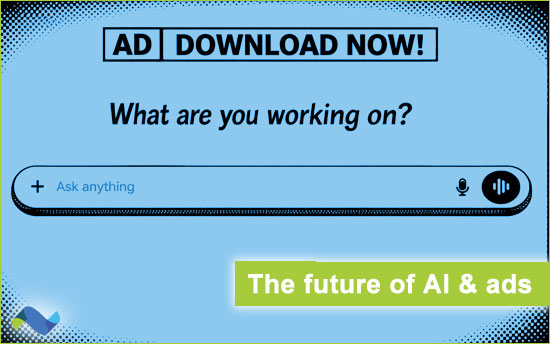
As part of its CES festivities, trade publication Adweek hosted agency leaders for a panel discussion on what the future holds for “ads in a chatbot” such as OpenAI’s ChatGPT.
Panelists included WPP Media’s Adam Gerhart, Horizon’s David Campanelli and Omnicom’s Megan Pagliuca.
Adweek’s Audrey Kemp reported:
“Taken together, the discussion offered an early picture of what ads in LLMs might look like: paid placements embedded directly within AI-generated answers; commerce links surfaced alongside recommendations; and prompts designed to guide next steps rather than send users elsewhere. In that world, advertising becomes less about banners or blue links, and more about influence inside the answer itself.”
Read more from Adweek. (January 7)
Related:
- The Trade Desk’s Jeff Green Says 2026 Will Be ‘The Best Year Yet’ for the Open Internet (January 7) – Adweek (subscription)
- Inside the Agentic Operating System Code and Theory is Teasing at CES (January 7) – Adweek
From tipsheet: Panelists’ suggested formats within chatbots may sound somewhat traditional, even boring, but where the “rubber meets the road” will be the performance. Does AI improve performance and by how much? Logically, it should.
Separately, ads may themselves become chatbots. Sounds like fraud-filled interactive ads from days of yore, I know. BUT, if you can improve communication with the consumer via an AI-enabled chatbot, why not serve an ad that is a chatbot? Especially if it was audio?
LLMs & CHATBOTS
Developments
- ChatGPT Health and what AI can do for a broken system (January 7) – OpenAI CEO of Applications Fidji Simo on Substack
- How Google Got Its Groove Back and Edged Ahead of OpenAI (January 6) – The Wall Street Journal (subscription)
- Anthropic reportedly raising $10B at $350B valuation (January 7) – TechCrunch
LLMS & CHATBOTS
OpenAI at Cannes in 2026
Imagine the sponsored yacht…
Digiday reporter Krystal Scanlon speculated yesterday that the inevitability of ads in OpenAI’s chatbot, ChatGPT, will soon drive the unthinkable: OpenAI at the Cannes Lions ad festival this year.
According to Scanlon:
“OpenAI’s executives are already debating whether to make the pilgrimage to Cannes Lions this year — a fitting metaphor for the company’s broader ambitions. The festival is where the ad industry goes to celebrate its ability to turn creativity into influence. And OpenAI, for all its Silicon Valley roots, is increasingly angling for a seat at that table.”
Read: “OpenAI’s countdown: monetization, ads, and a Google-shaped threat” (January 7) – Digiday (subscription)
From tipsheet: Pure-play AI companies seeing advertising opportunity by sponsoring and attending Cannes is a milestone to watch. I’d expect Anthropic there in stealth, at the least, as it “pans for gold,” i.e. B2B opportunity.
Meta, Google, and Amazon — even X — were all there last year, of course.
SELL-SIDE
AI enables contextual targeting in TV
In a CES “Leadership Roundtable” on Monday with executives from NBCUniversal, AWS, Adobe & WPP, AI’s intersection with media was at the top of the discussion list.
According to Deadline’s Dade Hayes, NBCUniversal EVP Kristina Shepard was already seeing impressive benefits for her company’s clients with AI tools:
“Buyers and sellers of ad time can now use AI ‘to get down, not just to a show or an episode, but to a scene level,’ Shepard said. ‘Contextual targeting in some regard has gotten a bad rap because it has seemed very basic, right? An advertiser would say, “I want to reach women 25 to 54, give me the top 100 shows.” Now, AI can allow us to actually identify scenes. For example, there might be an advertiser who wants to be the first ad in an ad pod right after a holiday kiss. How do we make that advertiser really, really relevant in that moment?’
AI can create ‘a great marriage between the viewer and the advertiser experience,” Shepard added. ‘We basically beta-tested this with a luxury brand, you know, doing contextual targeting in VOD content in 2026, you’ll see this in live’ at upcoming NBCU events like the Super Bowl and the Winter Olympics.’”
Read more on Deadline. (January 5)
More: Amazon Web Services GM Samira Bakhtiar lists more panel highlights on LinkedIn. (January 6)
From tipsheet: Understanding context is at the core of what makes Large Language Models (LLMs) so powerful. As a result, contextual targeting benefits.
PLATFORMS
Google’s new AI model flagging fraud
Google has revised an AI model which helps the company identify advertising fraud. Research discussing the new model was first published in April and then revised December 31.
The research: “ALF: Advertiser Large Foundation Model for Multi-Modal Advertiser Understanding” (Latest update – 2026) – Google Research
The Abstract from the paper:
“Our model achieves state-of-the-art performance on critical tasks including fraud detection, policy violation identification, and advertiser similarity matching. In production deployment, ALF reduces false positives by 90\% while maintaining 99.8\% precision on abuse detection tasks.”
Search Engine Journal’s Roger Montti reports on the “secret sauce” of the AI model:
“The model also uses a technique called ‘Inter-Sample Attention’ to improve its detection skills. Instead of analyzing a single advertiser in a vacuum, ALF looks at ‘large advertiser batches’ to compare their interactions against one another. This allows the AI to learn what normal activity looks like across the entire ecosystem and make it more accurate in spotting suspicious outliers that don’t fit into normal behavior.”
Read more on Search Engine Journal. (January 7)
From tipsheet: Another way of looking at the “secret sauce” might be from an advertising verification perspective. Brand-safe environments — i.e. environments of “normal activity” — are informing AI. This could be another layer for a content marketplace of the future.
AGENCIES
Havas integrating LLMs for workflow
At the Consumer Electronics Show (CES), Havas CEO Yannick Bolloré announced his agency holding company’s new AVA platform to improve agency workflow with AI.
With plans to begin rolling out AVA this spring, a press release explained its foundational elements:
“Designed to provide trusted access to insights, agents, and proprietary intelligence, it empowers teams to move faster from brief to breakthrough, while ensuring safety and compliance. By connecting users to top-tier models like GPT-5, Claude Opus 4.5, and Gemini 3, AVA supercharges creativity, strategy, and collaboration. This helps teams choose the ideal ‘partner’ for any task and unlock sharper insights, faster ideation, scalable solutions, and productivity at scale.”
Read the release. (January 7)
Also at CES, the company announced a partnership with Akkio which, it seems, will help Havas build its AI infrastructure.
More:
-
Havas partners with Akkio to accelerate agentic capabilities of the communication group’s Converged[dot]AI operating system (January 7) – Havas
Related: “For marketers, this isn’t about choosing between human creativity and AI capability. It’s about orchestrating both to create work that moves people and moves business.” (January 6) – Omnicom on LinkedIn
From tipsheet: In its race for clients with agency holding companies such as WPP and Publicis for “agency of the future”, Havas continues to push its “chips” into the middle of the proverbial AI “poker table.”
In 2025, the company has also touted its refreshed Converged[dot]ai platform as an AI marketing platform of the future (at Cannes) and extended its reach with a partnership on yet another AI platform — including a U.S. client arrangement — called BluConverged with indie agency Horizon (see Horizon Global) in late September.
Meanwhile, amidst the integrations and building, one has to wonder (marketing executive Barry Lowenthal is) if an inexpensive subscription to a chatbot such as Anthropic’s Claude becomes the most effective way to realize an AI marketing platform of the future.
SEARCH
AI taking over — or is Search holding up?
Depending on how you read it, a new study from SEO and pay-per-click marketing agency Eight Oh Two says that AI is gobbling up search — or search isn’t going away.
Search Engine Land breaks down the study and chooses to note AI chatbots’ search momentum:
“More than one-third of consumers (37%) said they begin their searches with AI tools rather than traditional search engines, according to the study. Instead of scanning ads and blue links, users want one clear answer they can act on right away.”
Read more in Search Engine Land. (January 7)
Study: 2026 AI & Search Behavior Study – Eight Oh Two (PII required)
From tipsheet: It’s all coming together: AI chatbot search and traditional search (i.e. Google Search). Even Google has brought AI Overviews and AI Mode to its traditional search box.
The implications would seem to mean that generative engine optimization (GEO/AEO) firms must learn SEO agency practices and vice versa.
PROTOCOLS
Tectonic shift vs. incremental building
On LinkedIn yesterday, Thomas From, chief product officer of Copenhagen-based ad platform Adnami, distilled what he sees as the current trends around development and governance of protocols in advertising.
“AdCP represents the ‘burn it all down’ philosophy. It is ambitious and bold. Within AdCP, there is an implicit belief that agentic trading is a new paradigm, a tectonic shift.
The IAB Tech Lab is more cautious. They are ramping up their investments in agentic development by building on top of the existing programmatic stack (see Tuesday’s press release). For the IAB, agentic trading is an incremental improvement, not a revolution.
In a space with significant scale and network effects, it is hard to cold-start new initiatives. The real challenge is not technology, it is adoption.
My bet is on incrementality.”
Read more on LinkedIn. (January 7)
From tipsheet: Nice analysis from Mr. From.
PEOPLE MOVES
Now hiring
- Angela Steele joins WPP Media as US Chief Client Officer (January 7) – Adweek
- Joe Ciarallo has joined Synthesia as Head of Communications, US (January 7) – LinkedIn
MORE
- “I put together a 2026 Agentic Commerce Audit Framework…” (January 7) – Ekapat Chareonlarp, SVP, Marketing, Criteo on LinkedIn
- Zeta Global and OpenAI Team Up to Deliver Answer-Driven Marketing with Athena by Zeta (January 5) – Zeta Global
- Why 2025 Marked The End Of The Data Clean Room Era (January 7) – AdExchanger
- AI-Powered Publishing Explained (January 7) – Mula sponsored post on Marketecture’s Ad Tech Explained
- Subjective Selects Samba TV Data to Power Actionable and Curated CTV Advertising (January 7) – press release