

LLMs & CHATBOTS
How do AI agents shop exactly?…
…that’s the subject of new research titled, “What Is Your AI Agent Buying? Evaluation, Implications and Emerging Questions for Agentic E-Commerce,” which provides observations on how agents will be influenced in the AI buying stream.
Authored by Custom AI team members—including former Meta AI researcher Amine Allouah—along with Columbia University students and faculty, the researchers share some findings on the paper’s landing page on arxiv[dot]org:
“[AI] Models show strong but heterogeneous position effects: all favor the top row, yet different models prefer different columns, undermining the assumption of a universal ‘top’ rank. They penalize sponsored tags and reward endorsements. Sensitivities to price, ratings, and reviews are directionally human-like but vary sharply in magnitude across models.”
The landing page for the report continues:
“Motivated by scenarios where sellers use AI agents to optimize product listings, we show that a seller-side agent that makes minor tweaks to product descriptions, targeting AI buyer preferences, can deliver substantial market-share gains if AI-mediated shopping dominates. We also find that modal product choices can differ across models and, in some cases, demand may concentrate on a few select products, raising competition questions. Together, our results illuminate how AI agents may behave in e-commerce settings and surface concrete seller strategy, platform design, and regulatory questions in an AI-mediated ecosystem.”
See the paper’s landing page on arxiv[dot]org.
From tipsheet: As noted on Friday by tipsheet, OpenAI may be thinking it’s avoiding a messy conflict of interest by turning to a revenue share on product sales and adopting an affiliate marketing strategy. But, as this paper shows, agents will “optimize” and it’s not always going to be in the user’s best interest. In fact, the AI agent may make a choice based on a better product description (as noted above) than product. There is no utopia—and that’s fine—which is why ads could make better sense for the answer engine given the transparency for the user in the choice they are making.
More: Ad industry executive Jay Friedman— who spotted this research yesterday— said about the report on LinkedIn (August 18):
“Most in retail media are focused on grinding out a few percentage points of additional growth or profit from their existing assets. The study shows that with the right optimization for AI shopper agents, there is 20% or more growth and efficiency to be had as agents come into use.
BRANDS
AI search has positive effect for retail
New data from SEMrush and Similarweb is saying that AI search – or answer engines such as ChatGPT – may be having positive effects on brand websites.
Ad Age’s Asa Hiken reported yesterday:
“Some retailers, including Zara and Macy’s, have seen visits to their websites rise despite fears that AI search from platforms such as Google, ChatGPT and Perplexity is squeezing internet traffic. Meanwhile, most sectors have only experienced minor fluctuations in web visits over the past year…”
Read more on Ad Age. (August 18 – subscription)
BRANDS
Curating the shopper using AI
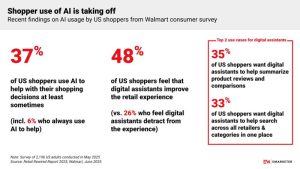
Yesterday, Vladimir Hanzlik, SVP of Content at eMarketer, gave a tip of the cap to Walmart and their recent consumer survey (May 2025) on shoppers’ use of AI assistants and AI agents.
Curating the data points of interest, Mr. Hanzlik noted, “37% of US shoppers use AI to help with their shopping decisions at least sometimes (incl. 6% who always use AI to help).”
And here’s a new eMarketer graphic using Walmart’s 2025 shopper data from LinkedIn:
BRANDS
Marketing turning to AI for creative
“Advertisers are increasingly using generative artificial intelligence to make their commercials…”
-
Read: Madison Avenue Is Starting to Love A.I. (August 18) – The New York Times (subscription)
More: Google’s AI Filmmaker Program Flow Helped Creators Make 100 Million Videos (August 18) – CNET
AGENCIES
AI regulation and advertising
The Digiday team cloaked an agency executive for another installment of its “confessions” series and discussed how AI regulation and advertising are intersecting globally today. The contrast between strict regulation in the EU and very little, bespoke AI federal regulation in the US are put into view.
Read more on Digiday. (August 15)
Agencies appear to be cautious according to this executive who says, “What agencies value a ton right now is indemnification.” In that regard, top priorities are copyright and contractual protections for the agency.
From tipsheet: Cross-border advertising using AI appears to be a serious concern for agencies. One wonders if this will further segment a brand’s strategy, too. On the domestic front, it could be argued that existing Federal regulation already covers artificial intelligence to some degree. For example, selling a product or service that misleads the consumer is fraud whether it’s sold by an AI avatar or a human and will incur the wrath of the Federal Trade Commission and efforts such as “Operation AI Comply.”
More: Should chatbots be regulated like people? (August 18) – Politico
SELL-SIDE
WPP Media flies the “W”
WPP Media Snatches Mastercard’s $180M Global Media Account From Dentsu’s Carat (August 18) – Adweek
SELL-SIDE
Small publisher AI revenue
In a Wall Street Journal podcast titled, “The New AI Data Trade: Web Publishers and Startups Look to Cash In,” reporter Coleman Standifer explored the AI data brokers who are trying to bridge the world between LLM companies and publishers. Of particular interest to Standifer are smaller, niche content publishers who potentially have large archives of content that could be ingested by LLMs.
It’s a two-part podcast (1 and 2) and the second part is arguably (and quite literally) the “money” episode. Mr. Standifer gets down to the details of whether small publishers can make revenue with their content and what types work best. He profiled one of the AI data brokers called Troveo and CEO, Marty Pessis, who is located in Austin, Texas.
“Troveo connects content creators who are interested in licensing their content to train AI models and AI companies that need data. Troveo is backed by venture capital firm 776, which was started by the co-founder of Reddit, Alexis Ohanian. Troveo is one of a list of companies that have started offering AI content licensing services.”
Regarding results, Mr. Pessis told the WSJ:
“As of November 2024, Troveo says it’s paid creators more than $5 million for their content. Marty told me that number will reach 25 million later this year. He also said nearly 5,000 content creators have signed up for their service. But when you sign up with Troveo, there’s no guarantee you’ll get paid at all.”
Hear more on the WSJ’s Tech News Briefing podcast in the Apple Podcasts app. (August 18)
TECH
New research: Amazon attribution
A new research paper appears to plant a flag for Amazon in improving its attribution offering. The product was first announced last year at Amazon Ads unBoxed 2024 conference and was described at that time as an “approach [that] helps you see the value of ads that appeared earlier in the customer journey, like awareness campaigns that build interest before shoppers are ready to buy.
The new research paper called, “Amazon Ads Multi-Touch Attribution” (MTA), and written by economists at Amazon including Russell Lewis, Florian Zettelmeyer and Brett Gordon among others, was quietly published last week.
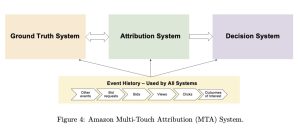
Within the 10-page paper, the team explained how MTA works at Amazon Ads and then summed it up in a single graphic.
“Amazon MTA is comprised of three systems, which we briefly describe in Figure 4 (above). First, the Ground Truth System contains the collection of [randomized controlled trials or RCTs] and the Causal Calibration Models. Second, following a conversion event, the Attribution System generates attribution credits based on the Causal Calibration Models and translates them into attribution shares. Third, the Decision System incorporates attribution scores into optimization models. Each system relies on Event History data that merges signals from a variety of sources.”
Visit the research paper’s landing page on arxiv[dot]org. (August 11)
From tipsheet: This paper intersects with the race for better attribution. Meta’s “incrementality” attribution within its AI-enabled Advantage+ ad system has received raves from some performance marketers and this may be part of Amazon’s response to the marketplace. “Last click” isn’t going to cut it. Plus, Amazon Ads wants those upper-funnel brand dollars pouring through the Amazon Ads DSP, let alone its owned & operated properties.
TECH
LiveRamp strategy takes shape
Yesterday, Chief Strategy Officer Dave Eisenberg of data collaboration platform LiveRamp announced a series of upcoming events on AI and marketing this fall.
LiveRamp is positioning itself for the AI future with a media and marketing strategy of its own.
“This September in London, New York, and San Francisco, LiveRamp will host AI in Marketing Forums—working sessions to define how AI agents in marketing consume, interpret, and act on data.
We’ll tackle the core building blocks: identity, audiences, permissions, context, and creative. Together, these become the foundation of an open User Context Protocol—a shared standard that ensures AI agents in marketing operate on trusted signals, consumer consent, and common semantics across every platform.”
Read more on LinkedIn yesterday. (August 18)
From tipsheet: To date, LiveRamp has been hinting at its AI future in various ways after probably seeing some existential risk – namely, LLMs “hoovering” up the advertising world’s data.
The company produced a graphical landscape of AI advertising companies in May that received some notoriety as it looked to define the space.
And then, in the lead up to June’s Cannes Lions event, LiveRamp CEO Scott Howe made the case for industry adoption of Anthropic’s MCP—or Model Context Protocol—which will help create standardization for the open web in the age of AI. (MCP could also prevent walled AI gardens from becoming even more walled.)
Most recently, CEO Howe appeared on the Marketecture podcast last week to discuss his company and industry trends. He shared:
“And we think that our industry needs kind of an even deeper version of MCP. You know, the protocols that allow companies who have large data sets to communicate with one another. We call that internally UCP, our user context protocol.”
More: Hear and read Mr. Howe’s pitch for the upcoming events on LinkedIn yesterday.
HR
You’re Hired!
- Microsoft Hires Google’s DV360 Head Neil Dhanowa For AI Advertising Strategy (August 18) – MediaPost
- “I recently joined Mediaocean as SVP of Partnerships for Prisma” (August 18) – Jesse Cozart on LinkedIn
PROMPT
What types of content will LLM companies want to crawl in five years?
In five years, large language model (LLM) companies are expected to prioritize crawling the following types of content to enhance their models:
1. High-Quality, Human-Generated Content
- Long-form articles (e.g., journalism, editorials, in-depth guides)
- Blogs and opinion pieces that provide nuanced perspectives
- Creative works like fiction, poetry, and storytelling
- Educational resources and textbooks covering various domains…
MORE
- ‘Vibe Marketing’ Is Taking Over Beauty. What Is It? (August 18) – Business of Fashion
- How a family-owned tamale shop in LA struck marketing gold using AI: ‘I made it in 10 minutes’ (August 18) – Business Insider (subscription)
- Forget about the tech, OpenAI and Perplexity are brands too (August 15) – Digiday
- Operationalizing generative AI for marketing impact (August 18) – Martech
- Facebook upgrades Professional Dashboard with new insights (August 15) – Search Engine Land
- Video: AI-generated models shake up the fashion industry and raise concerns (August 16) – PBS.org