
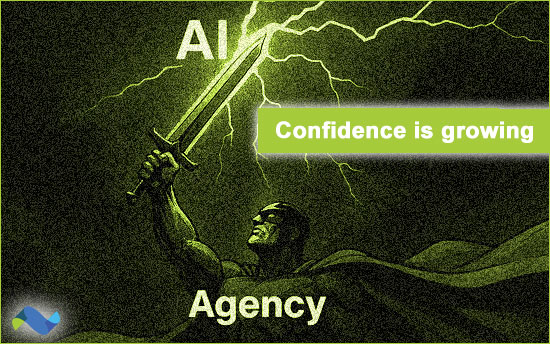
After a years-long pummeling, ad agency holding companies may be changing the narrative with Wall Street investors.
Bloomberg reported yesterday:
“Beset by contract setbacks, Britain’s WPP Plc has plunged 60% this year, while rivals including Publicis Groupe SA and Omnicom Group Inc. have fallen by a lesser extent amid broader fears that AI will replace much of the manual work behind advertising.
Yet a school of thought is developing among analysts that these companies will be able to turn the disruption to their advantage. Bulls argue that major brands will depend even more on agencies to navigate an increasingly complex, multi-platform media landscape. That’s reflected in recommendations for Publicis and Omnicom being near the best levels in years.
‘The industry is being disrupted, but it’s not being disintermediated — I think that’s the key,’ said Morningstar analyst Mark Giarelli.”
Read: Ad Agency Stocks Seen Turning AI Disruption to Their Advantage (December 14) – Bloomberg (subscription)
From tipsheet: Advertising is only getting bigger, as in $$$, due to AI.
Communication with the consumer will improve and lead to better outcomes for the consumer and the advertiser (ROI, ROAS, etc.).
And someone will still be in charge of the marketing budget.
Related: “There’s a huge opportunity in service right now to be a really light, smart, elite service team on top of commodity tech.” (December 12) – Adam Heimlich on AdTech AdTalk podcast on Apple Podcasts
LLMS & CHATBOTS
Developments
- Introducing GPT-5.2 (December 11) – OpenAI
- “Code Reds are not uncommon. We declare Code Reds as a way to marshal a lot of resources toward a priority.” (December 11) – OpenAI’s CEO of Applications, Fidji Simo on TBPN via X
- Cursor Launches an AI Coding Tool For Designers (December 11) – Wired (subscription)
SELL-SIDE
Pinterest’s Performance+ and CTV?
In a bold strategic move, Pinterest announced that it was getting into CTV advertising with the acquisition of connected TV (CTV) ad platform tvScientific on Thursday.
Pinterest GM/VP AdTech Sales Chip Jessopp explained his company’s rationale for the acquisition:
“Building on our existing partnership, we will be able to extend performance campaigns to the biggest screen in the house, turning Pinterest into a true search + social + CTV performance solution that reaches Pinterest’s exclusive high‑intent audience.
Pinterest’s 600M monthly users generate ~80B queries each month and have saved to 15B boards, an unmatched intent signal. With tvScientific, we’ll be able to connect that signal to an outcome-based CTV platform and give advertisers a clearer view of how TV drives incremental results across their performance mix.
tvScientific’s media buying tools, AI-powered optimization models, and deterministic attribution will meaningfully accelerate what we’re building in performance advertising. Advertisers will be able to run coordinated, multi‑screen campaigns across CTV, search, and social, and measure how these channels reinforce one another.”
Read more on LinkedIn. (December 11)
LUMA Partners investment banker Terence Kawaja saw wider implications of the deal for the world of advertising technology. He commented on X:
“M&A activity is back. The accelerated pace of technology innovation (and continued strength of the economy and easing of macro uncertainties) is driving the market towards more M&A. The steeper the innovation curve, the more companies have to default towards BUY vs. BUILD. 2026 is looking good!…”
Read more on X. (December 12)
From tipsheet: Mr. Jessopp promised “coordinated” campaigns in his LinkedIn post about the acquisition. Hmm… Will this be through Pinterest’s AI-enabled Performance+? If the coordination happens through Performance+, the additional CTV channel would be a clear differentiator among the competitive set of automated AI-enabled ad buying platforms.
SELL-SIDE
Google adds AI partnerships
Google VPs Robby Stein and Jaffer Zaidi announced new AI-related partnerships with publishers last week.
Regarding partnerships, the executives outlined the components:
“We’re now piloting a new commercial partnership program with a range of news publishers globally — including Der Spiegel, El País, Folha de S. Paulo, Infobae, Kompas, The Guardian, The Times of India, The Washington Examiner and The Washington Post, among others — to explore how AI can help drive more engaged audiences.
As part of this new AI pilot program, we’re working with publishers to experiment with new features in Google News. For example, we’re testing AI-powered article overviews on participating publications’ Google News pages to give people more context before they click through. And we’re experimenting with audio briefings for those who prefer listening. These features will include clear attribution and link to articles.
We’re also partnering with organizations like Estadão, Antara, Yonhap and The Associated Press to include real-time information to enhance results in the Gemini app.”
The executives also announced “Links in Search AI features” and said:
“We’re increasing the number of inline links in AI Mode, and updating the design of those links to make them more useful. We’re also adding contextual introductions to embedded links in AI Mode responses. These are short statements that explain why a link might be helpful to visit.”
Read more on Google’s The Keyword blog. (December 10)
More: Google announces AI deals with publishers (December 11) – PressGazette
From tipsheet: The commercial partnerships seem counterintuitive. Adding AI-generated article overviews would appear to keep traffic on Google News, no? Overall, Google continues to optimize with, and for, AI.
JOBS
Head of GTM Narrative
“As GTM Narratives Lead at Anthropic, you will own the strategic storytelling that defines how we communicate Claude’s capabilities, Anthropic’s mission, and the transformative potential of safe AI to enterprise customers and the broader market. You will craft the keynote presentations, executive briefings, and core narratives that shape how leaders, customers, and industry stakeholders understand what we’re building and why it matters for the future of AI.”
Learn more on Anthropic’s job board.
Former Marketo CEO Phil Fernandes, who spotted the role, commented on LinkedIn (December 14):
“I thought this was a fascinating role that Anthropic is hiring for. At the intersection of strategic comms, product marketing, and GTM excellence.
I bet we see more of this kind of new hybrid job. It’s sounds like a very compelling org design model.
From tipsheet: The B2B marketing pro who takes the Anthropic role will be embracing “Safe AI” (versus plain ol’ “AI”) which is core to Anthropic’s pitch.
LAW
Disclosing AI generated ads
The Mid-Hudson News reported that New York Governor Kathy Hochul has signed into state law two new regulations related to AI and ads.
“The first new rule requires advertisers to disclose when they use AI-generated ‘synthetic performers,’ digital creations that look and act like real people. With more companies turning to computer-generated faces and voices to pitch products online and on social media, officials say the line between real and artificial has blurred too quickly for comfort.”
The second law fortifies “posthumous rights” to a deceased person’s name, image and likeness.
Read more in Mid-Hudson News. (December 14)
Last Thursday, Gov. Hochul spoke at a news conference in front of a SAG/AFTRA audience announcing the signing of the bills:
“I’ve been proud to stand as you strike and say, ‘What about us? What about the human face? What about the flesh and blood people who are the creators of this? And it’s at a time when we do want to embrace innovation. We really do. It’s who we are as New Yorkers. It’s what makes us so fabulous and so great. But not to the detriment of people. That has to be the dividing line.”
Read more in Deadline. (December 11)
From tipsheet: This would appear to have repercussions for anyone advertising to New York State audiences.
MARKETERS
Use case: LLMs for paid search
Covering last week’s The AI Summit in New York City, New Street Research analyst Daniel Salmon attended a workshop hosted by a member of Pinterest’s paid marketing team.
The workshop explained how Pinterest was using LLMs to improve performance of its Google Search ad campaigns, which was Pinterest’s largest paid acquisition channel, according to Mr. Salmon.
He reported:
“The goal of the initiative was to better align ~100K+ phrases/search keywords (starting with strong performing organic traffic keywords) with ~4500 different ad categories and groups. Pinterest initially leveraged several open-source model libraries from AWS Bedrock, including FastText (first developed by Meta) and an internally developed BERT model (first developed by Google) for bulk labeling.
But this created challenges like a lack of transparency into the LLM’s decisions, as well as ‘unconstrained outputs’ that led the LLM to create ad categories that weren’t included in the original list. The team ultimately found the most success through a “hybrid approach” that included a vector database to help improve the text classifications, specifically tapping OpenAI’s vector embedding models.”
TECH
Podcast: Meta’s ads AI coming to CTV
On the Marketecture podcast, CloudX CEO Jim Payne joined Marketecture’s Ari Paparo and Aperiam’s Eric Franchi for an in-depth discussion on Mr. Payne’s new mobile SSP startup.
This is a great podcast with Mr. Payne, the “mobile” product guy, inviting questions from his “desktop” product peer, Mr. Paparo.
Later in the podcast, as they discuss the news of the day, the two product leaders trade “takes” on CTV and Meta:
ARI PAPARO: “I think Meta is in TV in the next six months.”
JIM PAYNE: “Yeah. I think it makes obvious sense for them to do it. And so I would expect them to. If you look at what they’re doing with us in third-party, I think it’s a good signal that they’re trying to go outside and make the investments that they’re making in ad recommendation engines and AI overall. Just drive that our way.”
ARI PAPARO: “Do you think, Jim, that’s because Meta feels like they’ve moved beyond IDs and to their AI-based system? If it was all IDFAs, and IDFAs get wiped out, then offsite isn’t as attractive. But now, they have this magical AI engine.”
JIM PAYNE: I do think that that’s driving it, yeah. Obviously, we’re going to work really hard to make them successful in mobile advertising next year too.”
Hear more on the Apple Podcasts app. (December 12)
From tipsheet: It’s striking how involved Meta is with Mr. Payne’s business. Obviously, Meta is looking to grow its advertising business in mobile beyond its owned and operated properties.
In a similar way, Meta’s Business AI initiative (announced in October) is extending Meta’s footprint beyond its “walled garden” — in this case, with AI customer-service chatbots.
Any way that Meta can feed more data to its AI is good for Meta.
CREATIVE
Podcast: Unleash GenAI creative now
On the Mobile Dev Memo podcast, analyst Eric Seufert unpacked with its authors a recent study titled “The Impact of Visual Generative AI on Advertising Effectiveness”, which addresses creative ad execution.
The tl;dr is that Generative AI doesn’t work for creative unless you fully unleash it beyond simple ad variant production. Or, as author Anindya Ghose said on LinkedIn in November, “Creation beats modification.”
On his podcast, Mr. Seufert observed about the study, “I hope that this is like a wake-up call to a lot of marketing teams who are reluctant to give that kind of control over to the generative tools. Because without giving them that control, you’re not actually unlocking the true power of what this technology has to offer in this use case.”
Hear more on the Apple Podcasts app. (December 9)
Related: “How can generative AI replace traditional product photography for non-standardized groceries?” – Eric Seufert on LinkedIn (December 14)
From tipsheet: One of the study’s authors noted that the impact of reduction in headcount due to GenAI should also be factored in to any ROI calculation. So if you needed, say, 5 people pre-GenAI, now you only need 2.
PEOPLE MOVES
Now hiring
-
Molly Parr has joined American Express as VP of Product Management, Digital Journeys and Customer Personalization – LinkedIn
MORE
- Amazon Built a $60 Billion Ad Business Using Adtech Firms and Agencies. Now Some Say They’re Getting Squeezed Out (December 12) – Adweek (subscription)
- AdsCopilot offers agencies an AI overlay at no cost (December 11) – Digiday (subscription)
- Podcast: “AI Has Come for Advertising” -about ad creative (December 12) – The Wall Street Journal