
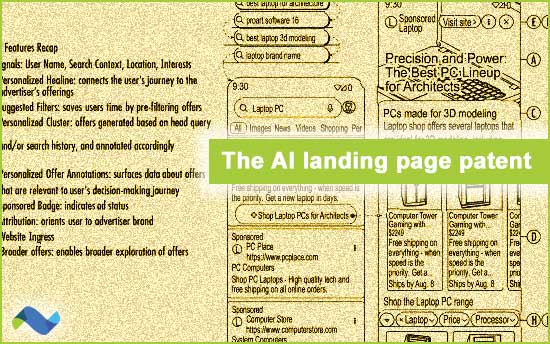
Google has been granted a patent covering AI-generated landing pages, according to a new filing at the U.S. Patent and Trademark Office.
MediaPost’s Laurie Sullivan summarized the patent:
“This patent allows Google to evaluate a brand’s landing page — and if it predicts the page will underperform for a specific user, generate a machine-learning-generated alternative page in real-time. It’s described in the background of a ‘conventional system.’”
The abstract for the patent goes deeper on the details:
“(…) The system can calculate a landing page score for the first landing page. The system can generate an updated search result page based on the landing page score exceeding a threshold value, the updated search result page having a navigation link to an AI-generated page for the first organization. The system can cause a presentation, on a display of the user device, the updated search result page.”
Read: When Google Changes Brand Websites To AI Pages In Dynamic Takeover (February 27) – MediaPost
More:
- “AI-generated content page tailored to a specific user” – Google Patents
- See diagram: “US 12,536,233 B1 – AI-generated content page tailored to a specific user” – USPTO[dot]gov
From tipsheet: This appears to be a fairly broad patent. Meta and AppLovin — among others — could take note.
Google is targeting the full funnel by controlling the bridge between media and conversion — the landing page.
This patent could also dovetail well with Google’s open-source UCP protocol. Read more below.
LLMs & CHATBOTS
Developments
- OpenAI gets investments from SoftBank, Nvidia and Amazon; reveals 900M+ weekly active ChatGPT users to go with 50M+ consumer subscribers. (February 27) – OpenAI
- Accenture and Mistral AI partner (February 26) – Accenture
- Perplexity in Samsung’s Android phones (February 26) – Perplexity
TECH
Amazon and AI bot crawlers
After reviewing data from generative engine optimization firm Profound, Tinuiti SEO executive Jen Cornwell wondered aloud on LinkedIn, “What the heck is going on with Amazon since they blocked OpenAI from crawling?”
With AI bot crawlers potentially disintermediating Amazon from its ecommerce clients (and ads), the company has already been very public about its intention to defend its massive product feed (see Perplexity in November, Google Shopping ads in August).
But, one company’s loss is another company’s gain as Ms. Cornwell observed:
“I’ve always joked that Amazon is the Wikipedia for products. It’s a massive library of product info, reviews, and comparisons that also happens to sell things. That makes it an obvious data source for LLMs.
But as of Nov 2025, Amazon blocked most OpenAI crawlers. So if it’s not Amazon… who is it?
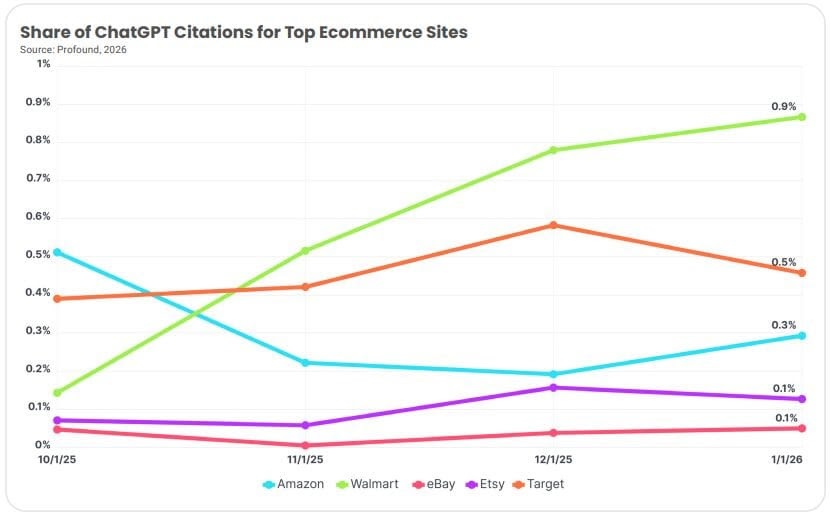
Walmart’s citation share in ChatGPT jumped from ~0.1% in October to ~0.9% in January. Small numbers, but a 9x increase in four months.
Meanwhile:
• Amazon declined (~0.5% → ~0.3%) in OpenAI surfaces
• Target spiked in December, cooled slightly, but holds #2
• eBay and Etsy stayed relatively flat…”
Read more on LinkedIn. (February 27)
Fellow SEO specialist and engineer Brandon Lazovic of BrightEdge built on Cornwell’s ideas and said, in part:
“Walmart and Target gain visibility by feeding data into ChatGPT and other external LLMs. Makes sense because they benefit from the distribution. Amazon doesn’t need that distribution because they ARE the distribution. So they wall it off and keep discovery-to-conversion inside their ecosystem.
What this means for brands.
If your product data lives on Amazon, it’s feeding [Amazon’s shopping assistant] Rufus, not ChatGPT, not Gemini, not Perplexity. That’s a closed loop. Optimizing Product Detail Pages (PDPs) on Walmart and Target for LLM visibility is one game. Figuring out what Rufus optimization looks like inside Amazon’s walls is a completely different one.”
Read more from Lazovic. (February 27)
Related: “Amazon and Walmart compete for top revenue spot with diverging workforce AI strategies” (February 24) – HR Executive
From tipsheet: GEO for Rufus may be its own vertical — though Profound, Evertune and Bluefish might disagree.
TECH
About that SaaSpocalypse
On the European Technology Network (“etn.”) show on X and YouTube, former Meta ad product executive and investor Gokul Rajaram discussed how software companies must innovate in the age of AI.
Rajaram is a board member of The Trade Desk and Pinterest, key players in the open web ad business.
etn.’s X account summarized his appearance:
“Gokul Rajaram: ‘All software is vulnerable if companies fail to innovate, the difference is more in terms of time horizons.’
He categorises software into two types of companies:
1) Utility is tied to the outcome
2) Utility is tied to the data (systems of record)
Gokul Rajaram: “Overall, systems of record like Salesforce have a longer time horizon while things that are purely based on outcomes… companies like [customer service platform] Zendesk… those are going to be the ones that are going to have to face a nearer-term reckoning”
See a 2-1/2 minute clip of Mr. Rajaram’s recent appearance on X. (February 27)
From tipsheet: He’s remarkably positive about Salesforce as long as it stays nimble and ends up giving away AI agents for free while being tied to proprietary data.
LLMs & CHATBOTS
Amazon, OpenAI and ads
Amazon’s decision to invest an additional $50 billion in OpenAI is more than just cash in exchange for a stake in the AI giant.
AWS will get even closer to OpenAI’s cutting edge tech and it will become an exclusive third-party cloud provider for OpenAI’s frontier enterprise platform (called Frontier). Ultimately, if OpenAI’s business takes off, AWS’ business will take off, too.
New Street Research analyst Dan Salmon reviewed the investment — and partnership — in a note to investors. Mr. Salmon looked ahead:
“The dog that didn’t bark in the agreement is a potential retail partnership, which was not addressed. CEO Jassy has made comments on the last few earnings call about his concerns over AI chatbots’ ability to fulfill customer promise and meet customer quality needs.
We expect that Amazon and OpenAI are now incrementally closer to an agreement with this deal and investment but given the major strategic implications for Amazon and customer relationships, as well as implications for advertising, we’re not surprised that Amazon is treading carefully and thoughtfully about any arrangement.”
Related: “Amazon Tries Its Low-Cost Approach to Winning the AI Race” (February 27) – The Wall Street Journal (subscription)
From tipsheet: Microsoft remains a major partner following its 2019 and 2023 investments.
OpenAI is becoming the AI layer on Microsoft’s and Amazon’s cloud infrastructure – and both cloud companies have their own, separate AI initiatives.
As Mr. Salmon implies, where these bigger deals intersect with advertising remains to be seen. Finding a way forward to preserve and grow its ~$70B high-margin ad business is likely top of mind for Amazon.
Over a longer timeline, does ad revenue turn into something else for Amazon — like gobs of AWS or eCommerce revenue — courtesy of the OpenAI partnership?
How about… everything gets bigger?
For ads, it’s driven by 1) improved communication with the consumer due to AI and 2) brands’ — old and new — unending desire to reach consumers. They’ll be able to do it more efficiently than ever.
PROTOCOLS
Google’s UCP ‘in the wild’
Google’s Universal Commerce Protocol is in production as Nick Smith of Australia-based retail media firm, Accent Group, reported on LinkedIn.
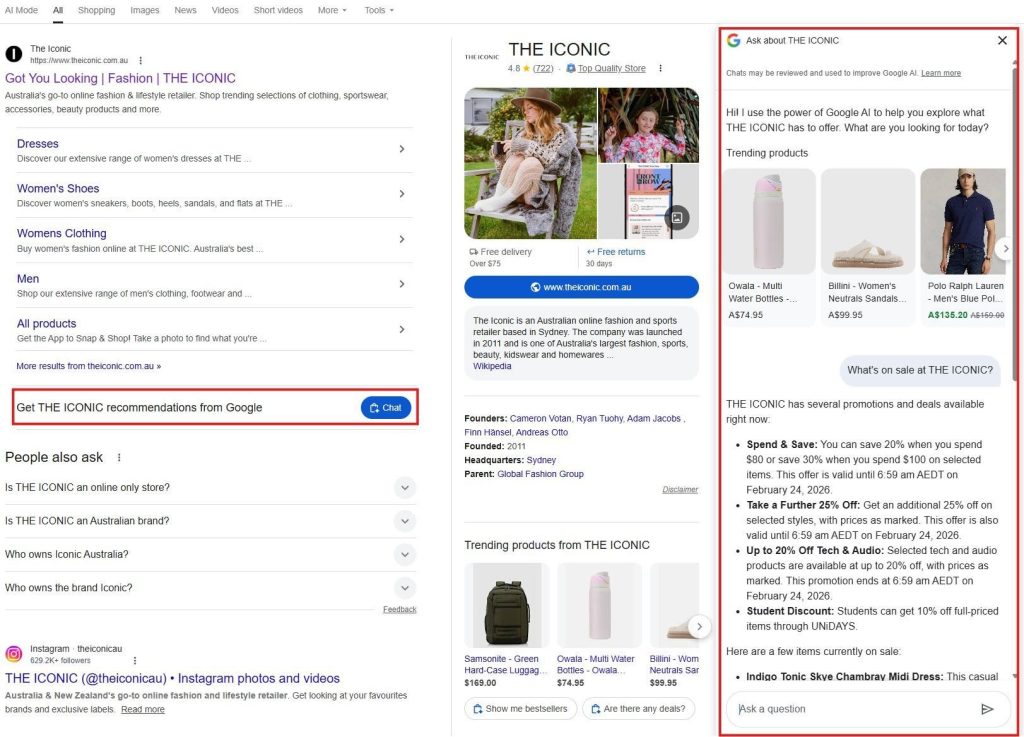
The search engine optimization strategist wrote (see screenshot below):
“As a part of the new Unified Commerce Protocol that was recently released by Google and other players, they also quietly rolled out ‘Business Agent’ as a way to chat directly with brands from the SERP.
Right now it will send you through to the website to complete the checkout, but in the future you will be able to complete the checkout within the experience.
Apparently you can control this in Google Merchant Center (GMC) under Marketing>Business Agent, but I can’t see it in any of my profiles that are triggering this, so I honestly don’t know what is controlling this…”
Read Smith’s post on LinkedIn. (February 27)
Brody Clark, also a search engine specialist, responded in the comments to Smith’s LinkedIn post:
“Has been showing more often in AU SERPs recently but has been pretty common in the US for a little while – either shows with the ‘Chat’ button attached to branded sitelinks or in the brand knowledge panel.
The Business Agent feature is only available for some US GMC accounts – have been playing around with it for a client but not a huge amount to customise at this stage.”
Read the comments. (February 27)
From tipsheet: Google Search turns into an ecommerce site with UCP.
AGENCIES
Trends: Outcomes, rebates, AI-first execs
Digiday continued its coverage of agency transformation in the wake of the latest earnings reports from companies such as WPP and Sir Martin Sorrell’s S4 Capital among others.
Seb Joseph, Digiday’s executive editor, recounted WPP’s results last week:
“At the presentation for its new strategy in London on Thursday (Feb. 26), WPP made the most explicitly public case that the future of agency compensation looks less like a staffing invoice and more like a performance contract — one where fees are tied directly to business results, not inputs.”
Outcomes FTW in the age of AI.
Read: “WPP is betting its future on getting paid for outcomes” (February 27) – Digiday (subscription)
On the Adtech Adtalk podcast with Chalice AI’s Adam Heimlich and Gamera’s Gareth Glaser, Digiday’s recent story on WPP’s principal-based buying was in focus. Mr Glaser noted that the evolution of the curation layer has helped agencies with “technology to insert their rebate logic” versus the previous manual process.
Hear more on YouTube. (February 27)
Meanwhile, Brandtech Group, which includes performance marketing agency Jellyfish, is tripling down on its “AI first” positioning for the marketing services company with three new hires.
Adweek’s Audrey Kemp reported:
“Brandtech Group has appointed three regional chief executives — Lisa De Bonis in the UK, Jeff Matisoff in North America, and Julie Hardy in France — as it bolsters its leadership in key markets with AI-forward talent.”
Read: Brandtech Names Regional CEOs to Power AI Push In Key Markets (February 26) – Adweek (subscription)
From tipsheet: The Brandtech positioning for these hires speaks to their view of the client side: brands want help with AI, first and foremost.
TECH
Podcast: Meta’s Manus, Business AI
On the latest episode of the Marketecture podcast, Mobile Dev Memo analyst Eric Seufert joined Ari Paparo and Aperiam’s Eric Franchi to discuss the latest industry news.
Top of mind for the group was the integration of AI agent builder Manus and its AI workflow capabilities into Meta’s advertising juggernaut led by Advantage+.
The team was impressed by what they’ve seen so far and Seufert noted its alignment with Meta’s Business AI customer service product launch (Read tipsheet coverage in October).
He explained (lightly edited):
“But what Business AI is, it allows a publisher — either on the web or in their app —to have a chatbot that takes the baton from the ad handover and walks the consumer through the purchasing journey.
Why is that meaningful?
Because you can grab a lot of ad information — particularly if you’re coming from the web [where] you can grab a lot of that from the UTM and know exactly what they clicked on and what brought them there. And then you can personalize the journey for them. So… you can assist with discovery.
(…) But there’s a lot more power that you could bring to that. This is just a very early application of this idea.”
And that’s where Manus likely comes in.
Hear more on the Apple Podcasts app. (February 27)
More: “Meta Launches Manus AI Integration in Ads Manager” (February 16) – Social Media Today
SELL-SIDE
In the weeds: AEO and keyword strategy
On Search Engine Land, Rob Garner, who is an SEO-turned-answer-engine-optimization (AEO) consultant focused on content automation, offered tips for citations within AI chatbots.
Overall, Mr. Garner’s view is that the keyword and slop-driven world of SEO tactics is more refined for answer engines – i.e. it’s more about establishing context than saying the right keywords.
Nevertheless, keywords are still in the mix as he prefaces his in-the-weeds discussion:
“If you’re still using keyphrase-first approaches and want a stronger grasp of deeper contextual and semantic strategy, keep reading.
Context, semantics, meaning, and intent have long been core to optimization. What’s changed is how content is presented and discovered, particularly within LLM-based platforms.
This shift affects how context is categorized and structured across a website. It applies to site taxonomy, schema, internal linking, and content chunking and clustering.
It also means moving away from verbose word counts and getting to the point. That benefits both the machine layer and the human reader.”
Read: “How to build a context-first AI search optimization strategy” (February 27) – Search Engine Land
From tipsheet: If you’re interested in the technical aspects of AEO or GEO, this is for you.
MORE
- PubMatic Is All In On Agentic AI (February 26) – AdExchanger
- The Revolution in the Podcast Business, According to the People Leading It (February 26) – Bloomberg
- “This is how Microsoft Copilot’s ad structure works…” (February 27) – SEO specialist David Konitzny on LinkedIn
- Opinion: “The word ‘agency’ is a misnomer. It’s time to move on” (February 26) – Ruben Schreurs, CEO at Ebiquity on The Drum (subscription)