
LLMs & CHATBOTS
Report: ChatGPT referrals plummet
Josh Blyskal, who leads strategy and research at AI marketing platform Profound according to his LinkedIn profile, reported plummeting referral traffic from OpenAI’s ChatGPT yesterday on LI:
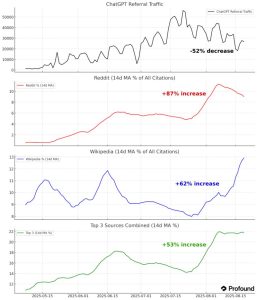
“ChatGPT referral traffic is down -52% since July 21st. I pulled from our dataset of 1+ billion ChatGPT citations and 1+ million referral visits from ChatGPT to figure out what’s going on: ChatGPT is shifting towards sites that provide ‘answers’, and the long tail of citations is shrinking as a result.
The referral decline started right as citation patterns shifted dramatically. Reddit citations increased +87% starting July 23rd, reaching more than 10% of all ChatGPT citations. Wikipedia simultaneously hit historic highs, up +62% since its July low to nearly 13% citation share yesterday.
The top 3 domains (Wikipedia, Reddit, TechRadar) combined have grown +53%, now controlling 22% of all citations. That’s 1 in 5 ChatGPT citations going to just three sites.
At the same time, branded websites are seeing fewer citation opportunities: millions of potential referrals are being absorbed by these dominant platforms. This isn’t a GPT-5 change because the consolidation started weeks before the model shipped.
Here’s what I think (and let me know your thoughts below): Reddit and Wikipedia aren’t winning because they’re special. They’re winning by default because they’re the only ones providing direct answers. When someone asks “what’s the best CRM for startups?” and a brand page says ‘Schedule a demo,’ while Reddit has a thread comparing 10 options, Reddit gets cited.”
Read more on LinkedIn (August 20).
Mr. Blyskal’s most interesting comment was arguably in the comments when he said about the referrals to Wikipedia and Reddit:
“This creates a double incentive for OpenAI: lower compute costs AND higher answer quality in one move. The implication here imo is that brands need to make their content as computationally “cheap” to trust as possible: clear structure, direct answers, consistent authority signals, or they’ll keep losing to platforms that already solved this.”
From tipsheet: The stats speak to the need for Profound’s own product line, of course.
But, the observation that OpenAI needs to get users off its site to lower compute costs is fascinating. Compute is expensive at the scale in which OpenAI is operating. This dovetails well with OpenAI’s Head of ChatGPT Nick Turley who stated on an OpenAI podcast in early July that his company was optimizing for retention – not ‘time spent.’ Big publishers with good answers seem to benefit.
If OpenAI could figure out an ads implementation for ChatGPT, would they start optimizing for ‘time spent’? Ad revenue could make the difference.
Side note: Things don’t look good for the wider open web or long tail with these stats.
BRANDS
AI adoption: Slow
In a discussion with fellow reporter Parker Herren, Ad Age Creativity Editor Tim Nudd reviewed AI trends in marketing and discussed many of the creative uses he’s seen with AI in the past year including those by Google and Polaroid.
Mr. Nudd said he is still waiting for marketers to do more:
“I think some of these campaigns really are talking about AI versus being powered by AI, if that makes sense. I think I was expecting this year maybe things would move a little quicker than they have, but I think marketers are still working through the legal, ethical and even procedural ramifications of how to harness this tech properly…”
Read more in Ad Age. (August 20)
And, listen to Ad Age Marketer’s Brief podcast on the Apple Podcasts app.
BRANDS
AI adoption: Internal is key
On venture firm Greylock’s podcast, The Intelligent Marketer, Adam Turner, CEO of SMS marketing for ecommerce company Postscript, discussed how AI is changing the game for his company both with the customer and internally.
Mr. Turner was unequivocal about the biggest AI opportunity for his company at the moment:
“I think that internal tooling is the name of the game right now. And I think that having slightly technical folks with a lot of business context solve internal problems is actually the way that you likely reduce headcount and end up doing more.
I think there’s the obvious stuff with like customer support, all that type of stuff…. But, I think that arguing engineers (i.e. developers) can all do ‘10x’ is not the efficient way to do it. Right now, it’s about focusing on the low risk, high rewards things that haven’t been able to be done before because you didn’t have technical people in those roles.”
He specifically named the “sales engineer” as a role that can be transformed by AI:
“…Mildly technical people are now the 10x engineers. They are 10x-ing their own output.
I’ll give a specific example of this.
Our sales engineers are now some of the biggest builders in the company. Because these are folks who understand what JSON is, understand their way around SQL, and they deeply understand business problems because they’re on the calls with customers, they understand the marketing challenges. And so, our sales engineers have been able to build internal tools, going “0 to 1” very quickly with LLMs.”
Hear more on the Apple Podcasts app. (August 19)
BRANDS
Less is not more: Users, ad impressions & data
A diminishing number of search referrals is having a downstream effect on marketers looking to find their target audience according to Adweek yesterday.
Adweek’s Trishla Ostwal wrote:
“‘Anyone relying on traditional search data to understand user behavior, segment audiences, and target ads is having to recalibrate,’ said Matt Prohaska, CEO of Prohaska Consulting. He cited a lead-generation company that had used the same DSP for eight years but can no longer predict lead volume with past accuracy, as search queries and related behaviors become less clear and frequent.
Fewer consumer visits means fewer display ad impressions for publishers and marketers alike.
eMarketer senior director Jeremy Goldman told Adweek that pricing could go up for those diminishing number of impressions, too.
CTV is mentioned as a possible workaround for dependency on open-web traffic.
Read more in Adweek. (August 20)
AGENCIES
In-housing generative AI
Bringing programmatic in-house – and its different “flavors” – has long been a discussion among marketers looking to create efficiencies with their automated digital advertising.
The same question is starting to be asked about generative AI according to an article in Digiday.
Michael Lacorazza, CMO at U.S. Bank, said he favored a “hybrid approach” and explained: “The brand doesn’t want to break up with its agency partners. On the other hand, the tech is ‘not very user friendly,’ making it cumbersome for a brand to adopt.”
Lower-hanging fruit for in-housing generative AI appears to be creative and content production but data, insights & strategy also represent opportunity.
Overall, the consensus is that it’s too early for in-housing.
Read more on Digiday. (August 20)
Related: Behind Kellanova’s AI-powered push to improve creative and alter agency fees (August 20)- Digiday
AGENCIES
Dentsu ready to sell
Dentsu signals possibilities of agency sales, partnerships (August 18) – PR Week
From tipsheet: Could an ad tech company finally buy an agency?
TECH
More funding for AI marketing tools
Answer engine optimization (AEO)—or generative engine optimization (GEO)—continues to catch investors’ eyes.
Yesterday, Bluefish AI, an AI marketing startup co-founded by CEO Alex Sherman (an early MediaMath employee and co-founder of PromoteIQ), CTO Andrei Dunca (also co-founded video ad platform LiveRail) and COO Jing Feng (also formerly of LiveRail), announced a $20 million Series A financing round after raising $4 million since the company was founded in February of last year.
According to the press release on the funding, the company aims to help “enterprise marketers gain visibility and influence over AI-generated responses.”
AdExchanger’s Joanna Gerber reported: “Bluefish helps marketers in three major areas, according to [CEO Alex] Sherman: tracking their performance across leading AI systems like ChatGPT, optimizing performance by generating and rearranging content and measuring the impact of optimizations.”
Read more in AdExchanger. (August 20)
From tipsheet: Just last week, Profound raised $35 million and Evertune raised $15 million for AEO/GEO. Marketing analytics and optimization services across AIs – or for just one LLM – will be valuable to large tech players looking to add to their AI product line. Salesforce’s strategic participation in Bluefish AI’s latest round makes sense.
Profound’s co-founder and CEO James Cadwallader perhaps said it best last week about what these companies are pursuing: “Eventually, it seems obvious that thousands of businesses of all sizes will rely on Profound to create marketing aimed at superintelligence instead of humans.” In other words: what kind of marketing do AIs prefer?
TECH
Understanding SEO/AEO/GEO
An infographic is making the rounds on LinkedIn that B2B marketer Chris Donnelly created two weeks ago where he broke down the SEO/AEO/GEO opportunity.
Mr. Donnelly urged readers, “Top businesses aren’t just optimising for Google. They’re already adapting to AI…” – and, therefore, they’re optimizing for all three.
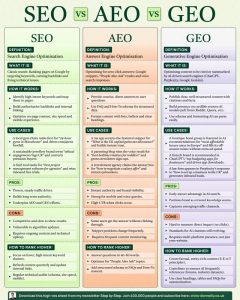
From tipsheet: As you can see, Mr. Donnelly made recommendations to marketers for each of the three optimization techniques including using Reddit/Quora for generative engine optimization (GEO).
Could Reddit and Quora become marketers’ new favorite websites? How will Redditors/Quorans respond? They’ve already been talking to marketers for years, but with particular focus on Reddit/Quora by LLMs, this would appear to invite a new level of marketer participation on these websites.
Overall, this infographic seems like a good place to start. I’m not sure I see the segmentation between AEO and GEO as so stark. For example, Google isn’t the only answer engine as OpenAI’s ChatGPT—or any of the chatbots—can be used as an answer engine.
But, the generative “conversation” with an answer engine is clearly different for GEO.
TECH
Opinion: AI helps the open web
“Major purchases and commitments require more than quick answers; they require exploration of reviews, imagery, videos, and authoritative reporting, all of which publishers already deliver.
Some publishers will monetize these interactions through transactions like I believe Gemini will, others through subscriptions like ChatGPT is doing now. For those who lean in, this represents a once-in-a-generation shift from pageview-driven models to relationship-driven value.
User trust becomes the foundation for both resilience and growth in the LLM era. The future of publishers (and Google) is bright.”- Adam Singold, CEO, Taboola on CNBC’s website
Read: “Op-ed: High-value AI conversations will lead to a new, richer era for Google and the open web” by Adam Singolda on CNBC (August 20)
Mr. Singolda added on LinkedIn: “Google may lose search traffic – but it will earn a lot more revenue. Trusted publishers will win big, because user trust is the one thing no one else can replicate.” Read more.
Regarding the long tail, he was less sanguine in the comments to his LinkedIn post: “…personally, i think long tail is at a big risk, and my guess they will become part of the ‘creator economy’ – going to Snap, Insta, Yahoo Creator Network, etc – and publish there (vs on www).”
TECH
Incrementality is the way
Eric Tilbury, Senior Director of Ad Operations and Solutions Engineering at AI ad tech company Inuvo, shared his frustrations on LinkedIn with CPA optimization in programmatic today.
He wrote:
“Too often, you see buyers try to get that CPA as low as possible to replicate walled garden performance numbers. This de-optimizes what you’re trying to do in programmatic, and it’s really to drive incrementality. Convince someone to consider your brand that would not have done so without seeing an ad.”
Incrementality attribution continues its march in the age of AI.
“Last click” is only the last step—if there is a click.
Read more on LinkedIn. (August 20)
PROMPT
What are usage-based deals that LLMs could offer publishers in the future?
Response from Anthropic’s Claude chatbot:
Usage-based deals represent a promising middle ground between the current landscape of content licensing and the publishers’ concerns about AI training on their content. Here are several models LLMs could offer publishers:
Pay-Per-Citation Systems
- Compensate publishers each time their content is directly cited or referenced in AI responses
- Offer premium rates for exclusive content that gives the AI a competitive advantage
- Scale payments based on the prominence of the citation (primary source vs. supporting reference)…
MORE
- Exclusive: Meta Freezes AI Hiring After Blockbuster Spending Spree (August 20) – The Wall Street Journal
- Opinion: Why Native API Development Won’t Survive the AI Era – Dan Jaye on the Aqfer blog
- China’s Baidu revenue drops as AI returns fail to offset ad decline (August 20) – Reuters
- Yesterday’s Google event: Gemini for Home is Google’s biggest smart home play in years (August 20) – The Verge
- Yesterday’s Google event: Powerful and proactive: Pixel 10 phones are here – AI at your fingertips (August 20) – Google “The Keyword” blog