
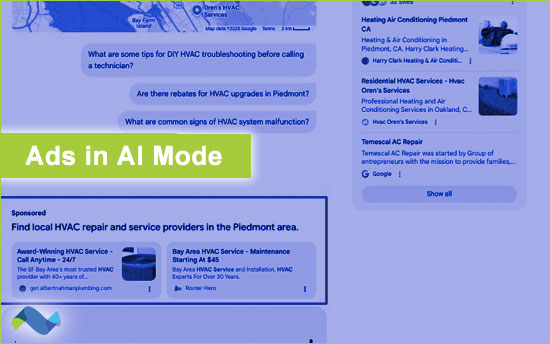
After first being announced by Google in May, the number of ads seen in Google’s AI Mode within Google Search has been limited. That may have changed in the last week according to Search Engine Journal’s Barry Schwartz who spotted a few examples. If you’re expecting something radically new, you’ll be disappointed. They look like Google search or shopping ads. See them now.
From tipsheet: Google is getting closer to formalizing ads in an AI chatbot – a line no other big chatbot such as OpenAI’s ChatGPT has been willing to cross. If these tests are successful for Google and it gets a wider rollout soon, the perception that OpenAI and ChatGPT is falling behind would only seem to increase. OpenAI will have to show impressive results with its decision to move forward with affiliate marketing. Those results could manifest themselves in Shopify earnings, for example, given Shopify’s partnership with OpenAI.
LLMs & CHATBOTS
Developments
- Brussels knifes privacy (GDPR) to feed the AI boom (November 21) – Politico
- How Google Finally Leapfrogged Rivals With New Gemini Rollout (November 23) – The Wall Street Journal (subscription)
- Meta Is Betting on Power Trading to Support Its AI Expansion (November 21) – Bloomberg
PLATFORMS
PubMatic previews agentic tech
Analyst Karsten Weide shared his observations at a recent event for PubMatic, where the sell-side platform introduced agentic and generative innovation for both buyers and sellers.
On the buy-side demo, Weide shared:
“As the campaign ran, the agentic AI detected pacing issues and immediately provided explanations and recommendations. Instead of traders sifting through spreadsheets and log-level exports, PubMatic’s agents surfaced root causes and drafted remediation steps in seconds. The effect is clear: buyers gain speed, precision and effectiveness, and their operations teams become more productive as the AI handles the tactical optimization tasks.
Mr. Weide concluded, “PubMatic’s introduction of agentic AI represents an important step toward a more automated, interoperable and efficient advertising ecosystem.”
Read the event summary on new products. (November 21)
From tipsheet: It’s another example of demand-side or sell-side platforms extending tools to the other side. For example, SSP Magnite added a buy-side product called ClearLine in 2023. Everyone’s just… a platform? AI and agents clearly have a growing role. PubMatic has notably chosen to make Ad Context Protocol (AdCP) a key part of the platform’s strategy even though the use of the protocol, at scale, is a ways off.
Related: Opinion: “Now and next: How marketers should be preparing for an agentic commerce future” (November 17) – WARC
RESEARCH
Social media stats
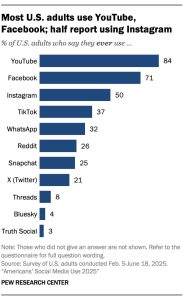
Americans’ Social Media Use 2025 – (November 20) – Pew Research
-
“Growing shares of U.S. adults say they are using Instagram, TikTok, WhatsApp and Reddit, but YouTube still rises to the top”
PLATFORMS
Podcast: Retail ads and agentic disruption
The latest episode of The Verge’s “Decoder” podcast with Nilay Patel revisited the battle between Amazon and answer engine Perplexity and its importance in defining how AI interacts with the web. The impact on advertising hovers throughout, too.
As you may recall from earlier this month, Amazon sent a cease-and-desist letter to Perplexity regarding its AI browser, Comet, and its unauthorized access of Amazon’s website.
Mr. Patel called it “The Door Dash problem” and explained.
“… it’s what happens when an AI interface gets between a service provider, like DoorDash, and you, who might send an AI to go order a sandwich from the Internet, instead of using apps and websites yourself. That would mean things like user reviews, ads, loyalty programs, upsells, and partnerships would all go away. AI agents don’t care about those things, after all.”
That’s the challenge for Amazon and, potentially, all retailers with a substantial advertising business when it comes to AI browsers like Perplexity’s Comet and their agentic functions on behalf of the consumer.
Hear more on The Verge’s Decoder podcast. (November 20)
From tipsheet: This is a very important topic – maybe the important topic – as AI agents connect between marketers, publishers and the customer.
Related: “OpenAI and Target partner to bring new AI-powered experiences across retail” (November 19) – OpenAI
TECH
Breaking down User Context Protocol (UCP)
On the Marketecture podcast, CEO Steven Liss of OpenAds breaks down User Context Protocol (UCP), a protocol that aims to standardize how context is shared on the open web among AI agents and ad systems –and in a privacy-safe way.
Submitted to IAB Tech Lab earlier this month, UCP hinges on technology called “embeddings.”
Mr. Liss explained:
“Embeddings are a very powerful technology for understanding context, for matching ads and audiences. It’s a technology that the walled gardens use extensively.
So the plus side here, adapting standards around embedding interoperability and open web, is a big thing we can do as an industry to close the performance gap between open web and walled gardens.
Now, the challenge with embeddings is they’re powerful, but the embeddings generated by one model are not at all interpretable by another model.”
After explaining about the two categories of embeddings — contextual and audience — Mr. Liss recommended the industry come to agreement on use of a model that is rotated every year or so for contextual embeddings.
On the audience embedding, he that a data provider such as LiveRamp should provide it to the industry.
Hear more on the Apple Podcasts app. (November 23)
From tipsheet: This is a great breakdown by Mr. Liss. Worth a listen or skim through the transcript.
M&A
Presentation: The fifth phase of ad tech
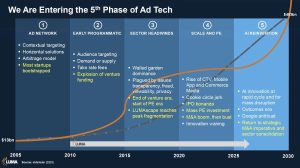
Investment banker Terence Kawaja posted his Powerpoint presentation from LUMA Partners’ Futurescape conference last week.
Titled “AI & Advertising: Prepare for Tectonic Disruption,” the 93-slide deck takes viewers through Mr. Kawaja’s thesis on digital advertising’s future including what he calls, “The Fifth Phase of Ad Tech.” (See below) He labels the fifth phase as “AI reinvention” and suggests that strategic M&A will be an imperative as will ad tech consolidation.
TECH
Awaiting Google ad tech trial remedies
The remedies phase of the Google ad tech monopoly trial neared a conclusion (before Google’s appeals start) with closing arguments from the Department of Justice (DOJ) and Google having taken place on Friday.
“The DOJ and a coalition of states have asked the judge to make Google sell its ad exchange, AdX, where online publishers pay Google a 20% fee to sell ads in auctions that happen instantly when users load websites,” according to Reuters.
But Judge Leonie Brinkema, who oversees the case, has already signaled that this solution wouldn’t work in that Google would likely appeal such a remedy for years. She wants agreed upon remedies that can be put into action quickly given the quickly shifting market trends (like AI).
Read more in Reuters. (November 21)
Marketecture’s Ari Paparo predicts behavioral remedies will be the outcome of this trial.
SELL-SIDE
Podcast: New content monetization model
On the most recent episode of the “Founder in Arms”, former Twitter CEO and current Parallel founder/CEO Parag Agrawal was the guest and he reiterated his interest in creating an “open market mechanism” (Reuters, Nov. 12) for content.
Currently, Agrawal’s startup sells access to web search agents. But, he also says he wants Parallel to help publishers monetize in the age of AI and help the open web proliferate. Today’s subscription model is a zero-sum game — his words.
Though, he wouldn’t divulge any specifics, Mr. Agrawal intimated that a content marketplace for agents was the right direction. Mr. Agrawal added:
“When you have a real value creation hypothesis — by bringing participants together like a publisher and an AI company and a customer — you can actually reasonably slice up the pie to make it worth everyone’s while.
Now, the question is, can we do this at a web scale, programmatically, open market?”
Hear more on the Founder in Arms podcast on Apple Podcasts. (November 21)
From tipsheet: Mr. Agrawal seems to be publicly trying to balance his nascent web search agent business (where presumably publishers are getting crawled by Parallel’s bots/agents) with the promise of a content marketplace which has yet to materialize.
PEOPLE MOVES
Now hiring
“Infillion has engineered a genuinely composable infrastructure populated with an array of agentic-ready components from the elite lineup of adtech companies it has acquired (TrueX, MediaMath, Gimbal, and Drawbridge, to name a few) that can operate independently or in concert, making Infillion the industry’s first platform purpose-built for agentic age…”
Brian Kaminski joins Infillion as COO (November 21) – LinkedIn
MORE
- Boosting CTV Success: How Yahoo ConnectID Improves Reach and Performance (November 19) – Yahoo DSP
- Podcast: “The Shifting Dollars Flowing Through Programmatic Pipes” (November 23) – AdExchanger’s The Big Story
- Vibe[dot]co’s Connected TV ad platform launches Certified Supply, a new solution that gives advertisers a direct path to publishers with zero fraud risk or inventory waste – press release
- Podcast: “The Age of the Undernet: How AI Agents could transform marketing” (November 21) – SeedTag’s Ad Tech Heroes on Apple Podcasts