

For many publishers it represents the loss of search referral traffic and the onslaught of AI bots – and that’s just for starters. They’re not alone. Advertisers have similar concerns as Digiday’s Sam Bradley found out.
Labeling Google’s “AI Overviews” and “AI Mode” a zero-click search “cul-de-sac” where users visit but never advance any further, Bradley discovered that advertiser “organic search” traffic referrals had been negatively impacted by 12%, according to data from Wpromote.
Nevertheless, the news isn’t all bad. Bradley reported:
“But there’s another ‘general trend’ at play that’s somewhat more promising, according to Charlie Marchant, CEO of SEO firm ExposureNinja. Marketers across categories are finding that when search traffic falls, sales or conversions are typically holding steady. And what referral traffic they’re able to track from the likes of ChatGPT appears to lead to higher rates of conversions. It’s a finding echoed during earnings calls this month.”
Read: “Zero-click reality is rewriting the rules of search for brands” – Digiday
From tipsheet: AI is taking the friction out of search referral traffic if the “valuable visitor” trend holds.
LLMs & CHATBOTS
Developments
- “We’ve identified industrial-scale distillation attacks on our models by DeepSeek, Moonshot AI, and MiniMax…” (February 23) – Anthropic on LinkedIn
- “… we’re launching Frontier Alliances — multi-year partnerships with BCG, McKinsey & Company, Accenture, and Capgemini.” (February 23) – Denise Holland Dresser, CRO, OpenAI on LinkedIn
- Guide Labs debuts a new kind of interpretable LLM (February 23) – TechCrunch
BRANDS
Tips for the CMO: Getting started with AI
Adweek spoke recently to marketing consultant Karen Timpone, who is the former Marriott and MLB CMO among other stops, about CMO best practices when it comes to implementing an AI strategy.
Among the tips:
- Pick a “strategic priority” and methodically build success with AI. (Don’t try to do it all.)
- Each priority needs to have a business outcome attached.
- To that end, “every AI project must ‘ladder up’ to growth, competitive differentiation, or customer lifetime value.”
- Have the priority stretch across teams such as “creative, analytics, and customer platform teams using an agile framework.”
Read more in Adweek. (February 23)
MARKETING
DTC marketing and Meta’s AI ad machine
In the latest episode of Andrew Faris’ eponymous performance marketing podcast, Connor MacDonald, CMO of online retailer Ridge, was the guest.
Ridge specializes in wallets, rings and other accessories for men with, reportedly, “nine-figure” revenue driven almost entirely online.
As a CMO at the front lines of direct-to-consumer retail trends, Mr. MacDonald’s observations are also rooted in years of using Meta’s AI-enabled ad platform (he started at Ridge in 2017).
Here’s a selection of his insights from the podcast:
- Meta-only: MacDonald said that any DTC retailer under $25 million in revenue only needs Meta. He added, “The first million dollars we’re gonna spend are probably best spent on Meta.”
- Creative portability: With Ridge reaching into the $100s of millions of annual revenue, he’s long since expanded his channels for reaching the customer and is especially enamored with video. MacDonald noted that being able to quickly take video ads — which his firm is creating for Meta ad placements — and slide them into video placements on YouTube is important. He said YouTube comprises 10-20% of Ridge campaign budgets today.
- Incrementality tests: Ridge is Haus’s largest client for incrementality measurement, according to MacDonald. That says something about his belief in the importance of the measurement framework.
- Channel diversification: Though his marketing organization is always testing new (and old) channels for digital ad opportunity, MacDonald admitted, “And I wouldn’t argue we’re currently optimally allocating, but it’s a lot easier when we are far more confident in 6 channels than not that confident and we have 14 channels.” So his point was to keep channel diversification relatively tight — but always be testing.
It’s a revealing discussion with one of DTC’s more disciplined and successful operators. Speaking of which, Mr. MacDonald is also a panel member of the popular “Operators” podcast.
Hear ”The Andrew Faris Podcast”. (February 23)
From tipsheet: Consider the implications here regarding the opportunity for the SMB market. MacDonald, an experienced online marketer, is saying if you’re an online retailer under $25 million in revs, you only need to go to one place — that’s a powerful endorsement of Meta’s AI flywheel. And Meta isn’t stopping as it refines its “machine” by investing in AI and products such as its Business AI customer service chatbot strategy.
From here, video/CTV’s proliferation seems to be a potential disruptor to — or an opportunity for — Meta.
RETAIL MEDIA
M&A: Infillion acquires Catalina
“Infillion will be leveraging Catalina’s U.S. deterministic data in its platform, enabling two unparalleled value streams that walled gardens cannot deliver.
- Exclusive access to the largest deterministic data set-including more than 400 million shopper IDs.
- Equipping retailers with the ability to activate retail media networks and digital commerce solutions with Catalina purchase-verified measurement and demand.” – Infillion (February 23)
Read:
- “Infillion Acquires Catalina, One of the World’s Largest Sources of Deterministic Purchase Data” (February 23) – press release
- “Infillion Strikes Again, This Time Buying The Retail Purchase Data Company Catalina” (February 23) – AdExchanger
From tipsheet #1: What magic could a deterministic database like Catalina’s facilitate with the help of a powerful, probabilistic large language model (LLM)?
Infillion (which ingested MediaMath’s infrastructure in 2023) will no doubt be trying to find out with its own AI-enabled ad tech.
From tipsheet #2: Ingesting datasets such as Catalina’s doesn’t seem to be a “thing” for LLMs yet — at least not overtly. Perhaps it steps over the line of violating “user trust” which is often cited by AI companies about ads.
But is that “data day” coming for valuable first-party datasets? Seems like an opportunity for AI companies looking to create moats.
CREATIVE
AI slop skepticism receding?
A Liquid Death Olympics ad caught the eye of Ad Age reporters as the team flagged what may be a grudging, but gradual acceptance of AI intertwined in today’s digital ad creative.
Yesterday, Ad Age’s Garett Sloane previewed a story penned by his colleague, Asa Hiken, on LinkedIn:
“The Liquid Death Olympics ad is a good case study in how to use AI in marketing.
The ad sparked a mystery because it streamed on Peacock and then apparently disappeared from the internet. Until Ad Age’s Asa Hiken found it.Liquid Death is known for its irreverent ads and guerrilla marketing. This one was a bit of both, a streaming-only commercial that generated some online buzz.
Some commenters were ready to declare the commercial as AI slop, but is it AI slop if the commercial is calling out AI slop. That’s a philosophical question.
Liquid Death wanted to use generative AI to speak about the AI fears among consumers, and the tone fit the line of products in the commercial…”
Read it on LinkedIn. (February 23)
More:
- Behind the mystery of Liquid Death’s Olympics ad—why brands embrace AI skepticism (February 20) – Ad Age (subscription)
- See the commercial on X (February 20) – Eugenio Fierro, brand ambassador, Adobe on X
From tipsheet: It’s not, “What if AI is OK?” But it’s another step in that direction.
Separately, the “doomer view” of AI is both picking up speed and threatening to become a caricature of itself.
Related: Pinterest Is Drowning in a Sea of AI Slop (February 19) – 404 Media
MARKETING
The Conversational AI opportunity
Stefano Puntoni, a professor of marketing at the University of Pennsylvania’s Wharton School, authored a hopeful opinion piece for AI marketing believers in the Harvard Business Review.
Mr. Puntoni noted the transition from SEO to GEO and “conversational AI” in marketing and cited a whitepaper he published late last year with Wharton colleagues titled: “Conversational AI: The Next Frontier of Digital Platform Monetization.”
Puntoni thinks things are just getting started in this new conversational AI world and concluded in HBR:
“Marketing has survived disruptive transitions before: print to broadcast, broadcast to digital, desktop to mobile. Each created winners and losers. This transition goes even deeper. We’re changing not just how marketing reaches human decision-makers but potentially also who those decision-makers are. The early evidence suggests that we have a rough ride ahead, given variations in AI agent behavior across models and the opacity of how chatbots weight information. We’re heading toward a period of uncertainty and experimentation.
But uncertainty is where opportunity lives. The companies that develop expertise in conversational AI marketing and that figure out how to optimize for both human and machine customers will reap large rewards.”
Read: “AI Is Upending Marketing on Two Fronts” (February 23) – Harvard Business Review (sign-up required)
From tipsheet: Couldn’t agree more with this POV.
FINANCIALS
The biggest digital ad companies
Yesterday, eMarketer chief content officer Vladimir Hanzlik reminded everyone who some of the “key companies” in digital advertising are. See the new eMarketer graphic below.
The list is fine-tuned to the most recent quarterly financial results reported by digital ad public companies. AI is impacting all of these companies to varying degrees.
One notable omission in the graphic is mobile ad technology company, AppLovin, which generated $5.4 billion in Q4 2025 and grew at a 70% clip.
The year-over-year digital ad revenue momentum would place AppLovin in second place behind LLM-favorite Reddit.
AppLovin is supported by its AI-enabled Axon platform.
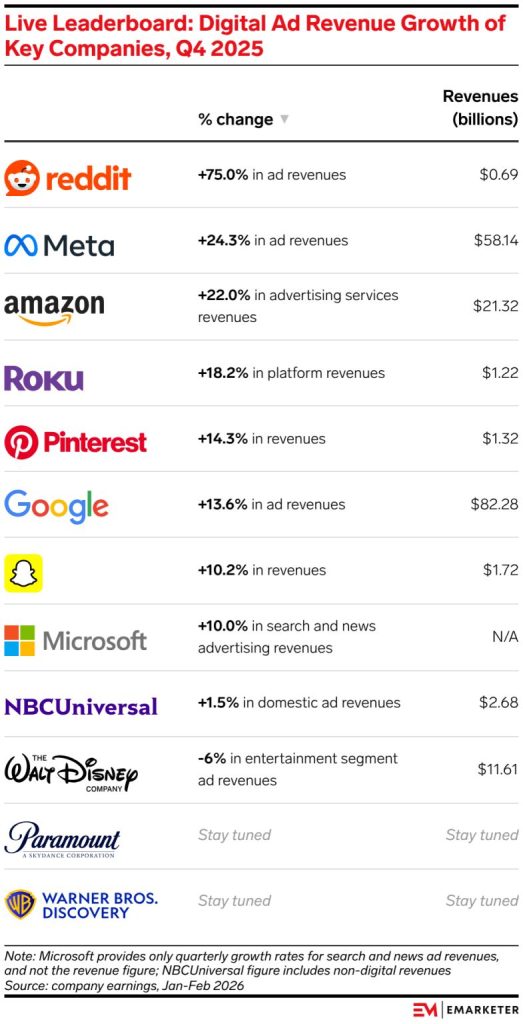
Mr. Hanzlik offered caveats to his list including:
“Meta, Amazon and Google are all growing ad revenues at double digit rates, but there’s a big difference between the 20%+ growth rates of Meta and Amazon and the 13.6% growth rate of Google.”
“Google’s ad revenues are still bigger than those of Amazon and Meta combined, but that will change within the next 6 months at the current growth rates …”
Read more on LinkedIn. (February 23)
From tipsheet: If you’re an agency holding company, you may want “in” on this digital ad revenue list. For reference, Omnicom had Q4 2025 revenue of $5.5 billion with a 28% increase due to its merger with holding company Interpublic Group.
Omnicom’s “organic” quarterly revenue was growing at a low single digits year-over-year in Q4. Prior to Q4, and when it was a standalone company, IPG’s quarterly revenue was declining.
SELL-SIDE
McClatchy launches AI marketing platform
“McClatchy today announced the launch of a new division, Assured Performance Intelligence (API), a marketer-first smart audience platform: a fundamentally different approach to commerce and lead generation performance marketing that combines proprietary data science, AI-powered consumer trend analysis, accurate, relevant content and a unique portfolio of wholly-owned distribution channels spanning entertainment, lifestyle, news, technology, and nationwide physical retail. The division will be led by President and Chief Commercial Officer Seth Rogin, who joined McClatchy recently as a member of the Senior Management team.”
Read more on LinkedIn. (February 23)
PEOPLE MOVES
Now hiring
-
“I’m joining Mars United Commerce and the Publicis Groupe Power of One team as EVP, Global Retail Media Channel Strategy. And I couldn’t be more energized by what’s ahead.” (February 23) – Former WPP, AppNexus and Del Monte executive Doug Chavez on LinkedIn
MORE
- Omnicom alum Erin Lanuti launches “authority intelligence” platform, Lilypath (February 23) – PRWeek
- A New Chapter for HUMAN: Trust as the Defining Infrastructure of the Next Internet (February 23) – Human blog
- Dentsu’s new CEO on how he’s going to grow the business again (February 23) – Digiday (subscription)
- “Hey AdTech/MarTech Friends: If you aren’t using multimodal models to decode video context, you’re leaving revenue on the table. With third-party cookies gone, ‘Contextual Intelligence’ is your only defensible edge.” (February 23) – Christina Yeung, Senior Developer Relations Manager, Nvidia on LinkedIn
- How Agentic AI Can Break In The Real World (February 23) – AdExchanger