
At the IAB Annual Leadership Meeting (ALM) yesterday, Amazon Ads announced the open beta of its Model Context Protocol (MCP) server for “advertisers and ad tech partners to connect AI agents to Amazon Ads through a single integration—rather than building custom connections for every workflow,” according to Adweek’s Trishla Ostwal.
Amazon Ads’ MCP server was in closed beta starting in November.
Amazon Ads VP of ads measurement Paula Despins shared details of an early prototype with Adweek:
“In one prototype, Amazon asked an agent to generate a path-to-conversion report showing all ad touchpoints before a purchase. Instead of pulling from an existing API, the agent wrote its own code and ran it through Amazon Marketing Cloud, processing more than three years of data…”
Read more in Adweek. (February 2)
More: Amazon Ads MCP Server Overview – Amazon Ads (still says closed beta at the top)
LLMs & CHATBOTS
Developments
- Introducing the Codex app (February 2) – OpenAI
- Snowflake and OpenAI partner to bring frontier intelligence to enterprise data (February 2) – OpenAI
- How AI assistance impacts the formation of coding skills (January 29) – Anthropic
RETAIL MEDIA
The allies of agentic commerce
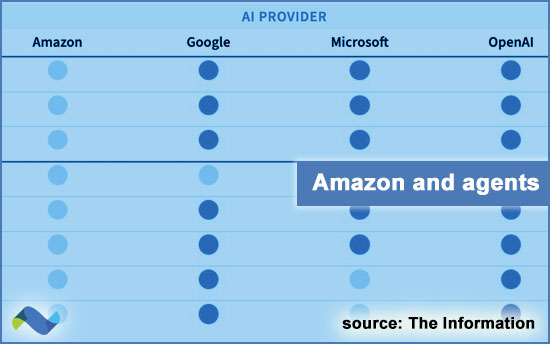
In a review of recent agentic commerce partnerships, The Information reported that Amazon is noticeably quiet among AI retailers — as well as AI providers — while almost everyone else that matters is not.
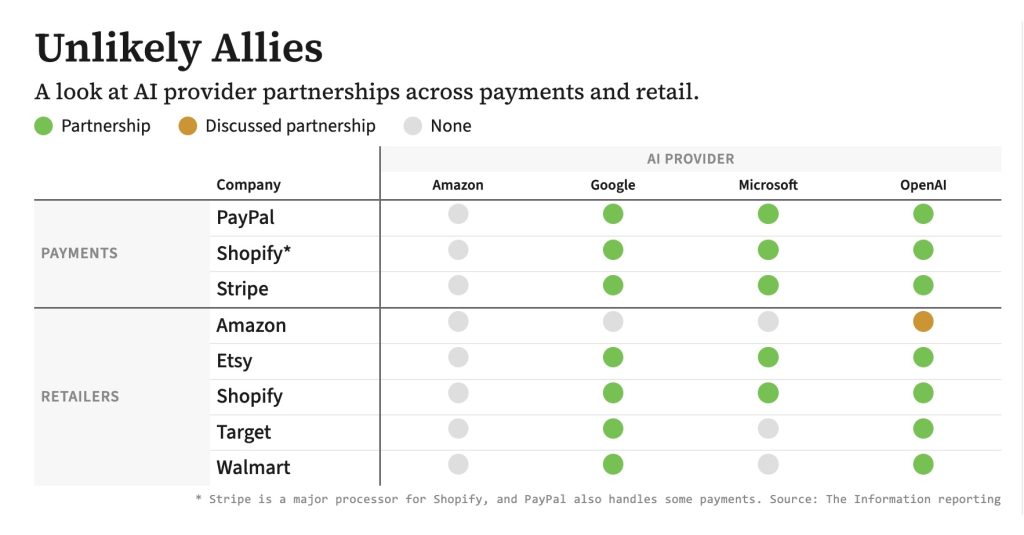
Michael Morton, Wall Street eCommerce analyst at MoffettNathanson says, “You’re seeing these types of partnership announcements and the willingness to work with everybody that you have not traditionally seen, because Amazon’s dominance just gets stronger every day. This is looking like the one opportunity to try to dislodge them.”
Read more in The Information. (February 1 – subscription)
Related: “How a Big Agent Bet Reshaped AWS”(February 1) – The Information (subscription)
From tipsheet: Morton has been one of the analysts signaling the potential for huge disruption in eCommerce due to AI.
In a November interview, he suggested to Stratechery’s Ben Thompson that retail media’s ad business could be subsumed due to product feeds in AI chatbots. Such a change would mean the loss of $60-70 billion in highly-profitable ad business for Amazon —if it happened. Morton’s POV has implications for all of eCommerce, not just Amazon.
But, other than Amazon, most eCommerce retailers do not appear to believe what Morton is saying — just look at all the partnerships with retailers who have significant ad businesses.
Also in the mix: Amazon’s feud with Perplexity over Perplexity using its AI browser (Comet Plus) to potentially skim-off transaction data on Amazon’s owned & operated properties. A cease-and-desist was sent in early November.
LLMs & CHATBOTS
OpenAI looking for ad pros
Looking for a job in advertising at OpenAI?
OpenAI’s CTO of Applications, Vijaye Raji, said yesterday on LinkedIn that he’s looking for engineers for his OpenAI ads team in Seattle and San Francisco. But he warned, “This isn’t about retrofitting old ad tech models; it’s about inventing something new, aligned with our ads principles around privacy, trust, and user control.”
Read more on LinkedIn. (February 2)
From tipsheet: Mr. Raji was put in charge of monetization strategy by OpenAI’s CEO of Applications Fidji Simo last month.
PLATFORMS
CEO explains AppLovin’s business model
In a post on his company’s blog titled, “The Axon business model”, AppLovin CEO Adam Faroughi said there’s confusion in the marketplace about his company’s business model — as well as its AI-enabled ad platform called Axon — and he hoped a detailed explanation could help set the record straight and attract new kinds of advertisers to his company’s platform.
TL;DR: AppLovin is a successful, performance marketing platform with ambitions beyond its traditional gaming clientele.
Mr. Faroughi presented his company in six parts:
- “The scale of the opportunity” – Well over $11 billion in ad spend pass through AppLovin annually, said Faroughi. And “most Axon ads are delivered through our own mediation platform (MAX). MAX reaches over one billion daily active users.”
- “Understanding our inventory” – Here, Faroughi differentiated between the company’s MAX mediation platform and Axon and said in part, “Given the strength of Axon, we are a major player in the MAX auction. The ad impressions we win are exclusive to us (i.e. Axon), and benefit solely the advertisers on our platform. If an advertiser is not buying through Axon, they are missing access to a significant portion of premium mobile supply.”
- “The power of Axon 2” – Faroughi stressed that the new version of Axon (Axon 2) isn’t about mobile games advertising only (like Axon 1 was). Axon 2 is for all advertisers. “These models now predict expected value distributions many days into the future with enough precision to support real-time capital allocation across e-commerce, subscription services, and other verticals.”
- “Attention creates intent” – Faroughi described the primary creative format for Axon which “delivers full-screen video ads that users cannot scroll past.” And, he claimed, this format created intent with the user by coordinating with Axon 2.
- “Driving optimal outcomes” – On outcomes, the AppLovin CEO didn’t hold back: “I have sometimes heard comparisons of us to legacy ad-tech companies, but that comparison does not hold. Many older ad-tech models relied on opaque arbitrage and misaligned incentives where revenue was driven by spreads on impressions, not by advertiser outcomes. Axon is structurally different.”
- “Creating economic growth” – Faroughi discussed the promise his company presents to customers: “We have created tens of billions in economic expansion over the life of the company, and as more businesses adopt Axon, we will see much more.”
Read: The Axon Business Model (February 2) – AppLovin’s blog
From tipsheet: The transparency here by AppLovin and Mr. Faroughi is new -or at least, I’ve never seen it before.
Market forces have perhaps pushed AppLovin to move from behind the mobile advertising curtain with its niche infrastructure and concerns — and which still drives billions in ad revenue and AppLovin’s roughly $160 billion market cap.
Will the transparency help the company grow into the advertiser base it seeks? We’ll see.
The company reports its Q4 2025 earnings next Thursday, February 11.
MEASUREMENT
Measuring the “right now”
CEO Jonah Goodhart of AI contextual advertising/measurement startup, Mobian, announced the launch of a new website that provides insights on a brand’s visibility “right now.”
On LinkedIn, Mr. Goodhart explained:
“AI is changing how brands are discovered.
But brands still matter. Stories matter. How a brand shows up, where it shows up, and how it tells its story matters. In fact, it matters more than ever.
Today we’re introducing Mobian AI (themobian[dot]ai). A place to see how brands are showing up right now.”
He offered a list of examples including one for Tiffany’s here.
As for the Mobian business model, it comes down on both the buy and sell sides as Goodhart continued on LinkedIn:
“If you are a brand, we’d love to talk about brand and creative intelligence, trends in your category, how we score creative, how to identify the personas being targeted, and how to use nuanced and transparent brand suitability and contextual signals across paid and organic environments to drive outcomes.
If you are a content creator or publisher, let’s talk about which brands are targeting personas that may be a strong fit for you and how modern contextual signals can help unlock inventory that has historically been demonetized.”
Read more on LinkedIn. (February 2)
More: About Mobian – Mobian
LLMs & CHATBOTS
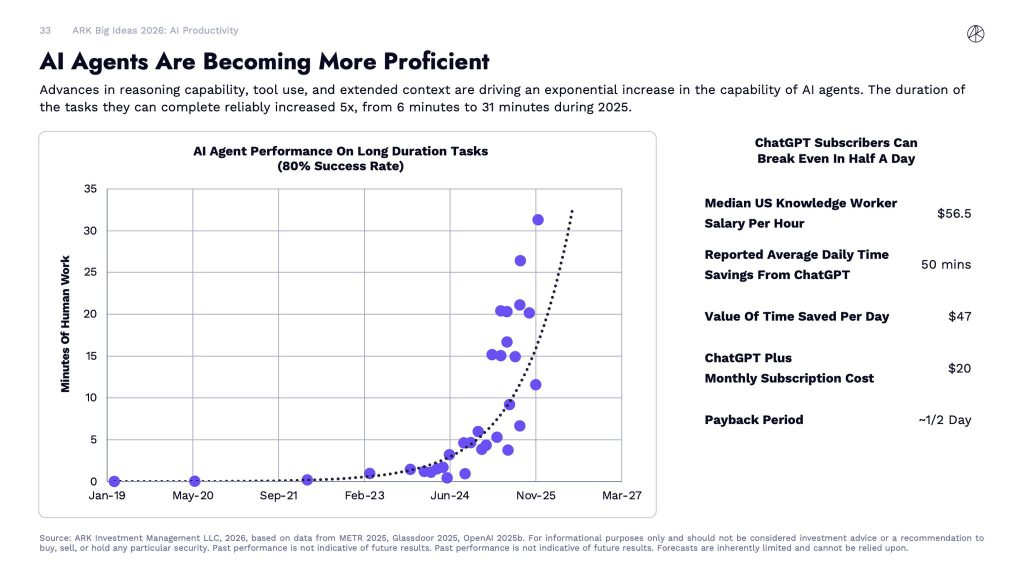
Chart: The AI opportunity and agents
“The AI opportunity is about to compound, not just grow. As agents become reliable at multi-step work, they move from productivity tools to economic participants, opening-up scalable new revenue pools across commerce, lead generation, and advertising. Subscriptions matter too, but the real upside comes when trusted agents drive outcomes, not just answers – advancing this capability is where we’re focused. Loved this chart from Cathie Wood and ARK Investment Management LLC”
SELL-SIDE
IAB: Law — not lawsuits — to harness AI bots
Announced at the trade organization’s leadership meeting yesterday, the IAB unveiled new legislation for the U.S. Congress to consider which “seeks to protect the ad-supported publishing ecosystem” and prevent AI bots from running wild over publisher content (i.e. scraping content for use in AI companies’ large language models without compensation to publishers).
Titled “AI Accountability for Publishers Act” (PDF), the advertising industry trade body’s President and CEO, David Cohen, said in a press release that there was no time for extended lawsuits — it’s time for a law:
“The proposed language released today is designed to protect publishers from AI companies becoming unjustly enriched. Unjust enrichment is a straightforward concept: if someone receives a benefit at your expense, it would be unfair for them to keep it without paying for it. This concept is so fundamental that it has literally been around since the Romans. That’s why we have built our proposed language around the concept of unjust enrichment. It’s basic fairness: you take my content, you pay for it.”
Read: “IAB Releases Draft Legislation Addressing AI Scraping” (February 2) – IAB
More: Ad lobby seeks law to protect publishers from AI scraping (February 2) – Axios
From tipsheet: How will the “walled gardens” respond?
MEASUREMENT
IAB wants a redo in measurement
Also at yesterday’s IAB ALM event, the IAB said it was embarking on a new initiative inspired by AI in order to improve measurement in digital advertising called “Project Eidos” (“Eidos” means “see” or “form an idea” in Greek.).
“Led by IAB’s Measurement Center and guided by the Measurement Advisory Committee, Project Eidos brings together expertise across IAB’s Centers of Excellence and AI Strategic Initiatives to provide shared direction for modern measurement. This work is designed to strengthen the foundation measurement is built on, so future tools, models, and methodologies can scale with greater consistency and confidence.”
Read:
-
IAB Announces Project Eidos: A Comprehensive, Interdisciplinary Initiative to Fundamentally Modernize Ad Measurement” – press release
As part of the new initiative’s rollout, the IAB also published an expansive report to make its case for Project Eidos and the need for better measurement in the age of AI.
The opening data point presents the measurement challenge:
“Most U.S. buy-side decision-makers (67-76%) use at least one of today’s three leading advanced measurement approaches: incrementality tests, attribution analysis, and marketing mix models (MMM). Incrementality testing is the most common, driven by the ease of platform-embedded A/B tests and holdouts. Yet only 39% use all three together, despite each serving a distinct purpose—incrementality measures causal lift, attribution captures conversion paths, and MMM informs budget allocation. This suggests combining them is too complex, leaving most marketers without the holistic view of ROI that today’s landscape demands.”
Read: “The AI-Powered Measurement Transformation: Implications for Attribution, Incrementality, and MMM – State of Data 2026.” (February 2) – IAB (PDF)
More: “The IAB Formalizes Its Measurement Initiatives Under Its New ‘Project Eidos’” (February 2) – AdExchanger
MEASUREMENT
M&A: Analytics platform buys Actable
“Six years ago, Craig Schinn and I started Actable with a core thesis: customer data was being undervalued and under-deployed, and enterprises needed better ways to turn it into real business outcomes. A few years later, we doubled-down on that thesis, launching Predictable to bring emerging AI capabilities into that mission.
Today, I’m excited to share that Actable and Predictable have been acquired by Ekimetrics…”
AI-powered analytic platform Ekimetrics announces acquisition of Actable, a US-based specialist in AI-powered customer analytics.
Read more on LinkedIn. (February 2)
From tipsheet: Prior to Actable, Mr. Greitzer was co-founder of programmatic buying platform Accordant Media (bought by Dentsu in 2016). Before that, he was co-creator of Atom Systems, agency Razorfish’s demand-side platform, which was folded into Publicis’ programmatic buying system after the holding company bought Razorfish from Microsoft (2009).
LLMs & CHATBOTS
The ChatGPT ads news ticker
- (Video) Will Advertising Change the ChatGPT Experience? (February 2) – Casey Newton and Kevin Roose of the “Hard Fork” podcast in The New York Times
- OpenAI Confirms $200,000 Minimum Commitment for ChatGPT Ads (February 1) – Adweek (subscription)
- Ads in ChatGPT: Why behavior matters more than targeting (February 2) – Search Engine Land
MORE
- PubMatic Launches AI Insights to Help Publishers Understand and Act on Demand Dynamics in Real Time (February 2) – PubMatic
- Will Publicis Groupe keep exploring M&A or does it need to focus on what it’s already got? – Digiday (subscription)
- TransUnion Acquires Mobile Division of RealNetworks to Enhance Voice and Messaging Solutions (February 2) – TransUnion
- Agentic AI is the new advertising battleground. Does it have to be? (January 28) – The Trade Desk’s The Current
- OpenAI Bets on Super Bowl to Break Through the Competition (February 2) – Bloomberg (subscription)