
On the AdTech AdTalk podcast, Chalice AI’s Adam Heimlich made the case for IAB Tech Lab’s proposed “Agentic RTB Framework (ARTF) v1.0”, which he helped create.
Mr. Heimlich provided a definition for “agentic” and why the new framework qualifies (lightly edited):
“People have been trained to think that agentic is like -the MCP (Model Context Protocol) server is the only example they have …and AdCP (Ad Context Protocol) is just a wrapper on the MCP server. And that ‘agentic’ means you can send a text prompt and it will pull something from an API… I have that in my office with Claude. I can ask it ‘What’s the status of this deal in HubSpot [or Confluence]?’… I don’t have to look in that SaaS anymore. It does the API pull and brings me back the answer.. That’s not the agentic part… That’s LLMs doing their magic.
The agentic part is that Hubspot and Confluence have used their APIs to ‘serve’ Claude. Essentially, Claude is my agent pulling from the API.
What makes it agentic is that multiple companies have agreed to create one thing together – they’re collaborating on something.
HubSpot is saying ‘All right, we’ll provide a service so that Claude can pull from our API and give you the answer in text.’ That’s what makes it agentic. It’s one company allowing another company to act as the agent.
What we’ve brought into RTB (real-time bidding) is the Chalice container that is responding to bids – it’s now the bidding agent. And Index Exchange’s role is the bid request or supply agent. Why it’s such a cool framework (ARTF Framework) is now there can be more which is why we’re calling it the ‘Agentic Framework’…”
Along with fellow podcaster Gareth Glaser and guest Keith Gooberman of Pontiac DSP, Heimlich then goes into the complexity of today’s technology and how the agentic future can lead to both scale and customization.
Hear the discussion starting at 45:19 on YouTube.
More: On LinkedIn, Mr. Heimlich crisply broke down the differences he saw between AdCP and ARTF on Friday (November 14) – LinkedIn
Industry reaction to agents and their frameworks:
- “We’d all be better off dropping the marketing gloss and describing things accurately. There’s enough real innovation to work on without pretending every container running a scoring function is an ‘AI agent.’” (November 14) – Christopher Francia, Director of Product Development, Cheil Worldwide on LinkedIn
- “If you believe the hype, we’re on the cusp of a structural shift in advertising. What if AI isn’t just powering optimizations, but actually planning, buying, and measuring media?…” (November 12) – Rio Longacre, Credera on LinkedIn
- “My quick framework is step one, automate your workflow inside one tool. That’s what’s going on here. Everyone’s using AI, so the traffickers and the ops people don’t have to fill out fifty forms with naming conventions and all that nonsense. Step two is integration of complimentary products. So your creative goes to your ad server without a human being cutting and pasting things and without errors and with data correction and things like that. Stage three is integration between non-affiliated companies. So this is where AdCP has a lot of investment…” (November 14) – Marketecture’s Ari Paparo on Marketecture podcast [30:25]
Related: When bots look like buyers: agentic traffic causing new publisher headaches (November 12) – Digiday (subscription)
LLMS & CHATBOTS
Developments
- OpenAI’s new LLM exposes the secrets of how AI really works (November 13) – MIT Technology Review
- Anthropic claims of Claude AI-automated cyberattacks met with doubt (November 14) – Bleeping Computer
- Leaked documents shed light into how much OpenAI pays Microsoft (November 14) – TechCrunch
AGENCIES
AI personalization > demo targeting
The BBC covered a new level of personalization that it says it’s seeing in digital advertising courtesy of AI. BBC’s MaryLou Costa wrote, “[AI] targets individual people, rather than the demographic segments or personas advertisers would traditionally use.”
Creative and marketing agency Cheil UK CEO Chris Camacho chimed in:
“The shift is that we are moving away from what was collected data based on gender and age, and readily available information, to now, going more into a deeper emotional, psychological level (…)
You’ve now got AI systems that can go in and explore your entire digital footprint – your entire online persona, from your social media interests to what you’ve been engaging in.
That level is far deeper than it was previously, and that’s when you start to build a picture understanding that individual, so whether they’re happy, whether they’re sad, or what personal situation they’re going through.”
Read: “Will AI mean better adverts or ‘creepy slop’?” (November 13) – BBC
AGENCIES
WPP attracting interest from Havas
A WPP stake — or swallowing the whole business — is apparently on the table for Havas as it looks to take on fellow French agency holding company Publicis and Omnicom-IPG.
“Britain’s stricken advertising giant WPP is attracting takeover interest after a nightmare year on the stock market that has left the company poised to drop out of the FTSE 100.
French rival Havas, controlled by the family of billionaire Vincent Bolloré, is understood to have held talks about WPP, while senior City sources said private equity firms Apollo and KKR had also run the rule over assets of the company…
The company is currently valued at about £3 billion, down from a peak of £24 billion in 2017.”
Read: Stricken WPP draws takeover interest as FTSE 100 demotion looms (November 15) – The Times of London
Meanwhile: WPP’s InfoSum launches AI-powered clean room solution for The Walt Disney Company and other clients (November 13) – Ad Age on LinkedIn
From tipsheet: Havas is busy. Havas and Horizon Media partnered on a joint venture in late September for media clients in the U.S.
BRANDS
Think content-first, not automation
In an op-ed on LinkedIn, Hershey marketing innovation leader Vinny Rinaldi urged marketers to think “content-first” in the face of ever-increasing automation capabilities.
Mr. Rinaldi wrote:
“The ‘who’ is becoming automated.
The ‘what’ is becoming the differentiator.
Privacy changes, AI acceleration, and platform design are all pointing to the same conclusion: Content quality, variety, and ecosystem thinking are the new growth engines.
Brands that cling to hyper-targeting as the hero of performance will struggle to compete in a world where algorithms elevate great content automatically.
Brands that embrace a content-first, iterative, platform-native approach will thrive…”
Read more on LinkedIn. (November 14)
TECH
Unity’s AI links ads to commerce
On the most recent episode of the Stratechery podcast, analyst Ben Thompson interviewed Unity CEO Matthew Bromberg about his journey as CEO and Unity’s continued expansion into ads and AI. Core to the company’s success is Vector AI, which Bromberg described as a “self-learning neural net system.”
Thompson asked Mr. Bromberg how Unity integrates Vector AI into gameplay and understanding target audience:
“So, the part one of this [is]: ‘Hey, let’s be fundamentally more competitive on our ad business’. Part two is, how do you think through those real connections between advertising, game creation, and the runtime? What connects those things is the need to have a deep and clear understanding of the gaming consumer. (…)
Whether you’re prototyping a new game, and want to understand how people are behaving in that game… —all that is a data challenge. How do I interpret data which we can have access to through the runtime as a way of better understanding how to build a game? And then when I’m operating in live service, how do I use that same connection to consumer understanding to optimize my live service?
Two weeks ago, we announced the commerce product…”
Unity’s Vector AI is another example of AI tying ads to commerce and vice versa. For Bromberg, that’s part 3 of his company’s strategy: tying together advertising, game creation, runtime and commerce.
Hear the interview on Stratechery. (November 13 – subscription)
From tipsheet: Unity is one of the many companies looking at mobile ad platform AppLovin’s revenue and saying to themselves, “I want some of that.”
Meta is another notable competitor with eyes on AppLovin. Note Meta’s launch partnership with CloudX and its Trusted Execution Environment (TEE) which helps Meta protect its first-party data in the mobile ad auction.
LLMs & CHATBOTS
Reviewing GEO shopping listings
Taking a cue from AI answer engines’ move into commerce, Adweek’s Trishla Ostwal spoke to generative engine optimization (GEO) firm Profound last week. The startup helps brands understand where and how they are listed in AI chatbots like OpenAI’s ChatGPT.
In the article, Profound detailed a new content optimization tool called “Shopping Analysis.” See Profound’s “Shopping Solutions” here.
Trevor Pyle, Profound’s head of product marketing, told Ostwal, “The idea is to help brands create content that highlights the products they want to sell, so AI assistants surface them more accurately and competitively.”
Adweek explained on LinkedIn:
“The tool identifies which of a brand’s products are appearing in AI shopping environments, how they’re positioned against competitors, and which prompts trigger them. While brands can’t control which items get pulled in, they can refine how products are described to improve visibility. Profound guides companies in optimizing product detail pages—emphasizing key attributes like comfort, sizing, or support—and adding FAQs that answer the questions consumers actually ask.”
Read more on LinkedIn. (November 13)
More: Profound’s New Tool Shows Retailers How AI Assistants Recommend Their Products (November 13) – Adweek
From tipsheet: Seeing how competitors are performing with listings in the answer engines could be a selling point in itself – which, in turn, drives more Profound business.
SELL-SIDE
Performance Max manual feature
Search Engine Land’s Ana Anu Adegbola covers the international roll-out of daily budgeting in Google’s AI-enabled Performance Max platform.
She noted the feature, which had been previously rolled out to marketers in the U.S., is a welcome change, “Advertisers have spent years manually calculating average daily budgets from fixed totals — especially painful for short-run, flighted campaigns. The new feature eliminates that workaround, giving PPC teams tighter control over spend pacing without relying on daily averages.”
Read: Google rolls out total campaign budgets for Performance Max beyond the U.S. (November 14) – Search Engine Land
From tipsheet: The push-pull between automation and customer control continues.
TECH
SMBs address marketing workflow
The Wall Street Journal took a look at how small- and medium-sized businesses were using AI to save time and money while “hallucinations” in the course of workflow can require the need for humans to double-check the output.
Nevertheless, a typical anecdote:
“Dustin Bruzenak, CEO of AI advisory and software firm Modern Logic, uses AI to turn a biweekly podcast conversation with his business partner into short videos for social media and a blog post for the company’s website. ‘From one hour of activity, we get an entire marketing campaign,’ Bruzenak said.”
Read more. (November 15 – subscription)
Related: When AI Hype Meets AI Reality: A Reckoning in 6 Charts (November 15) – The Wall Street Journal (subscription)
PEOPLE MOVES
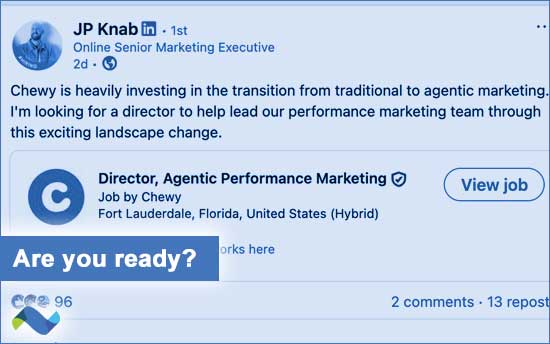
Job: “Agentic performance marketing”
Performance marketers are preparing at Chewy.
h/t Rick Welch on LinkedIn (November 15)
MORE
- The agentic commerce market map (November 13) – CB Insights
- Attain Expands OutcomeHQ With AI That Anticipates What’s Working Before Campaigns End (November 11) – press release
- The Future of Media Is Being Built on YouTube (November 12) – Mark Stenberg on Adweek
- billups Launches AI-Powered Agentic System for Out-of-Home Advertising – press release
- What Marketers Can Learn From Backlash to Coke AI Ads (November 17) – MediaPost