
LLMs & CHATBOTS
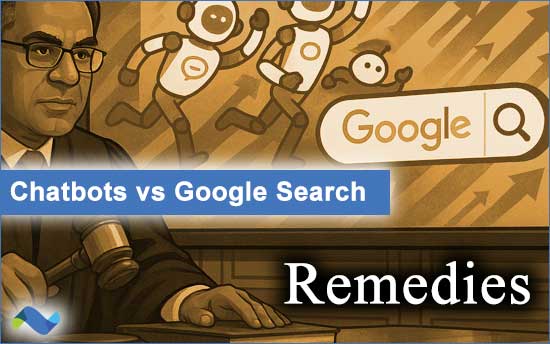
Google Search remedies & AI
Yesterday’s remedies’ ruling in the Google Search antitrust trial was clearly impacted by the evolution of AI. Read a remedies summary from CNBC. (September 2)
New Street Research analyst Dan Salmon quickly broke down the AI-related part of the ruling in a note to clients last night.
Mr. Salmon began with a quote from the judge involved in the case:
“On the role of AI in the ruling
‘Today, tens of millions of people use GenAI chatbots, like ChatGPT, Perplexity, and Claude, to gather information that they previously sought through internet search. These GenAI chatbots are not yet close to replacing GSEs [general search engines], but the industry expects that developers will continue to add features to GenAI products to perform more like GSEs.’ – Judge Amit Mehta, United States district judge of the US District Court for the District of Columbia, yesterday
Our Take: The Judge seems as convinced as the market that chatbots will indeed challenge search competitively.
What’s Next: Judge Mehta has asked both Google and the DOJ ‘to meet and confer and present by September 10, 2025, a joint revised final judgment that is consistent with this Memorandum Opinion.’
Once finalized, we expect GOOGL to ask for a stay on the newly imposed remedies, and soon after initiate an appeal of the ruling, which it has promised since the guilty verdict. With that said, we wonder if a much lighter set of remedies versus what the DOJ originally proposed could lead to change of plan, acceptance of manageable (in our view) remedies, and return focus fully to innovating search for its AI future.”
More:
- Department of Justice Wins Significant Remedies Against Google (September 2) – U.S. Department of Justice
- “For months we’ve all been saying that spinning Chrome and stopping search distribution deals were really tricky remedies to pull off. The judge agreed, and essentially ruled to just not do those things…” (September 2) – Ari Paparo, Marketecture, a thread on X
LLMs & CHATBOTS
Deprioritizing ads
Answer engine Perplexity is “deprioritizing ads” according to marketing leaders in an article yesterday by Ad Age’s Asa Hiken. Read more. (subscription)
In fact, Perplexity may lack the necessary scale to bring large marketing budgets to its platform – hence the “deprioritization.”
Perplexity only had 22 million users in June whereas ChatGPT reportedly had over 400 million users and Google’s AI Overviews which had 1.5 billion at that time. And ChatGPT has no ads at this time either.
So what is Perplexity doing next?
From tipsheet: Tipsheet covered this yesterday: raising money, selling the biz, refining the AI and developing the browser are a few alternatives to pursuing ads.
A quick look at Perplexity’s job board gives few clues on the strategy going forward for the company with the mobile version of Perplexity’s Comet browser and Search among the categories attracting the most open roles.
Regardless of reach, if Perplexity ads system had divined a unique, AI-enabled way to generate strong performance—even with smaller budgets—this could have been the fuel for pouring on the marketing “gas” and bringing more users to the platform. Perplexity apparently did not find the ad system (yet) or wasn’t willing to risk whatever downside it saw with users from an ad model.
Which LLM will finally pull the trigger on advertising in a much bigger way? TBD. I think somebody may need to buy some ad tech to get it done.
LLMs & CHATBOTS
Developments
- Anthropic raises $13B Series F at $183B post-money valuation [up from $61.5B in March, and reports a $5B+ run-rate revenue] (Sept 2) – Anthropic
- OpenAI shuffles executive roles, acquires Statsig for $1.1 billion (Sept 2) – The Verge
- Amazon launches Lens Live, an AI-powered shopping tool for use in the real world (September 2) – TechCrunch
BRANDS
Low AI literacy = High AI receptivity
If you feel like you’re falling behind given the latest AI developments… relax? That’s one possible takeaway from a research report penned by a trio of college professors in January called, “Lower Artificial Intelligence Literacy Predicts Greater AI Receptivity.”
See the report in the American Marketing Association’s Journal of Marketing archive.
The Wall Street Journal used the report as the basis of an article yesterday and spoke to one of the researchers, USC’s Stephanie Tully. Ms. Tully told the WSJ:
“When you don’t really get what’s going on under the hood, AI creating these things seems amazing, and that’s when it can feel magical. (…) And that feeling can actually increase people’s willingness to use it.”
What to do with this finding?
The tone of the article suggested that consumers need to understand how AI works at least a little bit and be able to question it. But, still, the enthusiasm shouldn’t be dampened.
The WSJ’s Heidi Mitchell concluded:
“Perhaps the best approach is to try to educate consumers about AI in a way that doesn’t completely eliminate their sense of awe or curiosity, the researchers say. Tully calls this ‘calibrated literacy’ —equipping users with enough understanding to make safe, informed decisions without dampening their delight.”
Read more in The Wall Street Journal. (September 2 – subscription)
BRANDS
Optimizing for brand visibility
In a study titled, “Brand Visibility – ChatGPT and Google AI Approaches by Industry Where Similarities Lie and Different User Paths Appear” (study), performance marketing platform BrightEdge – which also produces research – found that there are necessary and different approaches to AI search between the two biggest answer engines.
BrightEdge founder Jim Yu stated last week on LinkedIn
“When users seek actionable guidance, ChatGPT and Google AI Mode take distinctly different approaches:
– ChatGPT acts as a ‘trusted coach’ → Surfaces products, apps, and task-based tools
– Google AI Mode serves as a ‘research assistant’ → Highlights guides, articles, and institutional content”
Read more from Mr. Yu on LinkedIn, who provided examples of each approach. (August 25)
Get the study on BrightEdge’s website.
SELL-SIDE
Big publishers’ LLM strategy
“We have a licensing deal with OpenAI and we’re suing Perplexity, so I think it’s pretty clear what our general position is here. (…) If our content is going to be used, we need to be properly paid for it… We’re looking at each company in turn, and if there’s a deal to be done and it makes sense, then we’re happy to do it.”
Read: Why News Corp Is Both Suing – And Collaborating With – AI Companies (August 28) – AdExchanger
TECH
Fundraising pitch deck
Adweek’s Trishla Ostwal found a pitch deck in her inbox for answer engine optimization (AEO) firm Bluefish AI’s latest $20 million funding round. Curiously, there are no revenue numbers in the pitch deck.
Nevertheless, there are other “goodies” such as a snippet of Bluefish AI’s customer list.
Ms. Ostwal reported:
“About 80% of Bluefish’s clients are Fortune 500 brands, including Adidas, Omnicom, and Tishman Speyer, using the platform to influence how they show up across Google’s AI search, OpenAI’s ChatGPT, Amazon, and Perplexity, per the pitch deck.”
See it now. (September 2)
TECH
New AI-washing case
Yesterday, law publication JD Supra tracked the filing of an August 25 lawsuit filed by the U.S. Federal Trade Commission against a tech company for deceptive marketing practices a.k.a. “AI-washing.”
JD Supra explained:
“On August 25, the Federal Trade Commission (FTC) brought a lawsuit against Air AI Technologies, alleging the company engaged in deceptive marketing practices tied to its ‘conversational AI’ platform. The case, filed in the District Court of Arizona, centers on allegations that Air AI misled small business owners and entrepreneurs with exaggerated claims about the tool’s capabilities and financial benefits.”
“As part of the suit, the FTC requested a temporary restraining order to immediately halt Air AI’s marketing activities. According to the complaint, the company’s customers, “many of whom are small business owners, lost as much as $250,000 and are often left in debt” due to Air AI’s alleged misrepresentations…”
Read more on JD Supra. (Sept 2)
More:
- FTC Sues to Stop Air AI from Using Deceptive Claims about Business Growth, Earnings Potential, and Refund Guarantees to Bilk Millions from Small Businesses (August 25) – FTC[dot]gov
- FTC’s Latest AI-washing Case: A Focus on Agentic AI and Productivity Claims (August 27) – JD Supra
- FTC announces new enforcement initiative targeting deceptive AI practices (October 2024)- Davis Polk law firm
HR
Open role of the week
This role caught the eye of many LinkedIn users (1, 2, 3, 4, 5) in the past couple of days:
-
“Content Strategist, Chatgpt[dot]com, Product Design (San Francisco)”
See it on OpenAI’s career website.
The compensation salary range is $310K–$393k – not to mention OpenAI stock options.
Salesforce’s Senior Director, Global Integrated Campaigns Strategy, Charlene Marsh, said on LinkedIn of the role:
“So no, the AI revolution isn’t cancelled because OpenAI is hiring strategists. If anything, it’s proof that the future of content is human and machine, working together. The companies that win won’t be the ones who choose sides — they’ll be the ones who know how to orchestrate both.”
OpenAI has had plenty of go-to-market roles in the past, but “Content Strategist” may signal a new element of OpenAI’s strategy – that of a publisher.
Among the responsibilities for the role:
- “Develop and own the content strategy for ChatGPT.com, aligning it with growth, acquisition, and product objectives.“
- “Create, write, and edit content such as landing pages, guides, and campaign materials to drive awareness and product adoption.“
- “Define and refine ChatGPT’s brand voice and tone across owned online platforms.
- “Partner with SEO, growth, and product marketing teams to identify opportunities and measure performance…”
Related:
-
Opinion: Creative people will be at the heart of marketing’s AI revolution (Sept 2) – Tom Roach, on Marketing Week (UK)
PROMPT
How will brands interact with services for AI advertising strategy in 5 years?
Response from xAI’s Grok:
Based on current trends and projections, here’s a breakdown of how these interactions will likely unfold.
- Autonomous AI Agents as Primary Interfaces
- Hyper-Personalized and Predictive Strategy Development
- Real-Time Optimization and Adaptive Campaigns
- Integration with Ecosystem Platforms and Tools
- Human-AI Collaboration for Creative and Ethical Oversight
MORE
- How AI Is Reshaping [Financial] Advisor Marketing (September 2) – The Daily Upside
- How The Wall Street Journal is strategizing for ‘Google zero’ (September 1) – Digiday (subscription)
- Looking beyond AI: 9 marketing principles that will always matter (September 2) – Search Engine Land
- AI fails the cattle marketing test at 4 a.m. (September 2) – FarmProgress