
CES for Monday: AI, ads and marketing
If you’re attending the Consumer Electronics Show (CES) this week in Las Vegas, AI-related content for marketing and advertising is plentiful.
Among the AI panel discussions on Monday at CES:
Amazon Web Services GM Samira Bakhtiar (June tipsheet interview) will appear alongside Adobe VP of GenAI New Business Ventures Hannah Elsakr, WPP Chief Innovation Officer Elay Horwitz and NBCUniversal’s Kristina Shepard for “The Leadership Roundtable: Hollywood, Technology & Advertising“:
-
- Date: Today, Monday, January 5
- Time: 9:00 AM – 9:40 AM
- Location: ARIA, Level 1, Joshua 9
- Details
In a panel titled, “Monetization Matrix: Brand, Consumer & Tech – Dynamics of Immersion”, participants include: Monica Ellingson, Sports & Entertainment Practice Lead, IBM, Andrew Klein, SVP of Creative Technology, Publicis Media and Jess Shuraleff, Head of US & Canada, Uber Advertising:
-
- Date: Today, Monday, January 5
- Time: 11:00 AM – 11:40 AM
- Location: ARIA, Level 1, Joshua 8
- Details
For those with interests in AI data marketplaces, Rebecca Grossman-Cohen, Chief of Staff and SVP of Strategic Partnerships at The New York Times will appear on a panel titled, “Valuation Conversation: What Comes Next?“:
-
- Date: Today, Monday, January 5
- Time: 2:00 PM – 2:40 PM
- Location: ARIA, Level 1, Joshua 9
- Details
S4 Capital’s Sir Martin Sorrell takes the stage for a Monks-sponsored presentation titled, “AI Unleashed: Creativity That Inspires and Stays Human.” Monks is an S4 agency that has gone “all in” on AI:
-
- Date: Today, Monday, January 5
- Time: 4:00 PM – 6:00 PM
- Location: ARIA, Level 2, Mariposa 5
- Details (“Networking happy hour to follow session”)
From tipsheet: As part of Tuesday’s “Coded for Growth: The New Rules of Marketing, Tech & AI” track at CES, a morning panel titled, “The End of the Funnel” was supposed to include an executive from OpenAI – the company’s growth marketer Terri Wang. She’s the only participant from OpenAI that I could find at the event.
You can see her name listed among those scheduled to appear on agency sponsor Dept’s website. But on CES website, Ms. Wang is no longer on the panel.
OpenAI has arguably the biggest consumer brand in AI and it won’t appear publicly at the world’s largest consumer technology show?
I suspect OpenAI will meet privately with customers at CES but… “code red,” indeed.
EVENTS
Alt CES: The Trade Desk CEO Jeff Green
Meanwhile, at one of the many side events at CES, Brand Innovators Marketing Leadership Summit is taking place all week at The Aria in Las Vegas.
Highlights include LUMA Partners’ Terence Kawaja interviewing The Trade Desk CEO Jeff Green in a fireside chat on Wednesday at 9:15 a.m. local time.
The summary on the event website promises a spicy chat:
“2026 finds The Trade Desk at the center of a number of issues facing the digital media ecosystem with its Founder and CEO, Jeff Green, unafraid to take principled stands that don’t please everyone. This unscripted dialogue between two (in)famously unfiltered leaders will tackle the most burning issues. Expect radical candor. Expect hot takes.
The Trade Desk’s AI-enabled Kokai platform remains a key platform for digital media buying across the open web.
See Brand Innovators at CES 2026 agenda.
From tipsheet: AI is all over the 2026 agenda. Quite a change from the 2025 agenda when AI was barely present. What a difference a year makes.
LLMs & CHATBOTS
ChatGPT demographics and ads
A review of OpenAI’s current ChatGPT demographics showed how it may impact the potential for advertising revenue in a feature article in The Information yesterday.
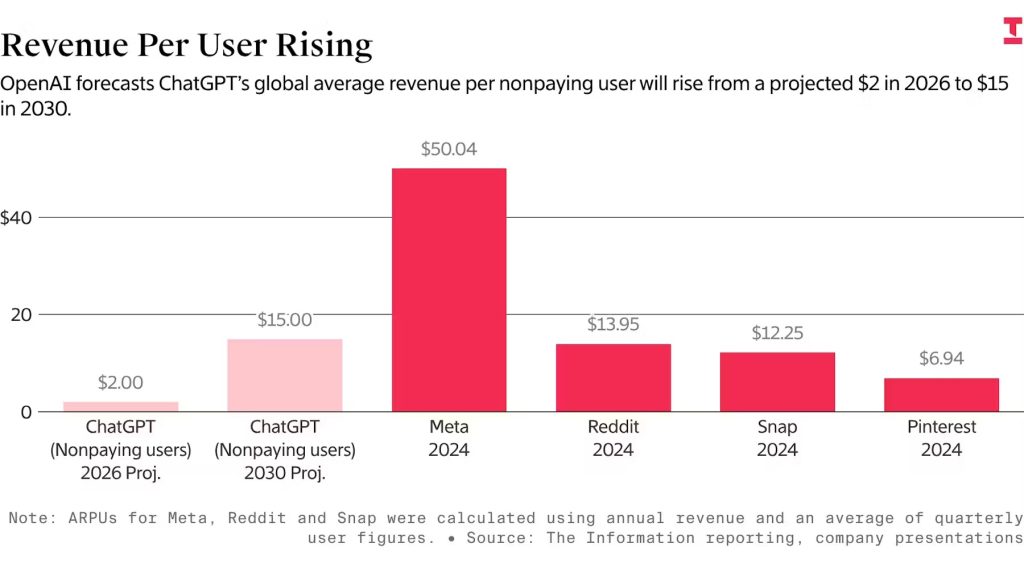
OpenAI is aiming for 2.6 billion weekly active users by 2030 (it has 900 million today), but North American users accounted for just 12% of monthly active users in Q3 2025, according to The Information’s Sri Muppidi.
She reported:
“OpenAI has told investors it could generate $112 billion in revenue from users of the free version of ChatGPT over the next five years, presumably from selling ads and taking a cut of online purchases made from the app. OpenAI spent 2025 hammering out how to put ads in ChatGPT and launching in-chat shopping features.
If those businesses take off, OpenAI has projected they could generate $46 billion in revenue from these nonpaying users in 2030 alone. But ChatGPT’s revenue will also depend heavily on where growth in its user base comes from, judging by the experience of existing digital ad firms.”
Read: OpenAI’s International Conundrum (January 4) – The Information (subscription)
From tipsheet: With “code red” just over a month old, the clock is ticking for OpenAI on how long it can wait before it holds off an ad product for ChatGPT. The company needs the ad revenue and the presumably fat margins.
Also, it’s not clear how much “hammering out” of an ads strategy the company had in place in 2025 for ChatGPT. For example, there was a widely-reported rumor in September of someone coming in to lead the ad strategy under CEO of Applications Fidji Simo. There has been no known hiring to date. Perhaps that hire is the next shoe to drop in OpenAI’s “ads in a chatbot” saga.
LLMS & CHATBOTS
Meta buys Manus, doubles down on agents
Last Tuesday, Meta agreed to acquire Singapore-based Manus, an AI agent company for $2 billion. In the press release announcing the acquisition, Meta explained:
“Manus has built one of the leading autonomous general-purpose agents that can independently execute complex tasks like market research, coding, and data analysis. We will continue to operate and sell the Manus service, as well as integrate it into our products.”
Press release: “Manus Joins Meta: Accelerating AI Innovation for Businesses” (December 30) – Meta
The reporting team at The Wall Street Journal broke the news:
“The deal is a move in a new direction for Meta, which is investing aggressively in AI to compete with Google, Microsoft and OpenAI. The deal would help the social-media giant cement its position in the product segment of AI agents, an increasingly intense battlefield of AI companies that make tools to conduct complex tasks with minimal human input. Microsoft has operated a popular AI assistant, Copilot.”
Read: “Exclusive: Meta Buys AI Startup Manus for More Than $2 Billion” (December 30) – The Wall Street Journal (subscription)
LLMS & CHATBOTS
Reaction: Meta buys Manus
Commenting on Meta’s acquisition of Manus, Mobile Dev Memo analyst Eric Seufert saw potential for Meta’s AI-enabled advertising business.
He wrote on LinkedIn:
“It seems likely that the Manus team could be deployed against Meta’s Ads Manager tools or its Advantage+ suite. That could also extend to Meta’s newly announced Business AI and Meta AI business assistant, revealed during AdWeek. I wrote about how Meta’s Business AI might ‘cross the ad-product divide’ when the tool was announced, and I recently hosted Meta’s Global Business Group VP on the podcast to discuss its use cases. (See Seufert’s links on LinkedIn)
If the Manus team is primarily tasked with developing agentic capabilities for Meta’s advertising tools — which would make sense, given the company’s core focus on agent development using third-party models — then it’d be a strong validation of the value inherent in continued campaign optimization automation as those systems approach total autonomy.”
Read more from Seufert on LinkedIn. (December 30)
From tipsheet: I asked the Manus agent (here) to explain the significance of the transaction and – after a bit of researching – this was Manus agent’s reaction:
“While much of the industry’s focus has been on the conversational capabilities of LLMs, Meta is betting heavily on the next frontier: agentic AI that moves from answering queries to executing actions. The price tag, exceeding $2 billion, underscores the perceived value of not just the technology but the established user base and revenue stream that Manus brings.”
Thanks, Manus.
If you want to use Manus Pro, it will cost you $400 annually – subject to changes by Meta, which said it will continue to offer the Pro version for now.
Related: How Meta’s Reels Became a $50 Billion Business (January 1) – The Wall Street Journal (subscription)
GOVERNANCE
IAB Tech Lab on agentic evolution
IAB Tech Lab CEO Anthony Katsur discussed the “agentic era” on the latest episode of the AdTechGod podcast released last Tuesday.
It’s a breezy, 27-minute listen for anyone looking to understand the high-level on agents in advertising from the perspective of, arguably, advertising’s most important trade body.
Katsur doesn’t go in-depth on initiatives such as IAB Tech Lab’s Agentic RTB Framework (ARTF) or the independent AdCP protocol, but he promises more announcements from the Tech Lab in January on agents.
Among Mr. Katsur’s observations…
It’s still “early days” for agents and addressing privacy is more pressing for the industry:
“I do think there is a ton of smoke and not a lot of fire. I think we eventually get there, but it does also feel like this is definitely a ‘shiny penny’ moment for the industry. And as an industry, we love shiny pennies.
And that doesn’t mean we shouldn’t innovate, but there are still a lot of fundamental things that we have to address as an industry, you know, greater supply chain transparency….
I keep hearing, ‘Agentic is gonna solve supply chain transparency.’ Protocols don’t solve for misaligned incentives and bad actors – they don’t.
That’s not what protocols address. So, I think there’s a lot of like hype around what ‘agentic’ is gonna do to the ecosystem while we’re still not tackling some of the fundamentals like supply chain transparency, privacy(…)
So there’s just still a lot of foundational work we need to do as an ecosystem before we jump to this new phase of agentic. And by the way, agentic is not the end all be all.”
On real-time bidding (RTB) versus agentic protocols:
“So there’s just still a lot of foundational work we need to do as an ecosystem before we jump to this new phase of agentic. And, by the way, agentic is not the end all be all.
There’s been talk of ‘Agents are going to replace RTB.’ Not anytime soon. RTB is incredibly efficient when used properly – the ability to inspect every single media impression and the audience attached to that and determine a fair market value of that between hundreds of buyers and sellers [across] billions of transactions happening per second. That is an incredibly powerful protocol.
RTB isn’t going anywhere anytime soon…”
On AI browsers:
“I think I have two fundamental thoughts on the AI-powered browser.
So, let’s take Chat GPT’s Atlas browser. First, I think it’s just a ‘Trojan horse’ to continue crawling – now you’re doing it from the browser and from a residential IP address. I think that’s number one.
Number two, I think the wider change with the AI browsers is going to come down to web design and information architecture. What is incredibly powerful is that you and I could be looking at the same content and Atlas could lay it out differently for each of us. It’s almost like personalized curation of content. The content doesn’t change. It’s just the way it’s presented to each of us.
Could be slightly or radically different. I think that has really interesting implications from a web design perspective. It also, I think, has interesting implications from an advertising perspective…”
Hear it on the Apple Podcasts app. (December 30)
From tipsheet: Katsur said 2025 was the “most hectic” year in his 25+ years of digital media. That’s saying something! What will 2026 bring?
LLMS & CHATBOTS
Anthropic’s Claude targets marketing plans
In a Google Search paid advertisement yesterday, Anthropic appeared to be targeting users seeking media planning and research capabilities via the company’s latest coding model, Claude Sonnet 4.5.
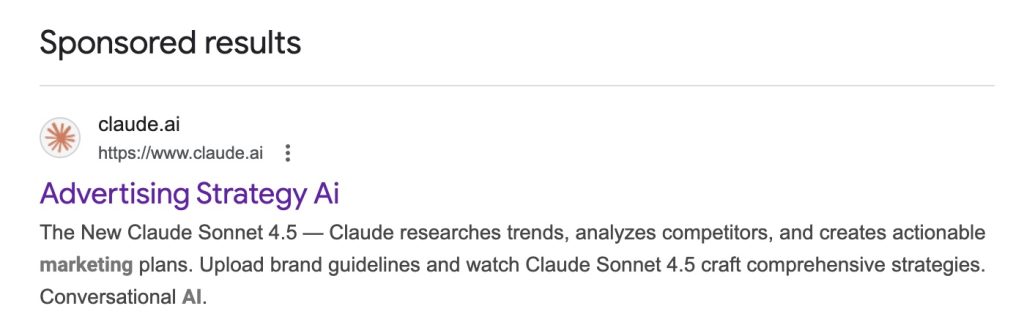
From tipsheet: Anthropic continues to target business-to-business users and use cases whereas OpenAI has straddled the B2B and business-to-consumer worlds.
LLMS & CHATBOTS
Meta’s Privacy Policy, AI and ads
“You might be noticing that ads on Instagram and Facebook are getting more personal, and that’s because they probably are.
Meta updated its privacy policy last month, adding that data it collects from user interactions with its AI services will now be used for targeted ads across the company’s social media platforms.”
Read: “Meta’s New Privacy Policy Opens Up AI Chats for Targeted Ads” (January 2) – Gizmodo
CREATIVE
Opinion: AI is reshaping how creatives work
Last Friday, a Rolling Stone opinion piece by Toronto-based Adam Rumanek of Aux Mode, a streaming video ad platform, dipped its toe into the topic of AI and advertising and the emerging trend’s potential.
“AI video and voice tools such as Runway, Synthesia and ElevenLabs are transforming production. These systems can create lifelike presenters, realistic voices and localized content without reshoots. A single video can now be automatically translated and dubbed into multiple languages while preserving emotion and tone, a massive advantage for global brands seeking efficiency and cultural relevance.
AI isn’t replacing creatives; it’s reshaping how they work. Marketers now use AI to spark ideas, refine visuals and iterate faster than ever. This ‘co-creation’ model blends human insight with machine precision. Skills like prompt engineering and knowing how to guide an AI toward a desired output are becoming just as valuable as traditional design and copywriting.”
Read: “The Rise of AI-Generated Advertising: How Brands Are Redefining Creativity” (January 2) – Rolling Stone
From tipsheet: As you might expect from an industry participant, the point of view is glass half-full on AI and ads. Nevertheless, seeing the industry reach out to consumers at this time of rapid change – through a consumer publication – appears refreshing. Consumers need to understand the benefits of AI beyond the continual refrain of efficiency and job loss.
MORE
-
- 2025 Ad Market Came In Like A Lion, Going Out Like A Lamb (December 31) – MediaPost
- Omnicom Preps for a High Stakes CES (January 2) – Adweek (subscription)
- 14 marketers predict what’s next for streaming, measurement, AI and retail in 2026 (December 29) – The Current
- Can AI Chatbots Run Ads Without Losing Consumer Trust? (January 2) – AdExchanger
- Why Selling Adtech Is So Hard (January 2) – Andrew Kraft on Substack