

In an interview in Wired, OpenAI CEO of Applications Fidji Simo discussed a range of subjects including her division of labor with OpenAI CEO Sam Altman and ads strategy. On responsibilities, Mr. Altman oversees research, compute, and fundraising, while Ms. Simo owns everything else — including ads.
Wired reporter Zoë Schiffer got the coveted interview and quickly pressed on the potential for an ad revenue model within OpenAI’s ChatGPT. Ms. Simo was ready.
ZOE SCHIFFER: ”Part of your mandate is figuring out how ads would work inside ChatGPT. How might that look, and what’s your timeline?”
FIDJI SIMO: ”Advertising as a model works really well when you have a lot of commerce intent. We have a ton of it already, people coming and asking for shopping advice. The important thing before we ever consider ads is making sure that our commerce experience is fantastic and that people come and really explore all the products that they want and get great recommendations.”
ZOE SCHIFFER: ”So you’re not at the point where if someone asks for shopping advice, they might get recommended a paid product?”
FIDJI SIMO: ”No.”
ZOE SCHIFFER: ”OpenAI has rich user data. It combines peoples’ work life, their most personal thoughts, their habits and product needs. That information is extremely attractive to advertisers. How are you thinking about data privacy as you scale?”
FIDJI SIMO: ”Whatever we do is going to have to be extremely respectful of that. That’s why we haven’t announced anything on ads, because if we ever were to do anything, it would have to be a very different model than what has been done before.
What I’ve learned from building ad platforms is that the thing people don’t like about ads very often is not the ads themselves, it’s the use of the data behind the ads.”
Read the interview in Wired. (November 17 – subscription)
From tipsheet: The “ads message” is two-fold in the interview: 1) Commerce first, then ads in a chatbot. 2) Contextual ads in a chatbot, right this way!
Previously, Mr. Altman has been, at best, reluctant (1, 2, 3) about inserting an advertising model into ChatGPT. In the Wired interview, Ms. Simo expressed that the use of a customer’s data in ad targeting is an issue that can undermine trust.. Given that answer, it would seem contextual advertising of some sort is in the ads pipeline at OpenAI.
LLMs & CHATBOTS
“Group Chat” limits and ChatGPT ads
OpenAI’s announcement last week regarding Group Chat capabilities in ChatGPT piqued the curiosity of Stratechery analyst Ben Thompson. He saw signs of OpenAI struggling to grow its subscription revenue model for its chatbot -and, yet another signal that ads are inevitable for the company’s chatbot.
Mr. Thompson wrote yesterday:
“Speaking of limitations, you can really start to see the seams of the paid subscription model starting to show in this paragraph (begins ‘Group chats work much like…’). Answers may differ in quality based on the subscription level of whoever asked ChatGPT a question, and some users in a chat may have rate limits, while others do not. What this says to me — unsurprisingly — is that ChatGPT really needs to get going on that ad-supported model! Seeking to build a network effect is a worthwhile line of defense against Google, and line of attack against Meta; more broadly, massive penetration and awareness is already ChatGPT’s biggest defense. All of this is dramatically enhanced if the best possible product is ‘free’ to use.”
Read more in Stratechery. (November 17 – subscription)
LLMS & CHATBOTS
Developments
- Today (November 18) at 11a P.T.: Webinar on OpenAI’s Atlas browser – “I freaking love using our new OpenAI browser ‘Atlas’ for work. So much so that we literally rushed forward a virtual session just to show a bunch of demos on how you can use Atlas.” – Dane Vahey, Marketing, OpenAI on LinkedIn yesterday
- xAI unveils Grok 4.1 (November 17) – xAI
- Jeff Bezos takes co-CEO role at secretive AI startup Project Prometheus (November 17) – GeekWire
LLMs & CHATBOTS
Ad revenue rockets at AI startup
AI coding agent startup Sourcegraph told The Information that ads in its free tier, which targets coding developers, is already generating $5M to $10M in annualized revenue. Free money!
The company’s the ad-supported tier was just launched last month.
Read more in The Information. (November 17 – subscription)
Regarding Sourcegraph’s AI-related revenue, Mobile Dev Memo analyst Eric Seufert commented on X, “This is a no-brainer, and it will seem odd in 1-2 years that OpenAI dragged its feet on the ad-supported model.” Read more. (November 17)
From tipsheet: I realize it’s not necessarily apples-to-apples when comparing to Sourcegraph’s product, but imagine the ads “spigot” which can be opened by OpenAI – or any of the chatbots. Also, at some point, an insurgent LLM-supported chatbot would be wise to just aim at ads while the other chatbots shuffle their AI “feet.”
LLMs & CHATBOTS
OpenAI is more than ChatGPT
On LinkedIn yesterday, OpenAI global business executive James Dyett reiterated the point that his company is not just a chabot supported by a best-in-class Large Language Model (LLM).
He showed off a new chart from research firm Gartner as proof and said:
“Most of the narrative is about OpenAI’s consumer product, ChatGPT. But, OpenAI has spent the last several years helping Fortune 500 enterprise customers use our tools to solve real problems. Gartner’s latest view reflects the results our customers are seeing and the product and engineering work happening behind the scenes”
Read more on LinkedIn. (November 17)
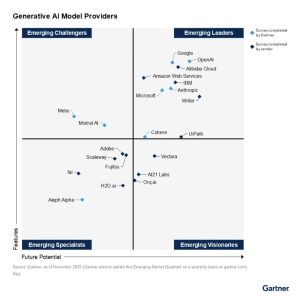
From tipsheet: Even though pay-for-play can be involved in studies such as this, it’s interesting to see the “meta,” and Meta, in the AI race.
PLATFORMS
Yahoo adding agents to DSP strategy
Adweek’s Kendra Barnett reported that Yahoo is moving toward agentic workflow and more automation with its DSP, according to her sources. Six new AI agents are at the core of the strategy as she explained:
“The agentic bots, which will live within Yahoo’s demand-side platform, or DSP, can not only respond to user queries but also take action on a user’s behalf. They are all being tested, in various capacities, by Yahoo advertising clients and adtech partners, one of the people said.
One media buyer who was presented with the agents during a demo earlier this month was skeptical, calling them ‘still largely an LLM wrapper’ without fully autonomous features.”
Read more in Adweek. (November 17)
Barnett added on LinkedIn that “Yahoo is planning a broader rollout in early 2026 and is positioning the offering under a ‘Yours, Mine, and Ours’ strategy, enabling brands to use Yahoo’s native agents or plug in their own via MCP.” Read more. (November 17)
BRANDS
Marketers learning, adapting with AI
- Marketers Are Learning That AI Is Only As Skillful As The Humans Prompting It (November 17) – AdExchanger
- Inside the AI skills race and how marketers are adapting (November 17 – Ad Age (subscription)
- New Agency Artists & Robots Aims to Underpin Brand Experiences With AI (November 17) – Adweek (subscription)
SELL-SIDE
Cloudflare turns to AI cloud
There was no mention yesterday of its AI content marketplace by Cloudflare’s regarding its latest acquisition, Replicate.
In fact, it’s the seeds of an AI cloud strategy as Cloudflare explained in a blog post:
“To meet the needs of developers, Cloudflare has been building the foundational pillars of the AI Cloud, designed to run inference at the edge, close to users. This isn’t just one product, but an entire stack.”
Read more on the Cloudflare blog. (November 17)
More: Cloudflare to Acquire Replicate to Build the Most Seamless AI Cloud for Developers (November 17) – press release
From tipsheet: Note the company’s positioning in the blog post – “the hub for AI exploration.” This could work for content publishers. They need to explore, too. And connecting with a community of AI developers courtesy of Cloudflare, and now Replicate, could be important.
PLATFORMS
Automating Amazon Ads with AI
Digiday reporter Ronan Shields previewed his latest piece on Amazon and connected some of the reduced headount at the company with platform upgrades for ads. He wrote on LinkedIn:
“Amazon Ads slashed headcount by up to 20%, according to sources (although claims vary), with the company relying on upgrades to its platform, i.e., lowering barriers between Sponsored Ads and its DSP (which often frustrates buyers), to bolster growth.
Can it sustain its ascendancy with less headcount and more AI?”
In the feature article on Digiday, Shields spoke to Amazon DSP director Meredith Goldman who detailed the iterative process underway as the Amazon Ads tech stack is automated:
“That automation is being powered by AI, which Amazon says can assist advertisers in everything from bid adjustments to creative generation. Goldman described a new ‘smart mode’ that uses conversational inputs to control campaigns. ‘You might say, “Show me all my campaigns pacing over 75% delivery,” and then, “Increase my bids by 20%.” It’s just an easier way to fulfill your planning and activation in a simplified form,’ she explained. Users can toggle between ‘smart mode’ and ‘expert mode,’ with the latter giving seasoned buyers full manual control.”
Read: How Amazon aims to do more with less (November 17) – Digiday (subscription)
Related: Will Amazon’s AI-powered one-stop shop for advertising change the game? (November 17) – Marketing Dive
TECH
Quantcast CEO Feldman on Q platform
Quantcast co-founder and CEO Konrad Feldman published a rare post on LinkedIn announcing his company’s new Q platform – or “Q Suite” – which positions itself as “Autonomous AI for Superior Campaign Performance.”
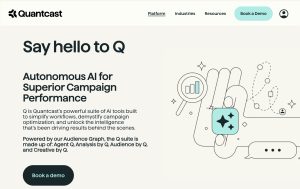
Mr. Feldman differentiated his company’s new automated demand-side platform (DSP) entrant by noting it was built natively with AI.
Mr. Feldman began on LinkedIn yesterday:
“Traditional DSPs don’t have an AI problem. They have an architecture problem.
They were built for a world where humans clicked buttons, waited for reports, and made changes days later. Then they bolted ‘AI’ on top and called it innovation. It might automate tasks, but it cannot overcome the core limitation: a system built around human cognition can’t learn from massive, high-dimensional data, instantly infer from millions of signals, or dynamically adapt at the speed of the digital world…”
Read the entire post on LinkedIn. (November 17)
From tipsheet: Quantcast was founded in 2006 and an early programmatic pioneer. Like many ad tech companies, Quantcast has been using AI in the form of machine learning for years. LLMs and more/better/faster compute appear to augment the AI opportunity by enabling autonomy and agents. It’s “found gold” for entrepreneurs like Mr. Feldman and many others – and you!
MORE
- Levi Strauss & Co. partners with Microsoft to develop next-gen superagent (November 17) – Microsoft
- “More Demand Gen features are launching just in time for the holidays including AI Image and Video Enhancements…” (November 17) – Google Ads & Commerce blog
- MiQ releases global report showing 27-point gap between AI usage and readiness in advertising (November 17) – MiQ