
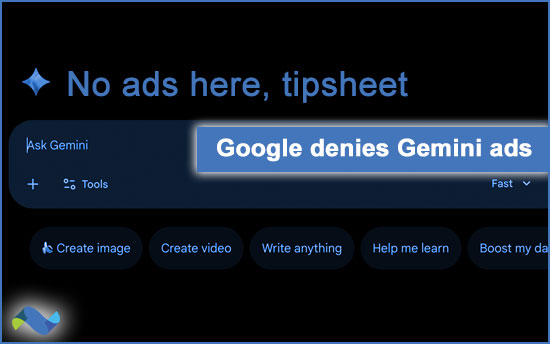
Ads are coming to the Gemini AI-enabled chatbot app in 2026, according to Adweek’s Trishla Ostwal per agency sources.
She reported:
“In separate calls with at least two advertising clients, Google reps indicated that ad placements in Gemini are targeted for a 2026 rollout, though details on formats, pricing, and testing remain unclear, according to one buyer, who spoke under condition of anonymity in order to discuss the meeting. This buyer said the plan is separate from advertisements in AI Mode, Google’s AI-powered search experience launched in March.”
Read more in Adweek. (December 8)
Yesterday afternoon, Google VP of Global Ads Dan Taylor refuted the story’s findings on X and said:
“This story is based on uninformed, anonymous sources who are making inaccurate claims. There are no ads in the Gemini app and there are no current plans to change that.”
From tipsheet: If/when this finally does happen, ads in Gemini would set up another apples-to-apples comparison with OpenAI’s ChatGPT. Google would be monetizing its standalone chatbot and OpenAI would not — a potential new challenge for OpenAI.
Related: Former Google advertising VP and current YouTube CEO Neal Mohan Is Time’s 2025 CEO of the Year (December 8) – Time
LLMs & CHATBOTS
eMarketer: Gemini versus ChatGPT, Dec. 2025
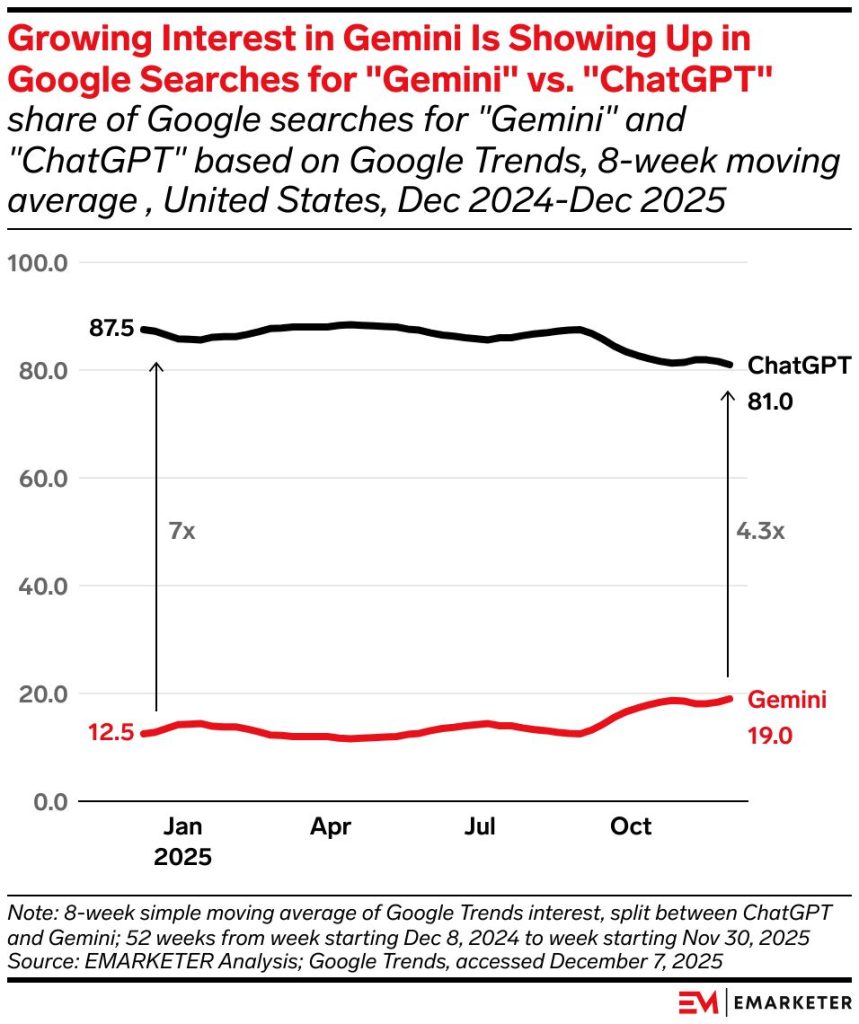
Vladimir Hanzlik of eMarketer “met the moment” on LinkedIn yesterday with a timely new graphic showing the effects of Google Gemini chatbot growth versus OpenAI’s ChatGPT.
Mr. Hanzlik explained:
“There’s been a lot of coverage of how the release of Google’s latest Gemini model led OpenAI to declare a ‘code red‘ and refocus its efforts on the quality of the company’s model.
What gets less coverage but might also be spooky for OpenAI is that consumers are starting to pay more attention to Google’s Gemini model.
A year ago, there were 7 Google searches for ‘ChatGPT’ for every search for ‘Gemini’. That number is at 4.3 today and ChatGPT’s lead appears to be coming down quickly.”
Read it on LinkedIn. (December 8)
LLMs & CHATBOTS
Developments
- Claude and Slack, better together (December 8) – Anthropic
- Architecting Security for Agentic Capabilities in Chrome (December 8) – Google Security blog
- You can buy your Instacart groceries without leaving ChatGPT (December 8) – TechCrunch
AGENCIES
Frontier AI models? Try frontier agencies
The global CEO for media agency AKQA, Baiju Shah, gave his first interview since taking over the role in July. The former Accenture executive explained how his full-service WPP agency is on the “front foot” with AI in a feature article on Fast Company.
In previewing the feature on LinkedIn, Mr. Shah explained:
“A good conversation has a way of sharpening your thinking, and this one certainly did. We spoke about operating as a frontier agency at the edge of what is possible, what that means for teams, and why imagination paired with technology is becoming essential to driving real growth. (…)
It reinforced a view I care deeply about: the more advanced the technology becomes, the more decisive human judgment, taste and imagination become.”
Read more on LinkedIn. (December 8)
Read: AKQA CEO Baiju Shah explains how the agency is leveraging AI instead of being disrupted by it (December 8) – Fast Company (subscription)
Related: How a venture capital firm’s (Spacecadet) new creative agency aims to serve frontier tech startups (December 8) – Ad Age (subscription)
SEARCH
The SEO specialist and Google AI
The IAB UK published a Q&A with Abhishek Agarwal, a Google UK agency sales manager, who provided guidance to search marketers concerned about the impact of AI Mode in Google Search and ongoing development of Google’s search ad buying platform, AI Max.
From the questions:
IAB UK: “What skills and capabilities do you think your teams will need to future-proof your search offering as AI evolves?”
ABISHEK AGARWAL: “This is a crucial question for our partners, as the required skills must evolve alongside the technology. For agency and advertiser teams, future-proofing their search offering will require a pivot from manual execution to becoming strategic partners who maximise the value of AI. Competencies such as strategic business consulting, mastering the deployment of AI solutions on strong first-party data foundations, best-in-class measurement approach and a test-and-learn mindset are essential to achieving this capability shift.”
Read the Q&A on the IAB UK’s website. (December 8)
From tipsheet: With Google leading the AI charge, the search engine optimization (SEO) specialist role may fully transform to an integrated SEO and answer engine optimization (AEO) discipline in 2026.
What will be curious to watch is how consumers embrace Gemini and its search function versus the traditional Google[dot]com.
STARTUPS
Video ads “that feel like they belong”
A startup called Halftime and comprised of three students from the University of Waterloo turned heads last weekend with their video ad product at the xAI hackathon. The students, Yuvraj Dwivedi, Krish Garg and Pravin Lohani, announced their win on LinkedIn yesterday (1, 2 and 3).
Mr. Dwivedi described Halftime’s AI-enabled solution as generating “cutscenes and product placements in real time based off of your interests.”
xAI confirmed the win late Sunday on X with a clip of the product demo and tweeting, “Halftime: Dynamically weaves AI-generated ads into the scenes you’re watching, so breaks feel like part of the story instead of interruptions.”
An X summary added, “The tool won first place at the December 6-7 event, which drew over 500 developers and featured Elon Musk announcing SpaceX launch trips for winners.”
See the demo. (December 7)
From tipsheet: Pretty cool demo. This video ad product appears to create all new scenes with shopping links within the the content courtesy of AI. This is not just virtual product placement — it’s virtual content creation.
This may be table stakes in a year.
PLATFORMS
AI Ad Variants for B2B marketers
LinkedIn announced a set of new marketing tools for its business-to-business advertisers yesterday.
The announcement explained in part:
“Producing enough high-quality copy to fuel continuous testing is one of the biggest challenges for B2B marketers. AI Ad Variants solves this by generating fresh, on-brand creative from a single seed input — your existing headline or intro — so you can expand your content pool without expanding your workload.”
Read: “How New LinkedIn Features Help You Scale Personalized Creative and Boost Awareness” (December 8) – LinkedIn for Marketing blog
From tipsheet: Creative seems to be the part of the AI advertising toolkit most often addressed by ad tech companies currently. Everyone wants to make it easier for marketers to spend.
COMMERCE MEDIA
Podcast: RMN vs. CMN… and AI
Consultant and Aperiam Ventures managing partner Danilo Tauro, formerly of Amazon and P&G, spoke to sell-side executive James Deaker on his “Yield Doctor” podcast recently.
Read Mr. Deaker’s podcast preview on LinkedIn. (December 8 )
The two discuss the coming impact of AI on retail media. Mr. Tauro believes [35:40] AI is, and will, bring benefits to RMNs led by automation across planning, campaign management and creative.
Also, at the top of the podcast, Messrs. Tauro and Deaker level set and tackle the difference between Retail Media Networks (RMNs) and Commerce Media Networks (CMNs):
JAMES DEAKER: “I’ve thought of Retail Media Networks as a subset of Commerce, in the sense that Retail for me is more directly people who sell physical goods – so Amazon, Walmart or Safeway/Albertsons, Target etc. Those to me are companies who are retailers who have extended into having Retail Media Networks.
Whereas I’ve thought about other Commerce Media Networks as being a broader category of other more service-oriented companies — i.e. Marriott, United, Expedia, etc.”
DANILO TAURO: “I think the way you describe it is 100% correct. And I like also the cluster that you built because ultimately you have Commerce Media Network, which is this bigger bucket.
Then within the CMN, you have a smaller one which is making more money, the RMN, where you have a marketplace – where you have the [consumer] buyer that enters the marketplace with the high intent to buy something. (…)
Is there a marketplace – Yes or No? If yes, it’s a Retail Media Network, and it’s easier.
If it’s not a marketplace, then it becomes a bit more picky to monetize because — again, video, display — it’s a more competitive space. So the absence of the marketplace in the broader sense of CMN, that’s what makes the overall business model different.”
Hear the 39-minute podcast on YouTube. (December 8 )
From tipsheet: This is an excellent podcast that breaks down the inner-workings of RMNs and CMNs and their economics.
Related: Commerce Media Surpasses TV Globally and Traditional Search Holds AI at Bay—For Now (December 7) – Adweek
TECH
Opinion: Advising advertisers on MFA sites
Speaking to his company’s platform capabilities, Zefr co-CEO Rich Raddon made the case on why advertisers need to be more sensitive when it comes to made-for-advertising (MFA) sites and AI generated content.
In an op-ed on AdExchanger, Mr. Raddon advised:
“Verify, don’t assume. Add independent layers of verification to see exactly where ads are running. Don’t accept platform reporting at face value.”
“Define your comfort zone with AI content. Work with brand-suitability and safety partners to distinguish between AI-assisted creative expression and AI-generated MFA or fraud.”
“Use AI thoughtfully. Automation can enhance efficiency, but advertisers should ensure it doesn’t compromise authenticity or quality.”
Read more on AdExchanger. (December 8)
From tipsheet: AI has helped renew the importance of contextual awareness in digital advertising after leaning toward audience and cookies for years. Also, “brand safety” has become more nuanced with “brand suitability” (where Zefr is trying to play).
MEASUREMENT
Triangulating the consumer data opp
Uber Advertising has partnered with LiveRamp to create a marketing analytics platform called Uber Intelligence which aggregates anonymized Uber user data, according to Business Insider.
BI’s Lara O’Reilly explained a use case: “A hotel brand could use Uber Intelligence to help identify which restaurants or entertainment venues it might want to partner with for its loyalty program, for example.”
Uber Advertising measurement exec Edwin Wong told O’Reilly that the aim with the new product “is for marketers to begin saying, ‘Oh, I’m not just understanding Uber, I’m understanding Uber in my marketing context.’”
Read more. (December 8 )
From tipsheet: AI loves context. Though there was no mention of it in the article, this product as a feed into AIs seems like a no-brainer. Perhaps there is a licensing business to-come for Uber and/or LiveRamp.
LLMs & CHATBOTS
OpenAI using clicks to optimize
As a result of “code red,” The Wall Street Journal reported last night that OpenAI and CEO Sam Altman may be optimizing ChatGPT with user clicks in order to improve engagement.
Journal reporters explained:
“And it was telling that he instructed employees to boost ChatGPT in a specific way: through ‘better use of user signals,’ he wrote in his memo.
With that directive, Altman was calling for turning up the crank on a controversial source of training data—including signals based on one-click feedback from users, rather than evaluations from professionals of the chatbot’s responses.”
Read: “Sam Altman’s Sprint to Correct OpenAI’s Direction and Fend Off Google” – The Wall Street Journal (December 8) – The Wall Street Journal. (subscription)
From tipsheet: Back in July, OpenAI head of ChatGPT Nick Turley said the company optimized ChatGPT for retention not engagement. This latest move to click-based optimization would seem to move in the opposite direction and make the chatbot more sticky.
TECH
OpenAI: How AI improves enterprise
OpenAI CEO of Applications Fidji Simo teased her company’s latest AI research report on LinkedIn yesterday (December 8):
“Some highlights of our Enterprise report:
- 75% of workers say AI improves the speed or quality of their work, saving 40–60 minutes a day
- Heavy users save 10+ hours per week
- Coding-related messages from non-technical roles are up 36%
- 75% say they can now complete tasks they previously couldn’t”
Read the report on OpenAI’s website. (December 8)
MORE
- “Pinterest faces ‘heightened AI risk’ and is losing advertisers to competitors — Wedbush” (December 8) – Seeking Alpha
- Judge limits Google’s default search deals to one year (December 8) – Search Engine Land
- Google and Apple partner on better Android-iPhone switching, i.e. data-transferring (December 8) – 9to5Google
- Paramount launches hostile takeover bid for Warner Bros. (December 8) – Axios
- “Affiliate networks have ‘stand-down’ rules about when and how software publishers–affiliates with browser plugins–can present their offers. Inexplicably, Microsoft Edge doesn’t follow the rules.” (December 8) – Ben Edelman on LinkedIn