

Aligning search partner ads with PMax
In a move toward more transparency, Google announced yesterday that marketers would be able to see where their ads ran on the Search Partner Network (SPN).
On the “Google Ads Help” website, Google explained:
“Similar to placement reporting for Performance Max campaigns, you can now determine exactly where your ads are appearing on the SPN for all your Search, Shopping and App campaigns. The report will provide a list of all SPN sites your campaigns served on, along with impression data for each site.”
Read more on Google Ads Help. (undated in August).
Related: “Search campaigns will soon drop manual language settings, leaving AI to automatically detect and target user languages.” – Search Engine Land (August 18)
From tipsheet: Google is unifying its AI- and PMax-first approach across its advertising products.
LLMs & CHATBOTS
Superintelligence developments
- Memo: Meta restructures Superintelligence Labs; Alexandr Wang heads TBD Lab, Robert Fergus heads FAIR, Nat Friedman heads products, Aparna Ramani heads Infra (August 19) – Bloomberg (subscription)
- Here’s what marketers want from Meta’s Superintelligence Labs – Digiday (subscription)
LLMs & CHATBOTS
Of interest: AI agent tech stack
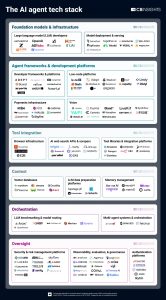
Yesterday, CB Insights’ Head of Insights Jason Saltzman laid out the “AI Agent Tech Stack” on LinkedIn and explained:
“The AI agent tech stack spans 6 interconnected layers, each serving a critical function in enabling autonomous intelligent systems: Foundation Models & Infrastructure; Agent Frameworks & Development Platforms; Tool Integration Layer; Context & Memory Management; Orchestration and Oversight & Governance…”
The landscape is not specific to advertising, of course. On the other hand, it likely contains elements of how ALL advertising agents are made.
Related: Will AI agents pave the path to CPA ads? (August 19) – Aaron Goldman, CMO, Mediaocean, on The Drum
BRANDS
Leading the AI charge
Unveiling results of a July reader survey, Adweek’s Paul Hiebert found that marketers aren’t really sure how to begin when integrating AI into their workflow.
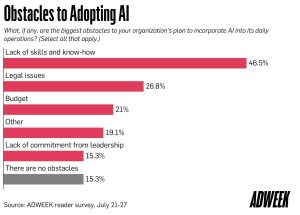
Perhaps part of the challenge stems from ownership of the AI transformation process at surveyed companies. Hiebert noted:
“As for who is leading the plan to implement AI throughout the organization, 23% of survey respondents said the marketing department was in charge. Another 19% pointed to the IT department, while 13% indicated the operations team was responsible.”
Read more in Adweek. (August 19)
BRANDS
AI experimentation and the CMO
On Google’s “Think With Google” blog, yesterday’s post targeted chief marketing officers in Africa, but the content could be relevant to CMOs everywhere. Performance lead for Sub-Saharan Africa, Vumani Ncube, encouraged fellow Africans to begin experimenting with AI across three silos of marketing.
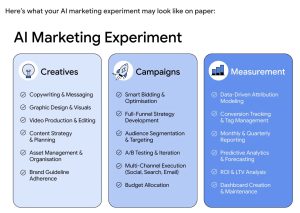
Citing data from a McKinsey report in May, Mr. Ncube noted that Africa actually led other areas of the world in terms of business experimentation with AI.
“40% of businesses across sectors in Africa have already either trialled generative AI or successfully implemented tools and solutions.”
Read more on “Think With Google.” (August 18)
AGENCIES
Optimizing for zero-click search
Havas’ AI-enabled Brand Insights tool received a deeper look on Monday. The tool was announced last week. Digiday’s Sam Bradley wrote:
“French holding company Havas is the latest to start offering some answers to their questions. It’s developed a tool called Brand Insights AI which can give advertisers a real-time ranking of their performance in search results generated by ChatGPT, Perplexity, Grok, Google, DeepSeek and Anthropic’s Claude model. The application has been used to ferret out key sources behind an AI response, and to provide recommendations for content that could indirectly exert more influence over zero-click results.”
Read more on Digiday. (August 18)
AGENCIES
AI advantage feeds client win
“[Mastercard] is a landmark win for our company that speaks to the momentum we’re building as WPP Media, the power of our integrated offer, and the value of the investments we’re making to give our clients an advantage in the AI era…”
WPP Media CEO Brian Lesser discussed his media agency winning the Mastercard account formerly managed by Dentsu’s Carat.
Read more from Mr. Lesser on LinkedIn. (August 18)
SELL-SIDE
Generative AI ads for podcasts
Spotify’s Chloe Wix, global head of product and commercial growth at Spotify, addressed the possibility of expansion plans for the company’s generative AI audio ads for podcasts launched earlier this year.
Ms. Wix told AdExchanger:
“For now, that tool is specific to our walled garden, but we are seeing advertisers lean into the AI tools being provided by DSPs. The Trade Desk, for example, which is one of our partners, has a pretty robust suite of AI audio creative tools. We may have our own first-party tools in the future, but we’re currently more focused on the third-party use case for our ad exchange.”
Read more on AdExchanger. (August 19)
SELL-SIDE
A shift to licensing, but usage coming soon
Catherine Perloff wrote in The Information yesterday that news publishers are shifting to AI licensing with Large Language Model (LLM) companies rather than usage-based deals. The basis of her article was the IAB Tech Lab’s meeting last month on the topic.
The real news appears to be that answer engine Perplexity will roll out a usage-based publisher payment program soon.
She explained on LinkedIn yesterday:
“As AI firms pose a huge threat to websites’ business models, web publishers are talking about a new way to get paid -by how much AI firms use their content. It’s a departure from the existing deals OpenAI have crafted with publishers, which have mostly been apportioned via flat fees.
Perplexity is launching a new publisher payment program in the coming weeks that will take usage into account, which join proposals for usage-based payment from Cloudflare and the IAB Tech Lab, introduced earlier this summer.
Will other tech companies play ball? Google, Meta, Amazon and Microsoft all attended an IAB Tech Lab meeting with web publishers last month to discuss the idea.”
Read more in The Information. (August 19)
More: Read about Bertelsmann executive Achim Schlosser’s observations from the IAB Tech Lab meeting back in July.
Licensing is for large, scaled publishers.
For smaller publishers, crawling such as what Cloudflare has proposed or brokering content (covered here) may make better sense.
TECH
Scale is not a friend of outcomes
In an op-ed in Ad Age, Cintia Gabilan, a B2B marketing veteran and SVP of product development with the IAB, said that advertising industry isn’t ready for an outcomes-based pricing model: “The reality is we’re not ready to make outcomes the core currency—not across all channels, and certainly not at scale.”
Read more. (August 19 – subscription)
From tipsheet: Reach and frequency lives another day.
TECH
AI meets audio ads
Wondercraft co-founder Oskar Serrander spoke to AdExchanger about his company’s AI-enabled audio advertising toolkit and its latest creation: “Wonda.” AdExchanger’s Joanna Gerber described as “an AI agent that works with creators to generate and revise new audio content, from audiobooks to podcasts to ads.”
Given Wonda’s apparent ability to generate an entire commercial or podcast episode, Mr. Serrander made clear to AdExchanger that “We’re not replacing podcasting [and] we’re not replacing the human.”
Read more on AdExchanger. (August 19)
More: Wondercraft launches Wonda AI agent for content creation (August 19) – press release
From tipsheet: Beyond the ads example, voice is another “sea change” yet to come with AI. No typing necessary. As much as browsers are seen as critical today, Yext CEO Mike Walrath made a good case for the voice-activated tipping point on a podcast (irony!) several weeks ago.
HR
Now hiring
- Stephen Palombo joined Universal Ads as “Executive Director, Machine Learning + Ad Marketplace” (August 18) – ADSN
- POLITICO elevated Francesca Barber to EVP, AI & Innovation (August 19) – Politico
PROMPT
In 5 years, what will Google’s Performance Max do that it can’t do today?
Response from Mistral’s Le Chat:
Predicting exactly what Google’s Performance Max (PMax) will be able to do in 5 years (around 2030) involves some speculation, but we can make educated guesses based on current trends in AI, automation, and digital advertising. Here are some likely advancements:
Voice and Conversational Ad Integration
- Today: PMax is primarily visual and text-based.
- In 5 Years: As voice search and conversational AI grow, PMax could optimize for voice-activated ads, chatbot interactions, and even generate dynamic audio ads…
MORE
- The Surf Lodge Reinvents Itself With AI Dinners And Wellness Mornings – Forbes
- Inside advertising’s shift in beauty standards—body positivity backtrack and the rise of AI models – Ad Age (subscription)
- Composability will Power the Next Generation of AI-Driven Advertising: Infillion’s Simon Asselin (August 18) – Beet.tv
- OpenAI Staff to Sell $6B in Stock (August 18) – TBPN (begins 07:18)
- ‘Brainstorm tool’: B2B firm Typeform on seeing AI as a ‘sidekick’ (August 19) – MarketingWeek