
LLMs & CHATBOTS
Usage-based deal from Perplexity
More details emerged about answer engine Perplexity’s usage-based deal for publisher content.
The Information’s Catherine Perloff had already hinted at Perplexity’s usage-based product last week, but it did not include the additional details reported by Bloomberg, The Wall Street Journal and others yesterday.
The Wall Street Journal said that Perplexity will use a “pool” of $42.5 million when publishers articles are used. Also:
“Perplexity plans to distribute money when its AI assistant or search engine uses a news article to fulfill a task or answer a search request.
Its payments to publishers will come out of the subscription revenue generated by a new news service, called Comet Plus, that Perplexity plans to roll out widely this fall.
Perplexity said publishers will get 80% of Comet Plus revenue, including from the more expensive subscription tiers that provide Comet Plus free of charge.”
It’s important to note that this usage-based deal is not “live” yet. And though it has deals with publishing companies like Gannett (July 2025), how will publishers participate?
Later, in a blog post, Perplexity said, “We’ll announce our initial roster of publishing partners when Comet becomes available to all users for free. Publishers interested in participating can join the program by emailing us via publishers[at]perplexity.ai.”
It was only two weeks ago that Perplexity made an offer to buy the Google Chrome browser.
More: Introducing Comet Plus (August 25) – Perplexity
From tipsheet: The company continues to hit many of the “hot button” issues in AI, media and marketing with its strategy announcements.
LLMs & CHATBOTS
A vote for modular ecosystems
“Meta announced last week its partnership with Midjourney to license its aesthetic technology for future AI models. This will enhance Facebook and Instagram and WhatsApp, but more so, it’s proof that even the biggest players in media won’t do it all alone. The winning strategies in media AI will come from those who can orchestrate the ecosystem, not own every piece of it.”
Jeremy Flynn, EVP of Product, Horizon Media (August 25)
Read more from Jeremy Flynn, EVP of Product, Horizon Media on LinkedIn. (August 25)
From tipsheet: If the modular open construct for AI is true, no one should count out Apple.
LLMs & CHATBOTS
Developments
“Elon Musk’s xAI sues Apple and OpenAI, alleging anticompetitive collusion” (August 25) – TechCrunch
From tipsheet: Interesting to see Apple and OpenAI grouped in this lawsuit. Considering the “modular” item above, it’s another breadcrumb on a potential future partnership, which Elon Musk may already see.
BRANDS
Know your (creative) diffusion model
On LinkedIn yesterday, Analyst Eric Seufert teed up a Mobile Dev Memo blog post on how diffusion models are changing ad creative.
This may be more than some marketers want to know—especially if they don’t want to get into the weeds of gen AI creative where “diffusion models, which power DALL-E and Stable Diffusion, are at the forefront.”
Read more on LinkedIn. (August 25)
On his Mobile Dev Memo website, Mr. Seufert laid out his premise:
“Denoising diffusion probabilistic models (DDPM), also known as diffusion models, represent an important area of frontier research in machine learning. Diffusion models are generative and have been used to produce high-quality samples of various media, including images and audio.”
This piece speaks to a trend in AI in advertising – the more creative executions, the better. But some models which make creative on the fly will potentially not do as well as others, so marketers may need to have their own diffusion models for creative development.
In summary, Mr. Seufert said:
“… as large ad platforms increasingly promote their end-to-end automation suites, creative variation — and the ability to generate large volumes of diverse creative — becomes vital for advertisers. While many of those platforms will offer this capability natively, not all will, and advertisers may see value in developing their own proprietary DDPM models for producing and deploying creative.”
Read Mr. Seufert’s piece titled, “Diffusion models for ad creative production” on his Mobile Dev Memo website. (August 25 – subscription)
From tipsheet: Agency service of the future: model development for ad creative?
BRANDS
Marketing and AI trends
Business publication Inc. released its latest small business CEO survey and found that almost everyone likes the idea of using AI for marketing. Bring on the automation.
That said, a professor at the University of North Carolina, Nels Popp, who has published research on the use of AI to train salespeople, told Inc., “I don’t ever see AI taking over the sales process from beginning to end… Sales is building relationships, it’s communication, and I don’t know that AI is going to make the prospect feel good about that.”
Mr. Popp added AI is “a great tool for sales. I just think it’s for improving efficiency, not necessarily building relationships.”
Read: Most Inc. 5000 Companies Use AI for Marketing—but That’s Not the Fastest-Growing Sales Use-Case (August 25) – Inc.
AGENCIES
More answer engine optimization
Spotlight CEO Michael Hermon spoke to AdExchanger about how his company is helping brands and agencies improve their “listings” in answer engines.
UK agency CEO Chris Camacho provided a use case of Spotlight tech in action:
“After noticing how often chatbots tend to cite Reddit, for instance, one of Cheil’s clients started adding more comments about its brand to the site and was able to track the resulting increase in search mentions.”
Spotlight’s Hermon emphasized the importance of responding in real-time to any changes seen in answer engines. Spotlight’s tech, which includes spidering the web, adapts accordingly.
Read more in AdExchanger. (August 25)
From tipsheet: The answer engine optimization (AEO) and generative engine optimization startup business model remains red hot with – for example – three different companies announcing tens of millions of dollars in funding this month. (Profound, Evertune and BlueFish).
Conversely, according to Crunchbase, Spotlight only shows one convertible note from Cardumen Capital raised in 2022.
SELL-SIDE
Sell-side perspective
Podcast: Former Business Insider, sell-side executive Jana Meron Joins (August 18) – The Adtech Adtalk with Adam Heimlich and Gareth Glaser
TECH
Amazon returns to Google, kinda
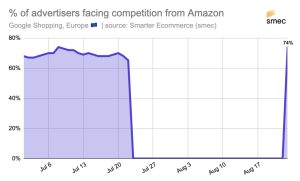
After announcing one month ago that Amazon had stopped spending on Google Shopping, Mike Ryan of analytics firm Smarter Ecommerce returned to LinkedIn yesterday to say Amazon had resumed spending, but with an important caveat.
Mr. Ryan explained:
“Amazon has started spending on Google Shopping once again (internationally, at least). In a massive show of force, Amazon appeared as an account-level competitor for three quarters of European advertisers OVERNIGHT.
Indeed, all feeds have been reactivated except for their home field, the US. The advertising outage lasted exactly one month to the day, lending credence to the widely-held theory that this might be a marketing measurement test.
Does this imply that the US market failed the test? Has Amazon permanently exited Google Shopping in the US?”
Read a bit more on LinkedIn. (August 25)
From tipsheet: If Amazon thinks it will benefit them, they’re going to run on Google Shopping. It seems hard to imagine this is a competitive maneuver tied to AI-enabled advertising technology, nor does it seem like Google Shopping has suddenly started to fail. But who knows? I’ll guess the answer is somewhere in the middle: perhaps there is a test of the Amazon ad system involved here in preparation for the Q4 BFCM holiday season. Shutting off Google Shopping now and then seeing its impact on AI-models powering the Amazon ad system when its needed most (Q4)?
Meanwhile, if you’re a bidder in Google Shopping auctions in the U.S. today, you’re enjoying a discount. We will see what happens next.
TECH
More spend, less share
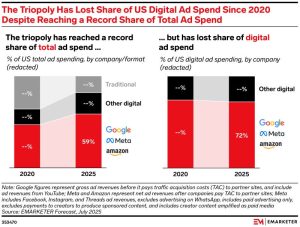
eMarketer SVP of Content Vladimir Hanzlik highlighted the “advertising triopoly of Amazon, Google, and Meta” and its momentum from 2020-2025 in a graphic on LinkedIn yesterday.
Even though the three companies have a bigger share than ever (59% in 2025 vs. 47% in 2020) of ad spend, Mr. Hanzlik argues that “their positions in the advertising world look more contestable than before.”
He argues that new digital players such as TikTok are eroding the big 3’s overall “digital ad spend” market share.
Read more on LinkedIn. (August 25)
From tipsheet: Digital ad spend got bigger in five years. Traditional ad spend shrunk.
PROMPT
What elements of an agency holding company are most likely to be eliminated in five years?
Response from Google’s Gemini app:
Over the next five years, the advertising agency holding company model is likely to see the elimination of its centralized, siloed, and high-overhead functions in favor of more integrated, technology-driven, and agile structures. The traditional holding company, which operates as a collection of independent and often competing agencies, is being challenged by new market dynamics. Here are four areas…
MORE
- The Future of Streaming Is Different Ad Loads for Each Viewer (August 25) Adweek
- More UK news publishers are adopting ‘consent or pay’ advertising model (August 21) – PressGazette
- Fashion models reckon with AI models and digital clones after controversial ad appears in Vogue (August 25) – Los Angeles Times (subscription)
- The golden age of social media is over, and smart brands are already moving on (August 20) – The Trade Desk on The Current