
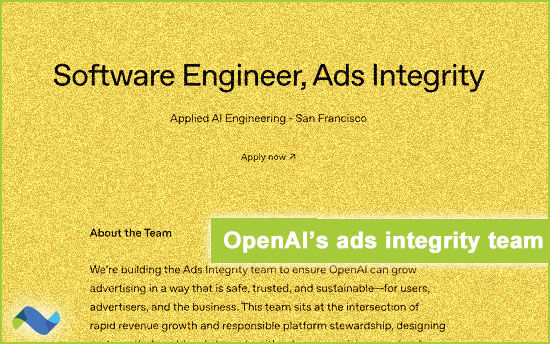
OpenAI’s job board piqued the curiosity of Business Insider reporter Lara O’Reilly when she noticed a role called, “Software Engineer, Ads Integrity.” See the job.
As O’Reilly discovered, the AI company apparently aspires to maintain user trust it fears it could lose by adding advertising to ChatGPT’s conversation interface.
A description of the “Ads Integrity team” in the job post says:
“We’re building the Ads Integrity team to ensure OpenAI can grow advertising in a way that is safe, trusted, and sustainable—for users, advertisers, and the business. This team sits at the intersection of rapid revenue growth and responsible platform stewardship, designing systems that enable ads to scale without compromising user trust or safety. It’s critical to us that our Ads product be built in a way that corresponds to our Ads principles, and this team is key to that.”
O’Reilly previewed her findings on LinkedIn:
“A job ad for a software engineering role describes how this person will help scale OpenAI ads without compromising user trust. Interestingly (to me, anyway), OpenAI wants to develop ‘know your customer’ systems to verify advertisers’ identities and assess their risk. It’s an important but labor-intensive discipline for cracking down on scam ads and bad actors. OpenAI is moving pretty early in this regard, considering it doesn’t have a self-service ad platform yet.”
Read more on LinkedIn. (February 5)
More: “OpenAI is building an ‘integrity team’ to prevent ChatGPT ads from going off the rails” (February 5) – Business Insider (subscription)
From tipsheet #1: Integrity doesn’t seem to be just an ads aspiration.
A keyword search for “integrity” on OpenAI’s careers page yesterday revealed 8 jobs (but only one dedicated to “Ads”) that involved integrity of some sort.
A “Product Manager, Integrity” job post for London explained, “Across all product lines, we ensure that these powerful tools are used responsibly. This is a key part of OpenAI’s path towards safely deploying broadly beneficial Artificial General Intelligence (AGI). Safety is more important to us than unfettered growth.”
From tipsheet #2: Nothing wrong in positioning with integrity especially when you’re in the media spotlight which OpenAI endures (and profits from). But, I’d argue integrity is table stakes and this company’s ad strategy needs to move forward with urgency and must plow through the inevitable missteps early on.
LLMs & CHATBOTS
Developments
- “GPT‑5.3-Codex, the most capable agentic coding model to date.” (February 5) – OpenAI
- “The new Claude Opus 4.6 improves on its predecessor’s coding skills.” (February 5) – Anthropic
- “OpenAI Unveils Frontier, a Product for Building ‘AI Co-Workers’” (February 5) – The Wall Street Journal (subscription)
FINANCIALS
Amazon reports Q4 2025, capex explodes
Amazon released its Q4 2025 earnings report yesterday and beat expectations on revenue but missed slightly on profit, according to CNBC.
The company’s stock initially fell 8% in after hours trading, which may have also been attributable to the company’s updated projections on capital expenditures related to AI. Read on.
Summary:
- Overall: “Net sales increased 14% to $213.4 billion in the fourth quarter, compared with $187.8 billion in fourth quarter 2024.”
- Advertising: Ad revenue grew 22% in the quarter to nearly $22 billion.
- Capital expenditures: $200 billion this year (was $146.6 billion, according to analysts)
- Amazon Web Services: AWS grew at a 24% clip year-over-year with over $35 billion in revenue.
Amazon[dot]com Announces Fourth Quarter Results – Amazon
From tipsheet: In spite of recent stock market turmoil, the size of the “mega cap” companies in advertising and marketing continues to astound:
- Amazon had a market cap of $2.8 trillion as of yesterday.
- Meta was at $1.69 trillion.
- Alphabet was at $4 trillion.
PLATFORMS
Reviewing Google earnings and AI ads
Late Wednesday, Wall Street analyst Dan Salmon of New Street Research published his first “take” for investors on Alphabet/Google’s strong Q4 2025 earnings report.
He noted with amazement Google’s second-to-none capital expenditure investment increase to a whopping $175-185 billion this year in support of the company’s multi-pronged AI strategy.
From Google management’s earnings call with investors, Mr. Salmon parsed the use of Gemini large language models (LLMs) and their diverse importance to ads going forward:
“Management reiterated that they are ‘not in a hurry’ to ramp monetization via ads on Gemini, (i.e., the app/web property). Rather, Gemini models contribute to advertising growth already in three major areas:
1) ads quality,
2) agentic actions in advertiser tools, and
3) new AI user experiences in Search.
The launch of the Universal Commerce Protocol or UCP in partnership with several launch partners, including Shopify, also serves as a foundation for future growth in retail.
We continue to believe Google has advantages in the new functionality of AI and commerce-related agents given its commercial similarities to conventional search combined with Google’s ability to scale and support large-scale AI using TPUs (Tensor Processing Units).”
SELL-SIDE
Mobian’s AI discovers context for Hearst
Mobian’s AI-enabled technology is discovering context — and brand safety — for publisher Hearst’s online news content according to an article in Digiday.
Similar to its Fox News client profiled in October, “Mobian is adopting a new approach to improve ad yield across its news outlets, properties that have historically been difficult to monetize, especially during politically polarized periods,” wrote Digiday’s Ronan Shields.
Promoting the article on LinkedIn, Hearst programmatic executive Nate Lopez-Ryckman said, “Blocking news = Worse outcomes for advertisers.” And it’s the worst outcome for publishers if the marketer can’t freely spend.
Read: “Hearst rethinks brand safety to unlock news ad yield” (February 5) – Digiday (subscription)
From tipsheet: The U.S. midterm elections are ahead and will unlock a mountain of political ad budget. News publishers are looking to monetize to the max.
AGENCIES
The Super Bowl of AI
“The Super Bowl is more than just a game; it’s the biggest stage for creativity in our industry and a cultural moment that gives me goosebumps every year.
I am incredibly proud of the work our teams across WPP have delivered for this extraordinary moment, connecting our clients with millions of fans globally.
This incredible creative work is powered by our AI marketing platform, WPP Open, giving our media and strategy teams the insights to ensure our clients’ brands show up with maximum impact on game day…” – Cindy Rose OBE, CEO, WPP on LinkedIn (February 5)
Read more from Ms. Rose on LinkedIn. (February 5)
More: Super Bowl LX: the integrated era of advertising – WPP (February 5)
BRAND
The Super Bowl of LLM
Noting the Super Bowl’s Silicon Valley proximity this year, Ad Age chief technology reporter Garett Sloane breaks down the AI company participation in the big game this year.
Sloane shared on LinkedIn:
“This has to be Super Bowl LLM.
AI was already set to be the hot topic in the commercials, even before Anthropic came out with a commercial that just punched OpenAI in the gut yesterday. Google, Meta, Amazon, Wix, Base44 and others are all playing with AI in their ads.
Like any defining Super Bowl—Dotcom, Crypto, Blackout—the ones that capture seismic brand and technological shifts, Sunday’s game deserved a monicker. LLM it is…”
Read more on LinkedIn. (February 5)
More: “Super Bowl LX is AI’s biggest test yet as OpenAI, Anthropic and others try to win over viewers” (February 5) – Ad Age (subscription)
TECH
Opinion: Soon-to-hatched agentic ads
In a Media Village op-ed titled “AI Advertising Doesn’t Have to Suck,” LUMA Partners’ Entrepreneur-in-Residence and media executive Pooja Midha took a look at the opportunity ahead in advertising using LLMs and chatbots.
In spite of worries expressed by many — including those represented by Anthropic’s Super Bowl ads (see Deception, Violation, Betrayal, and Treachery) which she labeled, “Ouch” – Ms. Midha was optimistic.
She wrote:
“For LLM’s and soon-to-be-hatched agentic ad businesses, there is opportunity to drive business results, and yes profits, from transparency, value exchange, calibrated use of data, along with innovation in ad measurement, creative, and ad format. The challenge is to avoid short-term thinking and the easy button of what’s been done before. Outsize returns require differentiated effort.
The LLM company that builds its ad business with transparency, control, and genuine value exchange could prove something remarkable: that advertising can make things better and drive the bottom line.”
Read more. (February 5)
Related: “Right now, I’d argue OpenAI is being more transparent about trade-offs they’re navigating. They’re building in public, making their monetisation strategy explicit, and engaging with the broader ecosystem on how this should work. While Anthropic are open-sourcing and posting great research and explainers, there’s a lot at stake and I’d like them to be more collaborative with the ecosystem.” (February 5) – Anne Coghlan, COO and co-founder, Scope3 on LinkedIn
From tipsheet #1: OpenAI will want to bridge to the advertising and marketing community eventually — especially when their ad platform begins to scale. Experienced, well-respected executives such as Ms. Midha would make sense as ambassadors for the AI company. The “Integrity + ads that perform (or don’t suck)” mantra should resonate.
From tipsheet #2: And if Anthropic’s Claude reaches appreciable scale with consumers, they’ll be launching an ads platform, too.
LLMs & CHATBOTS
Video: OpenAI CEO Altman on ads
Yesterday afternoon, OpenAI CEO Sam Altman spoke to online technology news show TBPN about a range of subjects — ads and Anthropic were top of mind.
Overall, the tone wasn’t much different than what he said on X on Wednesday about Anthropic’s statement and Super Bowl ads.
TBPN provided a list of Altman quotes from the interview:
-
“Well it’s just wrong. We respect our users. We understand that if we did something like what those ads depict, people would rightfully stop using the product.”
-
“Our first principle with ads is that we’re not going to put stuff into the LLM stream. That would feel crazy dystopic, like a bad sci-fi movie.”
-
“Using a deceptive ad to criticize deceptive ads feels – I don’t know – something doesn’t sit right with me about that.”
-
“I also think it’s great for them not to do ads. We have a differently-shaped business. I did notice that they said in their thing like, ‘We may later revise this decision and we’ll explain why if so.’”
Hear more in a three-minute clip of the interview via TBPN on X. (February 5)
PROTOCOLS
Agentic Real-Time jousting
Chalice AI executive and Agentic Real-Time Framework (ARTF) proponent Adam Heimlich continued his tireless crusade yesterday in support of ARTF, which is being overseen by the IAB Tech Lab.
On LinkedIn, Mr. Heimlich made his case with a link to his “Container Explainer” and wrote:
“No offense to those adopting AdCP, but automated guarantees don’t clear the bar. Automated guarantee functionality is not in the same ballpark, or even the same league as the unanimous request. It’s not even the same sport.
One immutable fact separates the poseurs from the achievers in agentic AI: Agents serve the intent of the end user. That’s the entire point; there is no other.
Containerized RTB, and the ARTF that standardizes it, meets the big request in the following ways: 1) It significantly reduces the cost of AI execution. 2)…”
Read more on LinkedIn —including the comments. (February 5)
Related: “The AI Revolution Is Increasing the Strategic Value of Scaled Advertising Platforms” (February 5) – PubMatic CEO Rajeev Goel on PubMatic’s blog
TECH
Criteo’s recommendations for chatbots
Criteo believes that LLMs can’t replace recommendation systems (yet) so it has rolled out an “Agentic Commerce Recommendation Service” to help AI chatbots. The company claimed up to a 60% improvement in relevancy of the recommendation with its technology.
Using Model Context Protocol (MCP) to connect to the AI assistant, Criteo laid out how it works in a press release:
- “A shopping request: A consumer asks an AI shopping assistant for a product that matches their needs, preferences, and budget.”
- “AI assistant query: The AI assistant queries Criteo’s Agentic Commerce Recommendation Service to identify relevant products.”
- “Commerce intelligence-powered filtering: Criteo applies real-world shopping and purchase signals to filter and rank products based on what is most relevant for that individual consumer, considering nuances such as product popularity, availability, and user intent.”
- “Curated results: Criteo returns a curated shortlist of product recommendations, rather than raw catalog data.”
- “Personalized, easy consumer experience: The AI assistant reviews Criteo’s recommendations, presents the results, compares options, and can support add-to-cart or checkout within the agentic experience.”
As for who’s using the service today, the release hinted: “Criteo continues to test with a major LLM platform that began in 2025, while also expanding testing to additional LLM platforms, retailers, and brands.”
Read: “Criteo Introduces Agentic Commerce Recommendation Service to Power AI Shopping Assistants” (February 5) – press release
More: “The Future of Commerce Recommendation: Why Hybrid Systems Will Win” – Criteo (October 14)
PEOPLE MOVES
Now hiring
- OpenX President Matt Sattel becomes CEO (February 5) – LinkedIn
- Building Momentum: Welcoming Our Newest Executive Leaders Romain Seguy, CFO, and Joe Doran, CPO (February 5) – botify blog
MORE
- Scope3 Cuts Engineering and Sales Staff in Second Round of Layoffs in 5 Months (February 5) – Adweek
- Snap embeds AI across its ad platform (February 5) – Q4 earnings call transcript on Motley Fool
- Some Learned Observations on Advertising, Hypocrisy, and a Certain Super Bowl Sermon (February 5) – Karsten Weide, analyst on W Media Research’s blog
- IAB CEO David Cohen: ‘The Health of the Publisher Community is Critical to the Health of Our Overall Business.’ (February 4) – AdExchanger
- Identity Is Not the Enemy of Modern Marketing (February 4) – Keith Petri, SVP, Viant on his personal blog