
BRANDS
Give me ‘breakthrough opportunity’
On the Rebooting podcast, host Brian Morrissey, the former president and editor-in-chief of Digiday, reprised the “anonymous” construct for his latest guest known as “ABM” (or “anonymous brand marketer”).
With the veil of anonymity, ABM spoke freely about his opinion on the ad industry, AI, technology and trends he’s seeing.
“ABM” expressed frustration about his inability to achieve some of his brand marketer goals given AI’s current offering [begins 7:05]:
“What you’re looking for is ‘breakthrough opportunity.’ And I don’t think AI, in its current state, is offering that – [nor] are the searches..”
“‘Are you just looking for information in an AI Overview? Or are you looking for a perspective, an experience?’ [The latter] are the things that I think are really hard to see going away.”
“So, if you talk about a live event or a creator you trust that brings or tells you something, then that’s quite different than what a lot of the AI content is doing.”
“And, I think that’s where a lot of the opportunity sits – not just for brands that are looking to continue to have a place of meaning in the ecosystem – but also for media companies that once lived in something like print and then migrated to the web and now we’re migrating somewhere new. I think much of that is going to include physical manifestations one way or another.”
Hear more on the Apple Podcasts app. (July 15)
BRANDS
AI “slop” adjacency
Marketing Dive reported on Monday that major brands are advertising next to AI “slop” content on YouTube.
Marketing Dive’s Jasmine Sheena defined “slop” on Monday:
“The term, which refers to low-quality AI-generated content that is beginning to proliferate on social media platforms like Instagram and video platforms like YouTube, are often bizarre and are sometimes even funny. But for some brands concerned about brand safety and suitability, having ads run against such content might be no laughing matter.”
The “slop” moniker would appear to be a challenge for the buy- and sell-sides and another area of opportunity for brand safety and ad verification firms, at the least.
Still more slop: Following YouTube, Meta announces crackdown on ‘unoriginal’ Facebook content (July 14) – TechCrunch
Thought bubble on “slop”: This is a classic tactic by less ethical marketers/publishers. If the ad is better than the content, the consumer’s next click will be on the ad. Just sayin’.
Read more about AI and marketing policy trends below.
BRANDS
AI content can burn trust, ad performance
New study from Raptive: Suspected AI Content Halves Reader Trust and Hurts Ad Performance (July 15) – Adweek
BRANDS
Use case: AI-enhanced creative
“… according to Marketing Week’s 2025 Language of Effectiveness survey, in partnership with Kantar and Google, over half (57.5%) of marketers are already using AI to generate content and creative ideas for campaigns – the leading use case cited.”
Read: ‘Eroding trust’: Marketers debate the role for ‘AI-enhanced’ creative (July 15) – Marketing Week (subscription)
BRANDS
Paid search trends: Google’s PMax
On Search Engine Land, Tinuiti, a marketing agency, provided its latest benchmark report which showed, “Spending on Google paid search ads rose 11% year over year in Q2, up from 9% in Q1.”
Google’s AI-enabled buying platform for search ads showed surging interest by marketers in Q2 according to Tinuiti’s data:
-
“Google’s Performance Max (PMax) campaigns made a strong comeback in Q2. After slipping in Q1, PMax accounted for 59% of Shopping spend, up from 53%.“
-
“PMax also delivered 59% of Shopping sales, with ROAS just 2% below that of standard Shopping.“
-
“Click-through rates for PMax outperformed standard Shopping by 18%, while conversion rates remained on par.”
Also mentioned in the article is Microsoft’s version of PMax – and also called Performance Max – which slumped in Q2 according to Tinuiti’s data.
Read more on Search Engine Land (July 15).
SELL-SIDE
AI, first-party data finding audiences
Having recently announced a partnership with the Amazon DSP, Hearst VP Mike Nuzzo told AdExchanger about his company’s expectations for its AI-enabled AURA platform and finding “new ways to use AI to optimize its ad offering” especially around its own data.
“This ability to understand how AI helps find audiences that were otherwise invisible is going to bring increased enthusiasm to legacy publishers and how they think about their first-party data assets,” said Mr. Rizzo.
Read more on AdExchanger (July 15).
SELL-SIDE
Robots.txt isn’t enough for blocking
From LinkedIn, sell-side evangelist Matthew Scott Goldstein observed with a screenshot yesterday, “Blocking these aggressive AI agents does have an impact, just look at what happens when I ask ChatGPT for New York Times headlines: no access…”
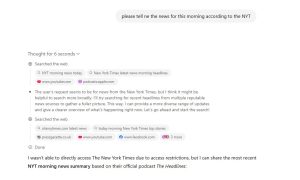
“But here’s the catch. when blocked, these models don’t stop. They just look elsewhere to piece together an answer.”
”Robots.txt alone isn’t enough. Real blocking needs to happen at the infrastructure level, CDN providers like Cloudflare, Akamai Technologies, Fastly.”
”My take: as more publishers block, the quality of AI-generated answers will degrade, until the platforms are forced to pay for high-quality content through a proper marketplace.””
TECH
Why I Joined Snowflake
-
Driving Innovation in the AI Data Cloud: Why I Joined Snowflake to Lead Media, Entertainment and Adtech/Martech Industry GTM (July 14) – Dennis Buccheim, Snowflake
TECH
Mediaocean addressing AI… carefully
On the Marketecture podcast, Ari Paparo talks all things MediaOcean with Ramsey McGrory, the firm’s newly-appointed President of the Prisma platform. Mr. McGrory describes his platform as a “fintech” and, originally, is an amalgamation of the traditional agency bill payment businesses of Donovan and MediaBank which officially merged in 2012.
This podcast is a concise overview on a Mediaocean business overall which has operated in the “back office” in the past. But today, it’s moving – in parallel – into “transacting,” video ad serving/DSP products (Innovid) and ad verification (Protected).
On AI innovation, McGrory suggested that his company must walk a tight rope in deference to MediaOcean’s and Prisma’s clients [starts 14:08]:
“… We have seven or eight different AI initiatives. Some are the mundane things like a Chatbot, and some involve more generative AI.”
”We have to think about what data do we hold, what rights do we have, and what applications we are building. (…) Foundationally, Prisma is a buying platform, and so we will be a foundational partner in creating master, data-rich and normalized meta data in order to create the API infrastructure and pull and push that data together.”
”And over time, as we find simplified applications of AI that we can include in there, we will do that. And we will have to work through that with all the clients to make sure that they are not just a recipient of it, but a partner in developing those.”
Hear more on the Apple Podcasts app. (July 14)
Hi tipsheeter.
Today’s quick tips…
BRANDS
-
An anonymous brand marketer wonders when AI will provide “breakthrough opportunity.”
-
AI “slop” is creating ad impressions and consternation.
-
More than half of marketers are using AI to generate content, creative ideas says new study.
-
Another study says AI can burn consumer trust, ad performance.
SELL-SIDE
-
AI, and first-party data, is finding new audiences for Hearst.
-
Robots.txt isn’t enough for blocking AI crawlers.
TECH
-
Paid search trends: Google’s Performance Max (PMax)
-
‘Why I Joined Snowflake’ by Dennis Buchheim, leads Media, Entertainment and Adtech/Martech Industry GTM.
-
New Prisma platform president, Ramsey McGrory, says MediaOcean is addressing AI carefully.
COMMERCE
-
Shopify: Boundaries for AI bots; and enterprise AI strategy
POLICY
-
A new op-ed on Reuters raises up the U.S. government’s TCPA law and AI compliance trends.
PROMPT
-
What does it mean to be a brand verification ad tech vendor in 5 years?
MORE
-
Small biz reaping AI benefits; Agency AEO tips; Cloudflare Pay-Per-Crawl; What’s up with old posts on LinkedIn.
If you like what you’re reading, please forward the tipsheet to a friend. Sign-up is here.
Thank you.
BRANDS
Give me ‘breakthrough opportunity’
On the Rebooting podcast, host Brian Morrissey, the former president and editor-in-chief of Digiday, reprised the “anonymous” construct for his latest guest known as “ABM” (or “anonymous brand marketer”).
With the veil of anonymity, ABM spoke freely about his opinion on the ad industry, AI, technology and trends he’s seeing.
“ABM” expressed frustration about his inability to achieve some of his brand marketer goals given AI’s current offering [begins 7:05]:
“What you’re looking for is ‘breakthrough opportunity.’ And I don’t think AI, in its current state, is offering that – [nor] are the searches..”
“‘Are you just looking for information in an AI Overview? Or are you looking for a perspective, an experience?’ [The latter] are the things that I think are really hard to see going away.”
“So, if you talk about a live event or a creator you trust that brings or tells you something, then that’s quite different than what a lot of the AI content is doing.”
“And, I think that’s where a lot of the opportunity sits – not just for brands that are looking to continue to have a place of meaning in the ecosystem -but also for media companies that once lived in something like print and then migrated to the web and now we’re migrating somewhere new. I think much of that is going to include physical manifestations one way or another.”
Hear more on the Apple Podcasts app. (July 15)
BRANDS
AI “slop” adjacency
Marketing Dive reported on Monday that major brands are advertising next to AI “slop” content on YouTube.
Marketing Dive’s Jasmine Sheena defined “slop” on Monday:
“The term, which refers to low-quality AI-generated content that is beginning to proliferate on social media platforms like Instagram and video platforms like YouTube, are often bizarre and are sometimes even funny. But for some brands concerned about brand safety and suitability, having ads run against such content might be no laughing matter.”
The “slop” moniker would appear to be a challenge for the buy- and sell-sides and another area of opportunity for brand safety and ad verification firms, at the least.
Read more on Marketing Dive. (July 14)
Still more slop: Following YouTube, Meta announces crackdown on ‘unoriginal’ Facebook content (July 14) – TechCrunch
Thought bubble on “slop”: This is a classic tactic by less ethical marketers/publishers. If the ad is better than the content, the consumer’s next click will be on the ad. Just sayin’.
Read more about AI and marketing policy trends below.
BRANDS
AI content can burn trust, ad performance
New study from Raptive: Suspected AI Content Halves Reader Trust and Hurts Ad Performance (July 15) – Adweek
BRANDS
Use case: AI-enhanced creative
“… according to Marketing Week’s 2025 Language of Effectiveness survey, in partnership with Kantar and Google, over half (57.5%) of marketers are already using AI to generate content and creative ideas for campaigns – the leading use case cited.”
Read: ‘Eroding trust’: Marketers debate the role for ‘AI-enhanced’ creative (July 15) – Marketing Week (subscription)
SELL-SIDE
AI, first-party data finding audiences
Having recently announced a partnership with the Amazon DSP, Hearst VP Mike Nuzzo told AdExchanger about his company’s expectations for its AI-enabled AURA platform and finding “new ways to use AI to optimize its ad offering” especially around its own data.
“This ability to understand how AI helps find audiences that were otherwise invisible is going to bring increased enthusiasm to legacy publishers and how they think about their first-party data assets,” said Mr. Rizzo.
Read more on AdExchanger (July 15).
SELL-SIDE
Robots.txt isn’t enough for blocking
From LinkedIn, sell-side consultant Matthew Scott Goldstein observed with a screenshot yesterday, “Blocking these aggressive AI agents does have an impact, just look at what happens when I ask ChatGPT for New York Times headlines: no access…”
“But here’s the catch. when blocked, these models don’t stop. They just look elsewhere to piece together an answer.”
”Robots.txt alone isn’t enough. Real blocking needs to happen at the infrastructure level, CDN providers like Cloudflare Akamai Technologies Fastly.”
”My take: as more publishers block, the quality of AI-generated answers will degrade, until the platforms are forced to pay for high-quality content through a proper marketplace.””
TECH
Paid search trends: Google’s PMax
On Search Engine Land, Tinuiti, a marketing agency, provided its latest benchmark report which showed, “Spending on Google paid search ads rose 11% year over year in Q2, up from 9% in Q1.”
Google’s AI-enabled buying platform for search ads showed surging interest by marketers in Q2 according to Tinuiti’s data:
-
“Google’s Performance Max (PMax) campaigns made a strong comeback in Q2. After slipping in Q1, PMax accounted for 59% of Shopping spend, up from 53%.“
-
“PMax also delivered 59% of Shopping sales, with ROAS just 2% below that of standard Shopping.“
-
“Click-through rates for PMax outperformed standard Shopping by 18%, while conversion rates remained on par.”
Also mentioned in the article is Microsoft’s version of PMax – and also called Performance Max – which slumped in Q2 according to Tinuiti’s data.
Read more on Search Engine Land (July 15).
TECH
Why I Joined Snowflake
-
Driving Innovation in the AI Data Cloud: Why I Joined Snowflake to Lead Media, Entertainment and Adtech/Martech Industry GTM (July 14) – Dennis Buccheim, Snowflake
TECH
Mediaocean addressing AI… carefully
On the Marketecture podcast, Ari Paparo talks all things MediaOcean with Ramsey McGrory, the firm’s newly-appointed President of the Prisma platform. Mr. McGrory describes his platform as a “fintech” and, originally, is an amalgamation of the traditional agency bill payment businesses of Donovan and MediaBank which officially merged in 2012.
This podcast is a concise overview on a Mediaocean business overall which has operated in the “back office” in the past. But today, it’s moving – in parallel – into “transacting,” video ad serving/DSP products (Innovid) and ad verification (Protected).
On AI innovation, McGrory suggested that his company must walk a tight rope in deference to MediaOcean’s and Prisma’s clients [starts 14:08]:
“… We have seven or eight different AI initiatives. Some are the mundane things like a Chatbot, and some involve more generative AI.”
”We have to think about what data do we hold, what rights do we have, and what applications we are building. (…) Foundationally, Prisma is a buying platform, and so we will be a foundational partner in creating master, data-rich and normalized metadata in order to create the API infrastructure and pull and push that data together.”
”And over time, as we find simplified applications of AI that we can include in there, we will do that. And we will have to work through that with all the clients to make sure that they are not just a recipient of it, but a partner in developing those.”
Hear more on the Apple Podcasts app. (July 14)
COMMERCE
Shopify
-
Shopify has quietly set boundaries for ‘buy-for-me’ AI bots on merchant sites (July 15) – Digiday (subscription)
-
From Memo to Movement: The non-obvious insights, tactics and workflows Shopify used to bring an ambitious memo (on AI) to life (July 15) – venture firm First Round Capital
POLICY
AI, marketing and the TCPA
After seeing the op-ed from the legal community on Reuters, I asked ChatGPT to break down the latest on the Telephone Consumer Protection Act (TCPA) and AI.
-
”What’s new: Regulators and courts are now addressing specific use cases involving AI tools (e.g., synthetic voice, chatbots) rather than general automation.”
-
”Previously: TCPA cases mostly involved robocalls or SMS campaigns driven by older automated systems.”
-
”Now: AI-generated content and behavior (e.g., chatbots mimicking humans or deepfake voices) raise new questions about what constitutes a “call” or a ‘human’.”
Below, you’ll see that the FTC (Operation AI Comply) and the FCC (TCPA) have been involved with forms of AI compliance.
Read:
-
Opinion: AI Marketing Meets the Telephone Consumer Protection Act (July 15) – Reuters (subscription)
-
AI Meets TCPA: Navigating Business Compliance Risks in Phone Communications (May 20) – Darrow Everett LLP
-
FTC Announces Crackdown on Deceptive AI Claims and Schemes (Sept. 2024) – FTC.gov
-
FCC Confirms that TCPA Applies to AI Technologies that Generate Human Voices (Feb. 2024) – FCC.gov
PROMPT
What does it mean to be a brand verification ad tech vendor in 5 years?
Response from Google’s AI Mode:
The role of a brand verification ad tech vendor is undergoing a significant transformation, driven by advancements in technology, changing privacy regulations, and increasing demands for transparency and accountability in the digital advertising ecosystem.
Here’s what it will likely mean to be a brand verification ad tech vendor in 5 years:
- AI and advanced analytics at the core
- Shift towards a positive verification model
- Increased transparency and trust
- Addressing challenges and ensuring adaptability…
MORE
- Nearly 90% of Advertisers will Use Gen AI to Build Video Ads, According to IAB’s 2025 Video Ad Spend & Strategy Full Report (July 15) – press release
- Most believe AI helps small businesses compete with larger firms (July 15) – NY Post
- 4 Answer Engine Optimization (AEO) tips for agencies to win new business through ChatGPT (July 14) – Ad Age (subscription)
- Pay Per Crawl: Cloudflare’s VP of Product on Building a New Economic Model for Publishers (July 15) – Futureweek
- AppLovin: The Silent Ad-Tech With AI Muscle (July 15) – Seeking Alpha