
LLMs & CHATBOTS
Mark Cuban on unmarked ads, LLMs
Investor Mark Cuban is concerned that LLMs and their chatbots will start rolling out advertising products that will mislead customers by not being labeled “Ad” or similar.
On Saturday, Cuban began his argument by calling out White House “Czar” of AI and Crypto, David Sacks, and said on X:
“Hey [David Sacks], my one request is that we make it illegal for AI models to offer advertising. And, we need to really examine referral fees as well.
The last thing we need is to have algorithms designed to maximize revenue driving LLM output and interactions.”
Mr. Cuban revealed his strong distaste for advertising, in general, in a response to a follower:
“Which is the ultimate goal of most advertising, manipulation”
Four hours after his first statement, he qualified his thoughts on chatbot advertising and said:
“Where I could see AI ads being ok is if they are just listed as a chat and identified as an ad. Completely independent from the user generated chats
Business Insider reported on the Cuban back-and-forth here.
From tipsheet: Oh, the political intrigue. Who was talking about having unmarked ads in chatbots? Nobody. Furthermore, Mr. Cuban’s concern would appear to already fall under the FTC’s jurisdiction. And if OpenX or another LLM tried unmarked ads, they would quickly lose the trust of the user, i.e. the consumer. It would not make business sense for LLM-makers to run with unmarked ads in their chatbots or similar applications. The same goes for disclosure on referral fees for eCommerce functions which have not even been rolled out yet.
LLMs & CHATBOTS
On Cuban, LLM eCommerce
On LinkedIn yesterday, Matthias Braun, CEO of market research firm eMarketer, saw Mark Cuban’s comments and found an opportunity to get in on the meme. He suggested that what LLMs are considering isn’t advertising as we know it -it’s all new.
“Investor Mark Cuban is concerned that LLMs and their chatbots will start rolling out advertising products.
Now imagine an AI that finds the right product, filters noise, compares prices, auto-fills details, and completes the purchase—all within one interaction.
This isn’t just a new channel. It’s a new paradigm. And it could do for eCommerce penetration what mobile did a decade ago.
The big unlock isn’t more eyeballs. It’s agency. The moment LLMs become trusted buyers—not just advisors—is the moment eCommerce stops competing with in-store. It just leapfrogs it.”
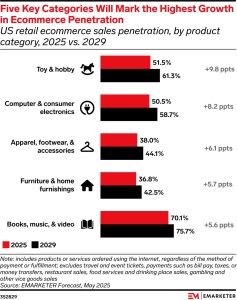
Mr. Braun added to his post an eMarketer graphic showing the eCommerce opportunity ahead in the age of AI.
Read more on LinkedIn. (July 28)
LLMs & CHATBOTS
LLMs and nondeterminism
Tom Chavez, co-founder of startup studio Superset and former CEO of martech platform Krux, commented on LinkedIn yesterday regarding the fluid nature of query responses by LLMs these days – where every answer is, potentially, different.
Mr. Chavez compared it to a guitarist who might go on a beautiful solo riff, and when asked to play it again, “He looked up, totally blank: ‘I can’t.’ He had already forgotten what he played. That’s kind of what working with LLMs feels like.”
He asked for help from his followers on LinkedIn:
“… I know we’re not the [only] ones banging our heads against the keyboard. Curious how others are handling nondeterminism in their stack. What’s working? What’s breaking? Who’s losing their mind? And remember, if your LLM ever does play the perfect solo? Don’t blink. Screenshot it. Because it won’t remember a thing in the morning.”
Read more. (July 28)
LLMs & CHATBOTS
AI browser wars: Microsoft puts Copilot inside Edge
“The experimental feature brings the Copilot chatbot directly into the browsing experience, allowing it to scan all open tabs and assist with tasks like booking a dinner reservation, comparing hotels, or choosing the best product to buy, marking Microsoft’s latest push to redefine how people browse and shop online.”
Read:
- Introducing Copilot Mode in Edge: A new way to browse the web (July 28) – Microsoft Windows blog
- Microsoft Edge is now an AI browser with launch of ‘Copilot Mode’ (July 28) – TechCrunch
BRANDS
Advantage + platform performance study
Analytics firm Haus released their “Meta Report” which created insights from 640 incrementality (Haus’s definition here) tests on Meta’s AI-enabled Advantage+ platform.
Overall, the report shows the unique power of Meta’s automated ad system for big brands pursuing consumers online and as part of an omnichannel mix.
Among the takeaways, which include plenty of supportive data points (and all connected to Haus’ incrementality tracking capabilities):
Meta is a highly incremental channel – for most brands, the question is more about how to optimize advertising on the platform for efficiency than whether Meta drives lift to the business.
Test into the ideal balance between automation (Advantage+) and Manual controls – every brand sees different outcomes and there is risk in making assumptions here.
If you’re an omnichannel brand, the testing burden is even higher – Meta tactics’ omnichannel impacts are not well-correlated with their DTC efficiency.
Mid- and upper-Funnel campaigns provide key levers to balance your funnel and drive omnichannel impact – test into them with a small budget at first and don’t expect to see the same in-platform efficiency.
Read the Haus blog post. (July 28)
And, get the report. (PDF)
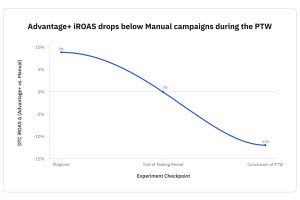
From tipsheet: “Manual setup” users actually outperformed in one instance in particular: when an incrementality test neared its end. Meta’s automated Advantage + tended to “drive more immediate impact but less lagged impact.” See the iROAS (Incremental Return on Ad Spend) graph below.
From tipsheet, Part II: This study will land in Meta CEO Mark Zuckerberg’s inbox. It’s exactly what he wants to hear about (“Does it work or not?”) if he’s going to meet his all-AI-automation goal for Meta’s ad system by the end of 2026.
BRANDS
Buy-side talks AI policy
Digiday takes the temperature of the marketing industry in an article covering the new AI policy rolled out by the White House last week.
Digiday wrote about the new guidelines: “Some marketers interpret [them] as the Administration taking a hands-off approach to AI regulation that could set a precedent for the ad industry.”
Similar to past efforts to self-regulate the browser “cookie” and enable user privacy in advertising, some see the need to create industry best practices and ethical guidelines before government regulation emerges.
Read more. (July 28)
BRANDS
Real estate marketer is not an automation fan
Jessi Healy, a real estate industry digital marketer, provided her opinion on automated ad systems on real estate news site Inman yesterday.
Like many marketers who’ve voiced concerns over giving the reigns to automated, AI-enabled ad platforms, Healy told her audience to maintain a level of control:
“As Meta and others roll out these tools, the agents who stand out will be the ones who blend AI speed with human strategy. Don’t let the bots do all the talking.”
Read more. (July 28)
TECH
Use case: AI for segmentation and scoring
“Segmentation and scoring are two of the most common marketing-led use cases for customer data. They’re rarely complex, and tools such as AI make them even easier. For example, we recently completed a ‘customer 101’ for a $2 billion B2B2C retailer. Marketing led the initiative, while IT was key in approving the data store’s design and security…”
Read: “The fatal flaw killing your customer data initiatives” – MarTech (July 9)
Related: “Use case: AI tools help Vodafone reduce blocking rates on news sites” (July 25) – sponsored research on WARC
TECH
LinkedIn data dialogues
-
“Not all PMPs are created equal as publishers will pass varying levels of metadata signals through different SSPs…” (July 28) – David Nyurenberg of agency InterMedia on LinkedIn
-
“‘Amazon Pulled out of Google Shopping for AI, not for Advertising’ – If you have the largest data catalog in the world, why would you give to your top AI competitor? I believe that is the question that Amazon is asking itself at the moment. The performance marketing agency world is only speaking about how DTC should now take advantage, and not much is being talked about as to why.” (July 28)- consultant Rick Watson on Linkedin
AI Mode in the UK
- Google launches new AI search feature in UK (July 28) – BBC
TECH
New hire
Former Googler and spider[.]io founder Douglas De Jager Named CEO of Eyeo (July 28) – AdExchanger
Related:
- AI Is Wrecking an Already Fragile Job Market for College Graduates (July 28) – The Wall Street Journal
- As Ad Industry Sheds Jobs, These Agencies Are Growing—and Hiring (July 28) – Adweek
- AI Can Do Your Job Better Than You Can (Well, Actually, It Depends) (July 28) – AdExchanger
PROMPT
What will a CMO’s daily schedule look like in 5 years?
Response from Perplexity.ai:
A CMO’s daily schedule in five years will look dramatically different from past routines, reflecting the rapid evolution of technology, the increasing influence of AI, and a business focus on measurable outcomes and agility. Here’s how a typical day might unfold for a forward-thinking CMO in 2030…
MORE
- Walmart—yes, Walmart—says AI agents are its future (July 24) – Fortune
- Forrester to B2B Marketers: Invest in Full Buyer Lifecycle, Improve AI Discoverability in 2026 (July 24) – Chief Marketer
- Sociable: Inside YouTube’s new generative AI features for Shorts (July 24) – Marketing Dive
- Is AI the exception to ‘America First’? (July 28) – Politico
- AI intensifies battle for talent, housing and investments in San Francisco (July 26) – The Washington Post
- Survey: “How will the ad industry look in 2030? Tell us.” (July 28) – Ad Age