
The sell-side is getting organized on how to manage its relationships with AI companies and their Large Language Models (LLMs) whose bots like to crawl publisher websites.
Yesterday, industry standards organization Prebid, whose roots are in header bidding standardization, announced the leadership team for a new task force devoted to LLMs and monetization.
On LinkedIn, Sigma Software CEO Katherine Tuluzova announced that she and Microsoft Principal Product Manager Paul Farrow will lead the way:
“I am very excited to lead the LLM Monetization Task Force—not only because it is a great honor and responsibility, but because this is a space I am deeply passionate about. A new ecosystem is emerging before our eyes, and I’m filled with curiosity and excitement about how it will take shape.”
Read it on LinkedIn. (January 14)
Prebid’s website has also been updated with the new task force’s expected meeting schedule.
Scope: AdTech and Publishing members.
Description: Help publishers create new revenue streams or preserve existing ones as LLM-powered search reshapes user traffic patterns.
Chair: Katherine Tuluzova (Sigma Software)
Vice Chair: Paul Farrow (MSFT)
Audience: Product, Business
Meeting: Every Friday at 11 am ET
See Prebid’s committees on its website.
From tipsheet: Meanwhile, IAB Tech Lab, the standards arm of industry trade association IAB, is also busy with LLM standards-making that speaks to the interests of publishers.
IAB Tech Lab currently has among its efforts:
After the Cannes Lions ad festival in June of last year, IAB Tech Lab CEO Anthony Katsur sounded the alarm with IAB’s membership: “Artificial intelligence was everywhere this year—but here’s the catch: it still feels like the industry doesn’t quite grasp how profoundly AI is already impacting our workflows, business models, and creative output.”
See more on tipsheet. (from June 20)
LLMs & CHATBOTS
Developments
- Microsoft’s Spending on Anthropic AI Is on Pace to Hit $500 Million (January 14) – The Information (subscription)
- Gemini introduces Personal Intelligence (January 14) – Josh Woodward, VP, Google Labs, Gemini & AI Studio on The Keyword blog
- Cerebras scores OpenAI deal worth over $10 billion ahead of AI chipmaker’s IPO (January 14) – CNBC
SELL-SIDE
UK government tackles AI and copyright
Google public affairs executive Roxanne Carter, AI entrepreneur Guy Gadney and government leaders appeared in front of the UK’s House of Lords Communications and Digital Committee on Tuesday to discuss AI and copyright again.
The Committee set the goals for the inquiry (in U.S. Congressional parlance, it’s similar to a series of hearings) as follows:
“This inquiry will explore the practical steps that would enable creative rightsholders to reserve and enforce their rights meaningfully in relation to AI systems; what levels of transparency and accountability can reasonably be expected from AI developers; and how licensing, attribution and labelling tools might support a viable marketplace for creative content.”
This was the “oral evidence” hearing by the Committee on AI and copyright since November.
See Tuesday’s agenda on the Committee’s website.
More: “13 January 2026 – AI and copyright – Oral evidence” – UK Parliament
PressGazette covered the inquiry and Ms. Carter’s appearance, in particular, which was filled with quotes that are likely to concern publishers:
“Carter responded: ‘When it comes to training AI models on freely available content that is available on the open web, we do not believe that we should license.‘
What the AI model is trying to do is analyse huge amounts of data to identify patterns and statistical relationships between words, language concepts. It is not an information retrieval system. It is not a database. It is not looking to make copies. What it’s trying to do is develop new tools to then produce wholly new content.’
Carter said they are, however, ‘seeing the market develop’ for access to content such as archive content, specialised datasets, or other work that has been opted out of AI training.”
According to the article, Google makes a distinction between archived content and freely available content – Ms. Carter suggested the company would potentially license archived content.
Read more on PressGazette. (January 14)
From tipsheet: AI and copyright remains a hot button topic for the courts. There are likely many court decisions and government inquiries/hearings to come which will impact advertising and media.
BRANDS
Agents connecting marketers, YouTube creators
Touting its end-to-end AI “native” infrastructure, startup Agentio says it’s seeing success with creators and its agent-driven YouTube marketing platform.
Agentio secured $40 million in funding in November.
On LinkedIn yesterday, Agentio CEO Arthur Leopold shared findings from a new report on YouTube creator marketing which aggregated client results:
“~40% of views and 30% of clicks happen 30+ days after go-live; Brands see up to 54% YoY reduction in CPM.
CTR improves 10% with every additional integration with the same creator, CVR nearly doubles by the 6th integration.
Testing 10+ creator verticals drives 2.3x higher partnership success rates.
YouTube doesn’t behave like a social feed. It behaves like a search engine and a library.”
More: “The Ultimate 2026 YouTube Creator Marketing Playbook” – Agentio (PII required)
From tipsheet: In addition to is end-to-end AI infrastructure, Agentio’s products aim at simplifying workflow and communication between marketers and creators. Workflow efficiency remains low-hanging fruit for AI ad and marketing platforms.
RETAIL MEDIA
‘Agentic AI’ takes center stage at NRF
“At NRF 2026, the message was sober: agentic AI isn’t a demo, it’s infrastructure. SAP, Dunnhumby and Mirakl explain why data, stores and discovery now determine whether retailers remain visible, trusted and chosen…”
Read: “How agentic AI is becoming retail’s make-or-break battleground” (January 14) – The Drum (email required)
Related: “Costco just revealed its entire retail media tech stack. Why?” (January 14) – The Drum (email required)
From tipsheet: Arguably, the biggest “Agentic AI” moment at NRF was Google announcing its agentic commerce vision. Read tipsheet.
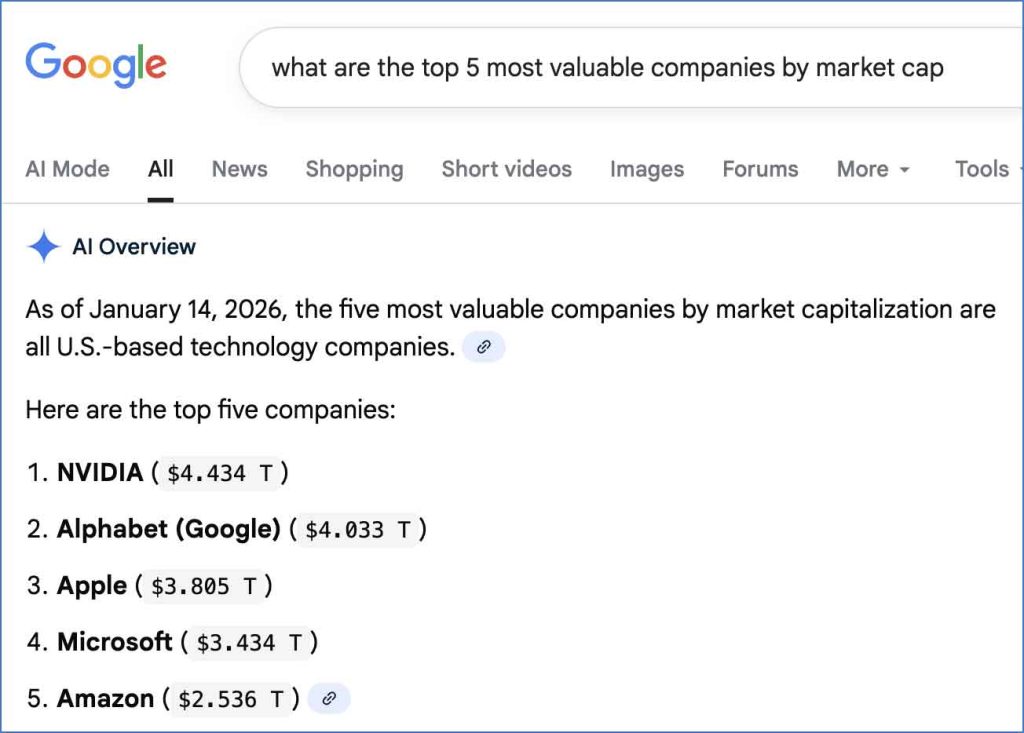
According to market data, Google’s market cap is now over $4 trillion — trailing only Nvidia.
PROTOCOLS
Scope3’s O’Kelley compares AdCP vs. RTB
Scope3 CEO Brian O’Kelley, a member and architect of the founding consortium of Ad Context Protocol (AdCP), threw down the AdCP “gauntlet” on LinkedIn yesterday.
Mr. O’Kelley appears to be aiming to carve out the critical need for AdCP’s role in an AI-enabled world when compared to real-time-bidded programmatic advertising:
“You can throw Claude’s entire context window at every single AdCP request and it’s still cheaper than the RTB auction infrastructure.
RTB layer: 500M req/sec × 4ms = ~2 million CPU-cores worth of compute, just to run the auctions. Latency-critical, deterministic, dumb-but-fast.
AdCP layer: 100 req/sec of natural language strategy. Latency-tolerant (seconds, not milliseconds). Smart-but-slow.
AdCP sits above the auction layer. It’s the interface where a human or agent says “shift 20% of budget from prospecting to retargeting” or “find me audiences similar to my converters but exclude high-carbon inventory” – and then traditional systems execute that at auction speed.
It’s the difference between:
Trading floor (RTB): Millisecond execution, no reasoning
Portfolio manager (AdCP): Strategic allocation, full reasoning…”
Read his entire argument on LinkedIn. (January 14)
Related: “I made this podcast + video on AdCP and Swivel.” – Swivel CEO Joseph Hirsch on LinkedIn
From tipsheet: AdCP needs adoption to succeed – initially from technology companies who will build the infrastructure. Quickly thereafter, ad buyers (the ad budget) and sellers (the inventory) will determine AdCP’s success by understanding the eternal question: “Does it (effectively) make me money?”
PROTOCOLS
IAB Tech Lab pushing ARTF — and RTB
At about the same time as the post from Scope3’s O’Kelley, IAB Tech Lab VP of Measurement Angelina Eng made the case for her organization’s agentic protocol effort known as Agentic Real-Time Framework (ARTF).
She wrote yesterday:
“Burning down the house vs. renovating? Agentic AI in ad tech doesn’t need a full rebuild. We have a foundation that we can build on.
Creating meaningful standards takes more than protocols. It takes adoption, real-world understanding, and sustained evangelism. IAB and IABTechLab have played, and will continue to play, a critical role here, but so does every company operating in this space…”
Translation: “Burning down the house” means AdCP’s framework and “renovating” means IAB Tech Lab’s ARTF framework.
Read more on LinkedIn. (January 14)
Ms. Eng linked to an ExchangeWire article by reporter Shirley Marschall to support her case.
Read: “Agentic Ad Tech Confusion: Revolution or Evolution?” (January 14) – ExchangeWire
From tipsheet: Spicy times. The advertising trade is moving to an AI future.
AGENCIES
AI making small agencies more nimble
In an article on The Current titled, “‘There’s a talent crisis’: Are smaller agencies behind in the AI race,” The Current’s Travis Clark spoke to leaders from smaller agencies as well as unpacked an AI Digital Labs report called “The State of AI Maturity” (download) .
Though he found where large agencies may be at an advantage when it comes to discovering and adopting AI tools and solutions, Clark spoke to a co-owner of a small performance agency who saw beneficial impact to workflow due to artificial intelligence:
“‘As a small, independent agency, o2kl has always benefited from being nimble, with less bureaucracy and faster decision-making than larger, publicly traded organizations,’ said Tracey Owens, co-founder and president of o2kl. ‘AI has amplified that advantage, enabling us to do more with less while maintaining a high standard of strategic and creative output.’
Owens added that the agency is moving beyond experimentation into a ‘phase of measured, intentional adoption.’
‘Alongside ongoing exploration, we’re building structure through training programs, documented workflows and defined use cases by discipline,’ she added.”
Read more on The Current. (January 14)
From tipsheet: The Current is a publication owned by The Trade Desk, which operates an AI-enabled ad buying system known as Kokai.
AGENCIES
Use case: Google Performance Max and PPC
In a company blog post, Casablanca-based search marketing agency SkyWeb3 takes marketers through its methodology for success when using Google’s automated Performance Max (or PMax) ad system.
According to SkyWeb3, PMax success begins with the foundational structures of paid search.
“A well-structured account provides boundaries for the machine to work with. It helps by:
Providing clean learning environments: Grouping products and services in a logical manner helps to ensure that products such as PMax aren’t trying to learn everything all at once. Through clear separation, you increase the likelihood of more accurate outcomes.
Maintaining budget control: If everything is thrown into one campaign, it makes it increasingly more difficult to avoid under-performing products from cannibalizing budget.
Reducing conflicting intent: When campaigns mix differing intents (e.g., providing varying conversion actions that are contradictory from a user journey standpoint), the machine receives much greater volumes of noise. Through clear separation and delineation within a well-structured account, advertisers can reduce skewed data and improve performance…”
From tipsheet: Separately, Google’s ad system that focuses on automated ad buying in Search is known as AI Max.
TECH
Partnering
- TransUnion and Actable Prove AI Success Starts with Data: Partnership Delivers 10% Lift in Predictive Modeling (January 14) – press release
- Next Net and Audacy Partner to Bring AI Discoverability Solution to Help Local and Regional Businesses Compete in the Next Era of Search (January 14) – press release
MORE
- “The Texas AG views the data collection and transparency methods of Smart TV manufacturers as an emergency…” (January 14) – Alan Chapell, Marketecture, on LinkedIn
- CPG Data Seller SPINS Moves Into Media With MikMak Acquisition (January 14) – AdExchanger
- Opinion: “Why Most E-Commerce Leaders Are Unprepared For AI Agent Traffic” (January 11) – DataDome CEO Benjamin Fabre post on Forbes
- Google adds new data transmission controls to Ads consent stack (January 14) – Search Engine Land
- “AI isn’t ‘killing’ jobs — it’s fueling a ‘new-collar’ era of AI marketing heads and creators, LinkedIn says” (January 14) – PR Week