
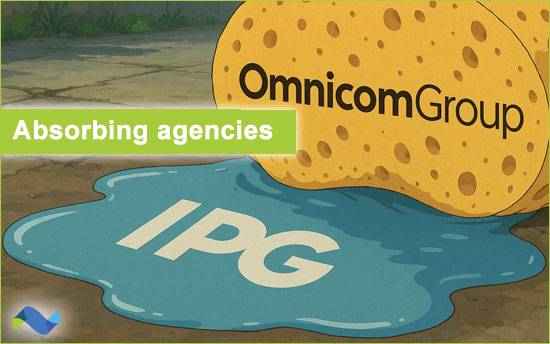
CEO John Wren talked about his agency holding company’s AI future in the wake of Omnicom’s successful merger/acquisition of Interpublic Group. Business Insider’s Lara O’Reilly spoke yesterday with Wren as well as Omnicom CTO Paolo Yuvienco and Omnicom Advertising Group CEO Troy Ruhanen, to get the scoop.
Read O’Reilly’s preview on LinkedIn. (December 1)
Wren was confident in the interview, stating:
“We will be in a position, for the foreseeable future, to be able to create the best commercial terms for our clients. Underpinning that is a platforms group powered by generative AI that will be far unmatchable unless you’re one of the big six tech companies.”
In discussing how Omnicom will differentiate its AI strategy in comparison to Publicis and WPP, Wren kept his cards close to his vest. But, he suggested that streamlining workflow was important initially.
After workflow, he saw “performance” as the next strategic consideration due to AI and said:
“We’re going to increasingly get more and more confident about our abilities to be paid for performance. In order to get there, the client’s KPIs have to be clearly articulated and explained, and we have to be certain that we can add value to that activity, which we believe we will.”
Read more on Business Insider. (subscription)
More:
- “Omnicom confirms post-IPG leadership, DDB, FCB & MullenLowe sunsetting and job cuts” (December 1) – The Drum
- “Omnicom Could Buy These Retail Media Tech Firms to Challenge Publicis” (November 26) – Adweek (subscription)
LLMS & CHATBOTS
Developments
- More of Silicon Valley is building on free-to-use Chinese AI (December 1) – NBC News
- OpenAI takes an ownership stake in Thrive Holdings to accelerate enterprise AI adoption (December 1) – OpenAI
- “China’s DeepSeek Debuts New AI Models to Rival Google and OpenAI” (December 1) – Bloomberg (subscription)
TECH
Google Search becoming AI Mode
On X yesterday, Google VP Robby Stein announced that his company will start bringing AI Mode by default to standard Google Search in mobile.
Using a visual, Mr. Stein explained about the new test on X:
“Today we’re starting to test a new way to seamlessly go deeper in AI Mode directly from the Search results page on mobile, globally.
This brings us closer to our vision for Search: just ask whatever’s on your mind – no matter how long or complex – and find exactly what you need. You shouldn’t have to think about where or how to ask your question.”
Read and see more on X. (December 1)
More: “Google tests pushing searchers from AI Overviews with follow up questions to AI Mode” (December 1) – Search Engine Land
From tipsheet: In Stein’s visual, ads are integrated throughout and look similar to past AI Mode ad implementations – with the ads showing images versus the text-only, conversational response of the AI Mode chatbot.
The transition to a new Google (AI) Search future may be nearing completion. Google engineers and bean counters are likely carefully watching the yield for ads in these mobile tests.
Meanwhile, how will search referrals play out for publishers?
Related: “Big updates dropping today. Gemini 3 and Nano Banana Pro are rolling out to more people around the world in Google Search.” (December 1) – Robby Stein on X
RESEARCH
Charts and chatbots
eMarketer Chief Content Officer Vladimir Halnzlik dropped eight more AI-related charts on LinkedIn yesterday for your upcoming company-wide presentation.
Regarding the chart below, Mr. Hanzlik said, “Advertising will remain the only model big enough to fund consumer AI…”- i.e. affiliate marketing will be not enough revenue for a chatbot like OpenAI’s ChatGPT, which the AI company has seemingly pursued to-date other than subscriptions.
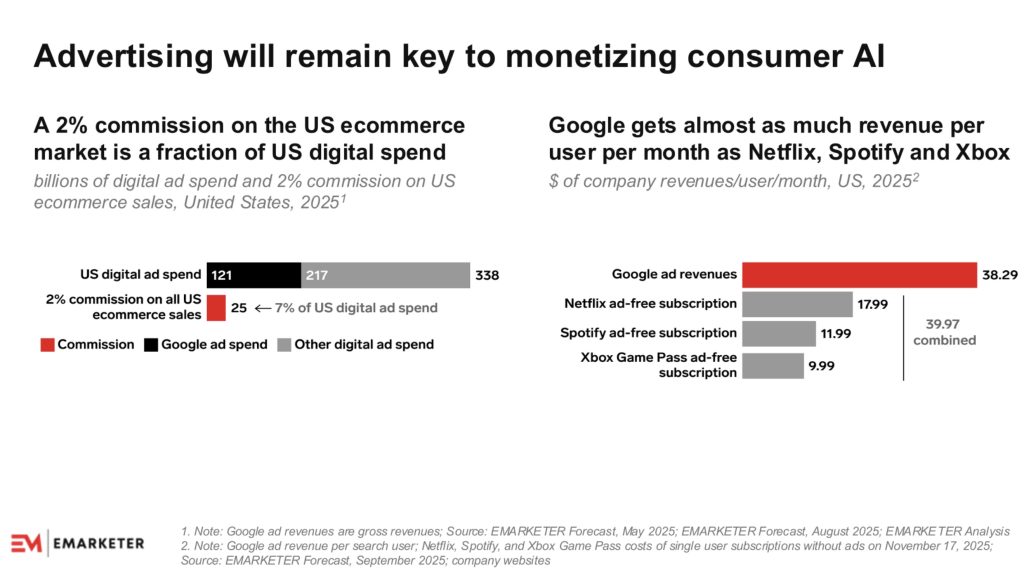
Read more — and see all the charts — on LinkedIn. (December 1)
Meanwhile, Stratechery analyst Ben Thompson continued to pound away on the need for OpenAI to adopt an advertising model for ChatGPT. He sees the possibility for the company to dig a much deeper moat:
“At one point it didn’t seem possible to commoditize content more than Google or Facebook did, but that’s exactly what LLMs do: the answers are a statistical synthesis of all of the knowledge the model makers can get their hands on, and are completely unique to every individual; at the same time, every individual user’s usage should, at least in theory, make the model better over time.
It follows, then, that ChatGPT should obviously have an advertising model. This isn’t just a function of needing to make money: advertising would make ChatGPT a better product. It would have more users using it more, providing more feedback; capturing purchase signals — not from affiliate links, but from personalized ads — would create a richer understanding of individual users, enabling better responses. And, as an added bonus — and one that is very pertinent to this Article — it would dramatically deepen OpenAI’s moat.”
Read more on Stratechery. (December 1 – subscription)
STARTUPS
Media planning and “the why” of data
A number of startups, and not-so-startups, see media planning as an area ripe with opportunity — and the need for streamlining — with AI’s help.
Startup Guideline[dot]ai is no exception as VP Kelley Train discussed her company’s AI-powered media intelligence platform and its unique approach in an interview with AdExchanger’s Allison Schiff
Schiff reported that Guideline is trying to get the marketer to adopt new technology, which provides data-driven insights:
“That’s the gap Guideline is trying to close by pulling together market data, pricing and performance benchmarks so agencies can quantify the value of their ideas. The platform gathers real transaction data directly from agency billing systems, strips out identifying details and compiles it into industrywide insights on spend and related trends.”
On the AI aspects of Guideline’s tech, Ms. Train said, “We’re using AI agents to give a more qualitative look at quantitative data. The why…” Read the interview. (December 1)
SELL-SIDE
Tracking AI’s effect on publisher M&A
Noting that “higher interest rates, economic tariffs, and a soft ad market haven’t helped” publishers, Digiday’s Sara Guaglione profiled how the mergers & acquisitions market is affecting media today.
Digiday editor Jessica Davies previewed her colleague’s piece on LinkedIn.
“Publishers’ traffic has dipped since AI tools arrived — and the fallout isn’t limited to audience or ad revenue. It’s now weighing on the media mergers and acquisitions (M&A) market, making deals harder to price during a time of disruption, according to investors and analysts.”
Read: “How AI’s hit to publisher traffic is quietly rewiring media M&A” (December 1) – Digiday (subscription)
WORKFLOW
QOTD: Agents create human interaction
“I think we’re getting to a point where with layering in agents, ideally, we finally get salespeople to a point where they’re actually spending 70% of their time interacting with humans.”
h/t Adam Epstein, CEO, Gigi, who noted his own AI-enabled media planning startup’s mission in reference to Ms. Grosser’s quote.
Read Mr. Epstein’s thoughts on X. (December 1)
PEOPLE MOVES
Now hiring
- Epic Games Vet Stacy Minero Named Marketing and Experiences Chief at IRL Marketing Firm Outfront Media (December 1) – Variety
- Julia Dubois joins Mastercard as Commerce Media Director for North & Latin America (December 1) – Julia Dubois on LinkedIn
- Expedia Hires Former Google VP, Xavier Amatriain, as First Chief AI Officer (December 1) – Skift
MORE
- Opinion: “Think Bigger. If I Were to Reinvent the AdTech Industry Today” (December 1) – Anthony Iacovone, Co-Founder and CEO, Veylan on LinkedIn
- Why Target, Canva and WPP are using the Model Context Protocol to power their agentic marketing (December 1) – Ad Age (subscription)
- Can Influencers be automated with AI? (December 1) – Fast Company
- Warner Bros. Discovery gets mostly cash offer from Netflix in second round of bidding (December 1) – NY Post
- Data Centers Are a ‘Gold Rush’ for Construction Workers (November 29) – The Wall Street Journal (subscription)