
In yet another blockbuster deal for OpenAI, the company committed $38 billion of compute business to Amazon Web Services over the next seven years.
The Wall Street Journal distilled the news:
“The deal is tiny compared with those OpenAI has signed with other cloud leaders, which include a $300 billion deal with Oracle and a $250 billion commitment to Microsoft. But it represents a crucial first step in Amazon’s effort to ensure that its cloud business can benefit from a company that is pledging to spend trillions of dollars on computing power in the coming years.”
Read more from the WSJ. (November 3 – subscription)
In analyzing the new partnership, New Street Research’s Dan Salmon saw similarities between OpenAI’s recent deals with Walmart and Shopify and what may happen with Amazon. Mr. Salmon said in a note to investors, “Our conviction in a potential ChatGPT + AMZN retail partnership is now even higher.”
More:
- AWS and OpenAI announce multi-year strategic partnership (November 3) – Amazon
- OpenAI signs $38 billion compute deal with Amazon, partnering with cloud leader for first time (November 3) – CNBC
From tipsheet: So, commerce may be next between OpenAI-Amazon with the potential for an affiliate marketing model where OpenAI takes a slice of the referring purchase price for the Amazon product.
And then ads after that with either ads supplied by the Amazon sponsored ads side of the house or Amazon DSP? We’ll see.
LLMS & CHATBOTS
Developments
- Large Language Models Get All the Hype, but Small Models Do the Real Work (November 1) – The Wall Street Journal (subscription)
- Alphabet, Amazon Stakes in Anthropic Boost Profit by Billions (October 31) – Yahoo! Finance
- Studio Ghibli and other Japanese publishers want OpenAI to stop training on their work (November 3) – TechCrunch
SELL-SIDE
IAB to OpenAI: Talk to us
Interactive Advertising Bureau (IAB) CEO David Cohen and Tech Lab CEO Anthony Katsur published an op-ed in Ad Age yesterday.
They began with their premise, “Of all the predictions about AI, here’s one you can bet on with confidence: Major large language models will start building ad businesses in the very near future…” The duo emphasize the importance for LLM companies to connect with existing ad industry players, some of whom the IAB represents, as they build out an ad strategy.
To OpenAI, the IAB kindly recommends that “[the] company should keep experimenting and listening to market feedback, and stay ready to adapt and refine any initial ideas.”
Of course, there has been frustration for the IAB’s publisher membership, in particular. Even though some publishers have hammered out deals with LLM companies, most publishers have no licensing deals. They also have been impacted by a loss of search referral traffic due to chatbots and, potentially, the unauthorized use of publisher content by some LLMs and their crawlers.
Read: “What OpenAI and other LLMs must do before building their ad businesses” (November 3) – Ad Age (subscription)
From tipsheet: There is impact for publishers with chatbots. But, there’s impact for ad tech too – the key IAB membership which funds the association. No one knows what the impact will be with “ads in a chatbot.” Here are a few questions to consider over the next 1-2 years:
- How big will OpenAI’s advertising business be?
- In general, will “ads in a chatbot” suck away ad business from the open web – similar to how chatbots have diverted search referral traffic?
- Could “ads in a chatbot” somehow supercharge the open web (or mobile apps or CTV or…) by enabling even better addressability?
- And how do “ads in a chatbot” affect walled gardens? Advertising would only seem to get better with an LLM “engine” running throughout a walled garden’s fully-transparent inventory. This is something that companies like The Trade Desk can relate to —“How do we make the open web more like a walled garden?” or, put another way, “How do we improve transparency on open web supply”?
AGENCIES
Earnings & evolution: Hold co’s
“End of the Old Guard? Publicis outperforms, WPP declines, Havas rises, Omnicom readies IPG merger:
As WPP reels from revenue declines and vows sweeping restructuring, Publicis and Havas ride strong AI-led client demand. With Omnicom and IPG on the cusp of a historic merger, the global advertising landscape braces for a power realignment built on data, technology, and efficiency.”
Read more on Storyboard18. (October 31)
TECH
Breaking down AdCP bit by bit
On Monday, Marketecture’s Ari Paparo provided his newsletter readers with a detailed breakdown of the new Ad Context Protocol (AdCP) launched last month. He outlined both strengths and weaknesses.
On the strengths side:
-
Creative – “The creative protocol is brilliant for [cross-platform automation using agents] because it flexibly solves a time-consuming and error-prone cross-platform workflow that is currently done by humans or unreliable 1-1 point integrations.”
On the OK side:
-
Signals – “I don’t want to be overly critical of the signals protocol since the use case makes sense (‘[allowing] cross-platform discovery of targeting and data parameters to be used in media execution.’). However, I worry that the business reality of the data world is that the parties often don’t have incentives to trust one another, and AI is not going to solve that problem.”
On the weaknesses side:
-
Media buying – “Once again, no shade to the hard work expended to get this project where it is. Amazing progress and a bright future, no doubt. But I think a lot of the focus of the project is on media buying, and that could be an area where we see over-promising and under-delivering.” He sees real issues around outcomes-based buying.
Read more on Marketecture. (November 3)
From tipsheet: This is an unparalleled critique of AdCP by a top product executive in advertising technology (Mr. Paparo). It’s a must-read.
Related: Why Your First AdCP Project Is Probably Going To Fail (November 3) – Mano Pillai, Hypermindz[dot]ai on AdExchanger
CREATIVE
(Over) Personalizing the creative
404 media took a look at how Ticketmaster, among other publishers, were using AI to create personalized media for users in order to sell tickets. It’s a gloomy look at what the author sees as a tidal wave of “slop” that goes too far with personalization.
He quoted Meta CEO Mark Zuckerberg during his company’s earnings call last week:
“Advertisers are increasingly just going to be able to give us a business objective and give us a credit card or bank account, and have the AI system basically figure out everything else that’s necessary, including generating video or different types of creative that might resonate with different people that are personalized in different ways, finding who the right customers are…”
Read more on 404 media. (November 3)
From tipsheet: No doubt over-personalization is ugly. But, I’d argue that if consumers don’t like a particular way they are being personalized or addressed, they’ll opt-out by 1) voting with their pocketbook and 2) going to social media with their grievances.
LLMs & CHATBOTS
AI Overviews showing research bias
According to research from search and answer engine optimization platform BrightEdge, Google’s AI Overviews (AIOs) are showing a tendency to assist with research rather than bottom-of-the-funnel buying.
Search Engine Land’s Danny Goodwin reviewed the report here. (November 3)
Takeaways from the research according to BrightEdge:
“This test reveals Google’s dual strategy: Help users research with AI Overviews, preserve commercial intent for traditional (search) results. The aggressive pullback suggests quality thresholds are higher than ever, while category-specific patterns show Google understands where AI adds vs. detracts from user experience.
For brands preparing for holiday shopping season, the message is clear: November is for research (AI Overviews), December is for buying (traditional search). Position your content accordingly.”
See the BrightEdge Study (for Sept-Oct 2025).
TECH
LiveRamp’s UCP and standards
Another protocol has made its way to the IAB Tech Lab as industry participants rush to make standards ahead of AI agent-enabled buying and selling of advertising.
IAB Tech Lab CEO Anthony Katsur wrote on LinkedIn that “LiveRamp has donated the User Context Protocol (UCP) to IAB Tech Lab, marking a pivotal moment in the development of open standards for the agentic web.”
LiveRamp CEO Scott Howe had spread the initial seeds of UCP in June —just prior to Cannes Lions Ad Festival— when he advocated for Model Context Protocol.
In August, Howe told the Marketecture podcast, “We think that our industry needs kind of an even deeper version of MCP. You know, the protocols that allow companies who have large data sets to communicate with one another. We call that internally UCP, our user context protocol.”
Now, the company is trying to make UCP an industry standard.
Katsur defined the protocol yesterday: “UCP is an open standard that defines how intelligent agents in advertising exchange signals—identity, contextual, and reinforcement information—that represent a consumer’s real-time intent and response to advertising.”
Read Mr. Katsur’s post: “Data Standards for the Agentic Age” (November 3) – LinkedIn
From tipsheet: Interoperability is key for non-walled garden, ad tech players. Protocols such as UCP will codify those interoperable standards for the open web, which is likely critical to LiveRamp’s future success.
BRANDS
Optimizing for the LLM
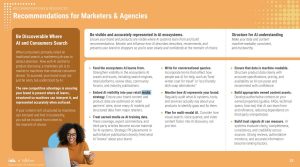
In a message to marketers last week, the IAB released a new study in partnership with Talk Shoppe which urges marketers, in so many words, to invest more in how they’re delivering their products and data to retail media.
The study is focused in large part on issues of answer engine optimization (AEO) and the consumer’s path-to-purchase: the marketer’s brand and products need to be properly ingested, and repurposed, by AI.
Among the “Key Takeaways”, according to the IAB:
- ”AI is now an essential tool in the consumer journey”
- ”AI is most effective providing clarity mid-journey where complexity peaks”
- ”Shoppers frequently run into friction with AI, eroding trust”
- ”AI doesn’t shorten the path to purchase — it reshapes it, creating new steps and opportunities”
Intro: “When AI Guides the Shopping Journey: Opportunities for Marketers in the Age of AI Driven Commerce” (October 28) – IAB
Download: Full study (PDF)
Related: “Ranking is out, visibility is in as publishers chip away at AI search optimization” (November 3) – Digiday (subscription)
CREATIVE
Should AI create or assist?
On LinkedIn yesterday, NYU professor Anindya Ghose announced new research she co-authored titled, “The Impact of Visual Generative AI on Advertising Effectiveness.”
She previewed the research:
“Creative is becoming the performance engine in an AI-first world. As targeting tightens and attention fragments, brands are turning to visual Gen AI to scale concepts at speed. But a practical question keeps popping up in boardrooms, media agencies and creative ops: Should AI create our ads end-to-end, or merely assist human designs?”
Read the research on SSRN. (October 21)
h/t Eric Seufert
TECH
Yahoo buys AI shopping platform
“Some news today: Yahoo has entered into an agreement to acquire Vetted, an AI-powered shopping platform that helps people find and buy products they love… By bringing Vetted’s incredible team and technology into Yahoo, we’re accelerating our ability to deliver more intuitive, personalized shopping experiences and continuing to strengthen Yahoo’s role as a trusted guide for millions of consumers around the world.”
See: Vetted
MORE
- Graphic: “Could the rise of generative AI truly mean the death of search, online retailers, iPhones, enterprise software, and social networks?” (November 3) – Vladimir Hanzlik, CCO, eMarketer
- Partnership: “Congrats to our friends at Brand Networks on launching their Universal Ads API integration within their AI-powered buying platform, Aimy.” (November 3) – James Burow, Comcast’s Universal Ads, on LinkedIn
- Coca-Cola’s new AI holiday ad is a sloppy eyesore (November 3) – The Verge
- The case for campaign AI (November 3) – Politico