
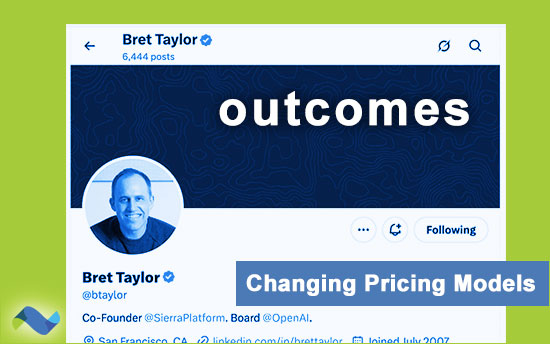
In an hour-long podcast conversation on June 26 with Ben Thompson of Stratechery, OpenAI chairman Bret Taylor discussed AI transformation and how it’s playing out in Taylor’s new startup, Sierra.
Mr. Taylor’s company has moved to outcomes-based pricing with Sierra’s agentic product and away from the traditional SaaS subscription model.
Is this another way of approaching advertising in the age of AI?
He does not speak to advertising directly, but Taylor’s comments raise a few questions…
- Is “outcome” the new way of buying advertising – i.e. cost per outcome – via agents? -or even via a plain, “vanilla” display ad?
- And then… what is an “outcome” exactly? It seems to depend.
- Thought bubble: In 5 years, all of advertising is based on outcomes with AI’s help.
Mr. Taylor on outcomes-based pricing [49:39]:
“At Sierra, we only charge customers when the AI autonomously resolves the problem. That means if we escalate to a person, it’s free.”
”I’ll give you my rationale for this. I actually think it’s very similar to the evolution of the web browser and subscription-based software as well, which is — let’s go back to 2000 or so, whenever Marc [Benioff] invented software-as-a-service…”
“… if you put a piece of software in a web browser and you serve it from your own servers, it means everyone has the same version of it. The business model of a perpetual license just doesn’t really make sense because: when do you buy the new version? How do you hold back the features? It was a technology-led thing, but it almost necessitated a different business model, which is this idea of ‘there’s one version and you’ll subscribe to it.’”
”What’s exciting about agents is – rather than just augmenting us with letting us become more productive – they can actually solve a problem [and] accomplish a task. Most salespeople get paid a commission, because when you can quantify the value of a task, the best way to pay for it is to incentivize the precise thing that you want. If you think of a Harvey agent doing an antitrust review or a Sierra agent answering a phone call, the natural way to pay for that is the job well done, to pay for the outcome that you’re looking for.”
Taylor has had extended stays at Google, Facebook and Salesforce during his hugely-successful entrepreneurial career. Read the Wikipedia summary.
Hear more:
-
On Apple Podcasts app (June 26). (subscription)
-
Visit Stratechery episode website. (subscription)
AI and chicken wings
From a WSJ article on Saturday titled, “How the Owner of Hidden Valley Ranch Learned to Love AI,” the story of how AI is being used by Clorox employees for R&D ideas, customer insights and better ads was on full display.
Chicken wings were apparently a creative challenge in an AI environment as Clorox sought to pair wings with Its Hidden Valley Ranch Dressing. But:
”’How do you explain to AI what deliciousness is like?’ says Will Hanschell, CEO of Singapore-based Pencil, a software company that Clorox hired to help with AI. ‘Is it about how moist it is? Is it about color? Is it about crispiness?’”
Nevertheless, Clorox sees opportunity ahead with AI.
“Clorox’s leadership says its AI push isn’t being driven by a desire to cut staff. For example, the company is using AI-generated ads so that it can make more than would have been affordable without the technology. So far, a company spokeswoman says, using AI at Clorox hasn’t led to any layoffs.”
Read more in The Wall Street Journal (July 5).
Use case: Airtable and eBay
-
VIDEO: From Airtable customer event – “AI-powered customer insights: eBay’s transformation story” (July 1) – YouTube
-
eBay’s Head of Product Operations Angela Yanes discusses Airtable’s AI-powered customer insights platform and a pilot program centered around eBay’s Promoted Listings advertising products. (July 5) – Value Added Resource
Google invests in sell-side strategy
The Information’s Catherine Perloff reported Thursday that Google is making new investment in the sell-side. She wrote on LinkedIn:
“Scoop: Google has told publishers that it is staffing up its publisher-side ad tech unit Google Ad Manager to market it better to big advertisers, who have been more likely to use rival adtech platforms in recent years, publishers say. That’s driven ad prices down for publishers using GAM. Google giving extra investment to publishers’ ad business come as publishers frustration with the search giant reaches an all time high over AI overviews and search traffic.”
Read more on The Information from July 3 (subscription).
Thought bubble: Two is a trend?…
Two weeks ago, Google rolled “Offerwall” in an effort to help publishers monetize beyond ads. Perhaps, these two latest roll-outs (GAM staff, Offerwall) are part of a broader sell-side strategy.
AI creative tests aren’t big enough
“…Resonance can seem utterly random; it’s more likely a complex interaction of features that are imperceptible to the human brain. I’m exploring AI-driven approaches to creative hypothesis testing — more on that coming soon! — but I haven’t seen intuition-driven analysis lead to meaningful performance improvements. What works best is simply thorough, extensive experimentation.”
Read more from analyst/investor Eric Seufert on LinkedIn (July 6).
Use case: AI-enabled media strategy
“From the Marketecture Media stage at Cannes, Hershey’s Vinny Rinaldi shared how custom AI drives sales lift for The Hershey Company, season after season.”
”Use case: What does shelf data + zip-level sales + AI add up to? A smarter media strategy that actually moves product…”
Read, and see more, on Linkedin.
Podcast: Cloudflare and bot revenue
Coming on the heels of last week’s announcement by web traffic manager Cloudflare that it would begin gating LLMs crawlers and charging them for access to its publisher client websites, Cloudflare CEO Matthew Prince appeared on TBPN for an in-depth interview.
So, are bot crawler fees a solution to publisher nightmares of losing traffic and ad revenue to LLMs?
Mr. Prince’s observations made it sound like there is significant revenue to be garnered by publishers (and his company), but it’s early days. Cloudflare is still figuring it out.
On the Spotify solution for crawling and fees
Taking inspiration from a meeting with Spotify founder Daniel Ek the week prior, Mr. Prince revealed [begins 01:31:30]:
“So you could imagine a version where Cloudflare effectively negotiates on behalf of all of the content that sits behind us with the big AI companies. People can opt in or opt out of being a part of that pool.”
”The more content that’s part of that, the more valuable it is the AI companies. And then we would look at how we could split that up across how much crawling is actually done across that. I think one of the real keys will be how can we give hints to the AI companies on what is the content, which is the most valuable to them (…).”
“And so what we have to do is (…) on an LLM, or an AI model by AI model basis, be able to give them signals back that say this is the sort of thing that you should be paying attention to, that you should be indexing, that you should be actually scraping and paying for. And the same way that in the music industry, we’ve got reviews, we’ve got different types of music that people are, you might be into country, you might be into classical, and it kind of allows you to compartmentalize that.”
On agents, ads and fees
Looking more broadly across the changing business model of the internet – and any content destination charging LLM bots for access to anything – Mr. Prince referenced Uber’s retail media network’s as an offset on the price of a ride.
He explained:
“I think that robots don’t click on ads. And so the [business] model – that part of the revenue stream to support these services- has to come from somewhere.”
”And if today, you know, Uber is able to monetize the time where I’m waiting for a car to come by showing me an advertisement, that means that they can effectively charge me less for the ride. And so it may be that if that ride is booked through an agent instead, and they don’t get that advertising experience. And again, I don’t know enough about Uber’s business model to know how important that is to them.”
”But if they don’t get that, then maybe there’s some sort of premium that an agent booked ride receives versus a human booked ride. And again, we’ve got to figure out what that looks like. I think that’s going to be less up to Cloudflare.”
Mr. Prince also sees traditional and blockchain payment methods as potential solutions for an LLM marketplace. He even suggested a Cloudflare stablecoin.
Is advertising ready for crypto?
Hear more of this informative TBPN interview on the Apple Podcasts app (July 1).
Addendum:
-
Marketing expert Nico Neumann observed on Linkedin yesterday:
“What’s interesting is that Fastly, another CDN key player, also introduced the option to block AI crawlers in April and has recently added a pay-per-crawl option.”
”What will the other main players like Google CDN, Amazon CloudFront, Microsoft Azure CDN, and Akamai do? Will AI crawler blocking become an essential feature of CDNs that publishers demand?”
-
Cloudflare: Dominating The Global CDN Market – statistical estimates (Feb. 2025) – Seeking Alpha
-
AI Scraping Is On The Rise. TollBit State of the Bots – Q1 2025 (June 2025) – TollBit
Complaint: AI summaries, publisher traffic
-
Google hit with antitrust complaint in EU over AI summaries harming web traffic to news sites: report (July 4) – The New York Post
Opinions
- “The Model Context Protocol (MCP) could set the standard that will make our agentic future a reality” (July 1) – Bob Walczak on Adweek
- “The future of digital advertising: transparency, control – and the open internet” (July 2) – The Trade Desk in Campaign Live UK (sponsored)
More stuff
- Google Ads rolls out AI Max search match type (July 2) – MarTech
- US ad employment dropped in June for the seventh month in a row (July 3) – Ad Age (subscription)
- “Sources: TikTok plans to launch a new version of its app in the US on September 5, ahead of the Sept. 17 deadline for the US to enforce the divest-or-ban law” (July 6) – Techmeme and The Information