
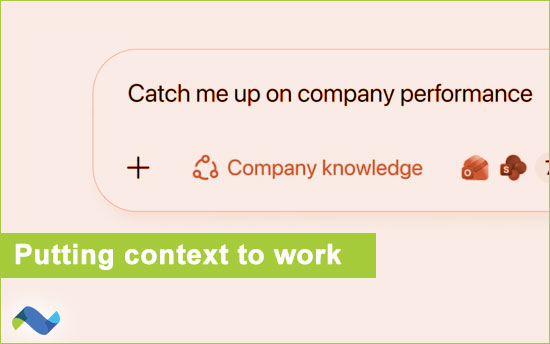
Last Thursday, the new “Company Knowledge” feature was rolled out in OpenAI’s ChatGPT and product executive Hemal Shah previewed it on LinkedIn:
“We just rolled out company knowledge — a new way for ChatGPT to put your context to work. It’s powered by a version of GPT-5 that’s trained to connect the dots across multiple sources and show its reasoning with clear citations so responses are based on what’s actually happening inside your company…”
Read more on Linkedin. (October 23)
More: Work smarter with your company knowledge in ChatGPT (October 23) – OpenAI
From tipsheet:If you believe AI is transformational, the “Company Knowledge” feature signals the bigger ‘unlock’ yet to come. Sure, LLMs are changing the game, but they’re not the end game. Successfully integrating a company’s unique context with the LLM is the big win.
It’s still early days… at least for another week or two.
LLMS & CHATBOTS
Developments
- The AI Startup Fueling ChatGPT’s Expertise Is Now Valued at $10 Billion (October 27) – The Wall Street Journal (subscription)
- Strengthening ChatGPT’s responses in sensitive conversations (October 27) – OpenAI
- How retail executives will be evaluating ChatGPT checkout this holiday season (October 27) – Modern Retail (subscription)
SELL-SIDE
Breaking down the AI bots
Content delivery network Akamai published an explainer on the different types of bots its seeing from AI companies, including:
- AI training crawlers
- AI search crawlers
- AI fetchers
- AI agents
With the publisher consternation about AI scraping, this explainer shows some of the nuance that publishers are dealing with as well as how AI companies are collecting data.
Akamai data scientist Rob Lester summarized:
“In creating this categorization, we realized one distinct truth:
AI fetchers behave differently from crawlers. Fetchers are focused on sourcing content on behalf of a user request, while crawlers periodically source content for use in training/updating models.
AI bot fetchers are growing more rapidly than crawlers, indicating that user-driven AI bot requests are driving a significant amount of the total AI bot traffic we observe on Akamai’s network…”
Sell-side consultant Matthew Scott Goldstein noted about the article:
“…We see that not all Fetchers act consistently, while many follow the circadian rhythms of the users Anthropic seems to differ. Maybe it’s because the Anthropic web fetch tool is available for developers building with Claude models via Anthropic’s API?”
Read more from Akamai. (October 27)
STARTUP
AI workflow for the creator economy
Agentio, an AI-enabled platform for creator advertising, was the focus of a feature in Forbes. Unlike many AI ad startups, though, this one is about workflow rather than AI-generated creative.
Forbes’ Jamie Gutfreund explained:
“…Agentio automates every part of a creator-led campaign using AI.
It enables marketers to purchase integrations directly within YouTube videos, streamlining the process of sourcing creators, handling contracts, obtaining creative approvals, and processing payments through a single system.”
Where’s the AI? According to Gutfreund:
“Agentio’s platform uses large language models to analyze every creator’s historical content, brand deals, and audience retention automatically matching them to campaigns, handling brand-safety checks, and even measuring ROAS through connected commerce pixels.”
Read more. (October 27)
From tipsheet: This is another example of a company using AI to reduce the friction between the biggest brands (and their big brand budgets) and the rapidly growing creator economy diaspora. At the same time, the creator economy is looking for easier ways to make ad revenue given the creator’s limited bandwidth or ad expertise.
STARTUP
Communicating about ads with AI
Former Hoppr CEO and Magnite CRO Joe Prusz talked to AdExchanger yesterday about his new startup called Medialive, which aims to “automate” ad buying workflow by connecting demand, supply, and communication tools with AI-powered intelligence.” Read Medialive’s home page.
AdExchanger’s Joanna Gerber explained that the AI-enabled communications system is the underlying differentiator:
…the system doesn’t just identify problems; it fixes them. Medialive’s agent can log into DSP consoles and automatically update targeting parameters and other campaign details, like time of day, based on its own research and by interfacing with agents and chatbots from other vendors.”
Read more on AdExchanger. (October 27)
BRANDS
CMOs confront AI
From the ANA Masters of Marketing 2025 event last week, Ad Age reporters E.J. Schultz and Jack Neff reviewed on-stage comments from CMOs and a consensus emerged… AI is not just a tactic to be used at scale. CMOs need to evolve their structure, culture, measurement and creative engines to truly win at AI.
Read: How CMOs are confronting a future defined by AI and reinvention (October 27) – Ad Age (subscription)
TECH
The AdCP wave: building
From his “BOK on Ads (and Climate)” Substack, Scope3 CEO Brian O’Kelley promised a series of upcoming posts that will explain AdCP (Ad Context Protocol) and how it will work for each member of the ad ecosystem.
Mr. O’Kelley began:
“The simplest way I can describe the Ad Context Protocol (AdCP) is that it attempts to make an agentic storefront for every publisher, platform, ad network, anybody who sells ads. It lets the agent discover ad products, place and manage a buy, get reporting, and even provide feedback on what’s working…”
In this initial post, even though there is a healthy dose of technical guidance, O’Kelley keeps the goals of each step accessible to all.
Read: “AdCP Basics: Creating a trusted advertising supply chain using adagents[dot]json.” – ‘BOK on Ads (and Climate)’ Substack (October 27)
Meanwhile, in an op-ed on AdExchanger, CTO Nick Ross of Scope3-backed contextual advertising startup Classify, made the case for Model Context Protocol (MCP) in advertising while agentic AI use cases develop.
Read: “AdCP And The Math Of Agentic AI: Building For Today’s Economics, Not Tomorrow’s Dreams” (October 27) – Nick Ross, Classify, on AdExchanger
Finally for a round-up of ad tech views on AdCP, read: “What the Ad Tech Industry Makes of the AdCP Agentic AI Standard” (October 23) – ExchangeWire
From tipsheet: In Mr. O’Kelley’s post, the publisher’s implementation of AdCP is at the top of the list —which makes sense. If the new protocol is going to work, it’s going to need publishers providing properly-configured inventory at scale.
TECH
The AdCP wave: facing pushback
On the latest episode of the AdTech AdTalk podcast, CEO Andrew Casale of sell-side platform Index Exchange discussed the recent rollout of the AdCP protocol. He expressed reservations, though he remains confident in an agentic future for advertising
And among the reservations, Mr. Casale worried about the impact on today’s auction standards for the open web:
[31:56] “If we’re talking about driving better outcomes… If we’re talking about beating Meta and Google.. we’re not going to do that if we’re trading impression-level decisioning for line items in an ad server.”
Also, Mr. Casale believed existing industry organizations should be running any industry protocol development:
[41:42] “I would love —as we continue to push into this agentic vision and future— because we absolutely will see this through and realize it… I’d love to see it happen within associations we already have because they’re there. All the right people are around the table. And we can have a very thoughtful debate. People can show their proofs. And we can all collectively agree on which ones are likely to scale. And that’s my hope long term -that this goes to the right home and we eventually realize that vision whatever it’s going to look like…”
This is a fascinating discussion on AdCP with a well-respected ad tech executive whose company has focused on open web monetization for many years.
Listen to AdTech AdTalk on YouTube beginning at 25:37 for the agentic chat. (October 25)
CREATIVE
Seufert: Big brands & gen AI creative
Analyst Eric Seufert reviewed the vagaries of generative ad creative on his Mobile Dev Memo blog.
Taking inspiration from Mondelez (was Kraft Foods) recent $40 million investment in AI-enabled, in-house creative tools, Mr. Seufert saw a pattern that sets certain big brand marketers far apart from the rest—especially performance marketers.
Mr. Seufert shared:
“There exists a spectrum of creative control that companies fall on, and there’s a boundary beyond which a company may cede no creative control to any specific platform, for two reasons:
1) That company requires visual consistency with all of its marketing campaigns, and it can’t allow platform-specific creative to deviate in meaningful ways, which platform-generated creative might.
2) That company is intensely protective of its brand imagery.
Mondelez clearly exists beyond that boundary.”
Read more on Mobile Dev Memo. (October 27)
BRANDS
Who manages the marketer’s AI tools?
Marketing consultant Tonya Walker explores “marketing’s next governance test” in a feature on MarTech.
Her concerns stem from the integration of unvetted AI tools into the marketing operations mix as marketers try to keep up with innovation. She recommends that CMOs:
- “Own the AI governance agenda.“
- “Budget for training, oversight and tooling.“
- “Build coalitions across security, legal and IT.“
- “Track governance metrics like campaign KPIs.“
- “Model the behavior you expect across your teams.“
Read more. (October 27)
From tipsheet: There are going to be other silos of the business looking to own the AI governance agenda – IT, for example. Good luck to the CMO.
Related: “Do I really need to spend hours every month learning how to use AI? Yes, but you don’t need to master it all before you start using it. You just need to try. It doesn’t matter who you are: CEO, manager, marketer, engineer, finance lead, or designer. If you’re not trying, you’re already behind someone who is. This moment rewards curiosity, not certainty…” (October 27) – Morgan Vawter, Chief Digital Officer, Personal Care & Home Care, Unilever, on LinkedIn
MORE
- Opinion: “The Costs Of Poor AI Creative Slop” – Cory Treffiletti, Rembrand, on MediaPost (October 23)
- Microsoft Needs to Open Up More About Its OpenAI Dealings (October 27) – The Wall Street Journal (subscription)
- Q&A with Pinterest CEO Bill Ready about changes during his tenure, winning over Gen Z, Pinterest’s business model, AI content, and more (October 26) – The New York Times (subscription)
- AWS’ RTB Fabric marks a new front in the battle between Amazon and Google – Digiday (subscription)