
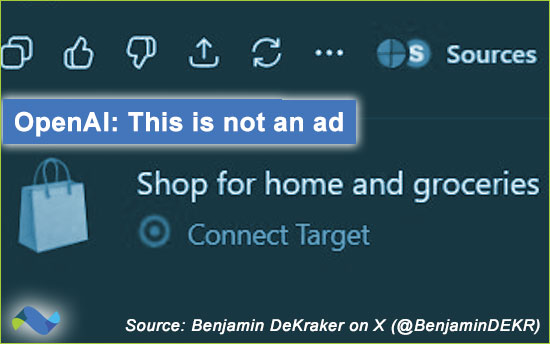
Late Friday night, head of ChatGPT Nick Turley felt compelled to refute the suggestion that ChatGPT was testing ads last week even though a screenshot (which is in our graphic above) from a relatively well-known developer suggested otherwise.
Mr. Turley tweeted on X (December 5):
“I’m seeing lots of confusion about ads rumors in ChatGPT. There are no live tests for ads – any screenshots you’ve seen are either not real or not ads. If we do pursue ads, we’ll take a thoughtful approach. People trust ChatGPT and anything we do will be designed to respect that.”
As head of the company’s premier product, the heat is on Mr. Turley. Last week, OpenAI CEO Sam Altman declared “code red” and ordered the entire company to focus exclusively on improving ChatGPT (suspending ads development) in the face of growing competition from Google, Anthropic and others.
If you look at the ChatGPT screenshot shared by former xAI developer — and now irate ChatGPT Pro user — Benjamin Dekraker on X last Tuesday, the placement in question says, “Shop for home and groceries > Connect Target”… meaning the Target app within ChatGPT, presumably.
In a reply to the tweet (December 3), OpenAI “data” employee Daniel McAuley attempted to set the record straight:
“hey benjamin, this is not an ad. we’ve launched apps from some of our pilot partners since devday, including target, and have been working to make the discovery mechanism for apps more organic inside chatgpt. our goal is that apps augment the ux when relevant to a conversation, and we’re still working on it. anyone can build apps using the apps sdk, and we plan to open submissions and the app directory soon.”
Dekraker wasn’t buying it and by Friday OpenAI chief research officer Mark Chen got involved and replied on X (December 5):
“I agree that anything that feels like an ad needs to be handled with care, and we fell short. We’ve turned off this kind of suggestion while we improve the model’s precision. We’re also looking at better controls so you can dial this down or off if you don’t find it helpful.”
The Decoder unpacked the entire drama. It’s a good summary. (December 5)
From tipsheet: One person’s discovery mechanism is another person’s ad — I get both sides of this argument. But, for the ad aficionado looking for the seeds of an ad system for ChatGPT, this isn’t it.
Much more likely, this screenshot is an example of OpenAI trying to figure out the contours of its affiliate marketing (a.k.a. agentic commerce) business where, we think, OpenAI gets a share of app partner revenue.
LLMS & CHATBOTS
Chart: ChatGPT user trends
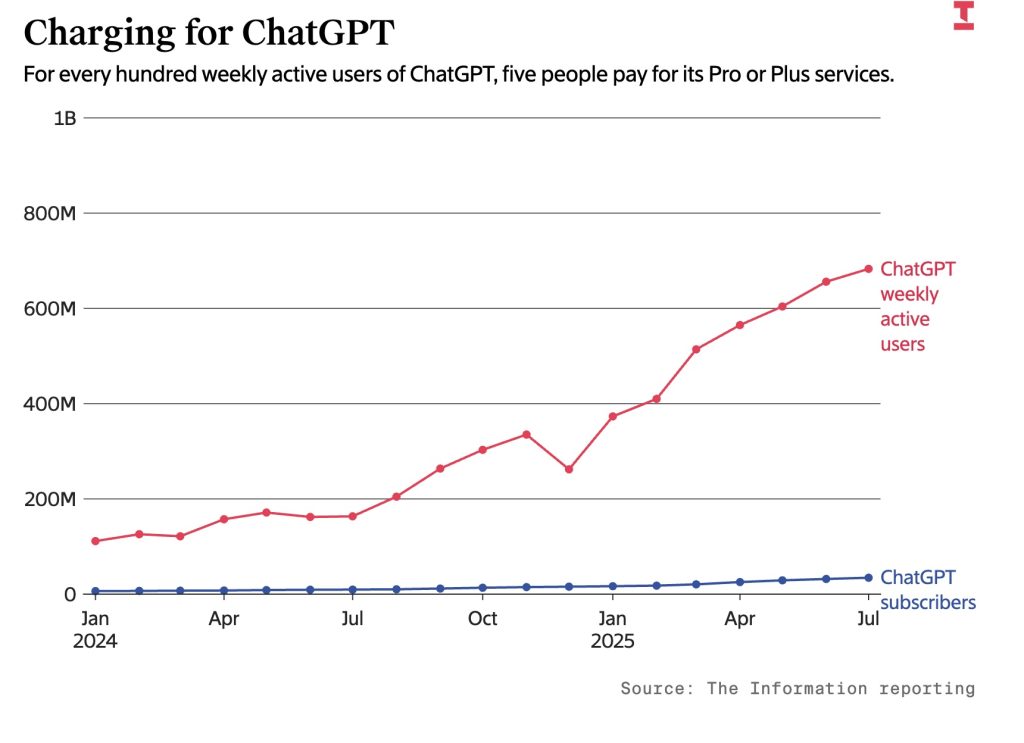
Read: The ChatGPT Product Chief (Nick Turley) Responding to a ‘Code Red’ – The Information (subscription)
From tipsheet: The real question in this ChatGPT chart is what happened from August to November such that OpenAI CEO Sam Altman decided to call a “code red.” With a plateau arguably developing in this chart, I think it’s safe to say he saw something go down in the past month.
In addition to Altman, Mr. Turley is in the “hot seat.”
LLMS & CHATBOTS
Podcast: OpenAI the incumbent and “code red”
OpenAI’s “code red” was on the agenda for discussion by the four members of the “All-In” podcast on Friday.
Co-host David Friedberg, a former Googler, had some compelling views on OpenAI’s predicament [24:10]:
“Google’s willingness to take risk has really highlighted the difference in posture in the last year. ChatGPT is now acting —and OpenAI has been acting— like an incumbent, fearful of losing market share and fearful of getting attacked in the media and attacked by consumers for saying the wrong thing.
They’ve taken this defensive posture that I think has fundamentally damaged the product and the brand.”
Later, Mr. Friedberg said that he believed Google’s monopoly trials and the guilty verdicts may have played a role in inadvertently benefiting Alphabet/Google in its AI race with OpenAI and its chatbot, ChatGPT.
Mr. Friedberg built on his “OpenAI as incumbent” argument and explained [26.50]:
“…no greater blessing has ever happened to Alphabet than OpenAI’s rise.
And I think that that rise, not only did it create the foil for Google in the monopoly sense, but it also took the attention away from Google, focused in on OpenAI and that attention fundamentally damaged OpenAI’s strategic product capabilities, because they had to start to be so much more careful about what they said, how they said it, and it fundamentally damaged the product. And the opposite was happening at Google at the same time, which is [founders Larry Page, Sergey Brin and CEO Sundar Pichai] being given permission by the board to take risk, to go hard, to figure this out.
And boom, you know, it’s amazing how the horse race has changed.”
Friedberg’s quotes sound dire for OpenAI but the “All In” crew were still optimistic about a huge business ahead for OpenAI with co-host Jason Calacanis predicting an eventual 30% market share for ChatGPT among chatbots (today it’s supposedly 60-something). There will be more than one winner in the chatbot race, according to All In.
Hear more on the Apple Podcasts app. (December 5)
From tipsheet: With OpenAI ad strategy publicly “mothballed” for now, one has to wonder if there will be some sort of skunk works effort on the side by OpenAI. How that plays out could be just a few people, a few developers. They know they need ads – even with declining market share for ChatGPT. Bolting on advertising capabilities through acquisition still seems like a possibility, too.
LLMS & CHATBOTS
Developments
- Meta acquires AI wearable device startup Limitless (December 5) – TechCrunch
- New LLM: Announcing Rnj-1: Building Instruments of Intelligence (December) – Essential AI
- Salesforce CEO Marc Benioff says he might rename the company ‘Agentforce’ (December 5) – Business Insider
TECH
Human moderators and Reddit’s AI slop
“AI slop” research published in October by Travis Lloyd, a PhD student at Cornell Tech, caught the eye of editors at Wired.
See the research. (October 20)
Mr. Lloyd found that AI-generated content is rapidly overrunning the human moderators at social publisher, Reddit – the same publisher which has benefited from licensing deals with AI companies looking to inform their Large Language Models (LLMs).
Wired’s Kat Tenbarge reported:
“The extra time it takes for Reddit moderators to sift through potential AI material is a reflection of how AI content in general has created new roadblocks, which extends well beyond the realm of social media moderation.
‘What Reddit moderators are dealing with is what people all over the place are dealing with right now, which is adjusting to a world where it takes incredibly little effort to create AI-generated content that looks plausible, and it takes way more effort to evaluate it,’ Lloyd says. ‘That’s a real burden on them, like it is for teachers and whoever else.’”
Read more on Wired. (December 5 – subscription)
From tipsheet: Automated AI slop detection startups in 3, 2, 1…
Related: “Why Does A.I. Write Like … That?” (December 3) – The New York Times (subscription)
MARKETING
$7 billion savings for auto industry
In a feature article published Saturday on AI creative, The Detroit Free Press proclaimed that “Jeep’s AI-generated talking animals signify change in auto industry.”
Talking animals is one benefit, but Detroit Free Press’ Liam Rappleye reported that auto brands and agencies are first and foremost embracing the efficiency. Instead of doing a shoot of a Jeep Grand Cherokee in the mountains, AI can easily replicate it for a tiny fraction of the cost.
Managing director Jonas Wagner of consultancy AlixPartners is the source for much of the story:
“The consulting firm Wagner works for recently published a study that found consumer-facing AI technology — meaning things like customer-serving chatbots and AI-powered marketing campaigns — could save more than $7 billion yearly for automotive companies across the industry.
In terms of marketing, the report reads, ‘We’ve seen generative AI transform automotive marketing by cutting content production costs by up to 60 percent.’”
Read more. (December 6)
From tipsheet: The creative agency featured in this article is Highdive Studios, an independent agency in Chicago, i.e. not part of a holding company. AI would seem to be creating opportunity for independents who don’t need the leverage of the agency holding company model.
You could say this example is, at best, zero-sum (what’s carved out of the holding company is equal to the indie).
Or, you could say this is the growing opportunity: More independents are going to be able to create high quality creative work at a fraction of the cost of the past due to AI – and that stretches between SMB advertisers and large advertisers.
OUT-OF-HOME
Podcast: AI helps out-of-home ads
On the latest episode of the Marketecture podcast, hosts Ari Paparo and Eric Franchi welcomed sell-side advocate Matthew Scott Goldstein to discuss publisher strategy for AI bot crawlers and Large Language Models (LLMs) today.
The team also branched out into recent M&A news such as BroadSign’s acquisition of digital out-of-home (DOOH) sell-side platform (SSP) Place Exchange and unlocked an insight on out-of-home ads in the age of AI (lightly edited):
ARI PAPARO: “I think out-of-home ads work. I think everyone knows that. But they’ve been resistant to really becoming a liquid market.
They are very differentiated by their position, screen size, creative, et cetera. So, it’s remained kind of fragmented. And so that combination means that it makes sense to own one for certain buyers, but it doesn’t scale well enough to have billion-dollar outcomes and anything like what we see in display ads, mobile ads with AppLovin, et cetera.
We’re a ways away from being able to have a buyer have an ‘easy button’ where I’m like, ‘Hey, I want to reach these consumers across the world,’ press a button and suddenly I can do it and get outcomes. We’re so far away from that.
So it ends up being a business of niches, many of which are profitable.”
MATTHEW SCOTT GOLDSTEIN: “I think as the digital advertising ecosystem and number of impressions decreases — and people know that — that out-of-home becomes even more important. It’s not going away.”
ARI PAPARO: “It’s great. Out of home really works. It’s just hard.”
ERIC FRANCHI: “That’s so interesting, Matthew. You’re not the first person that said that, ‘if the open web starts to decline, those dollars need to find a place.’ If you can start to put together some real scaled opportunities in things like out-of-home audio, obviously CTV is already there —and they become liquid, to your point, Ari, they become measurable… You can start to see maybe some non-obvious growth areas in advertising. So this is super interesting. And the first step is making it available at scale and liquid…”
Good one. Listen here on the Apple Podcasts app. (December 5)
From tipsheet: The negative space of AI includes out-of-home, but that doesn’t mean OOH isn’t affected by AI. The team’s point, in part, is that OOH will get more valuable in spite of its inherent fragmentation.
MEASUREMENT
Meta AI adds People real-time content
On Friday, People Inc. (fka Dotdash Meredith) CEO Neil Vogel announced a new AI content licensing deal with Meta along the lines of previous deals with OpenAI and Microsoft.
The deal involves many of the publisher’s well-known titles such as People and Better Homes & Gardens and makes “real-time content available to Meta AI users.”
The press release explained a bit more:
“The multi-year partnership provides Meta access to People Inc. content to help Meta AI users discover lifestyle topics tailored to their interests–from holiday trends to celebrity news–ensuring appropriate attribution and links back to all People Inc. websites.”
Read the press release on the IAC website, People’s parent company. (December 5)
People ad tech executive Pat McCarthy said on LinkedIn, “Huge news today with the announcement of our content partnership with Meta. AI companies licensing content created by people is the right way to maintain a thriving and sustainable internet.” Read more. (December 5)
From tipsheet: Got real-time content? AI wants you.
Also, this content, like all Meta content on Facebook, Instagram, etc., feeds back into Meta’s unmatched AI-enabled ad machine.
PROTOCOLS
Talking Ad Context Protocol (AdCP)
“It would be relatively trivial to slap AdCP on top of Open Direct, to do the kinds of negotiations that AdCP is aiming to do.” – Hillary Slattery, the “steward of OpenRTB” at IAB Tech Lab
Listen: Ms. Slattery and Gamera CEO Gareth Glaser discuss the latest ad tech trends including Ad Context Protocol (AdCP) – Adtech Adtalk podcast on YouTube
MARKETING
Programmatic marketing and AI trends
Digiday’s Seb Joseph shared highlights of Digiday’s most recent Programmatic Marketing Summit in New Orleans where AI was a hot topic. The big challenge ahead is not just to adopt AI, but also try to understand what an AI future really looks like.
PMG’s Doug Paladino told Joseph, “We’re at an inflection point. Things have developed so much in the last six months. There’s an LLM plugged into everything now.”
Read more on Digiday. (December 5 – subscription)
From tipsheet: Ad industry executives seem to agree that huge change is coming very fast. But no one knows what it looks like on the other side.
A hint at how programmatic is affected may be bubbling with agentic-related efforts like Ad Context Protocol (AdCP) and IAB Tech Labs’ Agentic RTB Framework (ARTF).
MORE
- Ad Spend to Grow More Than Expected in 2025 as Tariffs Sting Less and AI Gives a Leg Up (December 7) – The Wall Street Journal (subscription)
- Criteo looking to unlock its eCommerce-related data with unnamed LLM (December 5) – AdExchanger
- “Swat That Bot? New DV Tools Keep the Wrong Kind of AI Away From Your Ad Spend.” (December 3) – DoubleVerify blog
- The regulatory path ahead for a Netflix and Warner Bros. deal could get dicey (December 5) – CNBC
- The New York Times and Chicago Tribune sue Perplexity over alleged copyright infringement (December 5) – Engadget