
The FT reported that OpenAI “now aims to integrate a checkout system into ChatGPT, which ensures users complete transactions within the platform. Merchants that receive and fulfill orders in this way will pay a commission to OpenAI.”
Read the Financial Times on MSN. (July 16).
The FT added about the checkout system:
“The feature is still in development, so the details may change. However, OpenAI and partners such as Shopify have been presenting early versions to brands and discussing financial terms, these people added.”
Advertising executive Vik Kathuria commented on LinkedIn (July 18):
“What’s notable about this is how much of the process OpenAI wants to own. There are plenty of ad businesses that take their cut when the customer jumps to the advertiser’s site or app and don’t charge more based on performance.
If OpenAI believes that LLMs will be able to find better products for customers, and make a more persuasive case, it makes sense for them to own as much of that as they can.”
This latest OpenAI news appears to be tied to an eCommerce partnership the company made with Shopify in April.
Around that time, OpenAI provided a demo of how shopping would work:
“We’re experimenting with making shopping simpler and faster to find, compare, and buy products in ChatGPT:
– Improved product results
– Visual product details, pricing, and reviews
– Direct links to buy.
Product results are chosen independently and are not ads.
These shopping improvements are starting to roll out today to Plus, Pro, Free, and logged-out users everywhere ChatGPT is available. It will take a few days to complete the rollout.”

See the demo on X. (April 24)
Will product results continue to be chosen “independently” if revenue is at stake?OpenAI is trying to balance user trust and its need to generate revenue.
From tipsheet: An advertising strategy seems ever closer for OpenAI. Clearly saying “this is an ad” versus the appearance of biased product recommendations seems like an easy choice.
Either way, valuable first-party data will be generated and OpenAI will be closing the loop on buyer journeys for its Large Language Model.
Over time, AI could be the ad by effectively saying, “I know what you want. Here.”
Related: AI Is Dividing the Fortunes of the Magnificent Seven (July 20) – The Wall Street Journal
LLMs & CHATBOTS
Managing LLM access to first-party data
Erin Foxworthy, Global Head of Marketing and Advertising at Snowflake, appeared on the latest episode of the Marketecture podcast with Ari Paparo and Aperiam Ventures’ Eric Franchi.
Ms. Foxworthy described her firm’s integration of AI in its product strategy and how they wrangle LLMs:
“The way Snowflake thinks about AI is that we bring the models inside of your government infrastructure.”
”What’s nice is that you’re not making a copy of data out to an LLM. The LLM has to come to you and can only train on the data that you have inside of Snowflake – we have a governance feature and then you get to pick it.”
“So you can actually see what is the right LLM to use, what is going to be the most accurate, what’s the cost implication of that specific LLM… We’ve built a full service orchestration to help you decide on how you use AI and AI layers into your datasets.”
Hear more on Apple Podcasts app (July 18).
Note: Later in the pod, Messrs. Paparo and Franchi have a discussion about maintaining “brand consistency” with creative across LLM ad systems. They see an emerging need for a new ad tech product.
LLMs & CHATBOTS
Use case: Amazon Nova Pro
From a new post on the AWS blog, a pitch for creative agencies considering the use of AWS and AI.
AWS sets up the use case for one of its foundational models: “With Amazon Nova Pro, agency creative departments can rapidly retrieve insights from a company’s brand book, products descriptions, previous advertising campaigns, and existing marketing materials to generate campaign brief development in minutes instead of weeks. Its multimodal capabilities, which combine text, images, and video inputs to text output, help teams create better brand campaigns faster using AI-driven analysis to process various types of inputs such as past creative, videos, images, keywords, campaign results, and brand attributes. The personalized content creation process is more secure and customized, bringing advertising and campaigns closer to the clients.”
Read: Supercharging Ad Creative with Amazon Bedrock and Amazon Nova: How AI is Revolutionizing Content Generation for Advertising & Marketing Use-Cases (July 18) – Amazon Web Services
Related: AWS GM Bakhtiar: Ad Platform Clients Will Need To Be Multi-Dimensional (June 12) – tipsheet.ai
BRANDS
The 4Ps of modern digital marketing
On Saturday on LinkedIn, analyst Eric Seufert of Mobile Dev Memo riffed on what he called “The 4Ps of modern digital marketing.”
The ever popular p-word – “Platform” – made his list but was subsumed by Google and Meta’s automated offerings beginning with Performance Max:
-
“PREDICTIVE analytics (signal engineering, or explicitly constructing specific early-funnel events to revert back to an advertising channel)
-
“PERSONALIZATION (optimizing the on-site experience for a user based on observed and inferred characteristics)“
-
“PMAX (optimally adapting the marketing workflow to end-to-end platform automation like PMax, Advantage+)“
-
“Scaled creative production PROCESS (exhaustive experimentation while mapping the production process to performance and treating the success of individual outputs as essentially random)”
Adam Gerber, VP of Media at media agency Horizon, commented about a 5th “p”:
-
“What about… persuasion? Seems especially relevant given the new world of incrementality optimization. Basic ads get basic attribution. Persuasive ads bring incremental sales.”
Read more on LinkedIn (July 18).
BRANDS
What marketers need to do now
Rise, an independent digital marketing agency based in Chicago, self-published a recent article on agentic AI and commerce with a list of recommendations for marketers involved in “AI-led commerce.” The list includes:
-
“Invest in AI-readable product data: Structured metadata, detailed images and precise descriptions will be critical for visibility in AI-generated recommendations. Companies must shift their focus from website optimization to AI discovery optimization.”
-
“Reevaluate direct-to-consumer strategies: AI-driven purchasing means fewer opportunities for brand engagement. Businesses need to explore new ways to build connections beyond transactional incentives. Think: experiential retail and loyalty programs.”
-
“Expand in-store media efforts: Physical retail remains the most human-driven channel for product discovery and brand influence. Marketers should prioritize immersive, interactive in-store experiences to build stronger relationships with customers.”
-
“Monitor AI-driven shopper trends: Traditional funnel analytics will become less useful as purchasing moves to intent-based decision-making. Companies must refine their attribution models and embrace new ways to measure AI-mediated commerce.”
Read more on the Rise website. (June 2)
h/t Beth Ann Eason on LinkedIn (July 20)
TECH
Microsoft AI hiring for ads
Michael Smuga, Microsoft AI Partner Design & Research Director, said on LinkedIn that his team is hiring designers across all levels with ads in mind: “We’re reimagining how people interact with our Monetization / Advertising products in Microsoft AI (MAI), moving from task-based to goal-based experiences.”
Outcomes FTW!
Read more about the jobs (July 17).
TECH
AI-enabled audio ads
On the Smart Venture podcast with Grace Gong, adtwin.ai CEO Nait Jones discussed his company’s AI-enabled audio ads product for marketers.
Other topics include:
- “Why Audio Advertising Is the Next Big Channel”
- “The Truth About Fundraising as a Former VC”
- “The Rise of Voice AI in Performance Marketing”
Mr. Jones is a former investor at Andreessen Horowitz.
Hear more. (July 17)
Related: Who Is Watching All These Podcasts? An audio-only medium spawned a giant industry that is now largely focused on video. (July 20) – The New York Times (subscription)
TECH
Long-tail ad budget and AI
In an effort to “beef up” a self-serve advertising offering for smaller ecommerce product sellers, Paris-based Criteo announced a new integration with Paris-based Mirakl and its marketplace tech. Adweek reported on Thursday, “Through the partnership, Mirakl’s sellers can plug into Criteo’s ad server, reporting, measurement, and AI optimization tools.” Read more.
There’s also a new opportunity for small ad buyers, too, as Criteo and Mirakl look to capture a long tail of advertising budget.
On its website, Mirakl describes its commerce infrastructure business which includes elements to retail media networks: a marketplace & dropship platform, ads, sales capabilities, catalog management and payment rails.
According to co-founder and CEO Phillippe Corot’s LinkedIn profile, the company has raised over $1 billion in venture capital since its founding in 2012 and includes investors such as Silver Lake and Bain Capital.
Also read:
-
“Criteo and Mirakl Ads Launch Global Integration to Accelerate Marketplace Revenue Growth” (July 17) – press release
From tipsheet: AI unlocks the long tail’s – or SMB’s – ad budget. Every penny counts for SMBs when it comes to investing in new customers. Put another way, if the SMB knows the ad is going to work (thanks to AI), they’re going to invest in more ads.
TECH
MCP and campaign execution
AppsFlyer Debuts AI-Powered MCP (Model Context Protocol) to Streamline Data Access and Campaign Execution (July 17) – press release
TECH
Reaching the “anon” with AI
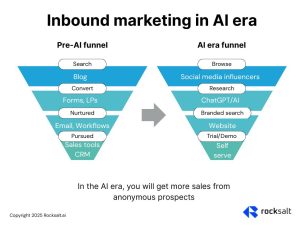
Current Rocksalt.ai CEO and former HubSpot VP Arjun Murthy makes his pitch on LinkedIn regarding a change to the marketing funnel and the importance of the anonymous prospect – core to his own company’s inbound marketing product.
He explains the details of the graphic below and concludes: “Throughout this journey the buyer was largely invisible to the vendor and when she moved into buying mode it was quick and largely anonymous.”
Buying what he’s selling?
Read more on LinkedIn where not all commenters agreed. (July 3)
PROMPT
What are 5 roles that don’t exist in advertising today and will in 2030?
Response from xAI’s Grok:
Predicting future roles in advertising involves anticipating technological, cultural, and economic shifts. By 2030, advancements in AI, immersive tech, and data analytics, combined with evolving consumer behaviors, will likely create new roles.
Here are five roles that don’t widely exist in advertising today but could emerge by 2030, based on current trends and reasonable speculation:
- Immersive Experience Architect
- AI Ethics and Personalization Strategist
- Neuromarketing Integration Specialist
- Decentralized Ad Network Manager
- Synthetic Media Creative Director
MORE
-
Google Ads moves brand controls under AI Max in new search campaigns (July 18) – Search Engine Land
-
Accenture Song/WPP merger rumors swirl, but would it make sense? (July 15) – The Drum
-
The AI Exec (at Microsoft) Who Isn’t Trying to Become God (July 19) – The Wall Street Journal
-
Opinion: Why advertising ethics must become a core creative capability by Andrew Susman, President, Institute for Advertising Ethics (July 18) – Ad Age (subscription)
-
More advanced AI capabilities are coming to Search (July 16) – Google’s The Keyword blog