
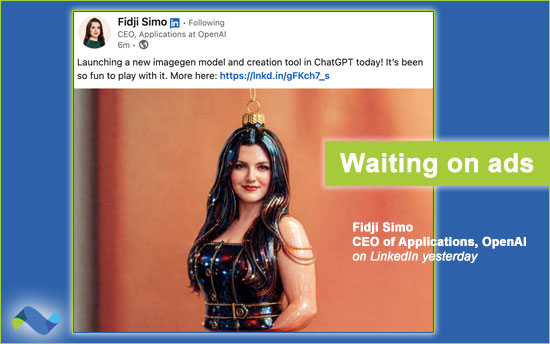
Today’s newsletter graphic was grabbed from a LinkedIn post yesterday by OpenAI CEO of Applications Fidji Simo who announced, “Launching a new imagegen model and creation tool in ChatGPT today! It’s been so fun to play with it.”
Yes, it’s a new “imagegen” model — or image model — for OpenAI’s chatbot.
On her Substack, Ms. Simo went much deeper on the topic and concluded:
“….it’s exciting to see ChatGPT move from being primarily text-based and conversational, toward a fully generative UI that brings in the right components based on what you want to do. When you’re creating, you should be able to see and shape the thing you’re making. When visuals tell a story better than words alone, ChatGPT should include them. When you need a quick answer or the next step lives in another tool, it should be right there. As we do this, we can keep closing the distance between what’s in your mind and your ability to bring it to life.”
Read Fidji Simo’s Substack. (December 16)
More: “The new ChatGPT Images is here” (December 16) – OpenAI
From tipsheet: “When visuals tell a story better than words alone” may be the music that brand advertisers’ ears hear when the inevitable ChatGPT ad product drops and it inherits the dynamic and responsive qualities outlined in yesterday’s Substack post.
Clearly, “Code red” is still in effect at OpenAI. Otherwise, Ms. Simo would be making ad strategy, not ornaments.
TECH
Google’s AI Overviews in review
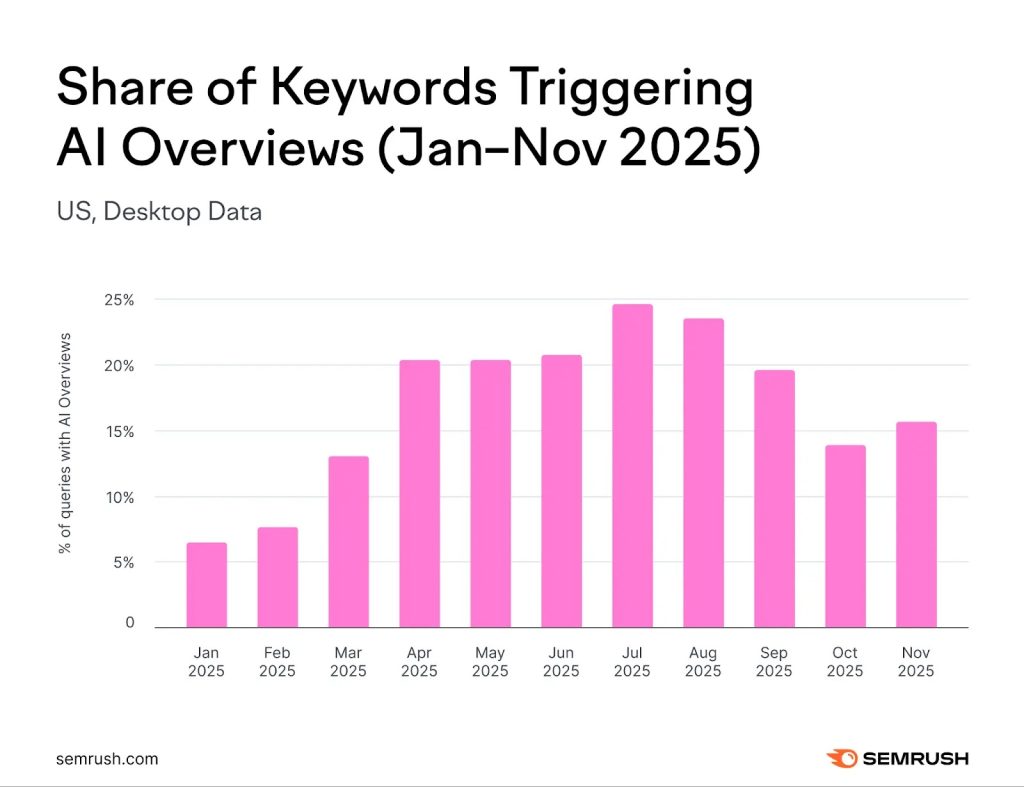
SEO platform Semrush, which was acquired by Adobe last month, published an updated study on Google’s AI Overviews (AIO) and what it means about the evolution of Google Search.
As you may recall, AI Overviews is a conversational answer at the top of the search engine results page after a user has input a query into Google Search.
But AI Overviews do not always show up, as the study showed.
Semrush provided several key takeaways:
Volatile growth: AI Overviews peaked in mid-summer, then declined. After starting the year at appearing for 6.49% of keywords in January 2025, the share rose to nearly 25% in July before sliding down to 15.69% in November 2025.
Surprising zero-click behavior: AI Overviews show up more often for searches that tend to get no clicks. But when we looked at the same search terms before the AIO was there and after, we found people actually clicked slightly more with the AIO. Also, the overall zero-click rate of keywords with AI Overviews has slowly declined since January 2025.
Beyond informational search: In January, 91.3% of queries that trigger an AI Overview were informational. By October, that share was down to 57.1%, and the share of commercial and transactional AIOs rose.
Read more on Semrush. (December 15)
Search Engine Land’s Danny Goodwin observed about the data, “Google didn’t roll out AI Overviews in a straight line in 2025. A mid-year spike gave way to a pullback, suggesting Google moved fast to test the feature, then eased off based on user data…” Read Search Engine Land’s take. (December 16)
SELL-SIDE
Optimizing content for Google AI Search
In an “AI Inside” podcast published on Monday, “AI Inside” hosts Jason Howell and Jeff Jarvis spoke to Nick Fox, Google’s SVP of Knowledge and Information, who oversees Search, Ads, and Commerce.
The hosts walk Mr. Fox through a range of publisher issues, including overall trust with Google when it comes to AI.
At one point, Jarvis tried to understand on behalf of publishers how they could better optimize their content for AI and presumably all of Google’s flavors of AI Search output, i.e. Google Search, AI Mode, AI Overviews and Gemini [26:09]:
(lightly edited)
JEFF JARVIS: “If the publisher says, ‘I want to be there, but we have a world where a lot of the conversation in the web is going to not include human beings,’ — such as agent-to agent and so on — is there guidance for publishers who want to be part of AI about how they should they view their content differently now?”
NICK FOX: “The short answer is no. The way to do well in Google’s AI experiences is the same as how to perform well in traditional search. And it really does come down to build a great site and content. The way we put it: build for users, what you would want to read and what you would want to access.”
“One way to think about it in the context of AI is the AI response might provide a framework, a broad sort of initial response. Where a user is likely to clickthrough is if they want to understand something more deeply. In the case of commerce, it might be to transact.”
“As I was saying earlier, you might want an authentic UGC-like corroboration or additional perspective on the topic.
JEFF JARVIS: Humanity, in other words.
NICK FOX: Humanity, exactly. (…) And so I think the right way to think about it is, it’s not AI or the web, it’s not AI or humanity, it’s actually the two of those coming together in a coherent way, that is where the magic is.”
Hear more on the Apple Podcasts app. (December 16)
From tipsheet: This guidance to publishers for AI search is the same advice Google has consistently given regarding search engine optimization (SEO): just build good content.
INVESTMENT
Evertune gets affiliate marketing strategic
Co-founder and CEO Brian Stempeck of answer engine optimization platform Evertune announced a new “strategic” investment for his company on LinkedIn yesterday:
“One of the core insights that we’ve seen across every brand we work with is that affiliate content surfaces a LOT as a source in AI models – it’s hugely influential. We’re super excited to announce our partnership today with impact[dot]com to help the brands we work with take action on our insights, and educate the AI models with commerce content. Big thanks to Per Pettersen, David A. Yovanno and Brian Marcus as we launch this partnership!”
Read more on LinkedIn. (December 15)
In 2021, impact raised $150 million at a $1.5 billion valuation.
No number is mentioned on the Evertune investment size. In the press release, there are several moving parts to the deal that will be familiar to affiliate marketers.
Here’s an excerpt:
“Through this new partnership, Evertune’s AI Brand Monitoring reports are now integrated directly into impact.com’s platform for select customers. Additionally, impact.com has created an activation capability, allowing brands to form partnerships with the commerce creators and publishers that are identified by Evertune’s Content Analytics. This connection between AI insight and partnership activation is an industry first.”
Read:
-
“impact.com and Evertune Partnership Helps Brands Influence AI Search Results, Supported by Strategic impact.com Investment” (December 16)- press release
From tipsheet: Affiliate marketing firms’ content is successfully finding its way into Large Language Models (LLMs). A partnership with an answer engine optimization and analytics firm such as Evertune makes logical sense.
Next up: Bring all the data together in a customer data platform and target ads in a chatbot as those opportunities finally begin to arise? Or target ads anywhere.
PEOPLE MOVES
Making ChatGPT into Commerce OS
At first glance, OpenAI’s hiring of former Shopify VP & Core Product Glen Coates for the role of “Head of App Platform” should make clear the importance the company sees with commerce integration into ChatGPT.
However, in discussing his new role on LinkedIn, Mr. Coates mentioned a broader purview:
“I grew up an operating-systems nerd. Screwing around with Linux CDRs till 5am, building a MMOG platform at BigWorld, building Handshake on top of the earliest version of iOS as it evolved, and then of course Shopify (look mum! web scale!) .. so when [head of ChatGPT] Nick Turley casually mentioned that OpenAI was thinking of turning ChatGPT into an operating system, I was immediately nerd-sniped.
I’ve joined OpenAI as Head of App Platform. We’re going to find out what happens if you architect an OS ground-up with a genius at its core that can use its apps just like you can. I can’t think of anything more exciting to work on…”
Read more on LinkedIn. (December 15)
The Infomation noted that Coates left Shopify over the summer and had “led teams working on initiatives to help Shopify merchants share their product information with AI apps and agents.” Read more. (December 15 – subscription)
From tipsheet: Sounds like OpenAI has aspirations to create an operating system for commerce.
I’m still waiting for the big advertising hire.
BRANDS
Predictions: Agent-to-agent trading
In “The 6 AI Trends That Will Dominate 2026,” Adweek reporter Trishla Ostwal takes a deep dive into what’s ahead in AI innovation for advertising.
On LinkedIn, Ms. Ostwal previewed some of her findings which encompass what she’s calling a “total re-architecture of the digital economy”:
“Chatbots will eat social discovery: The user path to purchase is bypassing the feed. We will see “share of conversation” become the new canary in the coal mine for social platforms.
Agent-to-agent trading: Media buying will go fully autonomous. AI agents will soon handle end-to-end negotiations and execution, forcing human teams to pivot to high-level strategy.
Brands move beyond SEO/AEO: Brands are building native, transactional interfaces inside platforms like ChatGPT and Gemini, reclaiming the consumer utility funnel.
Usage-based publisher deals: Licensing content will shift from one-time fees to revenue shares tied to consumption, mirroring the Spotify/YouTube model.”
Read more from Ostwal on LinkedIn. (December 16)
More predictions:
- Five agentic commerce predictions for 2026 and beyond from Criteo CEO, Michael Komasinski. – Criteo (December 16)
- The year AI companies pay for the value of publishing – Nicholas Thompson in Nieman Lab Predictions for Journalism 2026
From tipsheet: The SEO/AEO observation on transactions is filled with intrigue. ChatGPT and similar chatbots could come between the retailer and the customer. This would impact first-party data ownership, ad media opportunity and, most importantly, the relationship with customer. On the other hand, maybe it’s all additive for the retailer and the power of the retailer’s brand is strengthened? I’ll take the latter. OpenAI needs symbiotic, thriving relationship with partners.
TECH
Targeting across AIs and automation
AI ad tech company Fluency is turning to the world of AI agents after raising a $40 million Series A round of financing from Integrity Growth Partners, which announced a new fund of its own last week.
On its website, Fluency positions itself as a “Digital Advertising
Operating System” and in a boilerplate announcing the new funding, the company added detail on the “OS”:
“Fluency provides a Digital Advertising Operating System (OS) that centralizes all major campaign execution workflows into a single solution. The AI-powered platform automates campaigns across all major digital ad channels – including walled gardens and the open web. As a result, advertisers can activate, automate, and analyze any number of campaigns with unprecedented efficiency, working at a scale not previously achievable. Fluency powers nearly $3b in annual media spend. Its user base supports more than 250,000+ monthly campaigns for brands with 50,000+ locations.”
Business Insider’s Lara O’Reilly noted that Vermont-based Fluency’s current competitive set includes companies such as Hootsuite, Smartly and Sprinklr.
On the company’s agentic interests, O’Reilly reported:
“Fluency mostly uses Amazon’s Bedrock generative AI models, as well as Anthropic’s Claude and Google’s Gemini, the company said.
[CEO Mike Lane] said that for agentic AI to work effectively for a marketer’s digital advertising, the AI needs robust frameworks and structures to operate within, connections to all major media platforms, and for everything to be integrated into a single system.
He said these factors make Fluency well-positioned to be ‘the premium platform for agentic AI in the digital ads space.”
The article includes a selection of slides from a Fluency presentation deck. Read more from BI on MSN. (December 16)
From tipsheet: Centralize me. Automating and effectively optimizing ad spend across the open web AND walled gardens such as Google, Meta and Amazon is a holy grail for ads/marketing technology to pursue in the age of AI.
Meta’s Advantage+ may be the best at automating and optimizing your ad campaigns on Meta properties, for example. But what if you want to buy elsewhere, too?
The AI DSP!
ANALYSIS
Build the AI stuff, we have ads distribution
In his latest Mobile Dev Memo post, “Gemini in Chrome and Gmail, and Google’s AI distribution conduit,” analyst Eric Seufert says:
“[Google] has already transformed its most prominent consumer product, Search, into an AI-empowered experience and is monetizing it through ads. This was Google’s Gambit, and it is manifest. The entirety of Google’s consumer-facing product suite (including YouTube), as well as the Google Cloud Platform, is a distribution conduit for the company’s AI initiatives. This spans multiple billions of consumers, all of which are already monetized through ads. Every dollar Google invests in AI research and development can immediately improve an existing revenue line item.”
Read it. (subscription)
On LinkedIn, Seufert previewed his latest analysis and referenced OpenAI’s predicament given Google’s ads distribution advantage. Swipehouse CEO Faique Moqeet responded in the comments:
“That’s a great point – the longer the challengers wait to introduce ads, the population of people who will have used the product pre-ads shrinks, which increases the friction of introducing ads! To think 12-18 months ago, it felt like Google was losing its footing!”
From tipsheet: Seufert has effectively distilled how Google is winning and OpenAI is winning less -OpenAI needs to get monetization efforts going soon.
PRODUCT
Make mine agentic
- “IAS Moves Beyond Verification With New AI Agent for Ad Campaign Optimizations” (December 16) – Adweek
- “Infillion Launches Infillion Agent Connector – A New Way Of Managing AI-Controlled Buying That Runs On The First Agent-Native Composable Platform In Adtech” (December 16) – Infillion
MORE
- Publishers are hunting for AI prompt data — now they’re starting to get it) from third-party companies (December 15) – Digiday (subscription)
- CES preview (VIDEO): “AI-Powered Contextual CTV will Define the Next Wave of Streaming Advertising: WPP’s Jess Brown” (December 16) – Beet[dot]tv
- The Next Chapter for Performance TV (December 16) – Jason Fairchild, CEO, tvScientific
- Perplexity AI Revamps iPad App to Deepen Focus on Research Tool (December 16) – Bloomberg (subscription)
- Why 2026 could be the year of anti-AI marketing (December 16) – CNN