

In an interview published in Semafor on Friday, WPP CEO Cindy Rose shared rare public remarks regarding her agency holding company and the strategic road ahead.
Although the interview was brief with Semafor’s Andrew Edgecliffe-Johnson, Ms. Rose, who took over the WPP reins on September 1, spoke candidly about how agency compensation models will be disrupted thanks to AI.
An excerpt from the interview:
Semafor: “AI is a fundamentally disruptive technology. What does AI disrupt in WPP?”
Cindy Rose: “AI, like every other major tech shift in our history, will have some deflationary impact as productivity gains take hold. It will be our job, then, to help our clients optimize their spend on marketing and reinvest what they save into innovation and transformation. It could also disrupt what I’ll call the time and materials business model. Any player in the service industry that is charging on a time and materials basis is looking at how their commercial model evolves in the era of AI, and we are no different. I suspect we’ll [see] our clients transform and move to a hybrid of tech fees, fixed fees, and probably outcome-based fees. But it’s not going to happen overnight…”
Read more. (December 19)
From tipsheet: Who is going to create the magical outcomes analytics machine that bridges the divide between marketers and their service layer? 2026 awaits!
LLMS & CHATBOTS
Developments
- Meta Is Developing a New AI Image and Video Model Code-Named ‘Mango’ (December 18) – The Wall Street Journal (subscription)
- N.Y. Gov. Kathy Hochul signs sweeping AI safety bill (December 19) – Axios
- Salesforce Executives Say Trust in Generative AI Has Declined (December 19) – The Information (subscription)
LLMS & CHATBOTS
Lawsuit targets SERPs, literally
Late Friday, Alphabet took the wraps off a lawsuit being filed by the company against SerpAI. (“Serp” often stands for “search engine result page”)
Google General Counsel Halimah DeLaine Prado explained on Google’s Search blog, The Keyword:
“We filed a suit today against the scraping company SerpApi for circumventing security measures protecting others’ copyrighted content that appears in Google search results. We did this to ask a court to stop SerpApi’s bots and their malicious scraping, which violates the choices of websites and rightsholders about who should have access to their content. This lawsuit follows legal action that other websites have taken against SerpApi and similar scraping companies, and is part of our long track record of affirmative litigation to fight scammers and bad actors on the web.”
Read more on The Keyword. (December 19)
SerpApi does not pull any punches on its home page in describing its product: “Scrape Google and other search engines from our fast, easy, and complete API.”
Just prior to Google’s public announcement, SerpApi published “The Web Search API for AI Applications in 2026”, a de facto treatise.
Notable analysis: “Google sued SerpApi under the DMCA, alleging it circumvented SearchGuard to scrape and resell licensed copyrighted content from Google Search results at scale” (December 19) – Search Engine Journal
-
“Google is seeking a court order to destroy SerpApi’s technology, which could disrupt SEO tools.”
From tipsheet: For many, the irony will not be lost that Google is suing a company for scraping content, when the company has been accused of similar behavior as AI crawlers proliferate.
Search Engine Journal’s analysis pointed to the careful calculus Google must apply with its legal action as it tries to maintain an equilibrium with the search engine optimization and marketing community, let alone publishers.
TECH
McKinsey CES preview: Physical world AI
“Autonomous mobility, including humanoid robots and autonomous vehicles (AVs), is an area with ample potential, thanks to cost improvements, compute infrastructure breakthroughs, and at-scale deployment. To continue to scale autonomous mobility, three factors are vital: Safety…; Affodability…, Accessibility… and Acceptance…”
Read and hear: Webinar – AI in the Physical World: Looking ahead to CES (December 19) – McKinsey
More: What to expect at CES 2026—a guide for CMOs, brands and agencies (December 19) – Ad Age (subscription)
AGENCIES
Horizon: The latest ad tech is the OS
In advance of CES in early January, the independent agency touted its new OS late last week.
Called “HorizonOS”, the positioning portends what the agency of the future may look like for many. It isn’t so much a proprietary set of tools or operating system, but rather a nimble, “open” implementation of the latest tools to get the job done on behalf of marketers.
Part of the positioning for the OS from the press release:
“Open systems spur innovation. They create velocity through interoperability, shared progress, and transparency. They make it easy for intelligence to move across teams, partners, models, and data—so the entire system gets smarter and moves faster all in service of the client.”
Read more. (December 18)
More: Horizon Launches HorizonOS, Industry’s First Integrated System Built on Open Ecosystem of Partners (December 18) – Horizon
From tipsheet: Regarding “open,” this isn’t to say a marketer can’t specialize on the Google or Amazon or Meta stack. But, if a marketer (or agency) is going to work across more than one — “cross-protocol” — AND the open internet, though, the requisite solutions may be numerous — let alone changing all the time.
PROTOCOLS
On programmatic and direct buys
Last Thursday, developer and entrepreneur William Cichowski sparked debate on LinkedIn by publishing a provocative “take” that suggested the direct buying and selling of programmatic ads should not exist.
Read: “Why the Future of Programmatic DOES NOT Involve Direct Buys and Sells” (December 18) – LinkedIn
Publishers, for one, might not agree given the implied need of an intermediary that is taking a cut. But Mr. Cichowski knows this and on Friday, he continued:
“Direct deals aren’t evidence of a better system. They’re a reaction to a broken one.
At its core, programmatic RTB is a massive recommendation system: buyers express goals, sellers expose constraints, and prices and allocation are learned from outcomes at a scale a single deal could NEVER achieve. If that system were functioning efficiently, no brand would ever want fixed prices, fixed volume, and frozen assumptions, yet that’s exactly what direct buys do.”
Read more from Friday on LinkedIn. (December 19)
IAB Tech Lab’s Anthony Katsur wrote in response to Mr. Cichowski’s provocation:
“I couldn’t agree more with this post. Programmatic’s issues have nothing to do with the underlying protocol. As Gareth Glaser (more than) implied, programmatic challenges are due to misaligned business incentives and bad actors. Protocols don’t solve for human behavior. Protocols enable coordination and autonomy. Rigorous enforcement of business agreements with stiff penalties for bad actors is what will solve human behavior.”
Read the comment on LinkedIn. (December 19)
In a separate thread, 3C Ventures Daniel Landsman ascended the programmatic “pulpit” and concluded:
“The future isn’t RTB replacing direct. The future is allocating based on reality, not ideology. Programmatic will remain core infrastructure. Direct will remain a tool. Anyone claiming otherwise hasn’t spent enough time under the hood.
Ponder this over the holidays. We can talk about it at CES. I’ll be there. I know the conversations will revolve around AI, CTV, and retail media networks, and that’s fine. But remember this. Programmatic still pays the bills.
You like the internet the way that it is? You’re welcome.”
Read the post on LinkedIn. (December 19)
From tipsheet: Amidst all the recent talk about emerging agentic advertising protocols, more focus has come to “programmatic direct” due to how autonomous agents need to plan, negotiate, and execute outcomes.
Here’s how ChatGPT defined the resurgence:
“The big picture
Programmatic direct is re-surging because it matches how agents think:
|
Human-era RTB |
Agentic buying |
|---|---|
|
React in real time |
Plan in advance |
|
Optimize bids |
Optimize outcomes |
|
Tolerate noise |
Require structure |
|
Discover inventory |
Select inventory |
In short: Agentic advertising doesn’t kill programmatic—it re-selects the parts of programmatic that behave more like software contracts than casinos.”
BRANDS
Facebook Audience Network and automation
Facebook ads guru Jon Loomer guided marketers through proper use of Meta’s AI-enabled Advantage+ and its “Value Rules” setting.
Facebook Audience Network not delivering but still want the value of the automated ad buying machine of Advantage+? There is a way forward, says Mr. Loomer.
“One of the available criteria is placement. And thankfully, one of the placements you can adjust bids for is Audience Network.
So in this scenario, you don’t need to remove Audience Network. You can create a value rule that reduces your bid on that placement by 90%.
Then apply that value rule in the ad set.
When I did this, Meta didn’t spend a single penny on Audience Network.
Note that Audience Network isn’t the only problematic placement. Depending on your performance goal, you may run into other examples like Rewarded Video for ThruPlay and Ads on Facebook Reels for Reach and Impressions. Use value rules over restrictions when possible.”
Read more tips. (December 15)
From tipsheet: Facebook Audience Network still has a bad reputation in certain situations. Seems like there’s room for Facebook to do some optimization of its own and eliminate the poorly-performing inventory.
Despite Meta CEO Mark Zuckerberg saying 2026 is the year for fully autonomous ad buying on Advantage+, Mr. Loomer illustrated that most marketers will still need to manually optimize their campaigns to maximize ROAS.
TECH
Brands must meet consumers in ChatGPT
After Ad Age reporters put Gap’s AI assistant to “the test,” Ad Age senior tech reporter Garett Sloane reviewed the findings on LinkedIn.
Sure, not everything was perfect, but one of Sloane’s top observations seems prescient:
“… retailers and other brands are determined to make AI products work. Why? Because of ChatGPT. If consumers are moving into AI mode, then retailers don’t want that to be the gatekeeper of their brands. Also, consumers could come to expect natural conversation as a way of shopping now…”
Read more observations on LinkedIn. (December 19)
More: “How Gap’s AI chatbot broke character—what brands can learn from the high-tech retail assistant” (December 19) – Ad Age (subscription)
From tipsheet: If you’re a brand, like it or not, you need to “meet the moment” with your customers: meet them in the chatbot. So, while it may be easy at times to show how silly a chatbot can be in certain customer service situations, consumers are there and expect the brand to be there, too. The marketer must be comfortable in, and with, that environment.
Chatbots are the new ad. They are the new marketing experience.
Related: “Why ‘just good enough’ is generative AI’s real threat to marketers” (December 19) – Digiday (subscription)
EVENTS
AdCP Meetup in NYC was packed
“First meetup of AgenticAdvertising[dot]org! The room was packed, energy was high, excitement was palpable. It truly felt like the beginning of something new. Thanks to Brendan Norman, Steven Liss, Michael Misiewicz, and Harry Tong for having a very real conversation about AdCP – the hopes, the challenges, the possibilities. I’m truly excited to see how this unfolds and to be part of reimagining the future of advertising.”
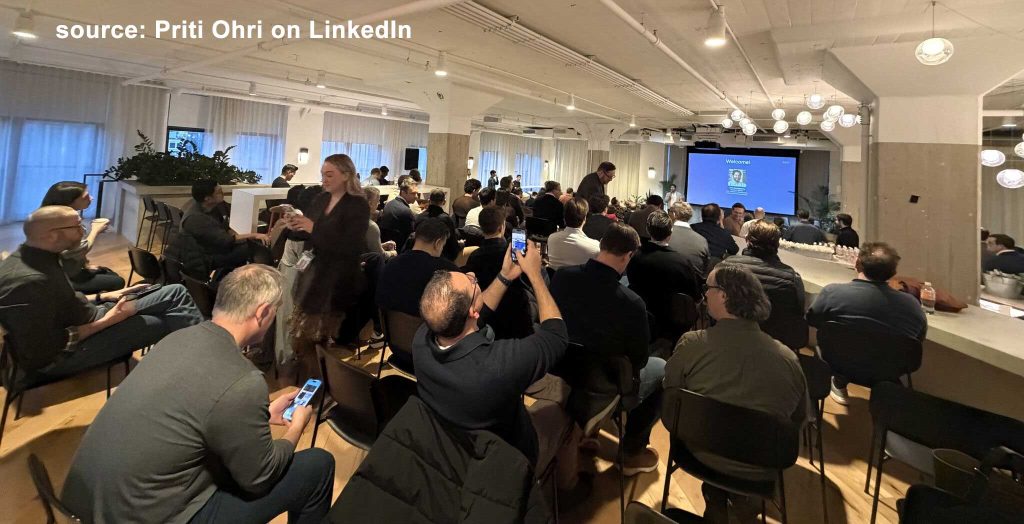
Nearly 250 signed up for the meetup held at Horizon Media’s offices last Thursday.
MORE
- Digital Ad Analytic Firm Hit With AI-Related Disclosure Suit (December 17) – Kevin Lacroix
- AppLovin (APP) Is Up 7.6% After Analysts Spotlight AXON Ads And AI Ad Stack Momentum (December 20) – Yahoo! Finance
- 3 Ways Consolidation Will Hit Commerce Media in 2026 (December 19) – Adweek
- The Agentic Commerce Opportunity (December 19) – General Catalyst
- Netflix and Disney+ probably only added ad-tier subscribers this year, says Morgan Stanley (December 18) – Sherwood News