
Generative engine optimization (GEO) firm Profound announced $96 million in Series C funding, valuing the NYC-based marketing tech startup at $1 billion — officially unicorn status.
Participating investors include Silicon Valley ‘blue bloods’ such as Lightspeed Venture Partners, Sequoia Capital, Kleiner Perkins and South Park Commons.
(Note that Profound is an NYC startup with West Coast venture. Evertune and Bluefish are NYC GEO startups, too. Trend?)
GEO remains hot despite comparisons to the commoditized world of search engine marketing/optimization (SEM/SEO). Marketers are desperate for control of their brand within AI chatbot answers. That helps explain why Profound has raised three rounds within a year (read about the last two).
Profound co-founders James Cadwallader and Dylan Babbs discussed the current roadmap on their company’s blog yesterday:
“Profound began by giving marketing teams best in class visibility into how AI talks about their brands, tracking mentions, sentiment, and performance across all major Answer Engines.
As our customers operationalized that insight, they often had to export Profound data into separate orchestration and automation tools, learning and using multiple systems just to execute. Now they don’t.
With Profound Agents, orchestration and automation are built directly into Profound, powered natively by our AI visibility data.”
Touting the emergence of a new role in the marketing org, “The Marketing Engineer”, the co-founders announced the Profound Ecosystem, which includes “training, certification, an agency marketplace, and Profound University, equipping marketers to master Agents and Answer Engine Optimization.”
Read the blog post. (February 24)
More:
- As AI threatens search, Profound raises $96 million to help brands stay visible (February 24) – Fortune (subscription)
- Profound Raises Series C at $1B Valuation to Lead a New Category of Marketing (February 24) – press release
From tipsheet #1: For perspective, Semrush, which added GEO capabilities to its search engine optimization tools, sold to Adobe in November for $1.9 billion as Adobe scrambled to bolt GEO on to its marketing platform.
At a minimum, these startups are at the forefront of understanding how AI will affect marketing today. That’s a valuable opportunity.
From tipsheet #2: Profound has an event called “Zero Click 26” on April 8 in SF and June 11 in NYC for “AI Search experts.” See more.
LLMs & CHATBOTS
Developments
- Meta and AMD Partner for Long-term AI Infrastructure Agreement (February 24) – Meta
- The persona selection model (February 23) – Anthropic
- Tech Firms Aren’t Just Encouraging Their Workers to Use AI. They’re Enforcing It. (February 24) – The Wall Street Journal (subscription)
LLMs & CHATBOTS
Opinion: Advertising to agents
“What does it look like to ‘advertise’ to AIs? GEO was the first baby step, but the art of influencing agents is growing as AI attention outscales human attention…”
Read: “How to Win Friends and Influence Non-People: Advertising to Agents” (February 23) – Steven Liss, co-founder and CEO, OpenAds on his Substack
RETAIL MEDIA
The 5 levels of agentic commerce
In Stripe’s annual letter written by co-founders John and Patrick Collison, the duo visualized “the progression we expect in agentic commerce,” according to John Collison on X yesterday.
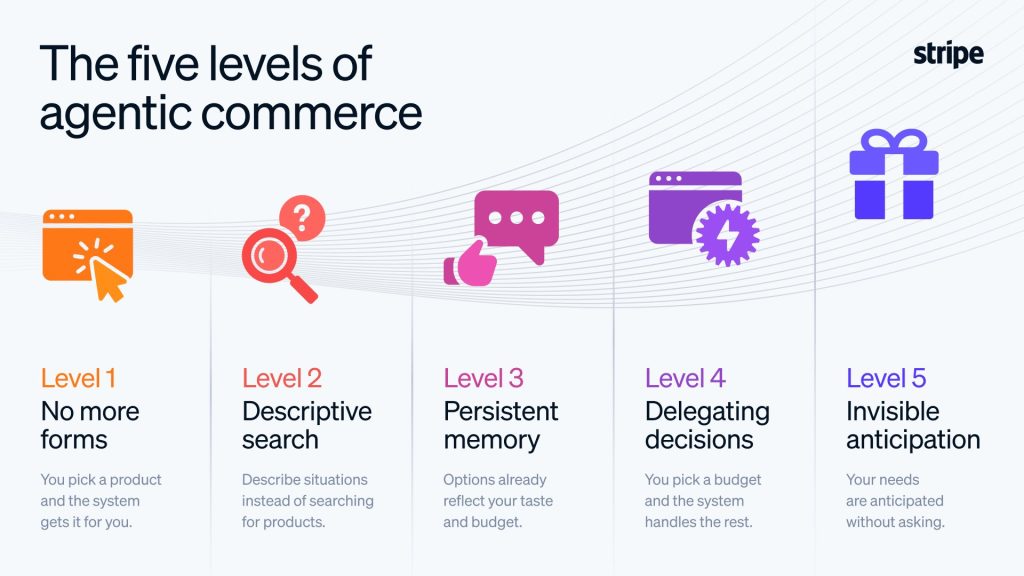
Mr. Collison continued on X, “You tend to hear the later levels discussed in the hype, but we’re already seeing lots of activity in levels 1 and 2 of agentic commerce.”
More: Stripe’s 2025 annual letter (February 24) – Stripe
From tipsheet: From here, agentic advertising could follow a similar set of levels.
For Level 5, I’d suggest calling it “addressable serendipity.”
LLMs & CHATBOTS
“Ads in a chatbot” gets funding
Koah — which tipsheet discussed on Monday — announced $20.5 million in Series A funding yesterday led by Theory Ventures. The startup offers ad technology for AI apps (i.e. chatbots) that mediates between advertisers and AI app developers.
It’s an ad network!
According to Adweek, Koah “takes a 30% cut of revenue generated across its network.” Read more. (February 24)
Co-founder Nic Baird shared on LinkedIn:
“In just 13 months since launching our product, the platform has processed more than 170 million queries and 35 million native ad impressions. We’ve become the primary monetization method for dozens of AI native apps. The internet continues to transform into a dynamic, personalized, agentic surface. Those surfaces deserve a dynamic partner to help them sustain revenue growth.
Koah is focused on quality and long-term partner growth. Our formats have next to no impact on user retention, drive superior revenue over every other sponsorship network available, and respect user privacy by targeting only against first party data. Every partner we’ve worked with has grown significantly since we started.”
Read more on LI. (February 24)
More:
-
See an explanation on the tech: “Theory Ventures and Koah: How We’re Scaling ‘AdSense for AI’” (February 24) – Koah blog
From tipsheet: Baird name checks Koah angel investor and AppLovin co-founder, Andrew Karam.
The chatbot ad network is likely an appealing growth opportunity for mobile ad tech firm AppLovin.
SELL-SIDE
Owning the niche as an AI defense
Adweek reported earlier this week that marketing platform HubSpot acquired a YouTube content creator network called Starter Story in an effort to boost its pipeline for its lead gen products. Terms were not disclosed.
HubSpot VP of media and content, Jonathan Hunt, said that owning deep-dive niche properties is one way to combat both overall fragmentation — and the concentration around AI chatbots.
Starter Story is “a video-first media brand with more than 800,000 YouTube subscribers, a 275,000-person newsletter, and a total audience of roughly 1.6 million across platforms,” wrote Adweek’s Mark Stenberg.
He continued:
“As search traffic declines and social advertising costs rise, potential customers are increasingly gathering information across fragmented environments, from Reddit and ChatGPT to YouTube and newsletters. Owning niche media brands, according to Hunt, creates a defensible channel for reaching those audiences earlier in their journey.”
Read more in Adweek. (February 23)
TECH
AWS GM sees digital ad growth ahead
From AWS GM Samira Panah Bakhtiar’s purview, AI is reshaping the value chain right now. Ms. Bakhtiar oversees AWS’ “MEGS” or “media, entertainment, gaming, and sports” division which also includes ad platform clients.
See her June interview with tipsheet.
In a thought leadership piece on LinkedIn yesterday, she continued to urge clients of all types to be pro-active when it comes to AI transformation:
“The 2026–2027 outlook is clear: the entertainment industry will grow from $2.8 trillion to $3.12 trillion, but that growth will be concentrated in digital advertising, sports rights, streaming, regulated gaming, and AI-powered platforms.
Leaders who make decisive resource allocation choices — investing in digital-first, mobile-optimized, AI-native capabilities while managing the decline of legacy assets — will capture disproportionate value. Those who hesitate will find the window closing faster than projected.”
Read: “The Great MEGS Divide: What 2025 Tells Us About 2026 and Beyond” (February 24) – Samira Panah Bakhtiar, GM, MEGS, AWS on LinkedIn
Related: New AI Tool From Amazon’s AWS Speeds Up Vertical Video Clip Process (February 24) – Deadline
PLATFORMS
Bridging probabilistic to deterministic
Gigi, an AI-enabled media management platform designed to automate tasks, optimization, and reporting within Amazon’s demand-side platform (DSP) and its marketing cloud (AMC), has reached a new milestone according to its CEO, Adam Epstein.
Mr. Epstein explained on X:
“Today [Gigi] steps out of beta on the hardest feature we’ve ever shipped: agentic campaign creation. Here’s why it was so difficult to build.
LLMs are at their best when turning unstructured data into reasoned, probabilistic output. Media planning is a perfect example. Absorb a mountain of messy inputs, synthesize them into a thoughtful analysis, and land on a defensible recommendation. There’s no single ‘right’ media plan, which is exactly what makes it a natural fit for AI.
Campaign creation is the opposite problem entirely. For Gigi to build campaigns, every detail has to match the customer’s exact specifications…”
Read more on X. (February 24)
From tipsheet: Part of the magic of large language model (LLM) technology is in its probabilistic power. But, when you need exact, precise answers every time, bridging to the deterministic world becomes requisite.
CAREERS
Another new ads role at OpenAI
A new role titled “Trust & Safety Operations Analyst, Ads” appeared on OpenAI’s “Careers” website in the past day. See it now.
Based in SF, the new position is on the “Ads Trust & Safety Operations team”.
Previous ads-related roles have been on teams for ChatGPT (1), Finance (2, 3), Ads Integrity (4) and Marketing (5).
The job listing for the Ads Trust & Safety Ops leadership role explains the team’s responsibilities:
“The Ads Trust & Safety Operations team protects our users, advertisers, and creators across all monetized surfaces. As OpenAI introduces new revenue-generating formats and partnerships, this team ensures these experiences remain safe, compliant, high-quality, and aligned with our broader safety standards. We partner closely with Product, Engineering, Policy, and Legal to identify emerging risks, build and mature enforcement systems, and ensure scalable, high-integrity operations.”
From tipsheet: There are also 3 new software engineer roles focused on AI, ads and monetization which are based in San Francisco. See those.
AGENCIES
AI transparency and the agency
“New court filings in the WPP whistleblower case have done something the company almost certainly didn’t intend: they put GroupM’s own internal trading data on the public record. The documents show nearly $1 billion in annual income from proprietary inventory deals that the agency’s largest clients were almost entirely not using. We unpacked the filings in full, including WPP’s defence, which has some real force.
The bigger questions they raise about how media agencies actually make money will outlast this lawsuit either way.
Related: “Ad Tech Briefing: As AI promises ‘transparency,’ more light is shed on the ad tech tax” – Digiday (February 24)
FINANCIALS
AI-enabled earnings imminent
- The Trade Desk – Today, February 25
- Magnite – Today, February 25
- PubMatic – Tomorrow, February 26
- WPP – Tomorrow, February 26
Related: “Zeta Global Reports 18th Straight ‘Beat and Raise’ Quarter and Record Full Year 2025 Results” (February 24) – press release
EVENTS
Now hiring
-
LoopMe adds Michael Scott as Chief Revenue Officer and Ammar Doosh as VP of Product, AI (February 24) – press release
MORE
- Good one: “The 4 Marketing Use Cases of AI” (February) – Jim Lecinski, professor, Northwestern U. on Think With Google
- Why assistive agent optimization (AAO) is the next evolution of SEO (February 24) – Search Engine Land
- Talpa Media Completes First Agent-to-Agent Campaign in the Netherlands (February 17) – Futureweek
- Event tomorrow, 2/26: “Last Thursday Club: Agentic AI – advertising on autopilot?” – IAB UK, London
- “The 2026 edition of the ‘MeasureMap for Marketing Mix Modeling (MMM)’” (February 24) – Nico Neumann, professor, Melbourne Business School on LinkedIn