
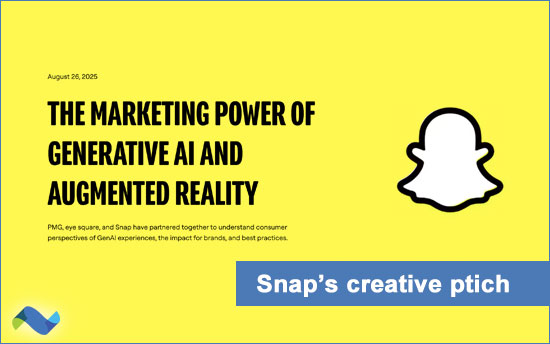
Snapchat’s development of new AI-based formats are showing results according to a new Snapchat-supported study.
Social Media Today reported on the study:
“First off, the data shows that Gen AI video ads, and in particular Gen AI AR Lenses, drive significantly higher rates of audience engagement. As you can see in these charts, Snapchat’s Gen AI experiences see significantly higher rates of user attention, with AI Lenses driving much higher interest.”
Read Social Media Today’s summary. (August 26)
The study: The Marketing Power of Generative AI and Augmented Reality (August 26) – Snapchat
From tipsheet: The utility of AI in creative is a constant refrain being heard by brand advertisers today. Snap’s data appears to be yet another proof point.
Listen to the pitch, er data, from Snapchat in the report:
“The prevalence of AI in daily life is evident, with a significant majority of users reporting having used AI previously and expressing satisfaction with the results. Marketers are also embracing GenAI, with three-in-four indicating a desire to increase its use.”
BRANDS
AI ad networks
Ad Age’s Garett Sloane asks “Why AI ad networks are popping up, even on ChatGPT?” as he tracks companies like a new startup from the co-founder of affiliate marketing company, Honey. Sloane explained, “ZeroClick (…) inserts advertising messages into the context of chatbot conversations.”
Read more. (August 27)
Founded by Ryan Hudson, the pitch on ZeroClick’s website could not be clearer: “ZeroClick weaves paid context into AI thinking to enrich answers.”
Ad Age’s Sloane went into detail about the article on LinkedIn:
“ZeroClick said it raised $55 million to build an ad network for AI developers to monetize their apps. It’s clear the ad tech industry wants to fill a void in the AI markets, so I spoke with ZeroClick’s founder Ryan Hudson about how the ecosystem is shaping up. There is a lot to consider when bringing ads to new surfaces, and it’s an interesting story.”
Read more on LinkedIn. (August 27)
From tipsheet: This is very similar to the affiliate marketing solution that OpenAI is reportedly considering, a.k.a. agentic commerce.
BRANDS
Protecting first-party data
In an op-ed, Chalice AI’s Freddie Turner argues that marketers shouldn’t let the competitive advantage of their first-party data get sucked into a Large Language Model (LLM).
Ms. Turner wrote:
“Too many ‘AI-powered’ solutions still require brands to send valuable data into platform-controlled systems that promise performance but offer little transparency or control. The real opportunity is to deploy your own AI layer, one that sits inside your business…”
Read more on ExchangeWire. (August 27)
From tipsheet: This advice syncs well with data cloud providers such as Snowflake and Databricks which advocate that brands have their own data environment from which they can manage permissions for contracted solutions.
BRANDS
What’s my org chart look like?
In an eMarketer podcast provocatively titled, “The Death of the Click: How AI is Reshaping the Internet’s Business Model,” CMO Huddles founder Drew Niesser joined a team of eMarketer analysts.
On his conversations with CMOs, Mr. Huddles shared that one line of questioning stood out:
“I would say that we are dealing probably with the biggest transformation in marketing—certainly in my lifetime—and CMOs are feeling that. And because of generative AI, the fundamental questions CMOs are asking is: ‘What’s my staff look like today and tomorrow? When am I going to have agents on my org chart? Do I need junior people anymore or do I not?’
Hear more on the Apple Podcasts app. (August 25)
LLMs & CHATBOTS
Agentic ad tech
With the help of industry colleagues, NBC Universal’s Trey Titone wrapped his digital arms around the concept of “agentic ad tech” and delivered a long-form piece focused on definitions for Marketecture.
Mr. Titone started broadly with AI and agents:
“Agentic AI is the ability of a system to take independent actions toward goals, operating proactively rather than just reactively and adapting its behavior as needed to achieve them. An AI agent is a tool or system that interacts with users, software, or data to accomplish specific goals autonomously.”
And then he went deeper with everything from Model Context Protocol (MCP) to prognostications about the future – all with ads in mind.
Read more on Marketecture’s Ad Tech Explained site. (August 27)
LLMs & CHATBOTS
AI Agents in retail
- The age of agentic AI: The next big tech trend in retail (August 26) – RetailWeek UK (subscription)
- AI agents for shoppers: Creating a new path to purchase through consumer-focused agentic AI in retail (July 27) – CapGemini
- How to prepare for having shopping agents as your customers (June 13) – Chain Store Age
Related:
-
Seizing the agentic AI advantage (June 13) – McKinsey
LLMs & CHATBOTS
Developments
- Apple’s Aversion to Big Deals Could Thwart Its AI Push (August 26) – The Information (subscription)
- Anthropic launches a Claude AI agent that lives in Chrome (August 26) – TechCrunch
- Image editing in Gemini just got a major upgrade (August 26) – Google’s The Keyword blog
- Adobe Firefly and Adobe Express now feature Google’s Gemini 2.5 Flash Image Model (August 27) – Sahil Gupta, Adobe, on LinkedIn
SELL-SIDE
AI and content monetization
In a post to his association’s membership, IAB UK Ad Tech Manager, Patrick Hann, took a look at publisher-focused projects for publishers in his region. Topping the list is the “AI Content Monetization Protocols (CoMP)” effort.
Mr. Hann explained about CoMP:
“As generative AI and large language models become more important in how we create and consume content, so too does how digital media is accessed, used and monetised. The AI Content Monetization Protocols (CoMP) aim to provide a standardised way for publishers to manage sharing of content with AI platforms. By defining clear terms and formats, this specification helps protect intellectual property while opening up new revenue opportunities through AI-driven content channels.”
Read more on IAB UK. (August 27)
TECH
Tracking Google’s search strategy
In a podcast released Tuesday, Mobile Dev Memo analyst Eric Seufert took on Google’s transition away from Search to the world of AI-powered search and products such as AI Overviews and AI Mode.
Mr. Seufert explained in his tease for the podcast:
“I’ve described Google’s ambitions with AI Overviews and AI Mode as ‘Google’s Gambit‘: an attempt to utterly reform the core Search experience through AI functionality while not alienating users. In this episode, I unpack Google’s motivations behind this gambit and attempt to outline its broader impact on the open web. I also consider this product strategy within the broader context of consumer engagement shifting from web-based content to LLM-empowered chatbots.”
Mr. Seufert can’t escape the publisher’s – and open web’s – challenge. He said later in the podcast:
“If most surviving publishers gate to survive, and the ones that don’t are incentivized to sell their content as [AI] model inputs rather than monetize it in situ, the web is no longer open in the economic sense that sustained independent publishing to date. So where does that leave the remaining open web holdouts? A publisher requires either a first-party moat through subscriptions or community functionality, or a licensing strategy that produces enough income to sustain a business.”
Hear more on the Apple Podcasts app. (August 27)
Related: “Google: We’re Testing Changes To AI Mode To Encourage Clicks” (August 26) – Search Engine Roundtable
TECH
Grok is coming, tipsheet riffs
Venture firm a16z published its latest update to “The Top 100 [Gen AI] Consumer Apps” list it started two and a half years ago. The list uses Sensor Tower and Similarweb data.
Debra Aho Williamson of advisory services Sonata Insights offered her take regarding the list’s biggest surprises including her #1 surprise, answer engine Grok and its app:
“Grok ranked 4th in monthly web visits and 23rd among mobile gen AI apps, based on MAUs. ‘The company’s jump on mobile has been particularly striking, going from a “cold start” with no app at the end of 2024 to upwards of 20M monthly active users now,’ Andreesen Horowitz writes. “
Read more on LinkedIn. (August 27)
From tipsheet: Grok and X are not dead as a potential, scaled AI advertising solution in the future.
On that note, given the revulsion to the “black box” AI-enabled ad system by some marketers, there may be an opportunity for some LLMs – like a Grok – to “open the box” and create a differentiated ad product with more transparency.
On the other hand, is the transparency really going to be important? I realize this is sacrilege to some! I’m riffing… you just gotta let AI do its thing?
The cost of trying to track what an AI is doing may be too big, too costly and too opaque, considering AI done at scale is already extremely expensive. Like I said, I’m riffing…
Will be interesting to see how this plays out.
TECH
Now hiring
- Former Netflix Ads Chief Jeremi Gorman to Lead Fanatics Advertising (August 26) – Adweek
- Identity management startup Optable announced executive hires including Patrick Viau as CRO (August 26) – Vlad Stesin, CEO, Optable on LinkedIn
PROMPT
How will AI help social video advertising in 5 years?
Response from OpenAI’s ChatGPT:
Recent developments already signal groundbreaking shifts, many of which will deepen and expand significantly. Here’s how things are poised to evolve:
#1 – Fully Automated Ad Creation & Personalization at Scale…
MORE
- TikTok owner ByteDance eyes valuation of over $330 billion as revenue surpasses Meta (August 27) – Reuters
- Forrester CEO on the biggest business disruption you will ever likely face (August 25) – Mi3 Australia
- How to Spot Problematic Meta Ad Placements (August 25) – Jon Loomer
- Why social video spend gets lost in reports — and how measurement standards fix it (August 26) – Angelina Eng, IAB, on MarTech
- Nvidia beats on top and bottom lines as data center revenue surges 56% (August 27) – CNBC