
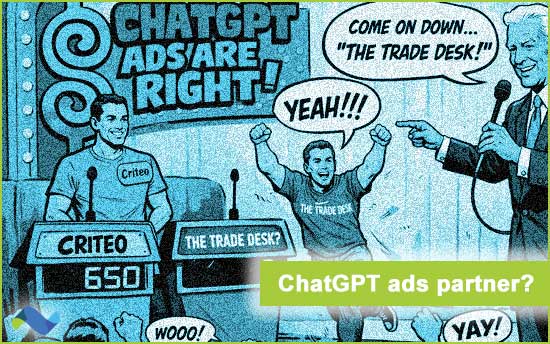
The Trade Desk has been in talks with OpenAI regarding selling ads in ChatGPT, according to The Information on Wednesday. Though details were scant, The Trade Desk’s SVP of Inventory Development, Will Doherty, was reportedly involved.
The Information’s Catherine Perloff and Sri Muppidi added:
“The talks indicate that OpenAI, which launched ads in ChatGPT in early February, will initially lean on external partners to help it sell ads and quickly ramp up its business. For instance, The Trade Desk offers an automated platform for advertisers to place ads on a large scale. It also offers technology to target ads and measure their performance.”
Read:
- OpenAI Held Early Talks With The Trade Desk to Sell Ads (March 4) – The Information
- The Trade Desk Shares Jump After OpenAI Report (March 5) – The Information
From tipsheet: This discussion with The Trade Desk doesn’t appear materially different from what was already agreed upon by ad tech company Criteo and OpenAI and announced on Monday.
Any ad tech company that can bring scaled demand to ChatGPT is likely of interest to OpenAI with the exception of Meta and Google.
In addition to The Trade Desk, partners could include:
- Amazon DSP — Amazon is an OpenAI investor. Plus, Amazon has reportedly been pursuing a chatbot ad network.
- AppLovin’s ability to monetize mobile could be ideal for ChatGPT. Rumors linger.
- Even though Yahoo DSP has a competitive chatbot in Scout (with help from Microsoft), the platform could end up being a partner.
- Microsoft, another OpenAI investor, may eventually test ChatGPT ads in its Performance Max platform where budget for Copilot ads and Microsoft’s Bing search engine are already flowing.
- The buy side capabilities of PubMatic and Magnite could be of interest if they can provide some differentiated demand.
LLMs & CHATBOTS
Developments
- Introducing GPT‑5.4 – Designed for professional work (March 5) – OpenAI
- GPT-5.4 Thinking in ChatGPT (March 5) – ChatGPT Release Notes
- Labor market impacts of AI: A new measure and early evidence (March 5) – Anthropic
PLATFORMS
Green invests “green”
The Trade Desk CEO and founder Jeff Green announced on LinkedIn yesterday, “Over the last few days I made the biggest purchase of my life. I bought ~150 million dollars of The Trade Desk stock. Tomorrow, I’ll explain why.”
Read it. (March 5)
LUMA Partners’ Terence Kawaja said in the comments to the post, “Jeff – No one can ever accuse you of lack of conviction. This is a hell of a way to show it!”
Financial markets rewarded The Trade Desk yesterday with nearly a 20% increase in its stock price and a $14 billion+ gain in market cap
Oppenheimer analyst Jason Helfstein said in a note to investors:
“While viewing today’s move as short covering, we conceptually think the idea of additional ad platforms/surfaces (ChatGPT, Claude, new AI hardware, etc.) could address the terminal value concerns for TTD around platform maturity or over-reliance on a small number of CTV platforms. The stock is currently trading at 10x 2026E EBITDA, discounting a nominal growth outlook.”
From tipsheet: Today, Mr. Green will likely explain that he feels more strongly than ever about The Trade Desk’s AI-enabled future — and that of the open web’s.
Will report back on Monday.
RETAIL MEDIA
Reactions: OpenAI changes checkout strategy
The Information reported on Wednesday that OpenAI is scaling back its plans for Instant Checkout and the affiliate revenue which was supposed to come with it.
“Instead of allowing users to make purchases directly from product listings that show up in ChatGPT search results, the company is now focused on having checkouts take place inside of specific apps that plug into ChatGPT, an OpenAI spokesperson said.”
Read: “OpenAI Scales Back Shopping Plans for ChatGPT” (March 4) – The Information (subscription)
Reaction 1 of 3
In light of The Information’s report, analyst Eric Seufert read the “tea leaves” on his Mobile Dev Memo blog:
“While The Information‘s reporting highlights weak retailer adoption of Instant Checkout, which is likely a function of the 4% fee OpenAI charges, I believe the Amazon partnership likely also influenced this decision, should the reporting about it turn out to be accurate. If OpenAI is aligning with Amazon’s advertising stack, an affiliate checkout model becomes strategically redundant, if not wholly incongruent…”
Read more on Mobile Dev Memo. (March 5 – subscription)
Apps that plug into ChatGPT — like Target’s — will provide the checkout functionality rather than ChatGPT itself, reported the Information.
Reaction 2 of 3
Elsewhere, entrepreneur Juozas Kaziukėnas didn’t agree with OpenAI’s decision to step back from checkout:
“ChatGPT is giving up too early and it shows lack of conviction. The next step after realizing that ‘while ChatGPT users were researching products to buy in the chatbot, they weren’t using the chatbot to actually help them make purchases,’ is that it is up to ChatGPT to change that. That’s why AI platforms in China like Alibaba’s Qwen spent hundreds of millions of dollars recently to kickstart shopping behavior – it takes force to change user behavior. Which then hopefully kickstarts a flywheel incentivizing retailers to figure out data integration.”
Read his thoughts on LinkedIn. (March 4)
Mr. Kaziukėnas founded business intelligence firm Marketplace Pulse, which he sold in 2024.
Reaction 3 of 3
Diaz Nesamoney, founder & CEO of DaVinci Commerce AI, had his own thoughts on the news:
“The article does point to something very important and probably should have been the headline. ChatGPT apps are the new storefront. It is in these apps that shopping will occur and depending on the sophistication of the app, the app either integrates with retailers commerce systems or provides options like nearest store location or handsoff to the retailers eCommerce site. Let’s remember over 70% of shopping still happens in physical stores.”
From tipsheet: That was quick. Instant Checkout was rolled out just last September.
Goodbye affiliate revenue, hello ads.
TECH
GEO, AEO tips and tricks
Interest in generative engine optimization (GEO) and/or answer engine optimization (AEO) continues to surge as marketers try to figure out how to embed their brands within AI chatbots’ LLM responses.
Ad Age’s Garett Sloane previewed his piece on GEO/AEO tips and tricks on LinkedIn:
“…Some of the experts in the space gave perspective on how exactly the LLMs work.
‘Most of ChatGPT is just Google in a trench coat,’ Leigh McKenzie at Semrush told me, and that’s why SEO is still foundational, even while applying GEO tactics. (…)
Also, YouTube video is a critical medium for influencing AI, especially Google Gemini, obviously. But the type of video that you want to create to get picked up by Gemini is not your average UGC, Jack Smyth tells me.”
Read more on LinkedIn. (March 5)
Sloane also outlines the differences between AEO and GEO. For example, AEO represents the optimization for single, direct responses from AI assistants like Amazon’s Alexa and GEO optimizes for citations within a response such as OpenAI’s ChatGPT.
More: How brands should craft their AI strategies—GEO and AEO tips for marketers (March 5) – Ad Age (subscription)
MEASUREMENT
Rumor: AI ad platform allegedly defaults
AI ad startup Icon, which launched a self-serve ad platform known as “AI Admaker” a year ago and acquired the domain “Icon[dot]com” for $12 million last April, has allegedly gone bankrupt, according to a well-known influencer on X yesterday.
In a LinkedIn post from a year ago by CEO Kennan Frost, Icon backers included Peter Thiel’s Founders Fund and tech executives from companies such as OpenAI, Pika and Cognition.
MEASUREMENT
Ramp data shows hot AEO vendors
On LinkedIn, a growth marketer for fintech startup Ramp, Eric Wu, previewed new findings about answer engine optimization products and their capabilities courtesy of the company’s own client data.
AEO/GEO startup Profound appears to be a big winner which helps explain its recent funding round at a $1 billion valuation.
Mr. Wu explained on Wednesday:
“AEO is an evolution of SEO. It’s not surprising that from a first principles standpoint, they aren’t all that different. They both revolve around solving an information retrieval problem for the consumer.
What is interesting is the new way of measuring and attributing growth metrics in this low attribution channel. AEO visibility tools are growing at a tremendous pace doubling (2x) from last year.
The leaders in the space Profound and AirOps aren’t surprising as both aren’t simply focused on measurement and reporting, but enabling their customers to take action.”
Read more on LinkedIn. (March 4)
Read:
- The search shift: How AI is powering the rise of “AEO” startups like Profound – Ramp blog
- Top ranking AEO software in Mar 2026 – Ramp
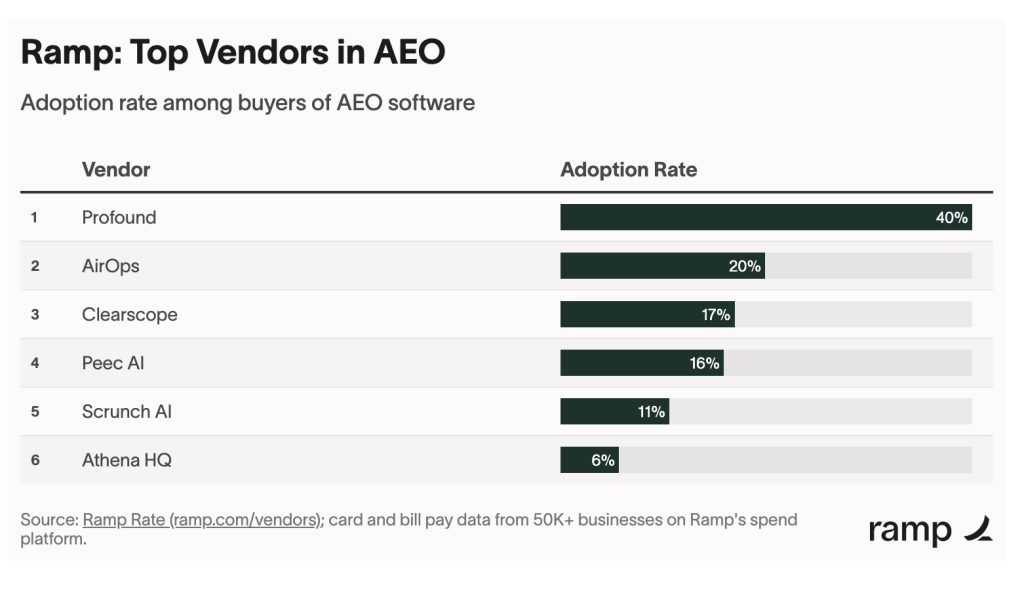
From tipsheet: Again, this isn’t an exhaustive list of AEO/GEO vendors but pulls data from Ramp’s clients only.
Wu’s conclusion on LinkedIn mirrors an ad industry trend regarding marketers seeking “outcomes”.
AGENCIES
Criteo’s ChatGPT ads pitch
“OpenAI and its first ad tech partner Criteo are framing their pitch around conversational advertising — a format that’s long been promised but rarely delivered at scale. The pitch is landing in clients’ inboxes just days after Criteo announced it would give its advertisers direct access to ChatGPT inventory through its platform.
And true to the pattern of the past month, OpenAI isn’t doing the selling itself. That job falls to Criteo.”
Read: “Pitch deck: How ChatGPT ads are being sold to Criteo advertisers” (March 5) – Digiday
AGENCIES
WPP Media gets a new U.S. CEO
Media agency group WPP Media announced a new CEO for its unit in the United States as it elevated its Chief Client Officer Nancy Hall to the leadership role.
Yesterday on LinkedIn, WPP Media’s global CEO, Brian Lesser, announced:
“With profound pride, I am pleased to share that a truly remarkable leader, Nancy Hall, is the new CEO of WPP Media U.S. We are incredibly fortunate to welcome someone who will ignite our community, infuse new energy into our teams, and set a powerful benchmark for leadership across the entire industry.
Nancy’s career is a testament to her vision. She has consistently built modern, technology-driven organizations that don’t just deliver exceptional results for clients but empower teams to lead confidently in a rapidly evolving landscape. She brings an extraordinary combination of strategic vision and expertise across data, technology, programmatic, and analytics, positioning us for significant advancement…”
Read more on LinkedIn. (March 5)
More: “WPP Elevates Nancy Hall to CEO of WPP Media U.S.” (March 5) – Adweek
TECH
AI ad platform Moloco’s IPO, new hire
AI ad platform Moloco has hired a new communications leader in advance of a reported initial public offering (Feb. 13, Bloomberg).
Formerly a senior executive at NBCU and SiriusXM, Maggie Mitchell will be the company’s Head of Communications, according to Axios.
Mitchell discussed her plans with Axios:
“Telling the story of AI and advertising technology — two notoriously complex areas of business — in a way that clearly and simply highlights the business’s strengths and differentiators is a real challenge, and it’s a challenge that is tailor-made for a strong communications team.”
In addition to the company’s AI-enabled ad platform, Moloco also addresses commerce media, mobile apps and CTV with its ad tech solutions.
Read: Moloco hires Maggie Mitchell to lead communications (March 5) – Axios
Related: “Two-Thirds of Top Marketing Leaders Expect a High Level of AI-Driven Disruption to Consumer Behavior” (January 21) – Moloco
MORE
- “Microsoft is Laying the Groundwork for AI Commerce” (March 5) – Debra Aho Williamson, analyst, Sonata Insights on LinkedIn
- AI Max increases revenue 13% but drives higher CPA: Study (March 5) – Search Engine Land
- TransUnion Advances AI-Driven Credit Intelligence with Google Cloud (March 5) – press release
- Comscore and Yahoo DSP Partner to Advance CTV Political Advertising with Proximic Political Audiences – press release
- Is AI The Magic Sauce That Will Unlock Value In Media Mega-Mergers? (March 5) – Deadline