
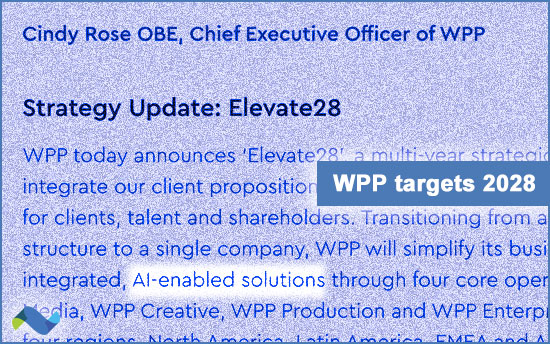
Yesterday, agency services company WPP reported its 2025 full year financial results and, perhaps more importantly, unveiled a new strategy called Elevate28 (i.e. 2028) with “AI-enabled solutions.”
The company also said it’s transitioning away from being a holding company.
On the financial results, 2025 showed an expected decline:
- “2025 reported revenue of £13,550m was down 8.1%, with a like-for-like (LFL) decline of 3.6%.
- “Global Integrated Agencies 2025 LFL revenue less pass-through costs fell 5.7% (Q4: -7.6%) with WPP Media declining 5.9% (Q4: -10.8%) and other integrated creative agencies declining 5.6% (Q4: -4.3%).”
In an effort to remedy the decline, the company shared extensive details on a new strategy called Elevate28.
TL;DR: The company is aiming to return to consistent growth by 2028.
“‘Elevate28’, a multi-year strategic plan to simplify and integrate our client proposition, restore growth and drive long-term value for clients, talent and shareholders. Transitioning from a holding company structure to a single company, WPP will simplify its business to deliver fully integrated, AI-enabled solutions through four core operating units: WPP Media, WPP Creative, WPP Production and WPP Enterprise Solutions across four regions, North America, Latin America, EMEA and APAC.
(…) The plan focuses on stabilising the business in 2026, building momentum in 2027, and delivering accelerated, high-quality growth from 2028, supported by £500m of gross annualised cost savings and portfolio rationalisation to unlock value.”
Read the release for all of the Elevate 28 strategy details. (February 26)
On LinkedIn, WPP CEO Cindy Rose OBE was looking ahead and said in part:
“As our clients navigate uncertainty, AI disruption and macro‑volatility, our mission is clear — to be the trusted growth partner for the world’s leading brands in the era of AI.
Today, we’re unveiling a bold plan for a simpler, more integrated WPP. We’re becoming one company, organised into four operating units across four regions, all powered by WPP Open, our pioneering agentic marketing platform.”
Analyst Ian Whitaker reviewed WPP’s results and new strategy and was optimistic for the company:
“We all knew WPP’s 2025 results would be weak – but the new strategy offers the glimpse of a better future. (…)
The new Elevate28 aims to fix three structural problems:
-
- An over-complex group
- Mixed execution
- Restoring balance sheet flexibility”
Read Mr. Whitaker on LinkedIn. (February 27)
More: WPP to sell assets and cut jobs in radical shake-up to counter AI threat (February 26) – The Guardian
Related: “Can agencies fix the AI disconnect between the C-suite and marketing teams? Boathouse is trying to” (February 25) – Digiday (subscription)
LLMs & CHATBOTS
Developments
- Nano Banana 2: Combining Pro capabilities with lightning-fast speed (February 26) – Google’s The Keyword blog
- Why Anthropic is giving Claude Opus 3 its own Substack (February 26) – Anthropic’s “Claude’s Corner” on Substack
- “AI coding agents made a huge leap forward since December, completing complex projects with minimal oversight, meaning ‘programming is becoming unrecognizable’” (February 26) – Andrej Karpathy, co-founder of OpenAI on X
SELL-SIDE
Orchestrating publisher AI monetization
Publisher monetization network Freestar announced its entry into the world of operating systems with PubOS, which the company described as a single integration comprising:
- Monetization technology – including its Prebid wrapper.
- Marketplace of third-party solutions including “TollBit and Dappier for AI licensing and monetization; The Media Trust and Ad Fontes Media for quality and security; and Gamera, Inc and Adomik for advanced analytics…”
- Service “where our team becomes an extension of the publisher’s team.’
Read more on LinkedIn. (February 26)
According to CEO Kurt Donnell in a post on the company’s website, the AI centerpiece to the new OS includes content monetization and yield management.
Donnell wrote:
“As we enter our second decade at Freestar, I’ve been reflecting on our journey and on how the current AI Age is reshaping the publisher ecosystem. Freestar was founded with a focus on optimizing header bidding and monetization, but over the last ten years, we’ve built something so much bigger. We realized that solving for revenue alone isn’t enough…”
Read: Introducing pubOS: A Toolkit for the Future of Publishing in the AI Age (February 26) – Freestar
On LinkedIn, Freestar founder David Freedman pumped up the volume on the new OS saying, “What is pubOS? It’s the most comprehensive publisher toolkit in the industry, all accessible through a single integration. It’s anchored by our award-winning monetization technology…” Read more. (February 25)
From tipsheet: An outsourced alternative for publishers who want to sell their content to AI companies seems like a smart niche for Freestar.
Publishers may also want to leverage Freestar’s in-house expertise in AI content monetization.
There was no mention of agents in Freestar’s rollout. That’s probably fine with SSP PubMatic which launched its AgenticOS at CES.
PLATFORMS
Manus 1 of 2: AI workflow use case
Meta’s Manus and its AI technology was the subject of a new article from Ad Age highlighting the company’s workflow capabilities in advertising.
Ad Age’s chief technology reporter Garett Sloane previewed the article on LinkedIn:
“Meta doesn’t always have an immediate advertising focus to its acquisitions, Instagram was bought before it had ads. Although mobile ads were clearly the goal, it took more than a year to get ads on IG.
The whole Meta ad buying community is talking about Manus, and looking for how it makes campaigns more effective.
One clear use is to have Manus analyze the Meta ad library, a repository of all active campaigns on Facebook and IG. The library is hard to navigate manually so having an AI agent do it is huge.”
Read more on LinkedIn. (February 26)
Read:
- How Meta’s Manus AI assistant is already reshaping ad buying (February 26) – Ad Age (subscription)
- Read about, and see, a competitive research use of Meta’s Manus in action from Bram van der Hollen on LinkedIn. (February 21)
PLATFORMS
Manus 2 of 2: assistants v. autonomy
One person’s workflow assistant is not another person’s autonomy — at least that’s how Viant CEO Tim Vanderhook sees it.
Yesterday, Mr. Vanderhook used Meta’s expedited integration of Manus AI (acquired in December) as a marker for distinguishing his company’s own automated advertising platform, Viant Outcomes:
“At CES, the market was flooded with AI assistants, overlays, and add-ons. Just two months later, many of those launches already feel stale. The product cycle has compressed so dramatically that anything short of full autonomy risks irrelevance almost immediately.
The real divide isn’t AI vs. no AI… it is autonomous vs. assisted. That distinction matters, because copilots simply augment labor but don’t collapse the decision-making process, while autonomous systems fully replace execution loops.
However, advertising is well-suited for this transformation. This is advertising’s Excel moment. (…)This shift also marks the end of the SaaS dashboard as a moat.”
Read more. (February 26)
More: Viant Launches “Outcomes” the First Fully Autonomous Open Internet Ad Product (January 6) – Viant
BRANDS
WebMCP and UCP need Salesforce
“Breaking: Google releases WebMCP & UCP … changing everything (again).
Here’s why: WebMCP was developed w/ Microsoft and released as a proposal a few days ago and it’s getting clear this is a major event
UCP is a proposal that builds on WebMCP and focuses on commerce (the “C”).
So why should you care about WebMCP?
As you know MCP is Anthropic’s Model Context Protocol – already widely-adopted – and WebMCP is a kind of Web- version of such…”
Read: Martin Kihn, SVP Strategy, Salesforce makes the case for Salesforce’s Data 360 (February 26) – LinkedIn
Related: Salesforce CEO Marc Benioff: This isn’t our first SaaSpocalypse (February 25) – TechCrunch
From tipsheet: Salesforce has been taking it on the chin with the “SaaSpocalypse” narrative exploding on Wall Street. The executive team is going on the offensive.
PROTOCOLS
IAB TechLab clarifies agentic initiatives
The standards arm of the IAB is sensing confusion in the marketplace when it comes to agentic advertising standards.
In previewing new guidance yesterday on LinkedIn, IAB Tech Lab CEO Anthony Katsur tried to set the record straight saying on LinkedIn that the Agentic Real-time Framework (ARTF) and Agentic Audiences (formerly LiveRamp’s User Context Protocol) are not the only agentic standards efforts underway by his organization.
In a separate LinkedIn post, Katsur announced “AAMP” or “Agentic Advertising Management Protocols.”
He wrote:
“AAMP is the umbrella initiative under which all this work is developed in partnership with the advertising ecosystem.
It has a defined roadmap.
It is being executed through the Agentic Task Forces at IAB Tech Lab. We now have buyer and seller agent task forces, and an agentic audiences task force.
And it encompasses far more than a single framework.”
AAMP is built on three pillars (see graphic below), explained Mr. Katsur.
- Agentic Foundations – “a high-performance delivery and execution control plane upon which agents can communicate”
- “Agentic Protocols”
- “Agent Registry” – Katsur says this is launching next week.
Read all about it: “Framing the Agentic Advertising Management Protocols (AAMP) (February 26) – Anthony Katsur, CEO, IAB Tech Lab on LinkedIn
From tipsheet: A year ago, none of this existed — the market is moving quickly.
It’s clear the TechLab is moving quickly, too, and on behalf of its membership.
The registry is launching right on schedule according to tipsheet’s interview with Katsur earlier this month.
FINANCIALS
Earnings reports
- PubMatic Announces Fourth Quarter and Fiscal Year Ended 2025 Financial Results (February 26) – PubMatic
- DoubleVerify Reports Fourth Quarter and Full Year 2025 Financial Results (February 26) – DoubleVerify
CEOs on agents:
- “Today, I shared my prediction for the future of agentic advertising: by 2028, 25% of all digital advertising will be executed autonomously via agentic AI. By 2030, that jumps to 50%. I say this because the evidence is already here. Since our launch of AgenticOS just last month, PubMatic has transacted more than 250 agentic deals and built out our accelerator program with nearly 100 new partners.” (February 26) – PubMatic CEO Rajeev Goel post-earnings report on LinkedIn
- “Advertisers still want to ensure that what they’re buying is what they think they’re buying — and it’s going to drive a result that they expect. That’s the role we play on those platforms. It’s the role we’ll play with agents, when that starts to scale. The dialogue today with most advertisers is, “How are you guys going to play in that new world?” I think the role we play is exactly the same one we play today, which is driving trust and transparency. In those cases, it will be with an agent who’s going to search for a buy, needs to make sure that that buy is safe, they are going to contact us first.” (February 26) – DoubleVerify CEO Mark Zagorski on the earnings call with analysts according to Yahoo Finance transcript
Related:
- The Trade Desk Faces Headwinds As Investors Reconsider The Thesis Of Objective Indie Ad Tech (February 26) – AdExchanger
- Perion Q4 2025 earnings highlights – “By transforming the Perion One Platform into an AI-native execution infrastructure, we will allow marketers to harness the power of AI Agents to control and optimize their marketing activities…” (February 18) – Tal Jacobson, CEO, Perion in Perion’s earnings release
SELL-SIDE
UK publishers unite for AI standards
In an effort to unlock the AI opportunity for its sector as well as defend it, a consortium of publishers in the UK has banded together to form SPUR (Standards for Publisher Usage Rights).
Sky News, which is a part of SPUR, reported:
“Sky News has formed a consortium with other major news organisations to develop industry standards for AI’s fair use of their material.
The founding members – the Financial Times, The Guardian, the Daily Telegraph, the BBC and Sky News – are calling on other media leaders to join in and develop shared protocols to ‘protect original journalism’ and respond to a ‘global challenge’…”
Read more. (February 26)
Could this group be the primary counterparty for AI companies when it comes to large publisher content monetization?
The fragmented landscape for AI licensing deals could serve publishers who are falling through the cracks, i.e. not making any money by licensing their content to AI companies.
Sell-side advocate Matthew Scott Goldstein said about the new org: “This might be marketplace formation move disguised as a standards body. The real play is that whoever controls the licensing rails for high-trust journalistic content controls a key input layer for AI that wants to be credible. AI platforms need provenance and reliability…” Read his ‘take’ on LinkedIn. (February 26)
More: Read the open letter from the founding publisher leaders on the SPUR Coalition’s website
From tipsheet: The UK publishers make clear that they are reaching out “globally” for additional members. Perhaps publisher trade organizations such as Digital Content Next will unite with the UK group? BBC and the FT are already a part of DCN according to DCN’s member list.
PEOPLE MOVES
Now hiring
-
“The market is recalibrating. AI is accelerating that shift. We are entering a new phase of our industry. That’s why I’ve joined inPowered AI as Senior Vice President, Sales.” (February 26) – Casey Lewis on LinkedIn
MORE
- “The fruit of the poisonous (programmatic) tree” (February 26) – Brian O’Kelley, CEO, Scope3 on his personal blog
- AgenticAdvertising[dot]org announces May 6 event in NYC (February 26) – LinkedIn
- Introducing Discovery Campaigns for Axon Web Advertisers (February 25) – AppLovin
- “We’re expanding beta access to text guidelines for all advertisers globally in AI Max.” (February 26) – Rushil Grover, Google Ads on Google Ads & Commerce blog
- Meta is auto-generating AI ads for its advertisers, causing headaches for image-conscious fashion brands (February 26) – Glossy