

BRANDS
Use case: Marketing communications
Marketing Dive was listening to Yum! Brands’ recent earnings conference call where the company revealed it was getting 5x better performance with its marketing communications to consumers by using AI.
“Yum Brands last year launched personalized marketing campaigns driven by artificial intelligence, teasing an ‘AI factory’ that leverages consumer data to enable its digital ecosystem. Last month, the company shared some early results from inside the factory, which helped send more than 200 million AI-generated communications that have been up to five-times more effective compared to traditional approaches, across KPIs including frequency and return on ad spend.
‘Across the organization, AI is supercharging our marketing,’ Yum CEO David Gibbs said on the company’s Q2 2025 earnings call. ‘This is not just marketing evolution, it’s a revolution, and we’re only getting started.’”
Read more in Marketing Dive. (September 16)
BRANDS
Quote: ‘CMOs want to move at the speed of culture’
“CMOs ‘want to move at the speed of culture… and if it takes an agency a month to produce something, the culture has already moved on – it’s not waiting for you.’”
Read: Omar Tawakol Is Merging His AI Startup Rembrand With Spaceback – AdExchanger (September 15)
BRANDS
‘AI ad server’ takes Coles RMN business
Australian grocer Coles —with over 1,800 stores— has chosen “AI ad server” Topsort to run its retail media network (RMN).
From Adweek:
“Topsort, founded in 2021, aims to bring a more tech-savvy approach to retail media. The adtech firm uses AI tools to help retailers scale their ad businesses more quickly and efficiently than competitors, according to CEO and cofounder Regina Ye. Topsort powers retail media for food delivery apps, online marketplaces, and grocers including DoorDash, Just Eat Takeaway, Poshmark, and Woolworths.”
Publicis’ Epsilon previously had the business and informed Adweek’s Kathryn Lindstrom that it was still working with Coles on its “Coles 360” RMN.
More: Coles partners with AI company Topsort to automate advertising (September 17) – AdNews (Australia)
LLMs & CHATBOTS
Developments
-
Powering AI commerce with the new Agent Payments Protocol (AP2) (September 16) – Google Cloud blog
-
OpenAI hires former xAI CFO as Altman-Musk rivalry escalates (September 16) – CNBC
-
Trump, AI — and what you missed at our summit (September 16) – Politico
AGENCIES
65% of agency tasks replaced by agents
Sir Martin Sorrell’s S4 Capital believes that CMOs won’t need traditional agencies in the future. Instead, they’ll turn to autonomous agents run by… an agency under the S4 holding company umbrella such as MightyHive or Media.Monks.
Media.Monks chief AI officer Wes ter Haar said on S4 Capital’s recent conference call with financial analysts:
“…we have both General Motors and the [Fast-Moving Consumer Goods company] mentioned earlier, choosing Monks really clearly because of our industry-leading AI offering. The reason that we are fast and first when it comes to that offering is that we believe AI is eating the agency business. We don’t believe that’s controversial to say it collapses the cost of creativity, it collapses the cost of media management, and whether agency leaders admit that or not, clients know that that is true and they want it. We estimate about 65% of the tasks agencies get paid for currently could be done by AI agents within today’s technology. Keep in mind that today is the worst that technology will ever be.”
Read S4 Capital’s earnings call transcript. (September 15)
Will the “agents” strategy work for Sir Martin and S4 as automation swamps the human touch? A move to outcomes-based buying by marketers may help.
Read more in Digiday. (September 16 – subscription)
AGENCIES
Publicis loses executive to AI
Bryan Wiener, CEO of Publicis-owned ecommerce analytics company Profitero, has decided it’s time to re-enter the world of startups thanks to AI.
Yesterday, Mr. Wiener announced his departure on LinkedIn, but not where he’s landing —yet:
“We haven’t seen disruption like AI since the rise of the commercial internet in the mid-90s — only this time it’s moving faster and with even greater impact. I’ve always been drawn to those rare windows when the clay is still wet and the future is undecided. Over the past two decades, I’ve leaned into those pivotal moments to build companies across VoIP, search, social, and e-commerce — selling four companies along the way. Now, with AI accelerating at unprecedented speed, that window is open again — and I’m not done building…”
Read more on LinkedIn. (September 16)
Mr. Wiener is well-known in digital advertising circles as CEO of digital agency 360i (acquired by Dentsu) as well as a brief stop at Comscore before he joined Profitero.
More: Bryan Wiener exits as Profitero CEO—what’s next for him and the Publicis-owned firm (September 16) – Ad Age
From tipsheet: Sarah Hofstetter has worked in tandem executive roles with Wiener at 360i, Comscore and Profitero, where she is currently Chairwoman. She may be on the move shortly, too.
SELL-SIDE
Google aims at creators with AI tools
-
YouTube to use AI to help podcasters promote themselves with clips and Shorts (September 16) – TechCrunch
-
YouTube announces new generative AI tools for Shorts creators (September 16) – TechCrunch
From tipsheet: This isn’t the ad or marketing tech of 10 years ago where marketers were the exclusive customer. Today, it’s also about delivering better self-serve, AI-enabled tools for creators.
SELL-SIDE
Gannett CEO on answer engine strategy
Taboola’s answer engine product called DeeperDive is getting traction with publishers seeking a way to increase engagement with readers and overcome a loss of referral traffic from search engines due to AI chatbot innovation.
At a Wired event last week, Gannett CEO Mike Reed said about his company’s installation of DeeperDive: “Visitors now have a trusted AI answer engine on our platform for anything they want to engage with, anything they want to ask… and it is performing really great.”
Gannett’s Reed said that he wants to work with Taboola on agentic tools to assist with reader shopping: “Our audiences have a higher intent to purchase to begin with… That’s really the next step here.”
Read more in Wired. (September 15)
From tipsheet: The answer engine format is the new affiliate publisher. Ads are shopping-focused, but there’s no reason brand advertising can’t run within these chatbot placements as Taboola’s DeeperDive network—in this case—scales.
SELL-SIDE
What publishers and ad platforms should not build
Following his comments in a WSJ article on connected TV the previous day, Roku’s Head of Ad Innovation Peter Hamilton clarified on LinkedIn yesterday:
“When it comes to video, my point is that there are literally thousands of generative video services popping up everywhere. I don’t think it is the publisher or platform’s job to focus on doing even more generative video.
We just need to provide transparent reporting, fast creative uploading, and the best performance optimization based on our unique first party signals.”
Spaceback CEO Casey Saran (who is now part of Rembrand) responded in the post’s comments on LinkedIn:
“I agree that it’s not a platforms job to ‘do even more generative video”‘, but its probably a good idea for platforms to understand which creative strategies and technologies are going to deliver results for their advertisers on their platform (that is how platforms win!)”
Roku’s Williams replied: “Casey Saran [we are] aligned. Not saying creative isn’t important. Don’t see why the ad platforms and publishers should be building it.”
TECH
Data: CPM trends
Touting its own AI-enabled ad platform, AdRoll released its “State of Advertising” report just in time for holidays. The company said, “The report reveals that digital ad demand is rebounding just as generative AI begins reshaping holiday shopping, creating both urgency and new challenges for marketers.”
Is AI already having an effect? Here’s some evidence:
“Display ad costs, measured by cost per mille (CPM), showed significant recovery in Q3. Display retargeting CPMs narrowed their year-over-year decline from 18% in Q2 to just 3% in August, while display prospecting CPMs improved from 31% below last year in Q2 to 14% below in early Q3. The trend signals growing advertiser demand heading into the holiday season.”
Read the press release. (September 16)
And see AdRoll’s “State of Digital Advertising Report” here.
TECH
Data: Google’s Performance Max CAC
Cendyn, which positions itself as a hotel technology and services company, said yesterday that it “found hotel customer acquisition costs (CAC) are down 19% year-on-year (YoY) as a result of utilizing AI in Google’s Performance Max for travel goals (PMTG).”
-
Regarding Google’s “Performance Max for Travel Goals” (PMTG), read about it here.
In promoting its Performance Max service offering, Cendyn also said:
“Drawing on aggregated data from the Cendyn Digital Marketing Platform (DMP), the Performance Index identified a 262% surge in conversion rate (CVR) and improved cost efficiency due to the intelligent application of AI with guest data to find high-value audiences…”
Read Cendyn’s press release. (September 16)
More:
- “Hotels face AI upheaval on both sides of the reservation desk. New studies show they can save money on paid search by switching to AI tools, but they also face a threat as AI booking agents ignore traditional brand ads.” – Skift (September 16 – subscription)
- The Power of Google PMTG: How AI-Driven Ads Drive Hotel Bookings (September 2024) – Hospitality Technology
TECH
Moving to outcomes with AI
Achieving real outcomes is the dream many marketers have regarding AI today.
Though not AI-specific, and coming out of a partnership with research firm eMarketer, TripleLift outlined how it tracked the marketer’s move to ‘outcomes’ for understanding digital creative success.
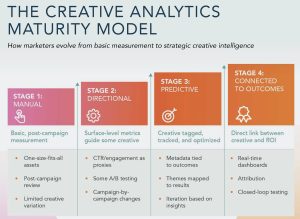
Read more on TripleLift’s website.
HR
Now hiring
Former IPG and Yahoo! executive Mike Brunick joins McKinsey & Co. as an Executive Advisor (September 16) – Mike Brunick on LinkedIn
PROMPT
How will ‘outcomes’ be defined in advertising in 2030?
Response from Google’s Gemini:
By 2030, advertising outcomes will be defined less by traditional metrics like impressions and clicks, and more by business-level results and consumer-centric metrics. The focus is shifting to how advertising directly contributes to tangible business goals, such as customer lifetime value (CLV), revenue growth, and brand equity…
MORE
- Magnite Files Lawsuit Against Google, Seeks Damages and Other Remedies Relating to Unlawful Monopoly in Ad Tech Following U.S. District Court Ruling (September 16) – press release
- Google thinks it can have AI summaries and a healthy web, too (September 15) – The Verge
- AI bots appear to be replacing human traffic on publisher websites (September 15) – PressGazette
- AI Will Not Make You Rich (September) – Jerry Neumann on Colossus
- Monday[dot]com reflects the ‘pressure to implement AI’ in new ad campaign for AI tools (September 16) – Marketing Brew