
In spite of a tumultuous history for its corporate parent — past ownership has included Aol, then Verizon and back to Yahoo! under Apollo Global Management in 2021 — Yahoo DSP has thrived in digital advertising and remains a leading demand-side platform (DSP) with a unique identity offering.
At the Consumer Electronics Show in January, the enterprise-focused DSP announced its first foray into agentics as ‘Agentic AI’ leads a new intelligence layer for automating planning, activation, optimization, and measurement are. Also, new agents for activation, troubleshooting, and audience discovery are a part of the mix.
Finally, in the interest of a more composable architecture, Yahoo DSP is undertaking what it’s calling a “Yours, Mine, and Ours” framework which “gives advertisers full AI flexibility, enabling their own models, Yahoo DSP agents, or both, securely and at scale.” Read more.
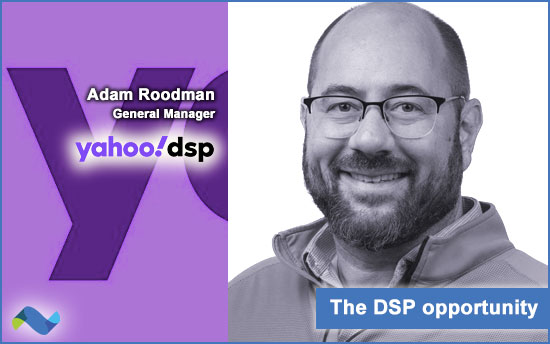
Leading the charge at Yahoo DSP is General Manager Adam Roodman, who has been at the company for more than a decade.
As Mr. Roodman explained to Tipsheet yesterday, he is ready for the next “moment”, i.e. AI.
Our interview topics included:
- Learnings from Yahoo’s evolution.
- Apollo Global and AI strategy at Yahoo.
- On the rollout of agents at Yahoo DSP.
- The current AI opportunity and workflow.
- How large language models (LLMs) benefit the DSP.
- On optimizing Blueprint, the optimization engine.
- Agentic protocols today.
- DSPs versus SSPs and the path to supply.
- AI and agents for CTV.
- On offering a fully-automated ad platform.
- The potential for self-serve.
- Yahoo!’s Scout and chatbot advertising.
- Post-cookie identity tech and LLMs.
Scroll down for the interview which has been lightly edited for clarity
TIPSHEET: Looking back on the 10 years since you joined AOL platforms from Microsoft, you’ve experienced what seems like quite a ride at what became Yahoo. What did you learn?
ADAM ROODMAN: I’ve seen a lot of moments where you can look back and say, “I know where I was when I first did X, Y and Z.” And “agentic” has sort of thrust me back into that nostalgic mindset which makes sense in that I work for a nostalgic 90s brand.
I still remember the first demand-side platform I hooked up to an exchange, AdECN. I still remember the first private marketplace (PMP) that went live, who the buyer seat was, and what was the targeting. I remember where I was when John Mansell turned on the first PGD campaign, when he was at Cadreon.
All of those moments were layered with a new technology innovation.
And so, what I’ve learned is those things are always coming — and some of them are overblown — and some of them really do deliver. I bring that up because it’s so top of mind right now.
After a few years of some cool stuff percolating, we’re at another big moment, which is really fun to be a part of.
As it relates to Yahoo’s private equity owner today, Apollo Global Management, is there an AI strategy being pushed by Apollo with Yahoo?
There’s an AI strategy with Yahoo, for sure. And it comes with the stewardship of Apollo and owning us. But, Apollo is not asking us, “Hey, make sure you’re doing AI…” — that cliché of upper echelon managers telling their employees to use it. We’ve all even moved on from that internally within Yahoo.
Now, it’s coming from the bottom up.
Frankly, what I see happening is this excitement from the users of the agentic tools on productivity. They’re telling us how excited they are about what they can do versus, say, 18 months ago.
For example, I saw excitement last week with a group of engineers on Slack telling us that they received access to more Claude licenses and what they could do with that. I think it shows you that it’s really coming from the employee base now, rather than any level of management like myself.
Apollo would tell you the same thing they said in 2021 when they first bought us: “Let’s innovate. Let’s get to growth and let you guys focus on what you do best.” And for me, that was evident day one, because they came in and said, “OK. Which ad tech platform makes the most sense… we have to make decisions that make the most sense on where we could grow.”
At CES, Yahoo DSP added new agentic capabilities, which appears to make the DSP — my words — more composable for its customers with its “Yours, Mine and Ours” strategy. How’s the rollout going?
Since CES, the most notable reaction to the go-to-market would be the partner ecosystem’s response.
Obviously, we talk to the marketer base all the time and educate them on all the tools, as well as launch new agents — we just had a new one last week. We’re continually in that rhythm.
What’s been notable are the responses from the partner ecosystem. Think about all the different partners that plug into the DSP — whether that’s measurement, creative, ad serving… there’s excitement to be a part of the “Ours” scenario, which is very interoperable.
What’s the new agent?
The latest new agent is “troubleshooting.” It’s about six days old. I just received a testimonial Slack to me this morning which said a certain airline was excited that they were able to troubleshoot something exponentially faster.
By the way, I made a rule we’re no longer creating percentages for time savings because we’re on a different level. Now, there’s no reason to say it was 20% 80% faster.
Building on the current AI opportunity you see, is the “low hanging fruit” workflow and making it agentic or automated?
Today, eliminating routine work is the biggest piece of low hanging fruit. It’s the most exciting, and it’s certainly an easy way for us to prioritize what goes next.
How would you say this relates to the innovation spurred by large language models? And in particular, what are you doing about large language models to benefit Yahoo DSP?
We are tapping into them and understanding what puts them in a position to operate fastest and with the most accuracy. As an ad tech platform, we understand what our core use cases are but we’ve never had to expose the “how-to” to an LLM. It’s re-energized the effort and accuracy needed in creating “knowledge libraries” that these LLMs can query.
Last summer, we realized the opportunity would be to isolate these knowledge libraries into specific use cases to speed up queries and eliminate hallucinations.
And so to answer your question more directly, it’s been about how do we interact with the LLM — rather than trying to create one.
Has this evolved Yahoo DSP’s optimization engine, Blueprint?
I’d compare it to the early days of ad tech when we saw ad platforms go from two or three manual optimizations per day to hourly — and then obviously into real-time bidding.
Blueprint went from a number of signals that we thought were massive and then quadrupled it. And that took place prior to agentic, which really took our machine learning up to a new level. Blueprint has also had some updates on the generative AI side to make the UX a little bit more streamlined.
But what’s next is rooted in the agentic progress we’ve made just recently.
And so, what’s next?
For right now, there is still a UX — and the amount of switching costs for a marketer to go from using us for part of their marketing buying to all of it or just using us for the first time… In general, there’s a process where traders would get certification, acquire learning and development that could take months etc.
Now, with the use cases of workflow that we just talked about the time and the switching costs is drastically and dramatically different. Consequently, that means standing up Model Context Protocol (MCP) servers that enable whether they want to use our native agents internally or the “Ours” scenario that we just talked about. Or, if they have something that they’re building themselves and they want to plug in.
From my own perspective, I’ve been using a new Slack agent that my team built in order to query my own database and I haven’t logged into the DSP since I’ve had that agent.
I can definitely imagine that these buyers are going to be looking to do the same and that’s what we’re trying to solve for.
Does this affect pricing or revenue as it relates to the DSP?
We’re not viewing it as a pricing advantage — right now — even with all the different use cases that are being delivered. It’s more about removing the routine work and helping folks become more interoperable.
The real price advantage would be the cost of switching. And, we’re eliminating that by reducing those barriers. Blueprint’s performance has always been about reducing the cost of media in order to gain better performance. And so that’s been “in line” prior to agentic.
Regarding agentic protocols today, any thoughts on using them today?
As of right now, February 2026, I have good activations and tools that are deployed using Model Context Protocol. That is not only something that we know how to operate, but we have put into the DSP, and we’re working with it. The evolution of legacy APIs into MCP has been awesome.
We are also founding members of Ad Context Protocol, as a company, and we see some interesting use cases there. Today, it’s probably a little bit more tilted towards our owned and operated inventory sales motion. But as a DSP, we’ve also leaned into seeing what we can do with it, and that goes for Agentic Real-Time Framework (ARTF) as well.
We are leaned in and not picking winners. But, we’re live and in production with MCP today.
Looking across the aisle, if you will, it seems like the DSP is starting to handle some of the SSPs duties. What are you experiencing?
I can see how that looks that way because there are publishers who — sometimes because of connections we want and sometimes because of connections they require — plug into us directly. So there is no SSP in the supply chain for the first time in the last few years. That is new, and I could see how that might be interpreted as “us” in their space.
We have not made any investment in yield management and there’s no aspiration to do that. In fact, we’ve gone the opposite direction. We sunset all those attributes when we got out of the SSP business a few years ago. We see a future with SSPs still bringing us that long tail of publisher supply. We don’t want to have 2,000-3,000 publishers integrating with the platform — at least today.
We get great coverage when we combine the direct to publisher access that we have with our backstage product — plus trusted SSP partners that are doing great things.
Do you think AI is affecting the path to supply?
I think there are easier ways to bring in tools to optimize the supply path today than there ever have been and so looking for the optimal path — such as machine learning which is evaluating every placement in real time, or agentic that takes in more offline attributes of certain supply paths and rationalizing it with the bidder — all of those things are pointing to great advancements in supply path optimization (SPO) and it’s never been a better time to be buying inventory.
Moving to CTV, Yahoo DSP has continued to grow its CTV inventory (Roku, Netflix, Spotify). Is there a path forward with CTV for AI and agents?
First, everything that we’re doing with the agentic framework is for omni-channel. Obviously CTV is a huge part of it. So every use case that we can come up with — from measurement to trafficking faster — it applies to CTV.
CTV has made so many advancements and predominantly driven by advanced identity infrastructure. The proliferation of identity in the CTV environment for addressability has propelled CTV faster and agentic just supports that from a workflow and measurement perspective.
There are platforms out there today which provide the end-to-end, fully-automated advertising buying solution such as Google’s Performance Max and Meta’s Advantage+. Has Yahoo DSP ever considered dabbling in that area?
First, we are a predominantly enterprise-focused DSP. Our marketer “roster” is a savvy and sophisticated group of marketers who want total choice and control. If you gave our platform to a marketer looking for “turnkey,” they might be overwhelmed with all the different offerings. They don’t need maybe 250 plus features for each step of the buying process, for example.
So, the move to offer something more simplified has never been more intriguing to us now with agentic workflows at our disposal, and I do think it is a foreseeable reality that we could offer something more simplified as you mentioned.
Along those lines, it sounds like you see a self-serve opportunity with SMBs?
Right now, the opportunity has never been more conceivable, given that there’s a way to offer “agentic” as a wrapper on top — also “agentic” as a decision layer to help with the multitude of decisions that you would have had to make with an enterprise product which we have in market today.
On Yahoo!’s Scout AI answer engine, it has hinted at the advertising opportunity. What’s the plan for Yahoo DSP as it relates to Scout?
I love the product and have been using it. It’s a refreshing approach compared to traditional LLM queries. So, nothing to report today, but we’re super excited about the product.
Any thoughts on, let’s call it, conversational advertising as that strategy gets rolled out with OpenAI’s ChatGPT, let alone Yahoo Scout. Do you see the opportunity there? Is it going to change advertising?
Contextual has always been, and will always be, one of the most powerful places to put advertising energy. This type of advertising certainly presents a new contextual and, possibly, audience-based environment. I think it has a place. All services that have great intent data are blessed with the opportunity to bring a product like this to market.
Obviously, it just puts continued areas for folks to be responsible — and that should not have to be said. But it’s the most obvious statement I could add to it.
Regarding Yahoo DSP’s addition of Conversion API (CAPI) last April, how’s that rollout going? Is there an agentic element?
So with CAPI, the most exciting part is the follow-on feature that we announced at CES — our ability to do in-flight outcomes which means taking offline conversions and feeding them directly into our bidding algorithm. That feature is the most exciting part of what is being enabled on top of an integration with CAPI. Agentic can be a wrapper to all the different features that we go-to-market, but in terms of CAPI, that would be the coolest thing that’s developed since its integration.
Is there a place for the post-cookie identity tech which Yahoo DSP has? How might that work in an LLM or the AI environment?
That’s where my eyes really light up. To be clear, I’m very excited about agentic, but the identity investment that we made originally with the thought that this would be super valuable for the browser environment, and obviously, there was a pivot (by Google).
But with that investment, we were able to take advantage of it and incorporate it into our CTV environment, and that has proven to be a really powerful tool for marketers: to have deterministic addressability within a CTV environment.
We did not predict that happening and with the reality of IP addresses being scattered and less stable right now, having that footprint which we invested in so many years ago has paid off. It’s huge for performance by having that deterministic targeting ability — and not just for individuals, but how it relates to the household.
Finally, what’s your view on the viability of the open web? – you pick the timeline.
In the next couple of years, you’re going to see the growth of very sophisticated marketers from the enterprise to the mid-market and even the SMB tail and they will leap into the open Internet in ways that they were not equipped with before.
I hope open Internet publishers reap the benefits. I know that the benefits are there for brands who want marketing performance that they’re accustomed to with search and social. On the open Internet, it’s across multiple formats and screens where consumer behavior is still rampant.