
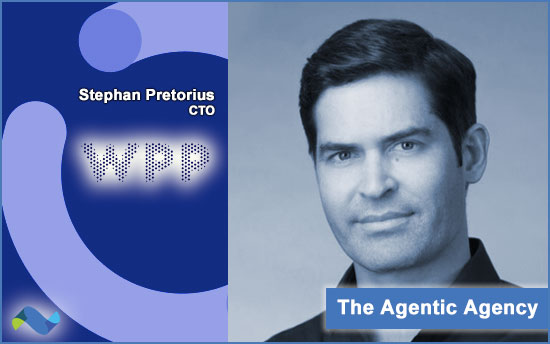
When it comes to understanding the future of the agency services model, WPP Chief Technology Officer Stephan Pretorius is ready for the challenge.
Having joined WPP in 2012 and assumed the CTO role for the holding company in 2018, Mr. Pretorius is at the forefront of understanding the AI opportunity in advertising and marketing for not only his company but today’s enterprise marketer.
It hasn’t been easy. During his tenure, WPP has seen significant changes as AI roils industries of all shapes and sizes.
Among the holding company’s moves has been to reposition media investment juggernaut GroupM as WPP Media, a “fully integrated, AI-powered media company,” and appoint board chair Cindy Rose OBE to the CEO role last fall.
The key element of Pretorius’ remit is arguably WPP’s biggest bet: WPP Open, which is positioned as an AI-powered marketing platform.
Rolled out methodically over the past two years, Open’s features include Production Studio (June 2024), Open Intelligence (June 2025), a self-serve version of Open called WPP Open Pro (October 2025) and the all-new Agent Hub, which launched earlier this month.
Mr. Pretorius spoke to tipsheet yesterday across a range of topics including:
- The WPP Open team
- Planned investment in Open for 2026
- AI’s impact on WPP employees
- On marketers and cost reduction
- How WPP is thinking about protocols (MCP, UCP, ARTF, AdCP)
- When will agentic advertising reach scale?
- Ads in a chatbot: OpenAI’s ChatGPT ad strategy
- Ads in a chatbot: What’s important to WPP and its clients
- Programmatic in the age of AI
- Startup ideas: Gaps in ad tech today
- On the “black box” of automated buying systems
- AI’s future impact on agency services
Scroll down for the interview which has been lightly edited for clarity.
TIPSHEET: Can you talk a bit about your team at WPP Open? Do you all consider the group an agency, a technology company…?
STEPHAN PRETORIUS: As a whole, WPP is definitely a marketing services organization where we use technology to provide the world’s best marketing services to our clients. But, the core technology team — the team that builds the product, my AI research team, my innovation team — we very much see ourselves as a team of technologists, building product and technology and innovating in AI for a particular category.
So, it is interesting. Most of what we do is applied AI. But we also have a whole team of people in our Satalia team that does actual frontier research and innovation in AI which includes building foundation models, doing research on all kinds of new areas, new architectures, etc.
We are technologists here.
WPP is a public company and spent $400 million USD on AI in 2025 and roughly $300 million in 2024. It’s the beginning of the year, so what’s the 2026 plan? And what does that mean for WPP Open?
So, look, $400 million is about 3% of our net sales… And the direction of “travel” is that, over time, we will spend an increasingly higher amount of our total expenditure on technology and on AI as these platforms and tools become even more central to our service offering and products.
In macro terms, the number is not going down, it’s going up. But it’s also because our service model and commercial model with clients is changing. Clients are no longer just buying people. They’re now buying a combination of people and technology. And very often, what we sell clients is outputs and outcomes, not just people’s time. And so technology becomes the way that you turn FTEs into outputs and outcomes. It’s the way that you create additional margin. It’s the way that you create better products.
So it’s definitely not going backwards.
What has been the impact to date of AI on the employees of WPP? Can you talk a bit about that transition as it relates to WPP Open?
I think we were in the lucky position that our workforce has traditionally been future-focused, curious individuals. We’re in a creative industry, and people love new ideas and adopting new technologies. I’ve not had any problem in getting people interested or curious about AI.
Even before we started introducing AI comprehensively into Open the teams that were experimenting in the middle of 2022 — with DALL-E and a few of the other tools — were extremely optimistic about what it wanted to mean for their craft and for the way that they did their work.
What you want to do in any kind of technology transformation is you want people to first understand the possibilities. You want to crowdsource all the use cases and opportunities — and we did all that.
Next, you want to empower the entire organization by giving them general purpose tools that they can adopt and use in their everyday work. Like any technology adoption, you’ve got your early adopters, your mass adoption middle and then, ultimately, you’ll have some people who are laggards in the adoption curve.
Today, we have comprehensive adoption of WPP Open across the business. We can see that through our analytics. People are really beginning to see not only the benefit in terms of how we deliver services and the value we can drive for clients, but also what it means for them personally.
But you’ve got to be thoughtful about this. Inherent in your question is… how do you get people to adopt AI in a way that isn’t threatening or doesn’t feel like it’s going to take their jobs. And the answer is it depends partly on the tools that you build for the people to use AI in and it depends partly on the messaging and narrative that goes along with it. So on both those fronts from the product side, we’ve always been careful to build products that make people feel good when they use them — so products that don’t alienate people by being too complex or overwhelming or makes them feel like they’re not relevant in the process.
This idea of “what is the human experience of using the software and making people feel good about that” is critical to how we design tools. And then the narrative has always been about human augmentation — i.e. humans at the helm, humans in control of designing agents. Specifically on agents, we’ve taken a really strong kind of internal policy decision not to anthropomorphize our agents, so we don’t call agents “John” and “Lucy” and so on. We say this is a “brand analytics agent” or a “creative ideation agent.” These are agentic systems that people have designed in order to do certain things.
We “forefront” the agent designers and agent authors. We don’t introduce agents into the workforce like a new colleague that you meet at the water cooler on a Monday morning. It’s weird and alienating. I don’t think it’s very human and, ultimately, what you want is smart people to design powerful agents. You don’t want people to feel like agents are these strange disembodied co-workers.
Regarding AI and agencies from the marketer’s perspective, the marketer wants to hear that things are getting better and things are getting cheaper and that AI is potentially replacing the headcount expense at the agency and moving to a more automated, efficient future. Do you agree with this sort of thinking?
The way to think about it is… what AI is certainly doing is allowing us to deliver a lot more value for clients for the same spend.
When I say a lot more value, it means either a lot more personalization, a lot more content, more granular activation plans, more continuous optimization — all of those kinds of things.
So you get more value for your investment. And certainly some tasks that were previously manual tasks have become automated, and therefore the unit economics of those tasks change permanently.
For instance, like ad resizing — you would never do that manually anymore. But, the way to think about it is not what AI is doing, but that AI is shifting the focus. It’s basically shifting away from repetitive manual work that can be automated to more high value work: more strategic thinking, more problem solving, more creative work.
Everyone realizes that that is what AI is doing both inside marketing organizations and at agencies. And both parts of the ecosystem are figuring out what is the optimal mix of people that we need in our businesses for this new reality. What is it that we are willing to pay for and what is it that we’re not willing to pay for or that we want to pay less for in the future.
That’s the transition we’re going through at the moment. I can tell you now that — in all cases — where we are embracing these new commercial models for clients, our engagements are growing. It’s when you don’t engage in those conversations, that it becomes a competitive or commercial threat.
You mentioned “agents” earlier. When you hear “agents” in advertising, what comes to mind?
I’m going to declare “2026” the year of agentic marketing. Let’s claim that…
Obviously, agents aren’t new. And the word agentic became commonplace maybe 18 months ago. But for us, 2025 was about enabling our entire organization with the ability to build agents through our agent builder tool in Open, and to give people the mental framework to understand that agents are effectively a model plus data plus instructions or steps — and then tools that solve a business problem which can be individual tasks.
They can be very narrow or they can be longer form problems.
In social, through social listening, you can understand trends and relate them to a brand problem. You can create content that matches the brand essence to the social trend. You can make a recommendation for where that content should be distributed, and then push it to a marketing manager to authorize — that is an agent.
What is beginning to happen is that throughout the organization, people are realizing that there’s a very natural evolution from agents that automate tasks within the marketing flow to agents that are agentic products and solve entire business problems.
The key thing is to not just invoke those agents manually or chat with the agent and get an answer. The idea is for those agents to run dynamically on a continuous basis in order to create new insights, new ideas, and then push them into the market. It’s a real revolution because what we had in the past with lots of martech and ad tech, and then [RPA – Robotic Process Automation] came along and it was very difficult to pipe together and integrate — you need lots of technology, time and effort and specialization.
What we’re moving into now is a world where if you can define the business problem, and you have the right agentic marketing platform at your disposal with all the right tools and data, people can compose these “recipes” for agentic problem solving in a completely distributed and “no code” way, which will be an absolute revolution in productivity, but also impact our field. So it’s a big deal and it’s probably not that well understood, yet.
There’s a lot of talk about protocols these days in advertising such as IAB Tech Lab’s Agentic Real-Time Framework (ARTF) and the emerging Ad Context Protocol (AdCP). Is WPP thinking about protocols?
Protocols are key in any ecosystem scaling. The ones you mentioned are, obviously, key for agentic media buying. There are some unique dynamics about what those protocols are trying to achieve, in terms of rewiring the whole ad tech ecosystem, which is potentially very interesting, I’d say, in broad terms, when people are trying to build protocols, they’re either trying to reinforce an existing status quo or disrupt an existing status quo.
We (WPP) are clearly going to be involved in all of these discussions.
Separately, think about what happened with Model Context Protocol (MCP), which Anthropic launched. MCP is a very elegant, simple protocol, but it unleashed an entire area of determinism in working with Large Language Models (LLMs). For the first time, you can speak in natural language to an LLM and then — through MCP — query a real data set and get real data back right now.
I’ll give you an example here at WPP. We have the Brand Asset Value (BAV) tracking database: 60,000 brands we’ve tracked for over 30 years. BAV is in WPP Open. Previously, in order to analyze BAV, you had to go into the business intelligence app and look at all the reports and run queries.
Today, we’ve created an MCP server for BAV, and now in WPP Open you can — through our brand analytics agent — simply chat with BAV and ask, “What are the brand category entry points for Dove in Indonesia?” and it will tell you. So, it queries the real data which gives this whole area of determinism.
More recently, Universal Commerce Protocol (UCP) — which Google launched last week — is absolutely transformational by integrating commerce into chatbot interfaces. So with natural language, LLM-based applications, you can now ask a question about a product, get a recommendation and then buy the product directly in Gemini.
This idea that you can push commerce — the transaction — right into the LLM, i.e. the chat-based app, is crazy… really insane.
Those two (MCP and UCP) will have enormous impact on our industry when it comes to agentic media buying protocols. Simplistically, with the ad tech ecosystem [in its earlier days] cookies were there and so were ad exchanges. Over the years, things have evolved kind of haphazardly and where we’ve ended up is with an ecosystem where an enormous amount of the media supply chain gets eaten up by, effectively, middleware: DSPs, SSPs, exchanges — providers that are kind of questionable as to how much value they add between what the client spends and what the publisher gets at the end of the day.
It’s going to be interesting to see how this evolves. Clearly, the vision is that if you can define a neutral protocol for connecting buyers to sellers in a more efficient way, then that will be good for everyone—but maybe not the providers of the middleware.
WPP will definitely be part of those discussions. We’re going to be at the table to help set the protocols. But we don’t have a horse in the race in terms of the intermediary layer. We want it to be the most effective for our clients. And we’ll keep that in mind as we make recommendations for it.
In your estimation, how far away are we from a scaled opportunity in agentic advertising?
I think it’s 18 months at least. I don’t think it’s this year. There’s so much still to do. It’s a medium-term opportunity.
Swinging over to OpenAI’s announcement on Friday about integrating ads in its consumer-facing chatbot, ChatGPT, what did you think about it?
It was inevitable. Clearly, when you hire someone like Fidji Simo, you’re trying to commercialize things, right? They clearly need to grow revenue streams. I don’t think anyone was surprised by the announcement.
I also don’t think it was particularly unique in terms of its approach. The approach is: keep it separate from the recommendations and the chat, protect user privacy, there’s an ad unit, and then there’s an exploration of the ad unit. It didn’t feel that revolutionary of an approach.
The reality is that whenever these new types of ad opportunities arise, our job is to evaluate them in terms of the opportunity for our clients and maximize how we can leverage them along with everything else. The same thing happened when YouTube or TikTok launched — it’s another one of these kinds of trends. Time will tell how effective their product is compared to search, commerce ads or brand agents that were launched as part of UCP. It’s a more complex landscape now, and it’s certainly not obvious that they (OpenAI) will dominate the market.
OpenAI made special mention of its “Ad Principles” and the importance of maintaining trust with the consumers as it rolled out advertising in ChatGPT. What’s going to be important for WPP as it facilitates advertising in chatbots on behalf of marketers?
It’s really about relevance. If you think about why Google Search was so successful, it was successful because it effectively balanced the interests of the brand and the consumer. Google said in effect, “Look, you can be willing to pay the highest cost per click for your placement, but if no one’s interested in clicking on it, because it’s not relevant, we’re not going to give it that much traction because we would be deprecating the consumer experience.” There was this very sophisticated balancing of interests in that formula – a kind of search maximization formula.
So this (ads in ChatGPT) is going to be the same thing. It’s going to be a question of: can OpenAI roll out their ad product in such a way that it feels relevant and natural to consumers and that when consumers engage with it, it generates leads or sales or whatever the KPI is for the advertiser?
And then, it will be important that there’s enough liquidity in the marketplace — and that’s, ultimately, what it’s going to come down to.
Clearly, what OpenAI is doing [with the chatbot ad product] is they’re doing it very carefully. They’re testing and experimenting and seeing how it goes as opposed to just going out there with a bang. OpenAI has the right approach.
Moving on to programmatic advertising, it seems to be changing due to AI and the infusion of LLMs. How does WPP think about it?
The fundamentals of programmatic advertising are really about how do you drive the maximum amount of relevance for an advertiser at the right time to the right consumer. What generative AI is doing is making all the decisions around that — it’s enhancing all the inputs and outputs around that significantly. And it’s allowing us to understand consumer relevance at scale with better data and more intelligence.
This means it’s allowing us to create more content, more dynamically and — because it’s cheaper — we can be more specific and more granular. Therefore, it’s allowing us to optimize placements and allocation and so on.
So on the one hand, programmatic advertising is a little bit more the same with AI, but just with better tools and more automation. I do think that a lot of what we have been doing manually in the last 5-10 years in the programmatic media buying and selling space will be automated with AI as humans focus more on the system design, the inputs, the intelligence as well as the data and the strategies that sit on top of that.
Any gaps in ad tech today that you’d like to see filled?
Two things.
First, we have been too obsessed about Personally Identifiable Information (PII) and trying to find consumer relevance from the point of view of PII. There are a lot of other data points beyond PII that can determine relevance. For example, where you are, what’s going on around you, the event that is happening, what time of year it is — all these kind of things that are contextual data sets that are far more impactful in terms of consumer behavior.
The idea of “world models” for advertising, or world models for consumer targeting, is really interesting. Predictably, companies like Google and Amazon and others are actually doing some amazing work in this field by pulling together much broader data sets around, for example, retail locations, weather, migration patterns and all the things that influence this.
So more comprehensive, more holistic data sets for consumer relevance is one area.
The other one is — and this might surprise you — I still don’t think that anyone has really cracked creative or content intelligence. In other words, how do you create that fully closed loop between what is good content?—meaning: what did consumers respond to? —why did they respond to it in the way they did? —what does that mean in terms of how you make better content the next time around? The closed loop.
DCO (dynamic creative optimization) is not content intelligence. DCO is a template with a whole bunch of variants, and then you optimize against the variance within the template. It’s like the last centimeter of the supply chain.
What clients really want is: what topics, what tone of voice, what kind of cultural relevance — the macro things in terms of content that matter a lot more than design elements and layout, which is what a lot of people optimize for today.
So, a total content optimization engine that looks, again, at content holistically.
I’m curious about your thoughts on automated buying systems such as Google’s Performance Max and Meta’s Advantage+ where the pushback among marketers has been that the “black box” used for optimization within those systems isn’t providing enough information on what’s going on. In your estimation, is the “black box” presenting a challenge in these automated systems?
If I worked for one of these big digital media platforms, I would be doing exactly what they are doing.
It’s their job to maximize the investment that people bring to their platforms and do so in the most optimal way while servicing the broadest number of customers. They obviously have clients like WPP and large enterprise marketers. But, they also have millions of long-tail customers who are not sophisticated marketers and just want the easy button.
For small to medium advertisers, these optimization engines are fantastic solutions and play a big role in terms of improving the sort of the addressable base of digital marketers. They generate a lot more value for those customers. But that’s not really what happens in enterprise marketing. I mean, enterprise marketing services is a lot more than just single-channel optimization. I mean if our clients only paid us to implement or optimize on Meta or Google individually, we wouldn’t really have a job to do. Our job is an above-market view of total investment options. And our job is understanding much stronger signals — not only to understand consumer relevance, like we spoke about before, which is what we’re trying to do with Open Intelligence — but also to help clients understand how to allocate their resources across all marketing activities, not just digital programmatic media. For example, “Should you launch a new product?” or “Should you enter a new market?” and so on.
Looking ahead five to 10 years, what are you anticipating in terms of changes brought about by AI and its impact on servicing the customer?
We’re in the thick of this right now — understanding the vision for how that plays out over the next couple of years…
What “strength of AI” in marketing services is doing holistically is that it’s moving work from the doing to the designing and the thinking. It’s moving from operations to strategy.
We will see more and more of our team members in agencies involved in the designing of agents, the orchestration of workflows and pipelines and the solving of strategically difficult business problems for our clients.
The work will be moving up the value chain and the execution of the work will become more AI-driven and agentic.
But what I also see happening is that we will work with customers and AI, together.
At the moment, it’s very much individual operators working with an agent. We have now introduced agentic teams and are working in multi-person, multi-agent collaboration on a single work canvas. And several of our leading clients are being introduced into those environments as co-collaborators.
You need to find ways for clients, agencies and agents to be able to work and collaborate together and co-create on a common problem and common vision.
All of that has massive implications in terms of the kinds of people we hire, what we train them for — the shift is as big on the client side as it is on the agency side.
Because in the same way that agencies have to move from operations to strategy, clients have to move from briefing and outsourcing to being a co-creator.
I think that will change internal marketing teams, too. At the moment, we have a very strong collaboration with all our key clients on this topic.
[But this vision] is still evolving. I don’t think there’s anyone who can confidently say that we’ve actually settled on a model or an end state.