
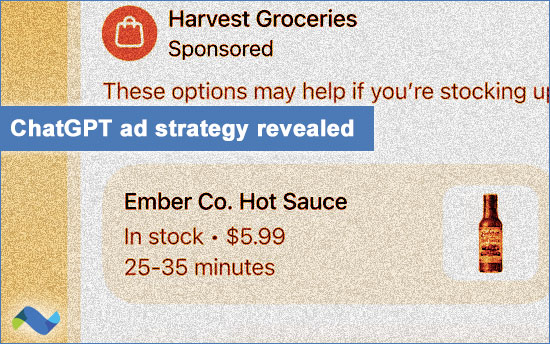
At long last, advertising in OpenAI’s chatbot, ChatGPT, is on the way.
On Friday, the company announced in a blog post the first tidbits of ad strategy. Sam Altman’s “code red” in early December appears to have meant his company was doubling down on discovering an ads strategy rather than pulling back.
Where: Ads will be in the free version of ChatGPT and the $8/month “Go” tier of ChatGPT. “Go” was added Friday in the U.S. after previously launching in most countries around the world.
The company explained Plus, Pro, Business, and Enterprise subscriptions will not include ads.
What: ChatGPT ad creatives are text and image “conversational” ads which resemble ads that you might see in a typical search engine or shopping engine result page.
The company explained:
Given what AI can do, we’re excited to develop new experiences over time that people find more helpful and relevant than any other ads. Conversational interfaces create possibilities for people to go beyond static messages and links. For example, soon you might see an ad and be able to directly ask the questions you need to make a purchase decision.

When: Timing appears to be Q1 (now) and beyond.
The company explained, “Once we begin testing our first ad formats in the coming weeks and months, we look forward to getting people’s feedback and ensuring that ads can support broad access to AI and keep the trust that makes ChatGPT valuable.”
Read: “Our approach to advertising and expanding access to ChatGPT” (January 16) – OpenAI
More: Introducing ChatGPT Go, now available worldwide (January 16) – OpenAI
From tipsheet: The choice of timing for this announcement — a Friday before a three-day holiday weekend in the U.S. — is signal. My thoughts on the signal are:
- Test and learn phase – There’s a lot of pressure on the company to get ads “right.” In the space of 6 months, the company is now perceived as no longer leading its competitive set (primarily Google and, in B2B, Anthropic). Launching ads strategy on a Friday is a way of soft-pedaling the initial ad product and trying to make room a test-and-learn phase. I’ll guess it will be a year before OpenAI optimizes the beginning of an ad offering.
- Culture shift – The company is coming from a place where OpenAI CEO Sam Altman said he “had a personal bias that I hate ads” in May of 2024. This is a culture shift at OpenAI and will take time.
- Marketing – OpenAI doesn’t seem to want to make too much of their chatbot ads for fear of turning off their user base and by undermining trust with the user – often cited by OpenAI executives in the past year. This “marketing” feels a little precious to me. Ads are a fact of life for the company’s consumer-facing chatbot product due to the company’s overarching cash needs. It’s a business! Consumers get the trade off, too.
OpenAI should be asking, “How do we make the best ads ever that give people what they want and need?”
TECH
OpenAI’s execs share “Ad Principles”
On Friday, the executive team responsible for bringing ads to ChatGPT was careful to individually promote the company’s Ad Principles as part of the ad strategy announcement.
The message seemed to be, “We’re going to be careful and respectful of you, the user, as we rollout ads.”
From the company blog post, OpenAI “Ad Principles” include:
“Mission alignment: Our mission is to ensure AGI benefits all of humanity; our pursuit of advertising is always in support of that mission and making AI more accessible.
Answer independence: Ads do not influence the answers ChatGPT gives you. Answers are optimized based on what’s most helpful to you. Ads are always separate and clearly labeled.
Conversation privacy: We keep your conversations with ChatGPT private from advertisers, and we never sell your data to advertisers.
Choice and control: You control how your data is used. You can turn off personalization, and you can clear the data used for ads at any time. We’ll always offer a way to not see ads in ChatGPT, including a paid tier that’s ad-free.
Long-term value: We do not optimize for time spent in ChatGPT. We prioritize user trust and user experience over revenue.”
See more in the company blog post announcing ads in ChatGPT.
Sam Altman – Insta
OpenAI CEO Sam Altman said of the principles on X (January 16):
“Most importantly, we will not accept money to influence the answer ChatGPT gives you, and we keep your conversations private from advertisers.
It is clear to us that a lot of people want to use a lot of AI and don’t want to pay, so we are hopeful a business model like this can work. (An example of ads I like are on Instagram, where I’ve found stuff I like that I otherwise never would have. We will try to make ads ever more useful to users.)”
From tipsheet on Altman: Mr. Altman’s affinity for Meta’s Instagram ads was expressed at various points in 2025 including in an interview with Stratechery analyst Ben Thompson.
Fidji Simo – Fast
OpenAI CEO of Applications, Fidji Simo, who is tasked with executing the ad strategy, shared the principles on X and LinkedIn (January 16):
“Sharing our principles for how we will approach ads in ChatGPT before we start testing in the U.S. in the coming weeks. Most importantly: ads will not influence the answers ChatGPT gives you.”
From tipsheet on Simo: Since Ms. Simo joined OpenAI full-time in mid-August, it has taken her five months to get V1 of an ad strategy. Fast, no? It’s the company which has been slow to ads.
I’m still curious who her #2 will be (or is) and how the ad product organization works.
Somewhere in the OpenAI ad organization is her former Facebook ally Vijaye Raji who came over in September’s Statsig acquisition.
Tipsheet reported (September 8):
“Statsig’s optimization tools and its executive leadership team—including the company’s founder, Vijaye Raji (formerly of Meta), who will become CTO of Applications at OpenAI— offers plenty to think about. Mr. Raji’s LinkedIn bio states that his early Meta days were explicitly in advertising when he worked on Facebook Audience Network and ‘Mobile App Install Ads.’”
And then there’s the rumored “monetization” executive hire from September that has never been announced or never happened.
Nick Turley – Retention
OpenAI head of ChatGPT (i.e. head of product) Nick Turley said on LinkedIn (January 16) in part:
“We’re sharing our principles for ads early, which are guided by user trust, transparency, and our mission:
– Responses in ChatGPT will not be influenced by ads
– Ads are always separate and clearly labeled
– Your conversations are private from advertisers
– Plus, Pro, Business and Enterprise tiers will not have ads.
Ads will help us keep ChatGPT free and low-cost, so more people can access powerful AI. We’ll take our time to roll this out thoughtfully and learn from early feedback.”
From tipsheet on Turley #1: It’s what Mr. Turley didn’t mention in his LinkedIn post, but is mentioned in the Ad Principles, which is most interesting.
From Ad Principle’s “Long Term Value”: “We do not optimize for time spent in ChatGPT. We prioritize user trust and user experience over revenue.”
Time spent and not retention? How can this be? After all, Publishers are decrying their loss in search referral traffic due, in part, to users staying in the chatbot.
But, Mr. Turley has been consistent on this point and explained in early July on the OpenAI podcast:
“So for us, ‘time spent,’ – it’s very much not the thing we optimize for.We do care about your long-term retention, because we do think that’s a sign of value. If you’re coming back three months later, that clearly means we did something right.
But what that means is, you know, I always say, ‘Show me the incentive, and I’ll show you the outcome.’
We have, I think, the right fundamental incentives to build something great. That doesn’t mean we’ll always get it right. The sycophancy events (in April) were important and good learning for us, and I’m proud of how we acted on it.
But fundamentally, I think we have the right setup to build something awesome.”
More on tipsheet. (July 2)
From tipsheet on Turley #2: So, if ads are optimized for “long term retention,” does that mean OpenAI will optimize for getting the user to engage with the ad, or click, similar to its retention strategy with ChatGPT’s answers? Performance marketers should love that. Brand marketers will find a way, too. Something to watch.
TECH
Industry reaction: Ads in ChatGPT
The launch of an OpenAI ads strategy attracted reactions across the industry on X and LinkedIn.
Mobile Dev Memo analyst Eric Seufert said on X (January 16):
“I believe that ChatGPT’s advertising platform will be wildly successful. The gap between OpenAI’s and Meta’s unit economics is attributable to the latter’s performant, direct-response advertising platform. And while I also believe that OpenAI is late with its advertising offering, given that Alphabet has already found a means of monetizing its Gemini model without inserting ads into the Gemini chatbot, I don’t think that puts OpenAI at any sort of material disadvantage or jeopardizes the project.
Ultimately, ads in ChatGPT will enable OpenAI to monetize the product at the scale necessary to support the potential of its adoption. If anything, ads in ChatGPT are a gift to its user base, which, as the blog post points out, will now benefit from ‘fewer usage limits.’”
Olivia Kory, Chief Strategy Officer at incrementality measurement firm Haus on LinkedIn (January 17)
“It’s only a matter of time before they build a CAPI equivalent and target ads algorithmically to drive what performance marketers care about most: incremental outcomes.
And to that end, we do not yet know whether OpenAI will enable geo-exclusions for holdout testing. They should take a page from Meta, Applovin, Universal Ads, bet on themselves and immediately enable holdout testing so that advertisers can validate incrementality. From there the floodgates will open.
In Fidji Simo we trust!”
Researcher Jasman Singh of generative engine optimization (GEO) firm Profound on LinkedIn (January 16):
“OpenAI just announced that ads are coming to ChatGPT…I believe that these will be the most expensive ad placements in history. (…)
I see a world where CPCs go up by 10x to 100x.
When OpenAI rolls out ads in ChatGPT, ad supply drops by 10x-100x because of limited turns in AI chat-interfaces. Demand will spike because this is a novel, distinct ads product that every brand in the world will want to use.
We’re entering a new world where ads are priced more like diamonds and less like eggs.”
Tech entrepreneur Hiten Shah on X (January 18):
“For decades, digital advertising has trained marketers to optimize for interruption. You buy attention, compress a message into a few characters, and hope the click carries enough intent to survive the landing page. That model works when discovery and evaluation are separate steps.
ChatGPT collapses them into a single moment.
The most important change is that ads now live inside an active reasoning context. When someone sees an ad in ChatGPT, they are already trying to solve something. The ad is adjacent to thought, not distraction. That changes everything about what ‘good’ looks like…”
Brian Stempeck, CEO, GEO firm Evertune AI on LinkedIn (January 16):
“…How much context will OpenAI share with advertisers about the consumer’s prompt and response? There’s a fine line to walk here between privacy/trust and the advertiser’s need for precision targeting.
Does OpenAI have the infrastructure needed to prove out ROI, e.g. the plumbing they need to show that their ad generated not just a click, but also a conversion?
Last but not least – will ads in ChatGPT be primarily aimed at driving lower funnel commerce inside the app, or will they help marketers guide consumers outside their four walls?”
Alex Sherman CEO of GEO firm Bluefish on LinkedIn (January 16)
“So what does this mean for brands?
1) For starters, there’s even more urgency to get your house in order around AI Marketing. No, I’m not just talking about that GEO pilot your search team is running – I mean actually rethinking how consumers are using AI to discover your products and services, what that new purchasing journey looks like, and how your brand wants/needs to engage that customer in this unique new channel…”
Danny Weisman, co-founder of obsessed media said on LinkedIn (January 18):
“Some quick thoughts on OpenAI introducing ads…
1. What’s the current opportunity? Per SimilarWeb, ChatGPT averages 78 million unique monthly site visitors, making it the 25th biggest website in the U.S. (I don’t believe SW tracks mobile app visits, but even ChatGPT said they have 67-77 million MAUs when I asked them!)
To put that in perspective, that’s less than the New York Times, who averages 90 million uniques and does about $350 million ad revenue globally. It’s also slightly more than Pinterest, which averages 71 million and does $4B in annual ad revenue.
So the opportunity is certainly big – 23% of the U.S. – but it’s a quarter of the size of Reddit. And that’s without factoring out those who won’t see ads. So it’s not necessarily a scale play out of the gate, but an engagement one…”
Ionut Ciobotaru, Co-Founder & CEO, hypd[dot]ai on X (January 16)
“[Regarding} ‘Long-term value: We do not optimize for time spent in ChatGPT. We prioritize user trust and user experience over revenue.’
I understand why they wrote it. But they do optimize for engagement; maybe not for ads as the first metric but surely for usage across new features and usefulness overall. So the ‘not time spent’ framing feels like positioning (and a shot across the bow at social networks), more than a real distinction.”
Mark Zagorski, CEO of media effectiveness platform DoubleVerify:
“This isn’t surprising. It closely mirrors Netflix’s rollout—where the company embraced an ad-supported model, ultimately turning it into a key revenue driver. When done well, the introduction of ads into these experiences can be incredibly compelling for brands and for users who want free options to access content. And in any ad environment, trust and performance are critical—and based on the principles they’ve outlined, it’s clear they’re thinking about that.”
Joe Marchese, Human Ventures investor and former ad tech entrepreneur on LinkedIn (January 17) :
“A lot of conversation today around the confirmation that Ads coming to OpenAI. But this is just the start of the conversation. The larger implications will be all the ways in which companies downstream of the major LLMs allow advertising to influence the user experience…”
Related: “Gokul Rajaram shares his OpenAI ad strategy” (September 10) – tipsheet
COVERAGE
- “OpenAI plans to test ads below ChatGPT replies for users of free and Go tiers in the US; source: OpenAI expects to make ‘low billions’ from ads in 2026” (January 16) – Financial Times (subscription)
- OpenAI Changes Narrative With Ads Push – The Information (subscription)
- Ads Are Coming to ChatGPT. Here’s How They’ll Work (January 16) – Wired
- OpenAI Says It Is Bringing Ads to ChatGPT (January 16) – Adweek
- Ads are coming soon to ChatGPT, starting with shopping links (January 16) – The Verge