
In a filing yesterday with the U.S. Securities and Exchange Commission (SEC), The Trade Desk reported that former Meta ad product leader Gokul Rajaram (known to everyone in ad tech as simply “Gokul”) would be leaving its Board of Directors in April.
From The Trade Desk’s Form 8K filing published yesterday:
“On March 3, 2026, Gokul Rajaram informed The Trade Desk, Inc. (the ‘Company’) of his decision to resign from the Company’s board of directors (the ‘Board’), effective April 3, 2026. Mr. Rajaram’s resignation was not the result of a disagreement with the Company on any matter relating to the Company’s operations, policies or practices.
Mr. Rajaram served as a member of the Board since May 2018. The Board thanks Mr. Rajaram for his years of service to the Company as a director.”
Read it on SEC[dot]gov. (March 9)
From tipsheet: Let’s take a look at the timing of Mr. Rajaram’s departure from TTD’s board…
- Rumors swirled about The Trade Desk helping OpenAI monetize ChatGPT last week (The Information, March 4).
- TTD CEO Jeff Green invested ~$150 million in his company last week (the week of March 2).
- Mr. Rajaram (at Meta 2010-2013) is likely well-acquainted with OpenAI CEO of Applications Fidji Simo (at Meta from 2011-2021) and OpenAI’s CTO of Applications — and head of OpenAI ads — Vijaye Raji (at Meta from 2011-2021).
- Rajaram outlined, in at least one podcast (World of DaaS podcast, September 9), what he would do if he were trying to monetize ChatGPT.
- On “The Invest Like The Best” podcast (January 29), Mr. Rajaram said The Trade Desk was an example of one of three ways to succeed in the ads business. Specifically: “You are the exclusive provider for a large advertiser or a large source of demand.” Read tipsheet. (January 30)
- ChatGPT still needs to be monetized (today).
Hmm. I’ll guess Gokul is going to go work at OpenAI at a minimum.
LLMs & CHATBOTS
Developments
- OpenAI to acquire Promptfoo for agentic security testing (March 9) – OpenAI
- Microsoft launches Copilot Cowork, integrating Anthropic’s Claude Cowork tech into Microsoft 365 Copilot (March 9) – Microsoft 365 blog
- Building for trillions of agents (March 8) – Aaron Levie, CEO, Box on X
PLATFORMS
Agentic workflow startup Mega gets funds
Workflow appears to be AI’s lowest hanging fruit when it comes to advertising technology lately.
In a sign of the times, startup Mega is using AI agents to streamline advertising workflow in service to SMBs who usually advertise through agencies. The startup has been rewarded with $11.5 million in Series funding that includes Goodwater Capital and Andreessen Horowitz.
Business publication Forbes reported on the problem Mega is looking to solve:
“SMBs today are expected to compete in a digital ecosystem built for enterprises, across SEO, paid ads, websites, and emerging AI channels. Agencies are expensive relative to SMB budgets, quality varies wildly, execution is manual, and iteration is slow. At the same time, AI marketing tools have flooded the market, but most still require business owners to learn and operate complex software. Mega takes a different approach by delivering services via software. Instead of managing tools, customers receive execution and measurable performance..”
How Mega ultimately competes with the increasingly autonomous offerings of Google’s Performance Max, Meta’s Advantage+ or any other ad platform has to do with its focus on business owners (doctors, lawyers, etc.) rather than marketers, says the startup’s founders Robbie Schneidman and Lucas Pellan — both of whom have an engineering background.
Read: “AI Agents Take Aim At The Local Marketing Agency As Mega Raises $11.5 Million” (March 9) – Forbes
More:
- “Mega raises $11.5M to give every SMB an enterprise-grade growth team, without the agency” (March 9) – press release
- Visit Mega’s website.
From tipsheet: I could see this sort of engineer-led company becoming a nice tuck-in acquisition (and handsomely reward the founders) for a much larger company looking to hit the ground running with agentic development in advertising and marketing.
LLMs & CHATBOTS
Perplexity storms back into ads
Who needs Google’s Performance Max or Meta’s Advantage+?
Last night on LinkedIn, CEO Aravind Srinivas of AI company Perplexity announced:
“Perplexity Computer can be connected to your Google and Meta Ads APIs. When you do that, it can run your ad campaigns autonomously at a frequency that’s not possible to match humanly.
Computer replaced $225K/yr in marketing tools in a single weekend.
It scans hourly, manages budgets, detects fatigue, and coordinates several campaigns end to end.
In one test run, it made 224 micro-optimizations to our ad stack.”
See his short video of a demo on LinkedIn. (March 9)
From tipsheet: I was skeptical when Perplexity tried throwing cold water on OpenAI’s foray into ads a month ago. Perplexity knows a good marketing opportunity when it sees it (selling to Apple, buying Chrome) and ADS ARE IT!
Hats off to LiveRamp CEO Scott Howe who suggested in January “an ads alpha” by Perplexity would happen in Q1.
Now… how real is this product?
PROTOCOLS
Explaining MCP to the trade
In an explainer article, AdExchanger reporter Allison Schiff unpacks Model Context Protocol (MCP) which was developed and then open-sourced by Anthropic in late 2024.
Schiff provides context for its use in digital advertising:
“[MCP] lays out which tools a model is allowed to use, how to call each one and where the limits are, meaning developers don’t have to build a new one-off integration for every use case.
Instead, developers define which actions their software can perform using the MCP standard format, including what data each action touches. AI systems can then string those actions together – for example, ‘pull a report,’ ‘create an audience,’ ‘send a message’ and then ‘launch a campaign’ – to complete a workflow.
That’s the base layer, and we’re already starting to see industry-specific protocols built on top.
AdCP, WebCP and UCP all use MCP as their underlying transport, but each one speaks to a different set of jobs.”
Read: “Understanding MCP, The ‘Universal Adapter’ For AI In Advertising” (March 9) – AdExchanger
More: What is the Model Context Protocol (MCP)? – ModelContextProtocol[dot]io
From tipsheet: The evolution and adoption of open protocols are believed to be critical (see LiveRamp CEO Scott Howe on LinkedIn last June) for any flourishing ad tech ecosystem outside the walled gardens.
Nevertheless, walled gardens like Google and Microsoft see open protocols and creating agentic “rails” as important, too.
See WebMCP or Universal Commerce Protocol (UCP).
LLMs & CHATBOTS
Stats for ‘ads in a chabot’
A new article in Robinhood’s Sherwood News covers the emerging ads in chatbot phenomenon. The overall themes will be familiar to tipsheet readers.
But, there are some stats I haven’t seen including the following:
- “Roger Beharry Lall, research director at IDC, estimates that over time, the roughly $300 billion to $400 billion spent annually on search ads could shift toward AI, with one market cannibalizing the other.”
- “OpenAI, whose ad business Evercore ISI’s Mark Mahaney estimated could generate $25 billion a year by 2030…”
- “IDC’s Beharry Lall expects chatbot ads to start out resembling traditional internet ads, but become more personalized and interactive over time.”
- Koah, a chatbot ad network which recently announced funding, “takes a 30% cut of the ad revenue generated through its marketplace.”
Read: “Ads have entered the chat” (March 9) – Sherwood News
MARKETING
Gartner: The risk with agency AI platforms
According to research firm Gartner, marketers are at risk of falling behind on a proper marketing strategy in the age of AI if they lock into an agency’s AI-enabled marketing platform.
Marketing Dive covered the report:
“Half of agencies’ proprietary AI platforms will either wind down or become obsolete by 2029, researcher Gartner predicts. That’s because agency-built offerings need to contend with the rise of open-source AI platforms developed by what are known as hyperscalers — the Googles and Amazons of the world — that can service functions beyond marketing, according to Gartner. (…)
‘I don’t hear [agencies] talking about those platforms, whether it’s [WPP] Open or Omni or anybody else, being an enterprise-wide AI platform,’ said Jay Wilson, vice president, analyst at Gartner for Marketers. ‘That’s the big disconnect or the big risk to agencies right now. They’re still kind of thinking at the marketing level, at the advertising level, maybe getting into CX.’”
Read: CMOs face risks locking brands into agency AI platforms: Gartner (March 4) – Marketing Dive
Related: “Gartner Predicts 60% of Brands Will Use Agentic AI to Deliver Streamlined One-to-One Interactions by 2028” (January 15) – Gartner
From tipsheet: Another take on “the end of agency AI marketing platforms” could be that the biggest tech platforms will still need a formidable service layer to integrate marketing interests into the enterprise platform — i.e. they will want agencies around.
Over time, the Agency AI marketing platforms and their teams will gradually then suddenly move to the enterprise-wide solution for marketing — the development of which the largest agencies will advise on.
RESEARCH
The merger of AI and traditional search
On LinkedIn yesterday, eMarketer analyst Nate Elliott offered a provocative ‘take’ on the future of search, saying “by the time AI search overtakes traditional search, that distinction won’t matter anymore.”
He went deeper by looking back at the evolution of mobile and desktop advertising and claimed that they ultimately converged.
Elliott explained:
“We’re going to see the same trend in AI vs traditional search: By the time most search is AI, the difference won’t matter. The leading destinations will look the same. The ad formats will look the same. The tech stacks will look the same.
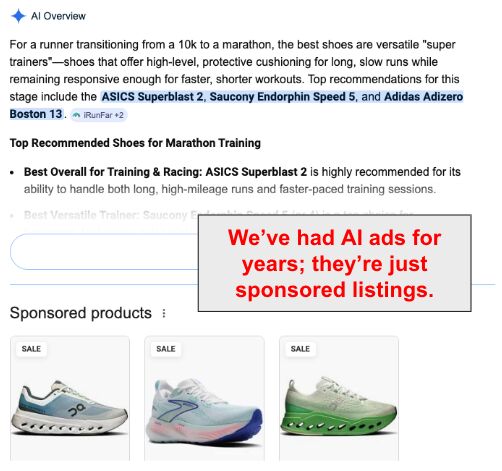
In fact, with Google displaying AI Overviews on so many traditional search results pages today, and displaying ads right next to them, we’re already most of the way there.
Because for all the fuss about ChatGPT introducing ads last month, Google already shows AI search results almost half the time and already puts sponsored listings next to nearly every one.
Same destination. Same ad format. Same tech stack.
The distinction doesn’t matter.”
Read more on LinkedIn. (March 9) He dropped the image below to make his case.
Related: “US Ecommerce Sales via Al Platforms Will Exceed $20 Billion in 2026 and Top $144 Billion by” (March 9) – Sarah Marzano, analyst, eMarketer on LinkedIn
From tipsheet: Elliott’s ‘take’ syncs with Google VP of Search Liz Reid, who didn’t have an answer to the “AI search/Google Search merger” question on a recent podcast.
Ms. Reid couldn’t say, “It doesn’t matter” given the enormous revenue impact of Search today and the fact that Google is a publicly-traded company (future-looking statements are bad).
GOVERNANCE
Privacy and agentic AI
“But here’s what gets me, I constantly hear about what a heavy lift it is to implement privacy correctly, tracking consent, managing data lineage, ensuring purpose limitation. It’s complex, it’s error-prone, it requires constant vigilance. So with all the promises of agentic AI, why aren’t we building agents to make preserving consumer privacy more efficient? If agents can optimize ad campaigns and negotiate media buys, why can’t they verify consent chains and flag privacy violations before they happen?”
Read: “As AI Agents Transform Digital Advertising, Where’s the Privacy Architecture?” (March 9) – Rowena Lam, Senior Director of Product, IAB Tech Lab on Cynopsis
RETAIL MEDIA
Protecting retail media’s search ads
Digiday revisited a popular topic in retail media these days: Will AI destroy retail media’s ad business?
Specifically, Digiday’s Kimeko McCoy reviewed the $38 billion search ad business which it says retailers host on their websites today which includes Amazon (largest by far), Walmart, Target and Instacart to name a few. (i.e. the “sponsored listings” that appear when someone searches on a retailer’s site or app.)
Could AI chatbots intercept this ‘discovery’ business?
McCoy ruminated, “As user behavior shifts, so too could retail media’s value proposition.”
Read: “How AI could disrupt retail media’s $38 billion search ad market” (March 9) – Digiday (subscription)
From tipsheet: MoffettNathanson analyst Michael Morton is the poster child/analyst for the retailer doomsday scenario with other Wall Street analysts not far behind. Mr. Morton called it going from “ads to product feeds” courtesy of AI chatbots. Learn more in his November interview with Stratechery.
With OpenAI’s move away from Instant Checkout in ChatGPT (The Information, March 4) and the windfall the AI giant once thought agentic commerce would bring (a.k.a. a 4% cut on participating retailer’s revenue), the winds have shifted. For now.
TECH
AI slop burger
“As CEO, I will never ask our customers to do something I wouldn’t do myself. Battling AI Slop, one slop burger at a time,” promised DoubleVerify CEO Mark Zagorski on LinkedIn yesterday.
See Mr. Zagorski taste the ‘slop burger.’ (March 9)
More: “The Rise of AI-Generated Slop Sites: What Advertisers Need to Know” (January 15) – DoubleVerify
From tipsheet: CEO influencer videos will never be the same!
PEOPLE MOVES
Now hiring
- Amy Sirlin, formerly of Response Media, has joined Acadia as Head of Growth and Client Strategy (March 9) – LinkedIn
- Eric Picard joins Fluency as SVP of Product (March 9) – LinkedIn
MORE
- Seedtag Reports 46% Year-Over-Year Growth in North America, Accelerating Neuro-Contextual TV and Client Expansion (March 9) – Seedtag
- RevContent and Mula Announce Partnership for Agentic Content Monetization OS (March 9) – press release
- Amazon’s Biggest Fire TV Redesign in Years Targets Faster Viewing and Better Ads (March 9) – Adweek
- Netflix introduces a CAPI (March 9) – Eric Seufert on Mobile Dev Memo (subscription)
- Who Benefits the Most from OpenTTD (Advertisers, Publishers, or TTD)? (March 9) – William Cichowski on LinkedIn