
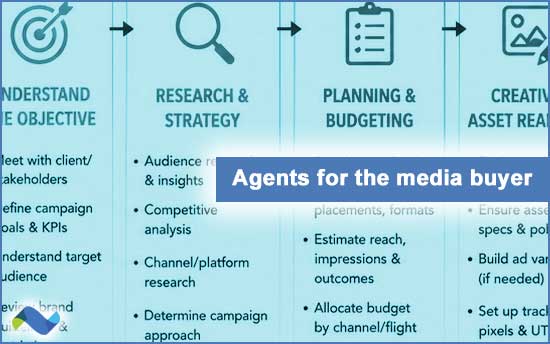
Kovva, a new AI ad tech startup which positions itself as “AI agents for media buying teams,” aims to create efficiency through agentic workflows.
AdExchanger’s Allison Schiff explores the use case:
“Kovva’s AI agents piggyback on a trader’s existing tools and are designed to function less as chatbots and more like team members who don’t mind doing scutwork.
Buyers can interact with them in Slack, via email or through a web interface. The point is to hand off work, not sit there typing prompts.
One early focus is quality assurance. A few hours after a campaign goes live, for example, a Kovva agent can run through the sort of checklists that traders usually have to do by hand to make sure everything’s kosher.”
Co-founders Tanja Mimica and James Hassett tell Schiff that they already have 50 integrations in place across DSPs, ad servers and social and measurement products.
Read: These AI Agents Want To Handle All The Annoying Parts Of Media Buying (May 18) – AdExchanger
Related: AI Agents Are Coming to Netflix to Grow Its $3 Billion Ad Business (May 13) – Adweek
LLMs & CHATBOTS
Developments
- Project Glasswing: what Mythos showed us (May 18) – Cloudflare
- OpenAI and Dell partner to bring Codex to hybrid and on-premises enterprise environments (May 18) – OpenAI
- Anthropic acquires Stainless (May 18) – Anthropic
TECH
Meta MCP server’s early friction
From Ad Age’s Asa Hiken:
-
“Advertisers are clearly eager to use Claude and ChatGPT to automate many aspects of their Meta campaigns—from tracking ad performance to devising and executing new strategies. But while this is suddenly a real opportunity thanks to Meta opening its ads ecosystem to third-party AI tools, some advertisers are reporting a rocky start to their integrations.”
Read: “How Meta advertisers hit automation challenges in rush to use AI” (May 18) – Ad Age (subscription)
Meta told tipsheet that the new MCP server is meant to unlock ‘conversational intelligence’ while complementing — not replacing — the Meta Marketing API.
From tipsheet: The friction here matters because MCP changes the interface layer, not the underlying complexity of Meta’s ad system. Advertisers are now trying to translate complex campaign operations into conversational agent workflows, but Meta’s optimization stack remains highly automated, probabilistic and opaque.
Early friction may reveal how difficult it is to operationalize black-box ad systems through conversational interfaces. Meta likely has strong incentives to preserve control over the underlying closed-loop optimization system itself — the real source of advantage.
COMMERCE MEDIA
Amazon reduces affiliate payments to publishers
In another blow for web publishers who depend on affiliate commissions for revenue, Adweek’s Mark Stenberg reported that Amazon has reduced payments by up to 50%.
Stenberg reported:
-
“The changes, which began rolling out in Asia-Pacific markets in late 2025 before landing in the U.S. around March 9, were never publicly announced. Publishers learned of them in individual conversations with their Amazon account managers and have spent the past two months absorbing the impact and weighing how aggressively to pivot to competing platforms.”
Read: “Amazon Cut Affiliate Commissions Up to 50% for Some Publishers, Leaving Them Reeling” (May 18) – Adweek (subscription)
From tipsheet: Amazon increasingly wants commerce discovery, recommendation and conversion to happen inside its own ecosystem. As a result, the strategic value of external affiliate publishers is diminishing.
PLATFORMS
Seufert: Personalization + AI-generated creative
Noting Amazon’s 90% authenticated reach of U.S. households paired with the positioning of Amazon’s new “Dynamic TV Creative” product for Prime Video, Mobile Dev Memo analyst Eric Seufert sees a unique opportunity arising for Amazon with AI-generated creative.
Seufert concluded: “To the extent that consumers detect the AI-generated nature of ads — or even care about the provenance of ads in the first place — through genericity or contextual irrelevance, Amazon is certainly well-positioned to mitigate that penalty through deterministic, impression-level personalization to a degree that few other platforms can match.”
Read: “Amazon’s advertising advantages” (May 18) – Eric Seufert on Mobile Dev Memo (subscription)
From tipsheet: If you’re using AI-generated creative at significant volume and can’t personalize, good luck. Generic AI creative becomes slop.
AGENCIES
Arthur Sadoun on ‘LiveRamp + Publicis’
In the Wall Street Journal yesterday, Publicis Groupe CEO Arthur Sadoun said about his agency holding company’s acquisition of LiveRamp:
-
“We did not need LiveRamp to win in the marketing space. Where LiveRamp plus Publicis is going to make a difference is in the agentic space, in this new market where there is huge opportunity because there is a huge barrier created by data.”
Read: France’s Publicis to Acquire LiveRamp for $2.55 Billion in AI Push (May 18) – The Wall Street Journal (subscription)
Notably, both stocks rose on the first trading day after the acquisition was announced: LiveRamp finished up 27.3%, while Publicis also rose 6.0%.
From tipsheet: It’s unusual for both the target and the acquirer to rise after a deal is announced. The target typically trades up toward the acquisition price, but the acquirer often trades down if investors worry it overpaid. Publicis rising suggests the market sees strategic value in the combination.
AGENCIES
More reaction: Publicis buys LiveRamp
Industry reaction to agency holding company Publicis Groupe’s plans to acquire data collaboration platform LiveRamp continued Monday.
- Identity as AI leverage: “‘Identity is the qualifier for AI’: Publicis’ $2.2 billion LiveRamp deal is a bet that whoever controls the data owns the AI era” (May 18) – Seb Joseph on Digiday (subscription)
- Operational skepticism around ‘agentic’ narratives: “Is the LiveRamp Acquisition an Agentic Story?” (May 18) – Ari Paparo on Marketecture
- Decisioning as the new control point: “The headlines about the Publicis–LiveRamp deal are focused on consolidation. What’s more interesting to me is what it signals about where the industry is actually going. AI is rapidly becoming the decision engine for marketing.” (May 18) – Brian Silver, EVP, TransUnion on LinkedIn
- Ecosystem mechanics: “Publicis Acquires LiveRamp In A Major Shakeup For Indie Data Collaboration” (May 18) – James Hercher on AdExchanger
- Strategic value migration: “The Publicis / LiveRamp transaction materially increases the strategic scarcity value of scaled identity and interoperable data connectivity assets.” (May 18) – Terence Kawaja, LUMA Partners on LinkedIn
- Operating-model transformation: “Publicis + LiveRamp: This Is Not a HoldCo Move. It’s an Accenture Move.” (May 18) – Ivan Fernandes, consultant on LinkedIn
ICYMI: Feedback-loop competition: “Publicis buys LiveRamp for federated future” (May 18) – tipsheet
From tipsheet: Everyone is right.
AGENTS
Know what the consumer says to an agent
New research from UK university professors Jafar Sabbah and Oguz Acar suggests that marketing to AI agents differs significantly from marketing to humans. The duo review their findings and offer strategic recommendations in the Harvard Business Review.
Sabbah and Acar begin:
“When we tested eight common e-commerce promotional mechanisms across four AI models in thousands of simulated shopping rounds, we found that only one behaved consistently the way we would expect it to for human buyers.”
After sharing proof points, the professors offer a recommendation:
“Understanding the most common prompt structures in your category is a new and important form of consumer research. Firms should begin studying what consumers are asking their agents to optimize for. This could be through direct research, analysis of query patterns, or partnerships with AI platforms. The brands that understand how their customers talk to their agents will be better positioned to ensure their products surface in the right way for the right queries.”
Read: “Research: Traditional Marketing Doesn’t Work on AI Shopping Agents” (May 13) – Harvard Business Review
From tipsheet: Understanding how consumers instruct AI agents could become as strategically important as understanding search behavior was during the SEO era. The strategic question is whether marketers will gain visibility into those prompts — or whether AI platforms will keep that intent layer opaque in order to preserve user trust and control over the interface.
MARKETING
Cheap traffic is disappearing
New 2025 benchmark data from digital marketing intelligence firm Wordstream by LocaliQ says CPCs may be going up, but the costs of conversions are going down for “Google Ads”
Search Engine Land’s Anu Adegbola distilled the results:
“The latest benchmarks reinforce a growing reality in paid search: cheap traffic is disappearing.
Rising CPCs mean advertisers can no longer rely on volume alone to drive performance. Instead, stronger targeting, better creative, improved landing pages and smarter automation are becoming critical to maintaining profitability.
The data also suggests that advertisers who adapt well to automation and intent-driven targeting are seeing stronger conversion efficiency despite rising costs.
Read: “Google Ads Benchmarks 2026: Competitive Data & Insights for Every Industry” – Wordstream by LocaliQ
From tipsheet: This study uses aggregate “Google Ads” benchmark data, which increasingly obscures the impact of blended inventory, branded demand capture and black-box automation systems like Performance Max.
MORE
- Comscore March 2026 Consumer AI Chatbot Usage Rankings Show Claude Gaining Share (May 18) – Comscore
- Baidu AI Sales Eclipse Waning Legacy Ads for the First Time (May 18) – Bloomberg (subscription)
- Study: “AI is in. Now comes the hard part – earning consumer trust” (May 13) – Canva
- OpenAI Sued For Allegedly Disclosing Queries To Meta, Google (May 15) – MediaPost
- “The AdTech story is not so much about competition but really chokepoint economics, and that changes the investment case.” (May 18) – Ian Whittaker, consultant, Liberty Sky Advisors on LinkedIn