
The race to be the AI version of Google AdSense is on.
Amazon has begun exploring the creation of an ad network devoted to advertising in AI chatbot interfaces including Pinterest, according to The Information.
The Information’s Catherine Perloff reported yesterday:
“Offering chatbot-focused technology—Amazon’s latest move to sell more ads outside its own retail site—would mark its entrance into an emerging ad battleground as more sites and apps introduce chatbots to help with tasks like picking out a gift or planning a trip. The move could also put Amazon in the position of helping other apps compete with OpenAI’s ChatGPT for ad dollars.
For instance, Amazon employees pitching the idea have pointed to scrapbooking app Pinterest as a potential user of such advertising technology, two of the people said. Pinterest released an AI shopping recommendation assistant in October, which has also started testing ads. Executives from the two companies have briefly discussed the topic of chatbot ads but not in any formal capacity, one of the people said.”
Perloff checks many of the boxes on companies exploring the chatbot ad network space, including:
- Google’s exploration of AdSense in chatbot interfaces with “AI search startups including iAsk and Liner.” See Bloomberg. (April 2025)
- Startup Koah, which announced new funding announced last week for an AI app ad network.
- Publishers such as Yahoo (January), Time (November) and Yelp (October) now have embedded AI chatbots and could soon add ads.
Others include:
- Taboola’s Deeper Dive which provides a chatbot to publishers and includes advertising. More.
- Companies such as Dappier (Sovrn is a partner) and Adgentic provide an AI monetization platform for publishers which can function as a white-labeled chatbot ad network.
- Teads offers an API to for conversational ads integrated into publishers’ AI apps and chatbots.
- Criteo also appears to be exploring the chatbot ad network model via commerce.
Read: “Amazon Explores Helping Other Apps Sell Chatbot Ads” (March 3) – The Information (subscription)
In his weekly newsletter, Marketecture’s Ari Paparo, an experienced ad tech product leader, expressed strong skepticism regarding the chatbot ad network model other than near- to medium-term exits for some chatbot ad network players.
Read: “AdSense for AI: FTW or DOA?” – Ari Paparo on Marketecture (March 2)
From tipsheet: As Perloff noted, OpenAI isn’t in this discussion yet.
But given the inevitable learnings from its ads pilot and ongoing development of its ads-in-a-chatbot product, the AI company could be in a good spot to start its own chatbot ad network — potentially with an OpenAI chatbot that publishers can embed.
How about an OpenAI chatbot that publishers can embed which also has content/data controls where publishers can uniquely train on their gated content and knowledge bases in addition to leveraging elements of OpenAI’s latest, powerful large language model?
The composable chatbot, anyone?
LLMs & CHATBOTS
Developments
- Gemini 3.1 Flash-Lite: Built for intelligence at scale (March 3) – Google’s The Keyword blog
- The AI Evangelist Shaking Up Colgate-Palmolive (March 3) – The Wall Street Journal (subscription)
- Perplexity claims News Corp tried to ‘entrap’ chatbot to make copyright case (March 3) – PressGazette
AGENCIES
The AI token and marketing currency
As the advertising services layer plugs into AI, it’s also having to deal with the token economics of AI usage.
For example, Business Insider’s Lara O’Reilly reported in November that — according to producers — a Coca-Cola holiday ad campaign required 70,000 prompts and the purchase of millions of tokens, which provided access to LLM compute. Every prompt and model output requires some number of tokens.
Digiday’s Sam Bradley took a look at both the creative and media side of agencies and how they’re dealing with token economics and access to AI.
Creative: Bradley finds that AI is often seen as an “overhead” cost or bundled into production costs. AI in these cases is used mostly for animations and visualizations. But, Brandtech’s Pencil agency is taking a different approach for its needs as CEO and co-founder Will Hanschell explained to Digiday:
“‘The client commits to a certain number of generations in Pencil; they can spend across any of the models or use cases and [it] is priced on volume. The more they commit, the more we can go and negotiate with the model providers, and the cheaper we can make that,’ said Hanschell. Clients are assigned a set number of tokens based on an initial cost estimate; if their needs exceed that amount, they ‘top up’ with another tranche.”
Media: Approaches vary here, too. Bradley found that some offer token costs as a passthrough — the client must pay but there is no markup. Others such as Kepler, which has an AI-enabled planning tool called KipAIR, bury the cost in the overhead since the agency works on a retainer, according to VP of data strategy and analytics Peter Rice.
Read: “Agencies grapple with economics of a new marketing currency: the AI token” (March 3) – Digiday (subscription)
From tipsheet: When do marketers start their ad buying with tokens? Bring on the agentic advertising protocols, for starters.
And see next…
PROTOCOLS
Prompt: wen AI tokens for ad buying?
Looking for an answer about the future, I asked ChatGPT to look ahead yesterday:
“When do marketers start their ad buying with tokens?”
ChatGPT responded
“The inflection point happens when:
- Buying agents execute media on behalf of marketers
- Creative agents generate assets at scale
- Optimization agents constantly rewrite creative or adjust bidding
At that point:
- Tokens become the fuel
- And fuel becomes material to margin
That’s when finance teams start asking:
“How many tokens are we consuming per campaign?”
That’s the early shift from CPM → cost-per-compute-awareness.”
From tipsheet #1: Let’s hope ChatGPT isn’t hallucinating because it sounds plausible.
From tipsheet #2: A new acronym is born? cost-per-compute-awareness = CPCA
COMMERCE MEDIA
Regarding Criteo’s OpenAI ads partnership
Following Monday’s announcement that commerce media platform Criteo partnered with OpenAI for its ads pilot, IAB AI and Innovation VP Caroline Giegerich was fascinated by the possibilities.
After reviewing the details, she shared on LinkedIn:
“When a user discovers a product through ChatGPT, gets served an ad via Criteo’s platform, clicks through to a retailer site, and buys, where does the credit go? OpenAI? Criteo? The retailer?
But here’s where it gets interesting.
The retailer owns the conversion signal, the actual record of the purchase. The real question is attribution credit. Who gets credit for why that purchase happened?
ChatGPT created the discovery moment. Criteo matched the ad. The retailer closed the sale. Everyone has a credible claim to a different part of the journey.”
Read Ms. Giegerich’s overview on LinkedIn. (March 3)
More: “Massive credit to Criteo for being the first ad tech company to integrate with OpenAI in the paid ads program. This development is significant for several reasons…” (March 3) – Nick King, consultant, Overline on LinkedIn
PLATFORMS
Meta on the move
- Simplifying Ad Measurement for a Social-First World (March 3) – Meta
- News Corp, Meta in AI Content Licensing Deal Worth Up to $50 Million a Year (March 3) – The Wall Street Journal (subscription)
- Meta Is Building Tools to Chase More Retail Media Budget (March 2) – Adweek (subscription)
MARKETING
The walled gardens share of media buys
eMarketer chief content officer Vladimir Hanzlik dropped another eMarketer graphic on LinkedIn yesterday.
This one visualized the dominance of the three walled gardens in advertising – each of which is innovating with its own AI-enabled ad platform:
Hanzlik explained:
“You can spend a lot of time and effort optimizing your ad spend across different channels, publishers, and formats, but a lot ultimately comes down to how much you spend on Amazon, Google, and Meta advertising.
In 2026, 60 cents of every US ad dollar (and more than 70 cents of every digital ad dollar) will go to one of these three players, per EMARKETER.
And by 2028, each of them will individually generate more US ad revenue than the entire traditional (non-digital) advertising market combined. (…)
These aren’t ad companies like any other. Each one is bigger than entire segments of the advertising market.”
Read more on LinkedIn. (March 3)
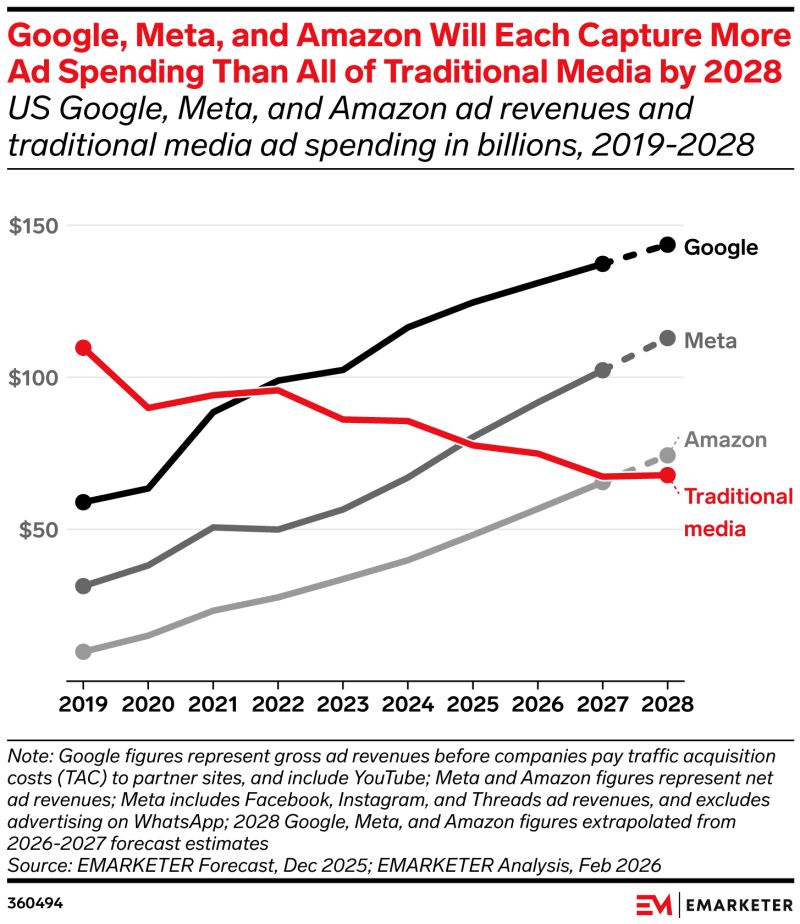
From tipsheet: If there was a “Walled gardens versus Open Internet” graph, the difference would appear to be even sharper given the “70 cents of every digital ad dollar” going to walled gardens, according to Mr. Hanzlik’s data.
CONNECTED TV
Incrementality measurement and AI
With some on Wall Street still questioning why Pinterest acquired connected TV ad platform tvScientific in December, tvScientific CEO Jason Fairchild returned to his personal blog yesterday and made the case.
Mr. Fairchild specifically focused on the crossroads of performance advertising and AI.
Top of mind was that AI will bring measurement certainty and, specifically, will result in “The end of ‘attribution theft.’”
He argued:
“AI is finally solving this by powering sophisticated incrementality models that can tease out the true impact of each channel and prove exactly how much upper-funnel investment contributes to the final sale. The underlying methodology isn’t new. Direct mail companies have long relied on structured holdout groups to measure lift between exposed and control audiences. Even walled gardens have started to roll out their own incrementality tools, but they operate solely within the confines of their own media footprint, fundamentally limiting their value by excluding the broader mix of touchpoints that shape real-world outcomes.”
Read: “Performance advertising in the age of AI” (March 3) – Jason Fairchild, CEO, tvScientific on his Beehiiv blog
More: “Pinterest expands into CTV advertising with tvScientific acquisition” (December 12) – Marketing Dive
Related: Pinterest’s Elliott-Funded Share Buyback Is a Sign of the Times (March 3) – The Information (subscription)
From tipsheet: Measurement — including incrementality — lies at the foundation of Pinterest’s acquisition of tvScientific as the search and discovery platform looks to track the consumer from the Pinterest app to CTV (thanks to tvScientific) to purchase.
TECH
The Trade Desk launches OpenTTD
Building on its “open” initiatives for the open web such as the OpenPath supply path infrastructure framework, The Trade Desk launched “OpenTTD” at yesterday’s RampUp conference in San Francisco.
AdExchanger’s James Hercher summarized, “OpenTTD will essentially be the analytics portal for all TTD partners and advertisers.”
The Trade Desk product marketer Jaime Nash provided more background, according to Hercher:
“Last September, The Trade Desk introduced a new data marketplace product, Audience Unlimited, that requires data sellers that participate to greatly decrease their prices, and further incentivizes data price decreases by turning any such discount into advertiser ROI. In other words, the further a data seller discounts its prices compared to TTD’s open marketplace, the better the ROI attributed to its data.
Using OpenTTD, Nash said, data sellers will be able to identify and study with much more granularity what particular audience segments or types of data are performing well for advertisers. Audience Unlimited, akin to another TTD data-selling product called Data Alliance, operates as a black box.”
Read: The Trade Desk Welcomes OpenTTD, The Partner Integration Portal To Rule Them All (March 3) – AdExchanger
More: “Put your assets to work: OpenTTD” – The Trade Desk
Related: “Given several press calls on this today, just want to be clear that as far we know, despite rumors that are circulating, we have not received any unsolicited offers to acquire TTD. TTD remains committed to championing the power and value of the open internet for the world’s largest brands, and we’re proud of the position we’ve established as the industry’s largest independent DSP. Can we get back to talking about innovation?” (March 3) – Ian Colley, CMO and EVP , The Trade Desk on LinkedIn
SELL-SIDE
Calculating your bot traffic
“What percentage of your site traffic is AI agents? (…)
We also just shipped three calculators on our refreshed site:
- Agent Traffic Revenue (how much agent traffic you have and what it’s worth)
- Classification ROI (what 90%+ semantic accuracy does to your yield)
- Contextual Lift (performance gains from our ContentGraph vs. legacy categories & keywords)”
– Brendan Norman, co-founder and CEO, Classify on LinkedIn (March 3)
MORE
- “It’s been a great month at CloudX since our GA. Request volume is growing exponentially. New demand partners are coming online. We’ve made some key hires. And publishers are seeing meaningful lifts.” (March 3) – Dan Sack, co-founder, CloudX on LinkedIn
- The exact LLM prompts media buyers are using right now (March 3) – The Current
- Can LLMs be used for ads ranking? (March 3) – Eric Seufert on Mobile Dev Memo (subscription)
- Genius Sports adds adtech deployments with Magnite, NBC Sports RSNs (March 3) – Sports Business Journal
- Zefr and OM Media Trials Release First-of-Its-Kind Study on Brand Impact of Ad Adjacency to AI-Generated Content (March 3) – press release