
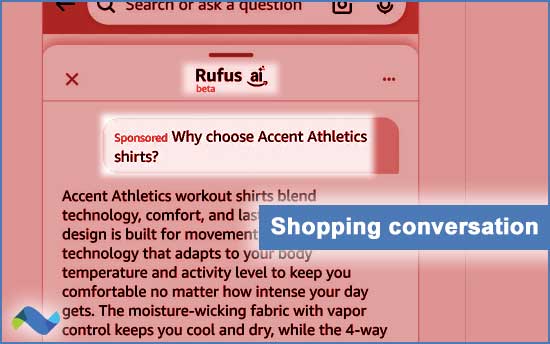
On Tuesday, Amazon Ads announced new AI-enabled workflow enhancements for advertisers with implications for Amazon’s Rufus shopping chatbot.
The product announcement explained:
“We’re introducing Sponsored Products prompts and Sponsored Brands prompts, a new AI-powered enhancement to your existing campaigns that automatically engages shoppers with relevant product information throughout their shopping journey. Prompts leverage Amazon’s first-party signals from your detail pages, Brand Store, campaign data, and more to surface your product expertise at key decision moments.”
Read: Sponsored Products prompts and Sponsored Brands prompts (March 10) – Amazon Ads
Amazon Ads Global Product Marketing lead, Ali Peikon Solomon, explained a bit more on LinkedIn (March 11):
“Amazon has officially launched its first conversational AI advertising product. This launch feels meaningful beyond the product milestone: shoppers can interact directly with brand-safe, 24/7 virtual product experts when making purchase decisions, with no additional work required from brands.
[Amazon CEO] Andy Jassy was recently quoted saying that even in this new AI era, shoppers will continue to value Amazon’s broad selection, low prices, fast delivery, and trust. Prompts are a tangible expression of that vision, using Amazon’s first-party insights to surface the right product information at the right moment, helping shoppers feel confident before they even need to ask a question…”
Read more on LinkedIn. (March 11)
In the context of Amazon Ads’ announcement, Sonata Insights analyst Debra Aho Williamson discussed the role of conversation and the AI chatbot (in this case, Amazon’s Rufus):
“Three things to know:
1) The new Sponsored Products and Sponsored Brands prompts (in beta since late last year) surface brand-linked questions and AI-generated answers during conversations with Amazon’s shopping AI, including Rufus.
2) Instead of waiting for shoppers to type keywords and scan listings, brands can now influence the discovery and evaluation process itself.
3) This feature is automatically turned on for Amazon advertisers; to opt out, visit your Ad Console account.”
Read Ms. Williamson on LinkedIn. (March 11)
Amazon said Sponsored Products prompts and Sponsored Brands prompts will move to general availability in the U.S. on March 25. (previously open beta)
From tipsheet: This is another example of an AI-enabled company taking the customer’s work out of their hands (AI optimizations are “on” by default) — and another step toward the autonomous future. See “Automation evolution: Manus working at Meta” below.
LLMs & CHATBOTS
Developments
- OpenAI Plans to Launch Sora Video AI in ChatGPT in Strategy Shift (March 10) – The Information (subscription)
- Introducing The Anthropic Institute (March 11) – Anthropic
- Perplexity pitches a more secure OpenClaw (March 11) – Axios
TECH
Podcast: Unpacking Criteo and RecSys
In the latest episode of analyst Eric Seufert’s Mobile Dev Memo podcast, Criteo CEO Michael Komasinski discusses his company’s expanding agentic commerce strategy — including its recently announced involvement in the OpenAI ads pilot.
One takeaway: Criteo isn’t just an advertising or ecommerce company. At its core, it’s a recommendation company.
Seufert previewed the conversation on Mobile Dev Memo’s blog: “We delve into how Criteo is positioning itself as a commerce intelligence layer for AI assistants and the technical distinctions between large language models and purpose-built recommendation engines.”
In the podcast, Mr. Komasinski unpacked Criteo’s “RecSys” capabilities — i.e. recommendation system (RecSys) engine — in the context of today’s AI capabilities:
(lightly edited) “LLMs by definition are semantic models and they’re great at language, but RecSys models need to be built on data loops and reward algorithms at high volume and scale.
We very much believe in that, and the Criteo backbone is built on a RecSys platform. This service is a way to give a front end to the RecSys platform in a way that can be tested in a partner environment and allows us to prove out the efficacy of that data set. (…)
We believe the future of great commerce recommendations in discovery platforms is going to be powered by a hybrid integration of semantic platforms and RecSys platforms.”
So, Criteo can recommend ads, recommend commerce products (recommend Netflix movies?) – but overall, for its RecSys to work best, Criteo needs to be able to ingest a huge product feed and the attendant data that flows around it (such as transaction data).
It follows that if you know what product the consumer wants, ads become even easier to deliver, i.e. more performant. (See Criteo’s LLM data, 3/2)
Listen:
- “Podcast: RecSys and internet commerce (with Michael Komasinski)” including transcript – Mobile Dev Memo (March 11)
- Hear the podcast on the Apple Podcasts app (March 11)
- Michael Komasinski comments about the podcast on Linkedin (March 11)
Related:
- Criteo Introduces Agentic Commerce Recommendation Service to Power AI Shopping Assistants (February 5) – Criteo
- “The Criteo deal with ChatGPT is proving to be a multiplier for the new ads platform, as it immediately lowered the barrier to entry for brands, Ad Age has learned…” (March 11) – Garett Sloane, Chief Technology Reporter, Ad Age on LinkedIn
- “How ChatGPT ads are becoming more accessible to brands after Criteo deal” (March 11) – Ad Age (subscription)
From tipsheet: A “must listen” thanks to Seufert’s expert questions and Komasinski’s skill and openness.
MARKETING
Automation evolution: Manus works at Meta
Back in December, DTC agency specialist Taylor Holiday saw the future of Meta in its acquisition of AI agent startup, Manus. His observation may be even more relevant today given changes to Meta’s ad products and possibly even its own internal workflow
Holiday tweeted less than three months ago:
“Here is why the Manus acquisition is a must watch for all consumer brands:
As of today, Manus leads the Remote Labor Index. https://remotelabor.ai
Which basically means it’s the best ‘employee’ agent in the market.
Where most agents hallucinate or get stuck. Manus scores highest on completing end-to-end freelance tasks (coding, scraping, analyzing) without human intervention.
Now remember the ‘Zuck Vision’ from his interview with Ben Thompson earlier this year (May 2025): ‘Eventually, I think we’re going to get to a point where you’re a business, you come to us, you tell us what your objective is, you connect to your bank account, you don’t need any creative, you don’t need any targeting demographic, you don’t need any measurement, except to be able to read the results that we spit out. I think that’s going to be huge. I think it is a redefinition of the category of advertising.’
Manus is the bridge…”
This tweet is worth a full review as workflow and work are transformed by Manus in all that Meta offers. Read more on X. (December 30)
It’s also a wider view on what’s possible with agents – just bring the objective (sell 1,000 widgets), the ‘Meta Machine’ does the rest.
Related: “Meta’s Moltbook deal points to a future built around AI agents” (March 11) – TechCrunch
From tipsheet: Meanwhile, rumors of Manus involvement in the management of account operations at Meta are cropping up in social media.
Specifically, the use of a Claude + MCP setup (read this user’s description on X, 3/7) connected to Meta’s ad system resulted in the permanent ban of an ad account. Mr. Holiday quote-tweeted the user and said (on X, 3/9), “Do not do this. You have to have an approved app. You will get banned. Meta is enacting the Manus protection plan ;)”
Taylor then pointed to Meta’s “Marketing API” authorization tweeting (on X, 3/7), “Start here.”
Yesterday, performance marketer Tomas Kliment observed similar banning and urged users to use Meta’s Marketing API authorization. Read more on LinkedIn. (March 11)
PLATFORMS
Screenshot: Recos for Meta’s Advantage+
Yesterday on X, DTC marketer David Hermann shared a screenshot of what appears to be a Meta Advantage+ campaign account.
The data point here is the “recommendation” activity which is likely enabled by Meta AI across attributes in campaign creation and optimization.
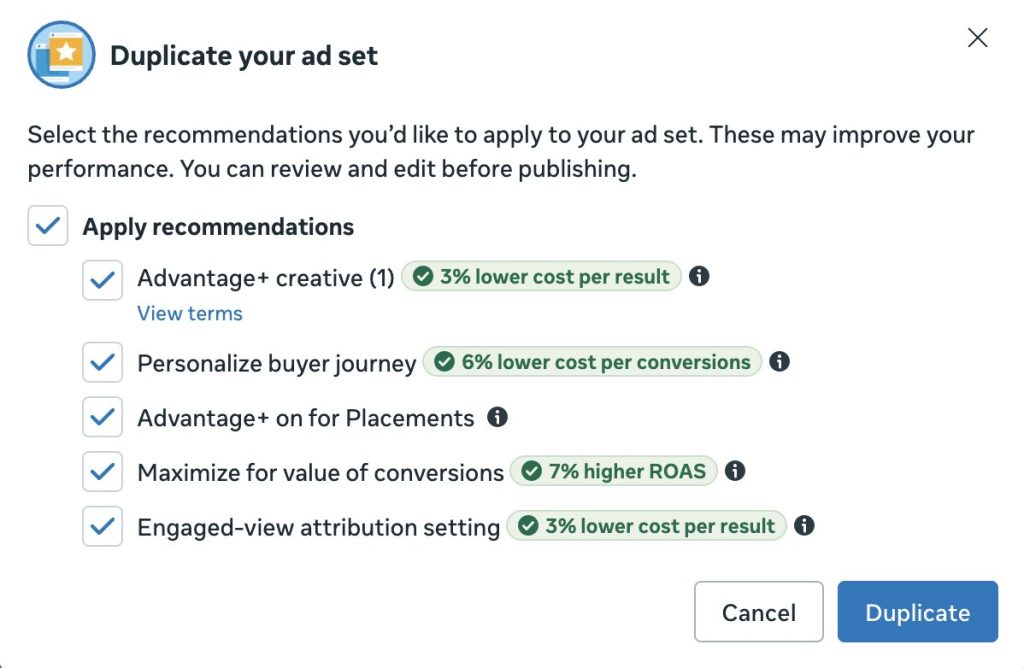
See it on X. (March 11)
From tipsheet: Some people may not want to use these recommendations which is likely why Meta currently makes them optional (via a checkbox). How long until that goes away?
Meta wants customers to spend more, so push the recommendations if it makes the campaign better for advertisers.
On the other hand, it’s still ‘early days’ and not all marketers trust ‘the machine.’
FINANCIALS
Capex intensity surging
In a note to investors, New Street Research analyst Dan Salmon parsed recent capital expenditure numbers for publicly-traded AI companies Amazon, Google and Meta.
He used a favorite Wall Street metric called “capex intensity” — or capital expenditure expressed as a percentage of revenue.
Salmon observed capex intensity is stronger for all three with Meta in the lead:
- “Meta capex intensity is now >50% of revenue vs 24% two years ago. We expect it to stay above 40% until 2029. Use of off-balance sheet financing could ease reported capex intensity sooner.”
- “Google reaches 38% capex intensity in 2026 and Amazon hits nearly 25%, both jumping from ~8% in 2023.”
- “We are above consensus for all three, with the largest gap for Meta as it re-accelerates frontier development within Meta Superintelligence.”
From tipsheet: More dollars in (for compute) means more performance out. That’s the idea anyway.
TECH
Profound’s GEO event includes OpenAI
Generative engine optimization firm Profound has rolled out the speaker list for its upcoming Zero Click 2026 event in San Francisco on April 8.
Notably, OpenAI monetization executive Asad Awan will participate. Mr. Awan appears to be the “right hand” of Vijaye Raji who assumed leadership over the ads product back in January.
You may also recall that Awan was on the OpenAI podcast for the launch of the ChatGPT ad pilot on February 9.
From tipsheet: Interesting to see OpenAI embrace a GEO firm by participating in its event. FYI, Profound investors Khosla Ventures and Sequoia also have stakes in OpenAI.
Beyond the investment connections, GEO firms have relationships to brands who are very concerned about their appearance in chatbots these days. These same brands will eventually ignite an ad product in ChatGPT.
Google has similarly embraced search engine optimization (SEO) experts through in-person events over the years.
Related: “GEO hype busted: How it differs (and how it doesn’t) from SEO” – Digiday (subscription)
CREATIVE
AI for cross-channel creative
“To generate ad creative more quickly across a wider array of channels, Realtor[dot]com has been working with AI-based ad startup BrandComms[dot]AI.
The startup, which was founded in Australia in 2024 and launched in the US on Wednesday, aims to prevent human strategy and insight from getting lost in the ‘messy middle’ between agency and brand, Chief AI Officer Isobell Roberts told AdExchanger.”
Read: How Realtor[dot]com Is Using AI Creative To Expand Its Ad Footprint (March 11) – AdExchanger
More: BrandComms[dot]ai Inc Debuts in U.S. (March 11) – press release
From tipsheet: Ads that can be easily propagated across digital advertising channels remain a theme for ad tech firms targeting creative workflow with AI.
CAREERS
More help wanted at OpenAI
“We’re looking for an Advertising Marketing Science leader to establish and scale OpenAI’s advertiser-facing reporting, measurement, and attribution credibility. You’ll combine deep measurement expertise with strong judgment and cross-functional leadership to define how advertisers understand performance on OpenAI and how our reporting aligns with their existing measurement frameworks (MTA, incrementality/lift testing, MMM/geo experimentation).”
New: Advertising Marketing Science Lead, Marketing (San Francisco) – Open AI Careers
Related: “OpenAI is building the ad tech stack it’s currently borrowing” (March 10) – Digiday (subscription)
TECH
Opinion: AdCP and Real-Time Bidding
In an op-ed on new B2B publication Signal & Noise, Rio Longacre, who is a consultant at Omnicom’s Credera, questioned the long-term dominance of real-time bidding in digital advertising. He believes the use of agents is a game changer and that Ad Content Protocol can have an important role.
Longacre argued:
“In an agentic environment, auctions stop being the default mechanism and become just one option among many. If agents can evaluate objectives, constraints, supply characteristics, and historical performance, arriving autonomously at agreements, then we’re looking at a future that look less like split-second bids and more like continuous, automated deal-making.
Later, Longacre pushed back on AdCP detractors:
“The industry can pretend this is just another standards discussion. Or it can recognize what AdCP really represents: a shift away from advertising as a series of isolated transactions, and toward advertising as a continuously negotiated market between autonomous actors. Once this shift begins in earnest, there is no going back to a world where bidding is the center of gravity The question is no longer whether the auction survives. It’s whether the rest of the ecosystem is ready for what comes after.”
Read: “AdCP and the Agentic Reckoning: RIP RTB?” (March 9) – Rio Longacre on Signal & Noise
From tipsheet: This opinion represents pushback — in part — against the IAB’s standards arm, IAB Tech Lab, and its proponents who argue that building on existing standards as the way to go with new protocol development in the agentic era.
Read: IAB Tech Lab CEO Anthony Katsur on AI and governance – tipsheet (February 2)
MORE
- From Marketecture Live: The Trade Desk Says It’s Testing AI Campaign Creation With Claude (March 11) – Adweek
- Eight out of ten Performance Max advertisers are now running CTV ads (March 11) – Search Engine Land
- “I’m a CMO who thinks AI has brought a long-overdue reckoning for top marketers. Here’s how I’m adapting for the future.” (March 11) – Business Insider
- What Will Agentic AI Do To Programmatic Advertising? (March 10) – David Kaplan on The Outcome by Attain
- How AI Agents Will Collapse the Martech Seat Model – and Concentrate Power at the Deep End (March 11) – Henry Innis, co-founder, Mutinex on his Substack