
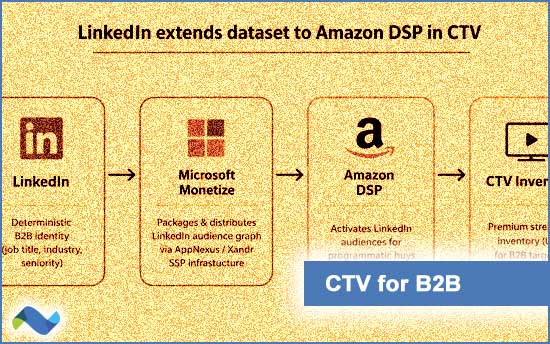
B2B marketers have another way to reach B2B audiences in CTV. LinkedIn announced that it’s providing its audience graph data to Amazon DSP for U.S.-only targeting of B2B audiences.
Similar LinkedIn-based B2B targeting has been available through The Trade Desk since March.
A press release explained on Thursday:
“With Amazon DSP, marketers can now use precise LinkedIn targeting – like job title, industry, and seniority – and reach buyers across premium streaming inventory through Microsoft Monetize.
Additional highlights include:
-
- Advertisers have more choice in how they plan, buy, and measure their LinkedIn CTV campaigns — either directly through Campaign Manager or programmatically
- Advertisers running full-funnel CTV campaigns in Amazon DSP can target LinkedIn professional audiences without fragmenting their media buy”
Reminder: Microsoft owns LinkedIn. And Microsoft Monetize is the evolution of the AppNexus / Xandr SSP infrastructure inside Microsoft.
Read: “How LinkedIn Is Expanding Programmatic CTV Buying for B2B Marketers through Amazon DSP” (May 7) – LinkedIn
More:
- “Activate your CTV Ads via DSP (Demand-Side Platforms)” (Updated May 7) – LinkedIn Help
- “Microsoft Monetize’s survival bet: LinkedIn data on Amazon DSP CTV” (May 7) – PPC Land
From tipsheet: The LinkedIn CTV announcement is a good example of LinkedIn providing deterministic B2B identity, Microsoft Monetize packaging and distributing it, and Amazon DSP consuming it for activation.
LLMs & CHATBOTS
Developments
- “Meet Anthropic’s ‘Perfect Wingman’ for Its Race Against OpenAI,” a profile of CFO Krishna Rao (May 8) – The Wall Street Journal (subscription)
- “Qualcomm’s CEO is working with ‘pretty much all’ major AI players on top-secret devices—and powering OpenAI’s first push into hardware” (May 9) – Fortune on Yahoo
- “I tested ChatGPT and Perplexity AI as my CarPlay voice assistants – both made Siri look bad” (May 3) – ZDNET
AGENTS
PubMatic’s Agentic OS and agentic reality
In light of last week’s earnings report, AdExchanger’s Anthony Vargas reviewed PubMatic’s Q1 2026 financials and, in particular, progress with its Agentic OS strategy.
Vargas reported on investor feedback which bubbled up during PubMatic’s earnings call:
“But investors are still skeptical of PubMatic’s agentic AI business sustaining true revenue growth. One investor pointed out that, even with AgenticOS running over 1,000 direct deals and more than 30 end-to-end autonomous campaigns, that still represents ‘an immaterial percentage’ of PubMatic’s overall business.
In response, PubMatic CFO Steve Pantelick said that AI is also impacting other areas of PubMatic’s business, such as helping publishers set up and troubleshoot campaigns faster, and the company expects those improvements will continue to drive double-digit growth alongside mobile and CTV.”
Read: PubMatic’s Agentic AI Is Going Beyond Direct Deals (May 8) – AdExchanger
More: PubMatic Q1 2026 Earnings Transcript (May 7) – Motley Fool
From tipsheet: This will be a long but seemingly inevitable transition toward truly agentic media buying and selling, where external agents connect with a sell-side infrastructure like PubMatic at scale. For now, it’s AI-assisted workflow automation within vendor-controlled systems — or agentic within a walled garden.
PLATFORMS
DSPs ‘clearing the field of rivals’
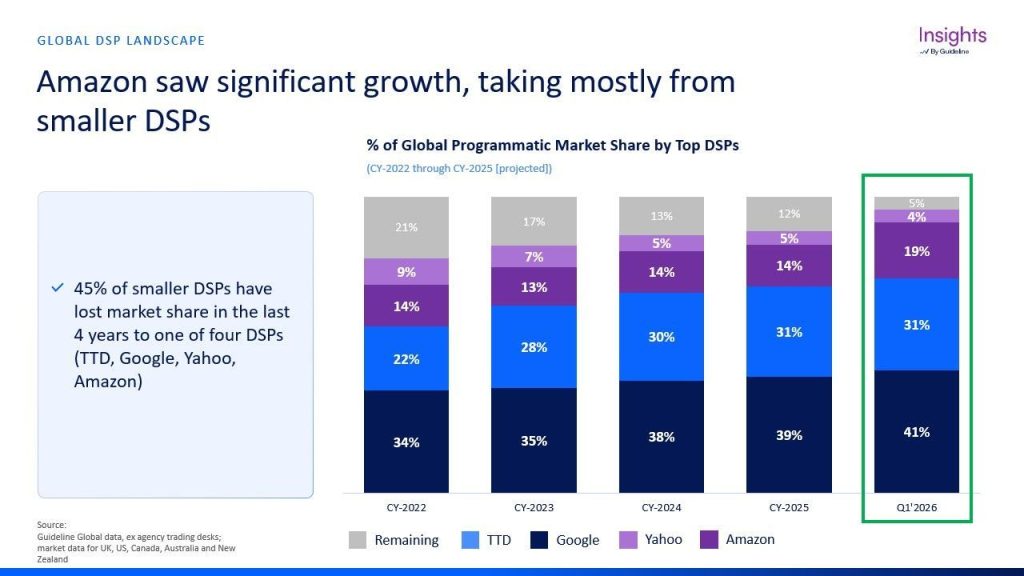
Reviewing new research presented by Guideline’s Sean Wright on the Media Unfiltered Podcast, analyst Ian Whittaker sees a whittling away of the global DSP market.
On LinkedIn, Whittaker shared a Guideline graphic saying:
“What seems to be happening in the market is similar to one of the oldest themes in strategic history. Three powers combine to clear the field of rivals. Once the shared task is done, the alliance unwinds and the weakest of the three, the one without an independent base of power, is the first to be pushed out. (…)
The same seems to be happening in the DSP market, but on a faster timescale.
Phase one was the big three – Google’s DV360, Amazon and The Trade Desk – taking share against the long tail. The top three DSPs accounted for over 90% in Q1 2026 of the market vs 70% in 2022. Yahoo and the long tail have lost materially. That reflected buyers increasingly favouring the larger players for efficiency reasons. That phase is largely complete.”
In the next competitive phase, Whittaker sees challenges for The Trade Desk.
Read more on LinkedIn. (May 9)
Listen: The Great Ad Spend Shift: Why Meta, Amazon & programmatic are reshaping media (May 6) – Media Unfiltered podcast
Related: “Joshua John, Head of DSP Strategy at Yahoo DSP, joins Signal & Noise’s Rio Longacre at Possible for ‘Why DSP Workflows Are About to Collapse Into AI Agents.’” (May 8) – Brett House, founder, HighSignals on LinkedIn
From tipsheet: The “big three DSP” framing may miss where the market is heading. As AI agents increasingly automate planning and buying workflows, the next major control point in advertising may not be the DSP seat itself, but the infrastructure layer connecting agents to supply, identity, and execution across the open web.
PROTOCOLS
Meta’s MCP server vs. the Marketing API
Former Fluent social ads marketer Caleb Kruse shared his observations on Meta’s new MCP server and compared it to Meta’s Marketing API.
He said on LinkedIn:
“There’s a lot of hype and excitement around Meta’s new official MCP server. (…) I’ve built out tons of apps and workflows already using the Meta API and pass those off to my Skool community members and use as lead magnets.
The API can be a technical barrier for a lot of folks. Setting the Meta MCP is extremely simple. But here’s the catch… the MCP only covers around 25% of the functionality of the API.”
Kruse used Claude Code to compare Meta’s Marketing API use cases to MCP use cases.
For MCP, he found the following capabilities:
- Automated reporting
- Duplicating ads
- Creating ads (from previously uploaded creatives)
- Automated updates (send updates every hour via Slack)
Read his post on LinkedIn. (May 7)
Related:
-
Q&A: Meta discusses new MCP functionality (May 1) – tipsheet
From tipsheet: The missing pieces may be the story. Meta appears comfortable exposing AI-assisted analysis and workflow automation through MCP while keeping deeper infrastructure controls inside the core Marketing API. The API remains the infrastructure layer. MCP is emerging as the agentic interface layer.
MOBILE
Seufert: AI will increase gaming engagement
On Eric Seufert’s Mobile Dev Memo podcast, Game Economist Consulting’s Phil Black discussed the mobile gaming economy.
Toward the close of the podcast, the two experts looked at the impact of AI on gaming. Seufert didn’t hesitate (lightly edited):
“So here’s what I think we’ll get from AI…
I don’t think it’s TAM expansion — it’s engagement expansion.
A lot of the analysis that points to sports betting and more participation in stock markets as taking away engagement from mobile gaming is a misread. The reality is those things are not mutually exclusive.
These are bite-sized sessions so there’s no reason why you can’t have those coexisting.
Look at the top 10 downloaded games chart — seven out of 10 launched since 2024. It’s not that it’s impossible to launch a hit new game.”
Listen: “Podcast: The modern mobile gaming economy (with Phil Black)” (May 6) – Mobile Dev Memo
From tipsheet: AI-driven engagement expansion could increase monetizable time across the mobile gaming ad stack.
COMMERCE MEDIA
The case for iROAS in retail media
On the latest episode of Unlocking Retail Media with Kevel’s James Avery, analyst Andrew Lipsman of Media, Ads + Commerce joined to discuss retail media trends.
Lipsman has a bone to pick with retail media network (RMN) operators still reliant on the flawed ROAS measurement system. He’s in favor of introducing incrementality.
Lipsman says:
“I tell RMNs all the time, ‘You should be trying to graduate brands to thinking about iROAS because — all else being equal — you win in that worldview right now. You’ve benefited from ROAS measurement. You’ve taken the easy money from it, the last few years. So it’s not like it hasn’t been to your benefit. But long term, there’s a much bigger part of the market that you can take if you start to align more with incrementality.’”
Listen: ROAS is the root of all evil: Debunking the ROAS Trap with Andrew Lipsman (May 6) – Unlocking Retail Media podcast
From tipsheet: AI systems optimized for ROAS learn how to capture conversions. AI systems optimized for iROAS learn how to create them. As AI-driven ad platforms evolve into autonomous optimization systems, incrementality may matter more than attribution capture. AppLovin CEO Adam Foroughi hinted at this shift during last week’s earnings call when discussing Axon: “We’re selling profit.”
FINANCIALS
Earnings reports
Companies with exposure to the AI in advertising and marketing opportunity reported financial results last week including:
Teads
- Markets: Teads stock was up 15% for the week.
- Stat: “Revenue of $266.0 million, a decrease of $20.4 million, or 7%, compared to $286.4 million in the prior year period.”
- Results: Teads Holding Co. Announces First Quarter 2026 Results (May 7) – Teads
- Earnings call transcript: Teads (TEAD) Q1 2026 Earnings Transcript – Motley Fool
- Earnings call quote: “Our ability to leverage AI for creative optimization and performance tracking across both CTV and the web is a unique value proposition that we are starting to scale.”
- From tipsheet: Teads was acquired by Outbrain in 2025. The combined company was renamed Teads.
MORE
- Omnicom quietly moves Flywheel into the media group (May 7) – Digiday (subscription)
- See what happens when creative legends use AI to make ads for small businesses. (May 8) – Google The Keyword blog
- Amazon Data Will Be Available on Netflix Inventory in the UK on May 18 (May 8) – Adweek (subscription)
- AI, connected TV, programmatic buying reshape India’s digital ad market (May 10) – The Economic Times